


Dbeibeh to Asharq Al-Awsat: No Normalization of Ties between Libya and Israel

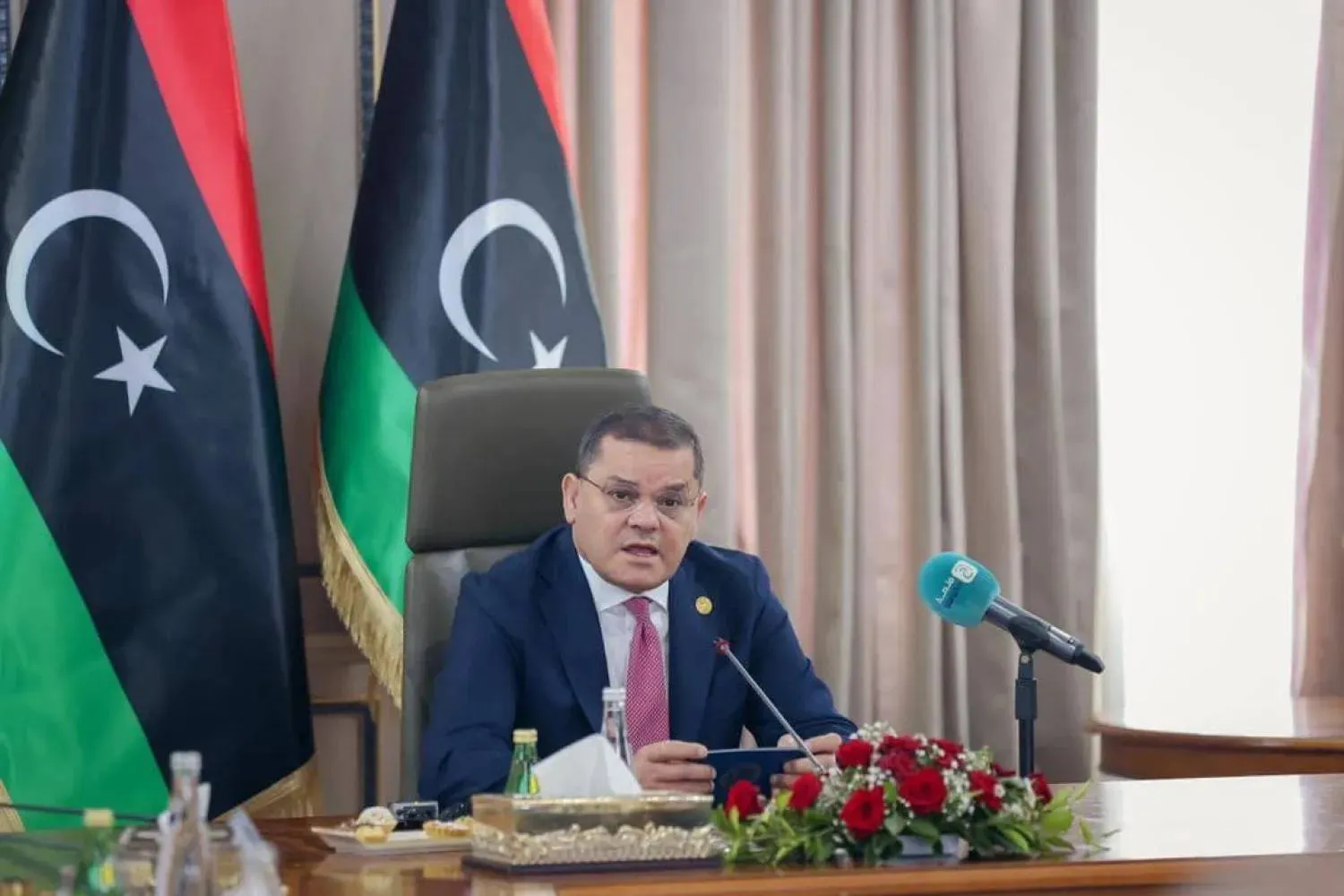
Head of Libya's Government of National Unity (GNU) Abdul Hamid al-Dbeibeh. (GNU)
TT

Dbeibeh to Asharq Al-Awsat: No Normalization of Ties between Libya and Israel

Head of Libya's Government of National Unity (GNU) Abdul Hamid al-Dbeibeh. (GNU)

Head of Libya's Government of National Unity (GNU) Abdul Hamid al-Dbeibeh rejected claims his government is pursuing normalization with Israel or preparing to host displaced Palestinians from Gaza.

Dbeibeh spoke to Asharq Al-Awsat in an interview days before the UN Security Council is set to discuss a new roadmap for ending the country’s political deadlock.

He also discussed elections, relations with foreign powers, and efforts to dismantle militias.

Below are excerpts of the interview:

Q: The UN envoy will soon present a roadmap for Libya. What is your position?

We held extensive discussions with the UN envoy Hanna Tetteh. She is working hard to produce a plan that leads to elections. We believe elections will renew legitimacy for the main political bodies, especially parliament, which must be the backbone of the next phase.

Q: The envoy has spoken of the need for a unified government before elections. Are you ready for that?

We made clear that the institutional confusion in Libya stems from parliament’s unilateral decisions. Ending this requires an elected legislature. This is a reality the international community understands well.

Q: Did Washington offer your government direct support during US adviser Massad Boulos’ visit to Tripoli?

Yes. The US expressed a clear commitment to supporting elections and to strengthening our partnership. We also discussed economic opportunities. Boulos reaffirmed his full support for these goals.

Q: Critics say your $60 billion investment plan is aimed at winning US backing.

That is not true. These are strategic investments in infrastructure, oil and energy designed to diversify Libya’s economy. They are not political bargaining chips.

Q: What about the military file — is unification of the army possible?

The hope is alive. But perhaps the most strategic moment for unifying the army will be after national elections under a strong civilian leadership.

Q: You launched a plan in May to dismantle militias. Why now?

It is a national project to rebuild the state, not a personal campaign. Militias grew stronger than state institutions in recent years. We did not create this reality, but we are working to change it by restructuring the defense and interior ministries.

Q: Do you have international backing for this plan?

Yes. Our regional and international partners see militias as a threat to security, migration control and cross-border crime.

Q: Some critics say many commanders in your forces once belonged to armed groups. Isn’t that a contradiction?

We offered fighters three paths, including integration into state institutions. Some former militia leaders are now serving as state officials. That is itself a model for others.

Q: Others accuse you of using the campaign to extend Misrata’s influence in Tripoli.

That is false propaganda. Our government includes leaders from across Libya. This is a national, not regional, project.

Q: Do you still support putting the 2017 draft constitution to a referendum?

Yes. The draft has strong legitimacy since its authors were elected by the people. A referendum is the fastest way to end the constitutional vacuum.

Q: And what about federalism as a solution?

Libya’s size and diversity require stronger decentralization, but whether through federalism or another system, it is for Libyans to decide in the constitution.

Q: How do you describe relations with Türkiye and Russia?

Our ties with Türkiye are excellent - political, economic, security and even personal. With Russia, relations are gradually improving. Our policy is openness to all partners based on shared interests.

Q: There has been speculation about normalization with Israel.

There is no desire or effort to normalize with Israel. This is a settled issue for Libyans.

Q: What about reports of hosting Palestinians from Gaza in Libya?

Completely false. Even the US embassy in Tripoli denied these claims. What is happening in Gaza is a humanitarian catastrophe that requires international action to protect Palestinians on their own land, not to displace them.

Q: Finally, will you run for president if elections are held?

For now, my focus is on strengthening the rule of law and paving the way for free and fair elections. As for running, the decision will depend on circumstances at the time.

Q: And if rivals such as Saif al-Islam Gaddafi or Khalifa Haftar compete?

Fair, enforceable election laws - not ones tailored to individuals - will determine who can run. Those laws must be completed quickly to let Libyans choose their leaders.


Rescue Teams Search for Survivors in Building Collapse that Killed at Least 2 in Northern Lebanon

A Lebanese flag is pictured, in the aftermath of a massive explosion, in Beirut's damaged port area, Lebanon August 17, 2020. REUTERS/Hannah McKay
TT

Rescue Teams Search for Survivors in Building Collapse that Killed at Least 2 in Northern Lebanon

A Lebanese flag is pictured, in the aftermath of a massive explosion, in Beirut's damaged port area, Lebanon August 17, 2020. REUTERS/Hannah McKay

At least two people were killed and four rescued from the rubble of a multistory apartment building that collapsed Sunday in the city of Tripoli in northern Lebanon, state media reported.

Rescue teams were continuing to dig through the rubble. It was not immediately clear how many people were in the building when it fell.

The bodies pulled out were of a child and a woman, the state-run National News Agency reported.

Dozens of people crowded around the site of the crater left by the collapsed building, with some shooting in the air.

The building was in the neighborhood of Bab Tabbaneh, one of the poorest areas in Lebanon’s second largest city, where residents have long complained of government neglect and shoddy infrastructure. Building collapses are not uncommon in Tripoli due to poor building standards, according to The AP news.

Lebanon’s Health Ministry announced that those injured in the collapse would receive treatment at the state’s expense.

The national syndicate for property owners in a statement called the collapse the result of “blatant negligence and shortcomings of the Lebanese state toward the safety of citizens and their housing security,” and said it is “not an isolated incident.”

The syndicate called for the government to launch a comprehensive national survey of buildings at risk of collapse.


Israel to Take More West Bank Powers and Relax Settler Land Buys

A view of Israeli settlement of Maale Adumim, in the West Bank, Sunday, June 18, 2023. (AP)
TT

Israel to Take More West Bank Powers and Relax Settler Land Buys

A view of Israeli settlement of Maale Adumim, in the West Bank, Sunday, June 18, 2023. (AP)

Israel's security cabinet approved a series of steps on Sunday that would make it easier for settlers in the occupied West Bank to buy land while granting Israeli authorities more enforcement powers over Palestinians, Israeli media reported.

The West Bank is among the territories that the Palestinians seek for a future independent state. Much of it is under Israeli military control, with limited Palestinian self-rule in some areas run by the Western-backed Palestinian Authority (PA).

Citing statements by Finance Minister Bezalel Smotrich and Defense Minister Israel Katz, Israeli news sites Ynet and Haaretz said the measures included scrapping decades-old regulations that prevent Jewish private citizens buying land in the West Bank, The AP news reported.

They were also reported to include allowing Israeli authorities to administer some religious sites, and expand supervision and enforcement in areas under PA administration in matters of environmental hazards, water offences and damage to archaeological sites.

Palestinian President Mahmoud Abbas said the new measures were dangerous, illegal and tantamount to de-facto annexation.

The Israeli ministers did not immediately respond to requests for comment.

The new measures come three days before Prime Minister Benjamin Netanyahu is scheduled to meet in Washington with US President Donald Trump.

Trump has ruled out Israeli annexation of the West Bank but his administration has not sought to curb Israel's accelerated settlement building, which the Palestinians say denies them a potential state by eating away at its territory.

Netanyahu, who is facing an election later this year, deems the establishment of any Palestinian state a security threat.

His ruling coalition includes many pro-settler members who want Israel to annex the West Bank, land captured in the 1967 Middle East war to which Israel cites biblical and historical ties.

The United Nations' highest court said in a non-binding advisory opinion in 2024 that Israel's occupation of Palestinian territories and settlements there is illegal and should be ended as soon as possible. Israel disputes this view.


Arab League Condemns Attack on Aid Convoys in Sudan

A general view shows the opening session of the meeting of Arab foreign ministers at the Arab League Headquarters (Reuters)
TT

Arab League Condemns Attack on Aid Convoys in Sudan

A general view shows the opening session of the meeting of Arab foreign ministers at the Arab League Headquarters (Reuters)

Arab League Secretary-General Ahmed Aboul Gheit strongly condemned the attack by the Rapid Support Forces on humanitarian aid convoys and relief workers in North Kordofan State, Sudan.

In a statement reported by SPA, secretary-general's spokesperson Jamal Rushdi quoted Aboul Gheit as saying the attack constitutes a war crime under international humanitarian law, which prohibits the deliberate targeting of civilians and depriving them of their means of survival.

Aboul Gheit stressed the need to hold those responsible accountable, end impunity, and ensure the full protection of civilians, humanitarian workers, and relief facilities in Sudan.
