


Jordan’s King Affirms Full Support for Lebanon in Safeguarding its Security, Sovereignty

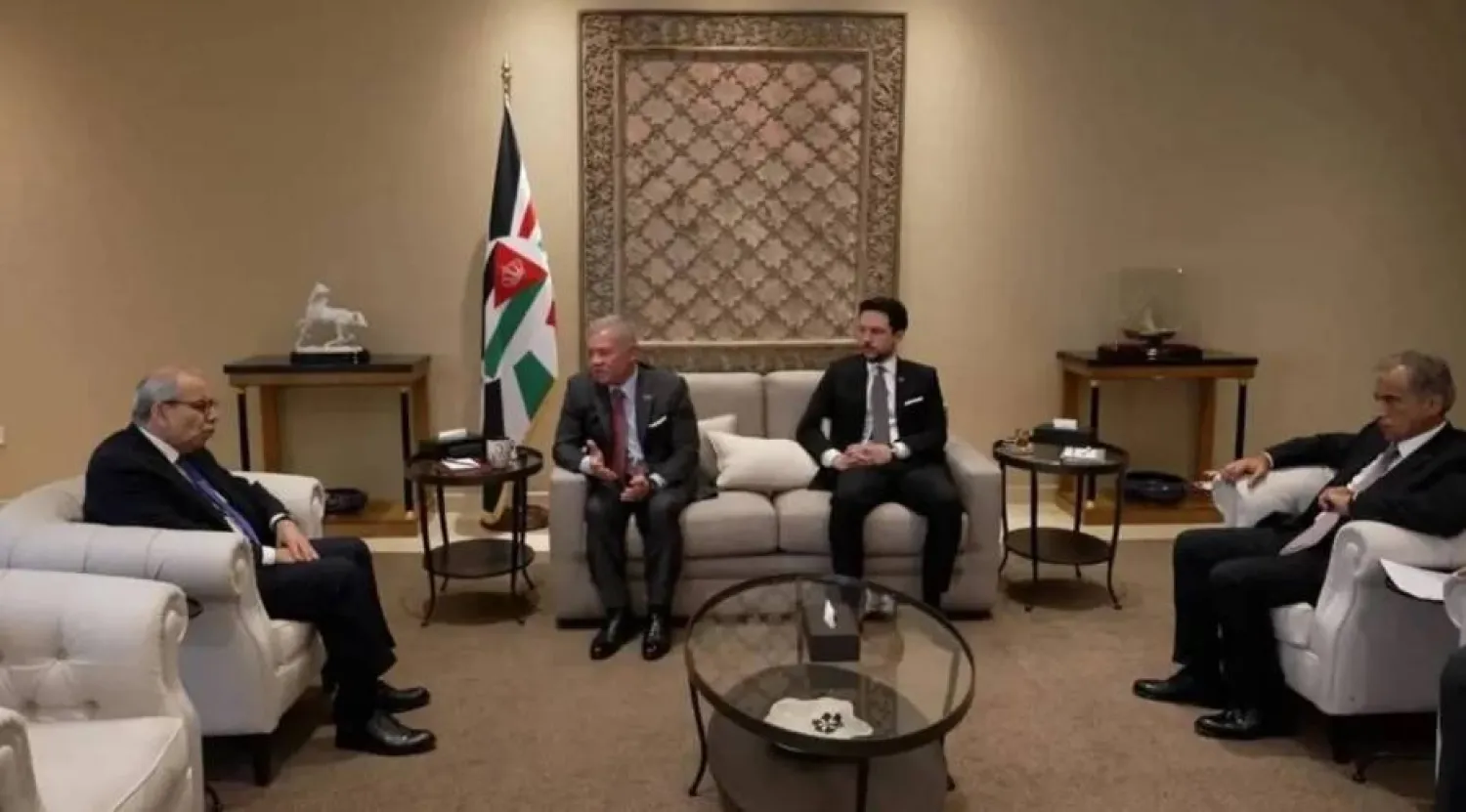
King Abdullah II received Lebanon's Prime Minister Nawaf Salam on Tuesday in Amman (NNA)
TT

Jordan’s King Affirms Full Support for Lebanon in Safeguarding its Security, Sovereignty

King Abdullah II received Lebanon's Prime Minister Nawaf Salam on Tuesday in Amman (NNA)

Jordanian King Abdullah II, who received Lebanese Prime Minister Nawaf Salam on Tuesday, affirmed Jordan’s full support for Lebanon in safeguarding its security and maintaining its sovereignty.

During the meeting attended by Crown Prince Al Hussein bin Abdullah II and Prime Minister Jafar Hassan, King Abdullah highlighted Jordan’s readiness to expand cooperation with Lebanon across all fields, especially economic sectors.

The King called for maintaining coordination with Arab countries to work towards regional stability.

The Jordanian King also affirmed that Syria’s security and stability are a shared priority, expressing Jordan’s support for Syrian efforts to preserve its stability, sovereignty, and the safety of its citizens.

Turning to regional developments, King Abdullah reiterated the need for an immediate ceasefire in Gaza, and increased aid to alleviate the humanitarian catastrophe in the Strip.

He reaffirmed Jordan’s full rejection of Israeli plans to expand its control in the West Bank, and the region, according to Jordan’s news agency, Petra.

Later, Salam and his Jordanian counterpart, Hassan, agreed to hold the Jordanian-Lebanese Joint Higher Committee this year.

The two sides announced the committee will focus on the trade, transportation, and energy sectors to expand bilateral cooperation.

Hassan responded to Israeli Prime Minister Benjamin Netanyahu, who openly declared his support for the vision of “Greater Israel.”

“The reality does not reflect the illusion of a so-called Greater Israel, but rather an outcast, isolated Israel besieged regionally and internationally as a result of its policies of brutality and extremism,” Hassan said.

During talks with Salam in Amman, Hassan warned against proposals and visions aimed at perpetuating the war indefinitely similar to delusions of a so-called Greater Israel promoted by extremist politicians in Israel, noting that reality points to policies that only fuel hatred due to the ongoing massacres.

He underlined that “the peoples of the region and the world will not forgive the massacres taking place.”

The PM reiterated Jordan’s condemnation of the continued Israeli occupation of Lebanese territory, calling for full implementation of the ceasefire agreement and an immediate halt to Israeli attacks on Lebanon.

Hassan called for intensified efforts to end the war in Gaza, the escalating Israeli attacks in the West Bank, and the wider regional escalation.

He said Israel bears full legal and humanitarian responsibility for the collapse of the relief system in Gaza.

“We are facing a tragedy we witness daily in Gaza, where starvation, killing, and massacres are taking place. All crossings must be opened immediately to allow aid to reach our people and children in Gaza,” he added.
Israeli Military Kills Two in Raid, Says Palestinian Ministry

 A man sits near a street in Jerusalem's Old City, following restrictions on large gatherings amid the US-Israel conflict with Iran, March 27, 2026. (Reuters)
A man sits near a street in Jerusalem's Old City, following restrictions on large gatherings amid the US-Israel conflict with Iran, March 27, 2026. (Reuters)
TT

Israeli Military Kills Two in Raid, Says Palestinian Ministry

 A man sits near a street in Jerusalem's Old City, following restrictions on large gatherings amid the US-Israel conflict with Iran, March 27, 2026. (Reuters)
A man sits near a street in Jerusalem's Old City, following restrictions on large gatherings amid the US-Israel conflict with Iran, March 27, 2026. (Reuters)

Israeli forces killed two Palestinian men on Friday during a raid north of Jerusalem, the Ramallah-based health ministry and relatives said, while the army said troops had shot at instigators of stone throwing.

"The young man Mustafa Asaad Hamad (22 years old) was killed by Israeli gunfire in Kufr Aqab," the ministry said in a statement.

In a separate statement, it announced the death of 46-year-old Sufyan Abu Leil, who died "of critical wounds he sustained after being shot by Israeli forces in Qalandia camp this Friday afternoon".

The Palestinian entity in charge of the area, the Jerusalem governorate, reported that Israeli forces had raided the Qalandia refugee camp, adjacent to Kufr Aqab, and wounded several Palestinians with live fire early Friday.

The Israeli military said its forces had twice in 24 hours carried out "operational activities in the Qalandia area... during which violent disturbances developed, including the throwing of stones at the forces."

"The soldiers responded by firing at key instigators and hits were identified," it said in a statement.

Hamad's father Asaad Hamad told AFP at the funeral that the army entered the area at around midnight, causing clashes with local residents, during which his son was shot.

"My son was shot twice in the leg. The bullet hit an artery and he died a martyr," Asaad Hamad told AFP.

Hundreds of young men attended Hamad's funeral as his body was carried through the streets of Qalandia camp on a stretcher, wrapped in a Palestinian flag, an AFP journalist reported.

Qalandia refugee camp, Kufr Aqab and other areas around Jerusalem have seen increased Israeli raids since the beginning of 2026 after Israel launched operation "Capital Shield", which it says aims to make Jerusalem safer.

Since the operation began, the military has arrested dozens of Palestinians and destroyed several buildings it said had been illegally built in Kufr Aqab and Qalandia camp.

Palestinians fear the demolitions will pave the way for Israeli settlers to move into the area, as has happened in parts of east Jerusalem in recent months.

Violence in the West Bank, which Israel has occupied since 1967, has soared since the Hamas attack on Israel triggered the Gaza war in October 2023. It has continued despite an October 2025 ceasefire.

Israeli troops or settlers have killed at least 1,053 Palestinians, many of them gunmen, but also scores of civilians, in the West Bank since the Gaza war began, according to an AFP tally based on Palestinian health ministry figures.


G7 Ministers Urge End to Attacks Against Civilians in Middle East War

First aid responders inspect the site of an Israeli airstrike that targeted a building in the southern Lebanese town of Saksakiyeh on March 27, 2026. (AFP)
TT

G7 Ministers Urge End to Attacks Against Civilians in Middle East War

First aid responders inspect the site of an Israeli airstrike that targeted a building in the southern Lebanese town of Saksakiyeh on March 27, 2026. (AFP)

G7 foreign ministers Friday urged a stop to attacks against civilians in the Middle East war and urged Iran to immediately restore freedom of navigation in the strategic Strait of Hormuz.

A joint statement, released in the name of all G7 members, including the United States, called for "an immediate cessation of attacks against civilians and civilian infrastructure".

"There can be no justification for the deliberate targeting of civilians in situations of armed conflict as well as attacks on diplomatic facilities," it said, after the foreign ministers of the world's leading industrialized nations met in France.

The joint statement had initially not been expected, which had been seen as a potential sign of transatlantic tensions over the US-Israeli war against Iran.

US President Donald Trump had threatened to strike Iranian energy facilities, but has since rowed back on that warning to give Tehran more time for talks he said were taking place.

A major theme of the meeting outside Paris was Iran's de facto closure of the Strait of Hormuz, a key energy and trading bottleneck whose throttling has led to a surge in global energy prices.

"We reiterated the absolute necessity to permanently restore safe and toll-free freedom of navigation in the Strait of Hormuz," the statement added.

In their meeting, the ministers focused on efforts "to mitigate global economic shocks such as disruptions to economic, energy, fertilizer and commercial supply chains, which have direct impacts on our citizens", they said.


Hezbollah Says Clashed with Israeli Forces in Two South Lebanon Villages

A man checks a destroyed house that was hit in an Israeli airstrike in Saksakiyeh village, south Lebanon, Friday, March 27, 2026. (AP Photo/Hussein Malla)
TT

Hezbollah Says Clashed with Israeli Forces in Two South Lebanon Villages

A man checks a destroyed house that was hit in an Israeli airstrike in Saksakiyeh village, south Lebanon, Friday, March 27, 2026. (AP Photo/Hussein Malla)

Hezbollah said Friday its members had clashed directly with Israeli forces in two south Lebanon villages, as Israeli airstrikes on several areas killed at least six people, according to the health ministry.

In a statement, Hezbollah said its fighters had clashed with "Israeli enemy army forces in the villages of Bayada and Shamaa at point-blank range with light and medium weapons," while also claiming responsibility for attacks on Israeli border towns and positions.

The coastal village of Bayada, adjacent to Shamaa, lies eight kilometres from the border with Israel, according to AFP.

Israeli forces are pushing into numerous towns in southern Lebanon, with officials saying they aim to create a security zone reaching the Litani River, some 30 kilometres from the border, to push Hezbollah back and protect northern Israeli communities.

On Friday, Israel launched a series of airstrikes on several areas, particularly in southern Lebanon, according to Lebanese state media.

One of the strikes, on the town of Saksakiyeh in the Sidon district, killed "four civilians and wounded eight others," in an initial toll reported by the health ministry.

At dawn, Israel had targeted the Tahouitet al-Ghadir area in Beirut's southern suburbs without prior warning, killing two people, according to the health ministry.

Israeli army spokesperson Effie Defrin said Friday that "Contrary to the declaration by the Lebanese government earlier this year - Hezbollah is still operating and conducting attacks from southern Lebanon."

"If the Lebanese government will not disarm Hezbollah, the (army) will," he said.

After nearly four weeks of war between Hezbollah and Israel, Nicolas Von Arx, regional director of the International Committee of the Red Cross, warned Friday that "the humanitarian situation is worsening and civilians, as usual, are paying the highest price" in Lebanon.

After meeting Lebanese President Joseph Aoun, he said, "Civilians must be protected wherever they are, whether they remain in their homes or are forced to flee".

According to the authorities, the war has forced more than one million people to flee their homes, and more than a thousand people have been killed since the conflict began.
