Scientists Get a Rare Peek Inside of an Exploding Star

This 2012 image provided by W.M. Keck Observatory shows the W.M. Keck Observatory in Hawaii, whose telescopes were used to spot the insides of a dying star. (Ethan Tweedie/W. M. Keck Observatory via AP)
TT

Scientists Get a Rare Peek Inside of an Exploding Star

This 2012 image provided by W.M. Keck Observatory shows the W.M. Keck Observatory in Hawaii, whose telescopes were used to spot the insides of a dying star. (Ethan Tweedie/W. M. Keck Observatory via AP)

Scientists for the first time have spotted the insides of a dying star as it exploded, offering a rare peek into stellar evolution.

Stars can live for millions to trillions of years until they run out of fuel. The most massive ones go out with a bang in an explosion called a supernova.

Using telescopes that peer deep into space, researchers have observed many such explosions. The cosmic outbursts tend to jumble up a dying star's layers, making it hard for scientists to observe the inner structure.

But that wasn't the case for the new discovery, a supernova called 2021yfj located in our Milky Way galaxy.

The collapsing star's outermost layers of hydrogen and helium had peeled away long ago, which wasn't surprising. But the star's dense, innermost layers of silicon and sulfur had also shed during the explosion.

“We have never observed a star that was stripped to this amount,” said Northwestern University's Steve Schulze, who was part of the discovery team that published the research Wednesday in the journal Nature.

The finding lends evidence to ideas scientists have about how large stars look near the end of their lives, organized into layers with lighter elements on the outside and heavier ones close to the core.

“Because so many of the layers had been stripped off this star, this basically confirmed what those layers were,” said Anya Nugent, who studies supernovas at the Harvard-Smithsonian Center for Astrophysics. She was not involved with the new research.

It's not yet clear how this star got so whittled down — whether its layers were flung off violently in the final stages of its life or yanked away by a twin star. Future research may yield clues, though scientists acknowledged such an event may be tough to capture again.


Germany’s WWII Munitions a Toxic Legacy on Baltic Sea Floor

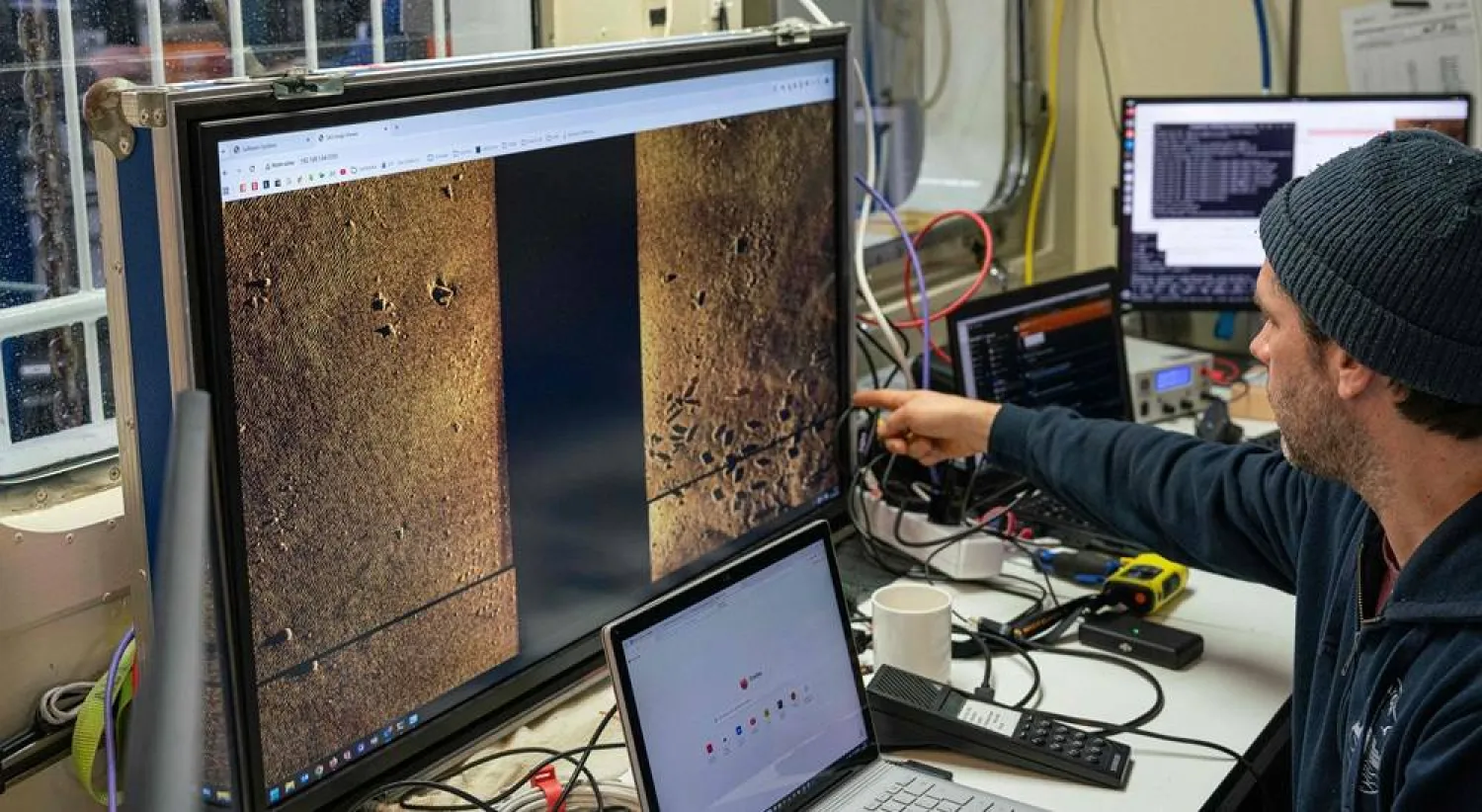
This handout photo taken on March 16, 2026 and released by the Kiel-based GEOMAR oceanographic research center on March 23, 2026 shows a scientist looking at digital scans highlighting munitions and various spots of interest on the seabed aboard the scientific research vessel Alkor in the Eastern Baltic Sea. (Lauren Peck / GEOMAR / AFP)
TT

Germany’s WWII Munitions a Toxic Legacy on Baltic Sea Floor

This handout photo taken on March 16, 2026 and released by the Kiel-based GEOMAR oceanographic research center on March 23, 2026 shows a scientist looking at digital scans highlighting munitions and various spots of interest on the seabed aboard the scientific research vessel Alkor in the Eastern Baltic Sea. (Lauren Peck / GEOMAR / AFP)

Below the waves off Germany's northern tourist beaches, a toxic time bomb lurks on the Baltic Sea floor -- enormous quantities of World War II munitions that are slowly rusting away.

Scientists warn that as salt water corrodes the metal casings on rockets, artillery shells and bombs, they will release contaminants such as the explosive TNT into the marine environment.

To better map the dangers, a research vessel set sail this month from the port city of Kiel, whose bay is among the most polluted with unexploded ordnance.

A dozen scientists from Germany, Poland and Lithuania, backed by an 11-strong crew, are to spend three weeks on the Alkor, operated by the Kiel-based GEOMAR oceanographic research center.

The voyage will take them past a sunken torpedo boat, a destroyer, a minesweeper and a submarine, all identified from naval logbooks and other records in the German military archives.

"One of the goals of the project is to develop some new tools for cleaning it up," Aaron Beck, a scientist leading the expedition, told AFP aboard the ship.

"The idea is, what can we do to prevent this before the pollution comes out?"

Along the German coast, about 1.6 million tons of munitions litter the seafloor, especially near the ports of Kiel and Luebeck, making it one of the world's most contaminated areas.

Most munitions were hastily dumped there by the victorious Allied powers after Germany's 1945 surrender, to quickly eliminate what remained of the Nazi war machine.

- Traces found in shellfish -

Almost 80 years on, traces of carcinogenic explosives have been detected in shellfish and other sea life throughout the area.

The Baltic is shallow, with only a narrow passage between Sweden and Denmark leading to the open ocean, meaning pollution tends to linger.

A modern-day boom in undersea construction of pipelines, telecom cables and offshore wind farms has cast a new spotlight on the issue.

The scientists on the ship are using an underwater robot to film the seabed, as well as probes to collect sediment and water samples.

They are also dispersing packets of mussels, which they will later retrieve to study the levels of contamination ingested.

Beck, however, reassured that the pollution does not pose an immediate danger to humans.

"For a human being to ingest, at current concentrations, a concerning amount of explosive compounds, they would have to consume seven kilos (15 pounds) of fish a day for more than a year," he said.

Ammunition on the sunken warships is not the only environmental danger.

"On some of these ships, you have 10 tons of ammunition, but 200 tons of fuel. That's undoubtedly the biggest problem," Beck said.

One wreck still holding fuel is the Franken, a German navy tanker torpedoed by Soviet forces on April 8, 1945. It sank off what is now the Polish city of Gdansk, at the time still the German city of Danzig.

Uwe Wiechert, 70, a former German naval officer and part of the research team, called it a "time bomb".

The Franken also poses a legal conundrum, he said: who will pay to pump this fuel from a German ship, sunk by the Soviets, that now rests in Polish waters?

- Slow disposal efforts -

Seafloor munitions dumps are a global problem, with other major sites located along the coasts of the United States, Britain, Japan and Australia and even in Swiss lakes.

Germany has been at the forefront of European efforts to deal with unexploded underwater ordnance, says the European Commission.

Beyond mapping the problem, Germany has taken first steps toward munitions disposal.

In Luebeck Bay, a pilot project to destroy WWII munitions on a specially built floating disposal platform has begun.

Some contractors working on the project have experience of clearing munitions for large offshore wind farms along the Baltic and North Sea coasts.

Divers and underwater robots have sorted through tons of dumped munitions at four sites in the bay as part of the project, funded with an initial 100 million euros ($115 million).

But it remains unclear whether the pilot project could become a model for cleanups elsewhere.

So far, at least, no government has committed the long-term funding needed to tackle the problem.

When a similar project might start in waters off Kiel, said Beck, "is anybody's guess".


413,793 KitKat Candy Bars Stolen en Route from Italy to Poland

FILE - A KitKat chocolate bar in Rugby, England, on July 25, 2018. (AP Photo/Martin Cleaver, File)
TT

413,793 KitKat Candy Bars Stolen en Route from Italy to Poland

FILE - A KitKat chocolate bar in Rugby, England, on July 25, 2018. (AP Photo/Martin Cleaver, File)

Swiss food giant Nestlé says about 12 tons, or 413,793 candy bars, of its KitKat chocolate brand were stolen after leaving its production site in Italy earlier this week for Poland.

The company, based in Vevey, Switzerland, said in a statement Friday that “the vehicle and its load are still nowhere to be found.”

The shipment of the crunchy bars, made of waffles covered with chocolate, disappeared last week while en route between production and distribution locations. The chocolate bars were to be distributed throughout Europe.

The missing candy bars could enter unofficial sales channels across European markets, the company said, but if this does happen, all products can be traced using the unique batch code assigned to individual bars.

A spokesperson for KitKat said that as a result, consumers, retailers and wholesalers would be able to identify if a product is part of the stolen shipment by scanning the on-pack batch numbers. If a match is found, the scanner will be given clear instructions on how to alert the company, which will then share the evidence appropriately.

“Whilst we appreciate the criminals’ exceptional taste, the fact remains that cargo theft is an escalating issue for businesses of all sizes," The Associated Press quoted KitKat as saying in a statement.

“With more sophisticated schemes being deployed on a regular basis, we have chosen to go public with our own experience in the hope that it raises awareness of an increasingly common criminal trend,” the statement added.


Virus Kills Tiger Cubs in Indonesian Zoo

Jelita, a Bengal tiger, is seen in its enclosure at Bandung Zoo in Bandung, West Java, on March 26, 2026. (Photo by Timur Matahari / AFP)
TT

Virus Kills Tiger Cubs in Indonesian Zoo

Jelita, a Bengal tiger, is seen in its enclosure at Bandung Zoo in Bandung, West Java, on March 26, 2026. (Photo by Timur Matahari / AFP)

Two Bengal tiger cubs born in Indonesia's Bandung Zoo last year have died from a viral infection, a conservation official told AFP on Friday.

The cubs, two males named Huru and Hara, were born last July to tigress Jelita, who remains in good health.

According to the conservation agency of West Java province, the cubs were infected at birth with the Feline Panleukopenia virus (FPV), which can sicken wild and domestic cats and is particularly dangerous for young animals.

Hara died on the 24th, two days after falling ill, and despite veterinary efforts to save him, Huru followed two days later, agency spokesman Eri Mildrayana told AFP.

The cubs had suffered from diarrhea, vomiting and lethargy in the days before they died.

Bandung mayor Muhammad Farhan, in a social media post Thursday, said the news had left him "very sad."

"This is an important lesson for us. The step that we can take right now is to improve biosecurity," he wrote on Instagram.

The US National Institutes of Health says FPV is also referred to as "cat plague" or "feline distemper" and usually occurs in unvaccinated or improperly vaccinated captive felines.

The Bandung Zoo in West Java has been closed for months due to what officials have described as internal management problems.

In 2017, activists demanded the zoo's closure after skeletal sun bears were pictured begging for food from visitors and eating their own dung.

AFP was unable to reach Bandung city authorities in charge of running the zoo.

According to the International Union for Conservation of Nature, the Bengal tiger is an endangered species, with fewer than 4,000 still in the wild -- mostly in India, Nepal, Bangladesh and Bhutan.