


Matcha Madness Leaves Japan’s Tea Ceremony Pros Skeptical 

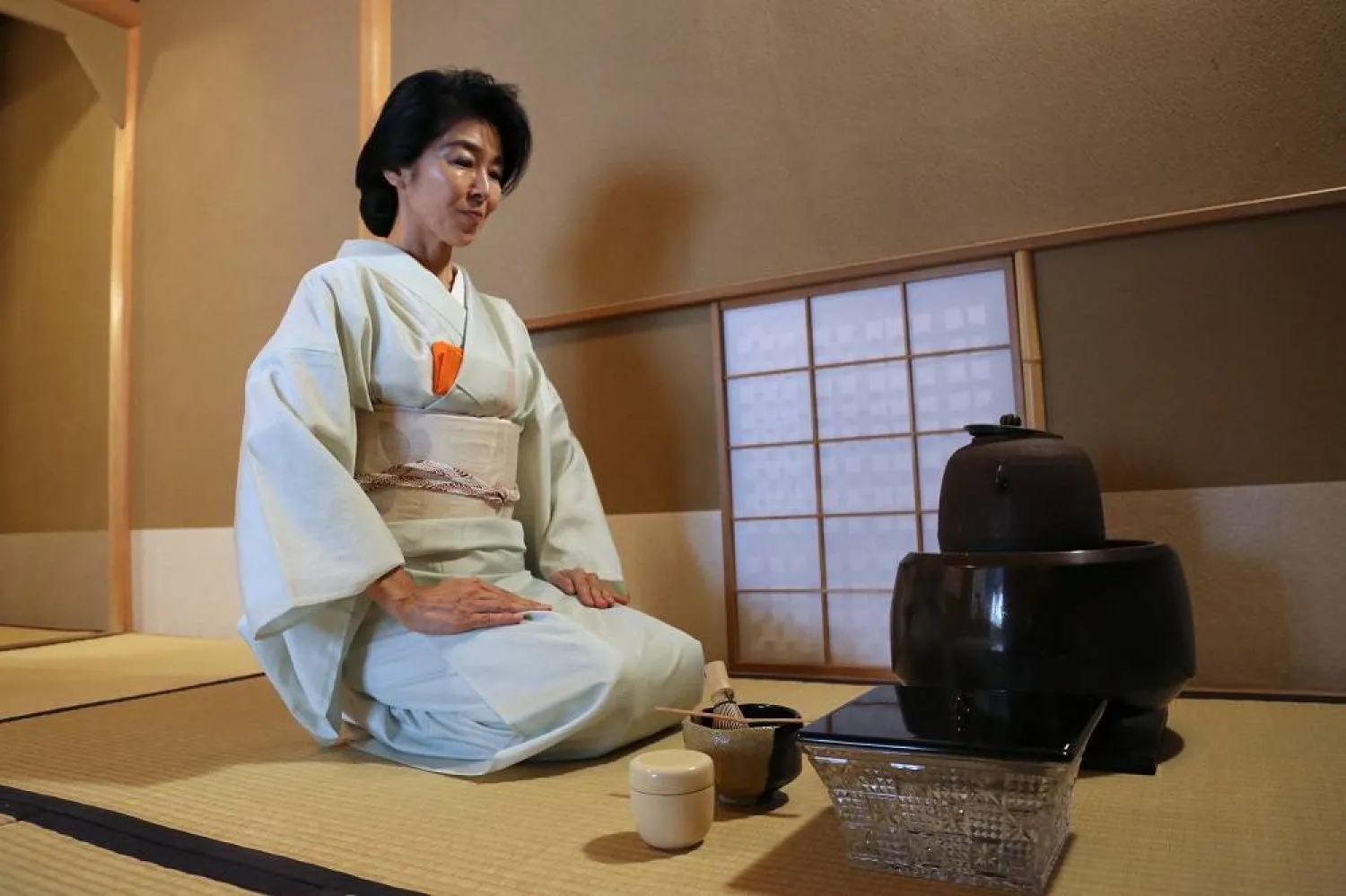
Tea ceremony master Keiko Kaneko demonstrates the tea ceremony at her tea house in Tokyo, Aug. 8, 2025. (AP) 
TT

Matcha Madness Leaves Japan’s Tea Ceremony Pros Skeptical 

Tea ceremony master Keiko Kaneko demonstrates the tea ceremony at her tea house in Tokyo, Aug. 8, 2025. (AP) 

Clad in an elegant kimono of pale green, tea ceremony instructor Keiko Kaneko uses a tiny wooden spoon to place a speck of matcha into a porcelain bowl.

She froths up the special powdered Japanese green tea with a bamboo whisk after pouring hot water with a ladle from a pot simmering over hot coal.

Her solemn, dance-like movements celebrate a Zenlike transient moment, solitude broken up by the ritualistic sharing of a drink.

No wonder Kaneko and others serious about “sado,” or “the way of tea,” are a bit taken aback by how matcha is suddenly popping up in all sorts of things, from lattes and ice cream to cakes and chocolate.

No one knows for sure who started the global matcha boom, which has been going on for several years. But it's clear that harvests, especially of fine-grade matcha, can't keep up with demand.

A booming market

Matcha is a type of tea that's grown in shade, steamed and then ground into a very fine powder. It's processed differently from regular green tea, with the best matcha ground using stone mills, and switching from one to the other takes time. No farmer wants to switch and then find that matcha fever has died.

The Japanese agricultural ministry has been working to boost tea growth, offering help for farmers with new machines, special soil, financial aid and counseling to try to coax tea growers to switch to matcha from regular green “sencha” tea.

“We don’t want this to end up just a fad, but instead make matcha a standard as a flavor and Japanese global brand,” said Tomoyuki Kawai, who works at the tea section of the agricultural ministry.

Production of “tencha,” the kind of tea used for matcha, nearly tripled from 1,452 tons in 2008, to 4,176 tons in 2023, according to government data.

Japan's tea exports have more than doubled over the last decade, with the US now accounting for about a third. Much of that growth is of matcha, according to Japanese government data. The concern is that with labor shortages as aging farmers leave their fields, the matcha crunch may worsen in coming years.

Other countries, including China and some Southeast Asian countries, also are producing matcha, so Japan is racing to establish its branding as the origin of the tea.

An art form turned into a global fun drink

Tea ceremony practitioners aren’t angered by the craze, just perplexed. They hope it will lead to people taking an interest in sado, whose followers have been steadily declining. But they aren’t counting on it.

The tea ceremony is “reminding us to cherish every encounter as unique and unrepeatable,” said Kaneko, who is a licensed instructor.

She pointed to the special small entrance to her tea house. Noble samurai had to stoop to enter, leaving their swords behind them. The message: when partaking of tea, everyone is equal.

The purity and stillness of the ceremony are a world apart from the hectic and mundane, and from the craze for matcha that's brewing outside the tea house.

The Matcha Crème Frappuccino is standard fare at the Starbucks coffee outlets everywhere. While matcha, a special ingredient traditionally used in the tea ceremony, isn’t meant to be drunk in great quantities at once like regular tea or juices, it’s suddenly being consumed like other fruit and flavors.

Matcha drinks have become popular at cafes from Melbourne to Los Angeles. Various cookbooks offer matcha recipes, and foreign tourists to Japan are taking home tins and bags of matcha as souvenirs.

It's a modern take on traditions perfected by the 16th century Buddhist monk Sen no Rikyu in Kyoto, who helped shape the traditions of tea ceremony and of “wabi-sabi,” the rustic, imperfect but pure and nature-oriented aesthetic often seen as synonymous with high-class Japanese culture.

Matcha's future

Minoru Handa, the third-generation chief of suburban tea store Tokyo Handa-en, which sells green and brown tea as well as matcha, says the appeal of matcha is in its versatility. Unlike tea leaves, the powder can be easily mixed into just about anything.

“The health boom and the interest in Japanese culture have added to the momentum,” he said, stirring a machine that was roasting brown tea, sending a pungent aroma through the streets.

“It’s safe and healthy so there’s practically no reason it won’t sell,” said Handa.

His business, which dates back to 1815, has a longtime relationship with growers in Kagoshima, southwestern Japan, and has a steady supply of matcha. To guard against hoarders, he limits purchases at his store to one can per customer.

Handa, who has exhibited his prize-winning tea in the US and Europe, expects that growers will increase the supply and shrugs off the hullabaloo over the matcha shortage.

But Anna Poian, co-director and founder of the Global Japanese Tea Association, thinks lower-grade matcha should be used for things like lattes, since one has to put in quite a lot of fine-grade matcha to be able to taste it.

“It’s a bit of a shame. It’s a bit of a waste,” she said.

The best matcha should be reserved for the real thing, she said in an interview from Madrid.

“It is a very delicate, complex tea that is produced with the idea to be drunk only with water,” she said.


Saudi Culture Ministry Launches UK-KSA Arabian Peninsula Cultural Research Fellowships

The Saudi flag. Asharq Al-Awsat
TT

Saudi Culture Ministry Launches UK-KSA Arabian Peninsula Cultural Research Fellowships

The Saudi flag. Asharq Al-Awsat

The Ministry of Culture has launched the UK-KSA Arabian Peninsula Cultural Research Fellowships in partnership with Effat University and the National Archives of the United Kingdom, to support archival-based research, advance cultural inquiry on the Arabian Peninsula, and strengthen collaboration between researchers and institutions in Saudi Arabia and the United Kingdom.

The program includes a 10-week research residency at the National Archives of the United Kingdom, where participants receive hands-on training in archival methods and gain access to a wide range of archival collections and cultural institutions across the UK. It supports diverse areas of cultural research related to the Arabian Peninsula.

This initiative aligns with the Ministry of Culture’s strategic vision for advancing cultural research, reflecting its commitment to fostering both local and international collaboration and promoting meaningful cultural exchange.

The fellowship is open to researchers and cultural heritage specialists capable of conducting independent research in English, regardless of their professional level.


Culture Ministry Signs Partnership with Guildhall School of Music & Drama for Riyadh University of Arts

Culture Ministry Signs Partnership with Guildhall School of Music & Drama for Riyadh University of Arts
TT

Culture Ministry Signs Partnership with Guildhall School of Music & Drama for Riyadh University of Arts

Culture Ministry Signs Partnership with Guildhall School of Music & Drama for Riyadh University of Arts

The Ministry of Culture signed on Thursday a partnership with Guildhall School of Music & Drama for Riyadh University of Arts (RUA)’s College of Music. The partnership aims to further develop cultural and artistic talent and drive cultural exchange.

Under the terms of the partnership, Guildhall School will work with RUA to co-design undergraduate, postgraduate and research programs spanning music performance, production and education, in addition to training and capability development opportunities for RUA’s faculty body.

The programs will help cultivate and support Saudi talent across a wide range of musical disciplines, as well as provide students with a firm understanding of creative processes, research pathways and professional skills.

Founded in 1880, Guildhall School is a vibrant, international community of musicians, actors and production artists. Ranked as number one in Arts, Drama and Music by the Complete University Guide 2025, and in the top three in the world for Music by the QS World University Rankings 2025, Guildhall delivers world-class professional training in partnership with distinguished artists, companies and ensembles, SPA reported.

The partnership with Guildhall School sits within a series of partnerships for the Riyadh University of Arts and its colleges with leading international institutions to co-design academic programs, collaborate in research, and offer enriching programs in cultural education and development.

In December 2025, RUA announced partnerships between their College of Film and the University of Southern California’s (USC) School of Cinematic Arts (SCA); between SOAS University of London and their College of Heritage and Civilization Studies; AMDA College of the Performing Art and RUA’s College of Theater and Performing Art; and between ESSEC Business School and RUA’s College of Cultural Management. A further agreement was signed with the Royal College of Art (RCA) and RUA’s College of Architecture and Design and College of Visual Arts and Photography in January 2026.

Riyadh University of Arts was established by royal decree and is headquartered in Riyadh. Its Board of Trustees is chaired by Minister of Culture Prince Bader bin Abdullah bin Farhan. The university is dedicated to advancing education in the fields of culture and the arts, serving as a cornerstone for creative learning and cultural innovation. It aims to empower students with the knowledge, skills, and vision needed to shape the future of Saudi Arabia’s creative economy.

The university will launch its programs in phases, gradually expanding to cover a wide range of fields and specialized disciplines. It will offer a comprehensive academic portfolio that supports continuous education across the arts and culture sectors, including short courses, diplomas, bachelor’s degrees, higher diplomas, master’s degrees, and PhDs.


Czech ‘Arks’ Help Preserve Ukraine’s Cultural Heritage

A photo taken in Prague's National Museum shows a 3D scanner in the Archa III (Ark Project) truck on March 24, 2026 in Prague, Czech Republic. (AFP)
TT

Czech ‘Arks’ Help Preserve Ukraine’s Cultural Heritage

A photo taken in Prague's National Museum shows a 3D scanner in the Archa III (Ark Project) truck on March 24, 2026 in Prague, Czech Republic. (AFP)

The National Museum in Prague on Tuesday unveiled a van containing a 3D scanning device that will soon travel to war-ravaged Ukraine to help preserve its cultural artifacts.

The Archa (Ark) III is a Volkswagen van comprising a studio equipped with a robot and three cameras to create precise models of endangered historic items in Ukraine, which has been battling a full-scale Russian invasion since 2022.

"Archa III is a unique mobile digitization device enabling us to create high-quality 3D images of endangered artifacts and collection items out in the field," National Museum director Michal Lukes told reporters.

He added the scanners could handle both tiny objects and more sizeable items even inside museums.

"In this way, we can create precise digital copies of items that can then serve for documentation and research purposes, but also for restoration, potential reconstruction, or the production of copies," he added.

Museum staff will drive the van to Kyiv in early April and hand it over to Ukrainian partners under the project carried out in cooperation with the foundation of Czech billionaire Karel Komarek.

It follows an Archa I container equipped to conserve and restore books and an Archa II van digitizing two-dimensional items, which Prague sent to Ukraine earlier.

The foundation, which worked on the first two "Arks" with other institutions, said they have so far handled almost 40,000 pages of documents, such as historic newspapers retrieved from the Regional Scientific Library in Kherson.

"The van comprises an autonomous robotic system designed for photogrammetry and 3D output," said the museum's IT director Martin Soucek.

Speed is crucial, and the robot moving along three axes can generate thousands of high-quality photographs within minutes.

"It then uses the photographs to create a hyper-realistic model with high detail, a so-called digital twin," Soucek added.

The project also involves expert training and a website on which the scanned artifacts will be exhibited.

Vitalii Usatyi, the charge d'affaires at the Ukrainian embassy in Prague, hailed the van for being able to work across Ukraine, "including regions exposed to risks related to the Russian aggression".

"This is crucial for preserving cultural heritage," he added.

A recent UNESCO report said that 523 cultural sites had been verified as damaged as of March 11, including 153 religious sites, 273 buildings of historical or artistic interest, 39 museums, 33 monuments, 20 libraries, four archaeological sites and one archive.
