

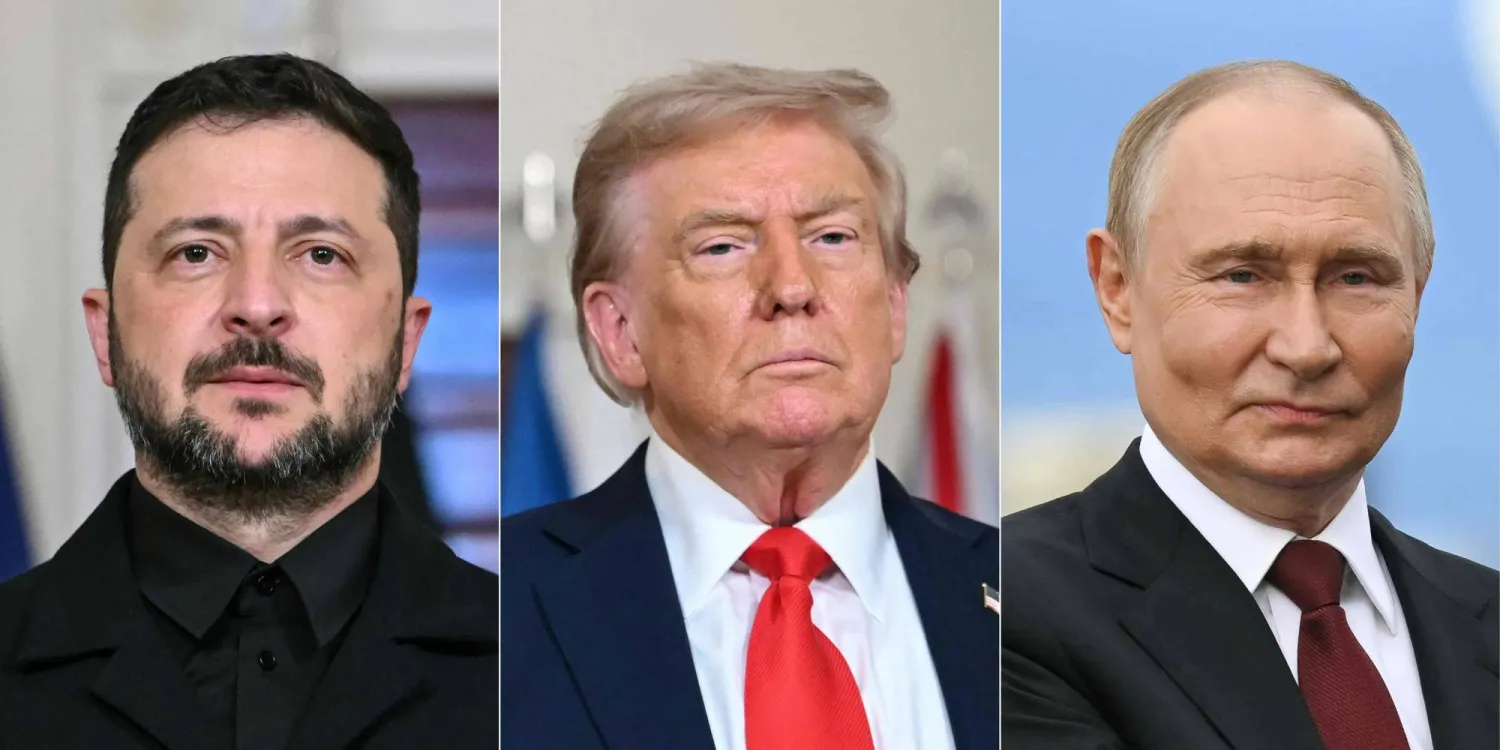

Trump Frustrated after Thinking He Made Headway on Russia-Ukraine Talks Only to See Putin Balk

(COMBO) This combination of pictures created on August 18, 2025 shows US President Donald Trump and Ukrainian President Volodymyr Zelensky in Washington, DC, on August 18, 2025 and Russian President Vladimir Putin in Anchorage, Alaska, on August 15, 2025. (Photo by ANDREW CABALLERO-REYNOLDS / AFP)
TT

Trump Frustrated after Thinking He Made Headway on Russia-Ukraine Talks Only to See Putin Balk

(COMBO) This combination of pictures created on August 18, 2025 shows US President Donald Trump and Ukrainian President Volodymyr Zelensky in Washington, DC, on August 18, 2025 and Russian President Vladimir Putin in Anchorage, Alaska, on August 15, 2025. (Photo by ANDREW CABALLERO-REYNOLDS / AFP)

US President Donald Trump started the week declaring a diplomatic breakthrough in his bid to prod Moscow and Kyiv closer to peace, announcing he had begun arranging for direct talks between Russia's Vladimir Putin and Ukraine's Volodymyr Zelenskyy.

Four days later, the Republican president's optimism has diminished. Russia's top diplomat made it clear Friday that Putin won't meet with Zelenskyy until the Ukrainians agree to some of Moscow's longstanding demands to end the conflict, The Associated Press reported.

It's a stinging setback for Trump, who had been touting his diplomatic blitz as resulting in indisputable momentum for a deal to halt a conflict he vowed as a candidate to end on Day One in office.

Trump said Friday he expected to make a decision on his next actions in two weeks if direct talks aren’t scheduled. He raised the possibility of imposing new sanctions or tariffs on Russia, a threat he has previously floated but not followed through on.

“We’re going to see whether or not they have a meeting,” Trump told reporters in an Oval Office appearance. “It’ll be interesting to see. If they don’t, why didn’t they have a meeting, because I told them to have a meeting. But I’ll know what I am going to do in two weeks.”

Trump has touted a breakthrough that wasn't Trump announced Monday that he had begun making the arrangements for a Putin-Zelenskyy meeting soon after concluding White House talks with Zelenskyy and European leaders as well as speaking by phone with Putin.

European leaders cheered the president's tone at the White House meeting, when he made vague promises to back European security guarantees for postwar Ukraine.

Trump also appeared to ease European anxiety heightened by his comments after his Alaska summit with Putin days earlier, when he appeared to tilt toward the Russian leader's demand for Ukraine to give up land seized by Russia. The European leaders even offered guarded optimism that Trump was making headway after he announced his plans for direct talks, followed potentially by three-way negotiations involving him.

But uncertainty has grown in recent days about Putin's commitment to Trump's peace-making efforts as Russian officials raised objections about cornerstones of the nascent proposals on the negotiating table.

Russian Foreign Minister Sergey Lavrov said Putin is ready to meet with Zelenskyy to discuss peace terms but only after key issues first are worked out by senior officials. That could involve a protracted negotiating process because the two sides remain far apart.

“There is no meeting planned,” Lavrov said in a taped interview for NBC’s Sunday show “Meet the Press with Kristen Welker.” “Putin is ready to meet with Zelenskyy when the agenda is ready for a summit, and this agenda is not ready at all.”

Russia injects uncertainty into any headway on security guarantees Ukraine wants Western security guarantees to deter any postwar Russian attack, and US and European officials are scrambling to come up with detailed proposals of how that might work. But Lavrov said earlier this week that making security arrangements for Ukraine without Moscow’s involvement was pointless.

Putin, meanwhile, on Friday made a visit to Sarov, a closed city about 370 kilometers (230 miles) east of Moscow that has served as a base for Russia’s nuclear weapons program since the late 1940s. The visit offered a not-so-subtle reminder that Russia is one of the world's foremost nuclear powers.

“He hasn’t moderated his position in any significant way,” said Nigel Gould-Davies, a senior fellow at the International Institute for Strategic Studies in London and former British ambassador to Belarus.

Even as Trump touted his plan for peace talks, Russia on Thursday launched one of its biggest aerial assaults so far this year, focusing on western Ukraine in the barrage of 574 drones and 40 ballistic and cruise missiles.

“The Russians are trying to do anything to avoid the (summit) meeting. The issue is not the meeting itself, the issue is that they do not want to end the war,” Zelenskyy said Friday alongside NATO Secretary General Mark Rutte, who was visiting Kyiv.

Rutte said Trump wants to “break the deadlock” with Putin and engage the United States in providing security guarantees for Ukraine.

Rutte explained that guarantees under discussion would rest on two “layers.” The first, to take place after a peace deal or long-term ceasefire, would focus on making the Ukrainian armed forces “as strong as possible.” The second would involve security commitments provided by Europe and the United States.

Europe's chief diplomat warns of Putin ‘trap’ The European Union’s foreign policy chief said Friday that the possibility of Ukraine ceding land to Russia as part of a peace deal to end their three-year war is “a trap” set by Putin.

The Russian leader is demanding Ukrainian concessions in return for halting his army’s invasion, but granting him those demands would amount to rewarding the country that started the fighting, Kaja Kallas said.

The recent talk about handing Putin concessions is “exactly the trap that Russia wants us to walk into,” Kallas said in an interview with the BBC.

“I mean, the discussion all about what Ukraine should give up, what the concessions that Ukraine is willing to (make), whereas we are forgetting that Russia has not made one single concession and they are the ones who are the aggressor here, they are the ones who are brutally attacking another country and killing people,” she said.

“Russia is just dragging feet. It’s clear that Russia does not want peace,” Kallas said. “President Trump has been repeatedly saying that the killing has to stop and Putin is just laughing, not stopping the killing, but increasing the killing.”



CENTCOM to Iran: We Will Not Tolerate Unsafe IRGC Actions

This handout image from the US Navy shows Capt. Daniel Keeler, the commanding officer of the Nimitz-class aircraft carrier USS Abraham Lincoln, as he prepares to fly an MH-60R Sea Hawk helicopter in the Indian Ocean on Jan. 23, 2026. (Mass Communication Specialist Seaman Daniel Kimmelman/US Navy via AP)
TT

CENTCOM to Iran: We Will Not Tolerate Unsafe IRGC Actions

This handout image from the US Navy shows Capt. Daniel Keeler, the commanding officer of the Nimitz-class aircraft carrier USS Abraham Lincoln, as he prepares to fly an MH-60R Sea Hawk helicopter in the Indian Ocean on Jan. 23, 2026. (Mass Communication Specialist Seaman Daniel Kimmelman/US Navy via AP)

US Central Command (CENTCOM) has warned Iran’s Revolutionary Guard (IRGC) not to make any “unsafe” behavior near American forces in the Strait of Hormuz.

Iran is conducting a two-day live-fire naval exercise in the Strait scheduled to begin on Sunday.

“CENTCOM urges the IRGC to conduct the announced naval exercise in a manner that is safe, professional and avoids unnecessary risk to freedom of navigation for international maritime traffic,” it said in a statement on Friday.

“The Strait of Hormuz is an international sea passage and an essential trade corridor that supports regional economic prosperity. On any given day, roughly 100 of the world’s merchant vessels transit the narrow strait,” it said.

While acknowledging Iran’s right to operate professionally in international airspace and waters, it said that “any unsafe and unprofessional behavior near US forces, regional partners or commercial vessels increases risks of collision, escalation, and destabilization.”

CENTCOM also stressed that it “will not tolerate unsafe IRGC actions including overflight of US military vessels engaged in flight operations, low-altitude or armed overflight of US military assets when intentions are unclear, highspeed boat approaches on a collision course with US military vessels, or weapons trained at US forces.”


Trump Says Iran Wants Deal, US ‘Armada’ Larger Than in Venezuela Raid

US President Donald Trump signs executive orders in the Oval Office at the White House, Washington, DC, USA, 30 January 2026. (EPA)
TT

Trump Says Iran Wants Deal, US ‘Armada’ Larger Than in Venezuela Raid

US President Donald Trump signs executive orders in the Oval Office at the White House, Washington, DC, USA, 30 January 2026. (EPA)

President Donald Trump said Thursday he believed Tehran wanted to make a deal to avoid military action, adding that the US "armada" near Iran was bigger than the one he dispatched to topple Venezuela's leader.

"We have a large armada, flotilla, call it whatever you want, heading toward Iran right now, even larger than what we had in Venezuela," the Republican president told reporters in the Oval Office.

"Hopefully we'll make a deal. If we do make a deal, that's good. If we don't make a deal, we'll see what happens."

Asked if he had given Iran a deadline to make a deal on its nuclear program, ballistic missiles and other issues, Trump said "yeah I have" but added that "only they know for sure" what it was.

Trump, however, cited what he said was Iran's decision to halt executions of protesters -- after a crackdown in which rights groups say more than 6,000 people were killed -- as evidence to show Tehran was ready to comply.

"I can say this, they do want to make a deal," Trump said.

Trump declined to say whether, if Iran did not reach a deal, he planned a repeat of the dramatic operation in Venezuela in which US forces captured president Nicolas Maduro.

"I don't want to talk about anything having to do with what I'm doing militarily," he said.


‘He Probably Would’ve Survived’: Iran Targeting Hospitals in Crackdown

A bus burned during protests on a street in Tehran, Iran, January 16, 2026. Majid Asgaripour/WANA (West Asia News Agency) via Reuters
TT

‘He Probably Would’ve Survived’: Iran Targeting Hospitals in Crackdown

A bus burned during protests on a street in Tehran, Iran, January 16, 2026. Majid Asgaripour/WANA (West Asia News Agency) via Reuters

Hospitals are no longer places of safety as Iran's crackdown on anti-government protests impacts all aspects of life, rights groups say, with authorities arresting wounded protesters and even the medics who treat them.

Activists accuse security forces of killing thousands of people and wounding more by directly firing on protests, often with birdshot that can leave metal pellets lodged in the body until hygienically extracted by a professional.

But rights groups say authorities have raided hospitals searching for people with wounds that suggest they were involved in protests. At least five doctors have meanwhile been arrested for treating them, according to the World Health Organization.

Amnesty International said security forces had "arrested protesters receiving treatment in hospitals", adding it had received information that medical staff in central Isfahan province had been ordered to notify authorities about patients with injuries from gunshots and shotgun pellets.

The New York-based Center for Human Rights in Iran (CHRI) said it "has documented cases in which security forces raided hospitals to identify and arrest protesters injured during demonstrations".

In apparent response to the charges, Iran's health ministry this week urged those injured in the protests to go to hospital.

"Our advice to the public is that if they suffer any kind of injury, they should not try to treat it at home, and they should not worry about going to medical centers," the health ministry said, in a statement carried by state television.

- 'Raiding medical facilities' -

Sajad Rahimi, 36, from Iran's Gulf island of Qeshm, was badly wounded after security forces shot at him when he joined a protest in the southern province of Fars at the peak of the movement on January 9, according to Norway-based NGO Iran Human Rights.

But fearing he could be shot dead by security forces in a "coup de grace", he asked friends not to take him directly to hospital, said IHR, which has investigated this and several other cases and spoke to the man's brother.

Eventually, the family transferred him to hospital, but he died as a result of a deep wound caused by live ammunition and severe bleeding.

"The doctor said that if he had arrived at the hospital just ten minutes earlier, he would probably have survived," his brother told IHR.

The group said it had reports of "security forces raiding certain medical facilities and informal shelters for the wounded in order to arrest medical staff and volunteer first responders".

The Hengaw rights group, also based in Norway, highlighted the case of Dr Ali Reza Golchni, a physician from the city of Qazvin, northwest of Tehran, who it said had been arrested "for providing medical care to injured protesters".

- 'Grave violations' -

World Health Organization director general Tedros Adhanom Ghebreyesus said he was "deeply concerned by multiple reports of health personnel and medical facilities in Iran being impacted by the recent insecurity, and prevented from delivering their essential services to people requiring care".

He said there were reports of "at least five doctors detained, while treating injured patients".

The World Medical Association (WMA) said it had received reports that security forces arrested injured protesters in both the Isfahan and the southwestern province of Chaharmahal-and-Bakhtiari.

"Hospital staff have also been instructed to report patients suffering gunfire injuries to security authorities, with non-compliance exposing them to prosecution and other reprisals," it said, citing information received by the WMA.

Hengaw also cited the case of Taher Malekshahi, a 12-year-old Kurdish-Iranian boy from Qorveh in western Iran who was severely injured after being shot in the face and eyes with pellet ammunition.

It said he lost one eye and suffered serious damage to the other, publishing a picture of his face with the boy's entire forehead pock-marked with pellet wounds.

It said while he was currently receiving intensive medical treatment in Tehran, "authorities have pressured his family to falsely claim he was wounded by 'terrorists' in exchange for state recognition as a war-disabled victim."