
Lebanon Awaiting Syria’s Official Response to US Proposals

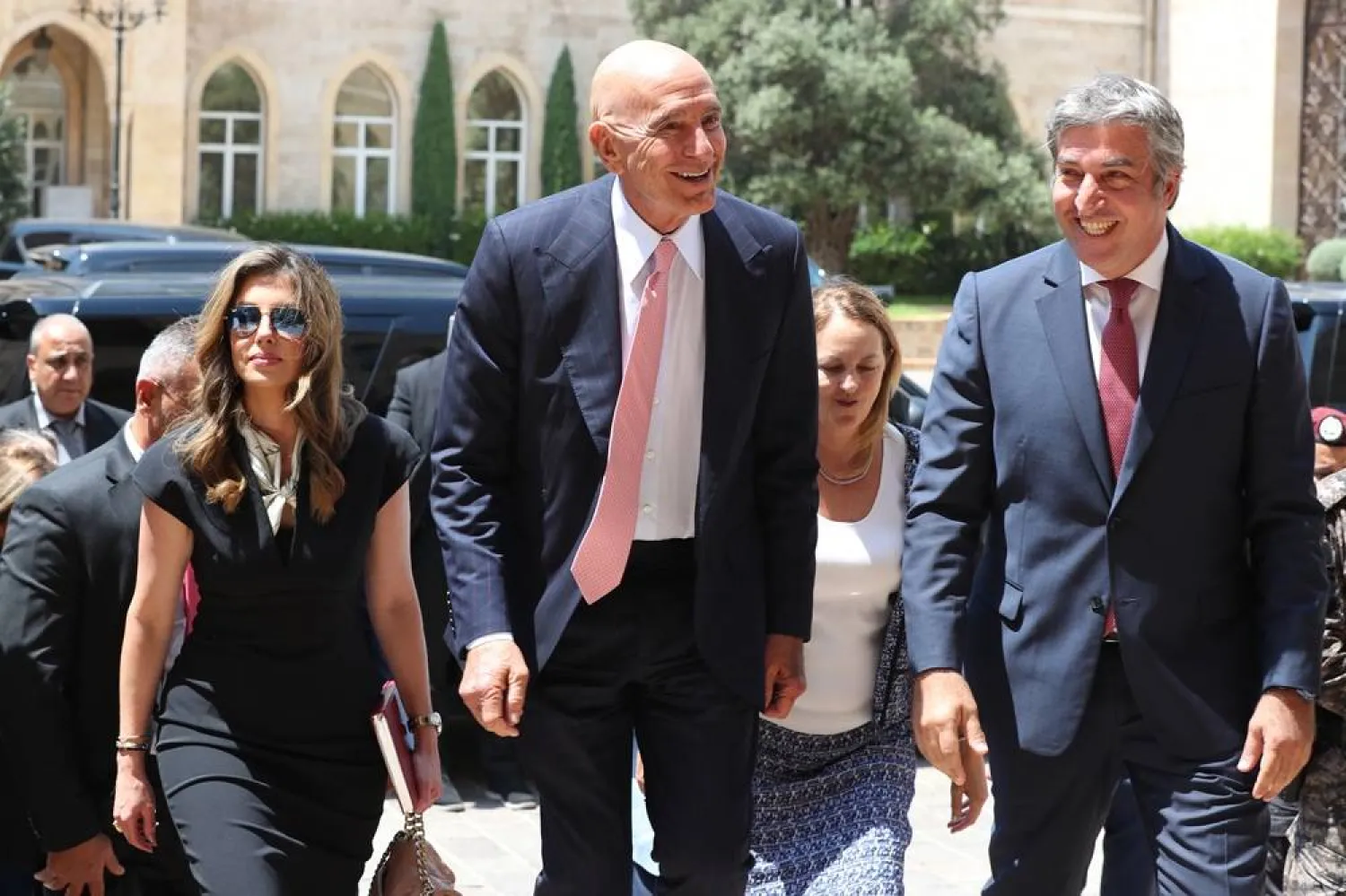
US Ambassador to Türkiye and Special Envoy to Syria Tom Barrack (C), and US Deputy Special Envoy for the Middle East Morgan Ortagus (L) arrive for a meeting with Lebanese Prime Minister Nawaf Salam at the government palace in Beirut, Lebanon, 18 August 2025. (EPA)
TT

Lebanon Awaiting Syria’s Official Response to US Proposals

US Ambassador to Türkiye and Special Envoy to Syria Tom Barrack (C), and US Deputy Special Envoy for the Middle East Morgan Ortagus (L) arrive for a meeting with Lebanese Prime Minister Nawaf Salam at the government palace in Beirut, Lebanon, 18 August 2025. (EPA)

Lebanon is not only waiting for Israel’s response to its stance on the US proposals related to a ceasefire, limiting the possession of arms to the state and the demarcation of the border, but it is also awaiting an official position from Syria.

Two out of the 30 articles of the “US document” concern Syria. They cover the demarcation of their shared land and sea borders and determining exclusive economic zones. The second article focuses on jointly combating drug smuggling.

Implementing the first article calls for forming a tripartite committee of Lebanese and Syrian representatives and United Nations experts, as well as assistance from the US, Saudi Arabia and France.

The document says the proposals will be effective as of August 1 as soon as they are approved by Lebanon, Israel and Syria. Lebanon is the only party to have so far approved them.

A government source told Asharq Al-Awsat that Lebanese official channels have yet to receive any official Syrian position on the US document.

US Ambassador to Türkiye and Special Envoy to Syria Tom Barrack was in Lebanon this week to further discuss the proposals. He met with President Joseph Aoun, parliament Speaker Nabih Berri and Prime Minister Nawaf Salam before traveling to Israel.

Aoun had informed Barrack that Lebanon demands a response from both Israel and Syria. Barrack said he will ensure that Damascus makes its position clear.

At the moment, contacts between Lebanon and Syria are taking place through security and military channels.

The source said a Syrian official delegation is set to travel to Lebanon next week to discuss pending files between the countries, most notably border demarcation, drug smuggling and Syrian refugees and detainees in Lebanon. Damascus has notably not yet appointed an ambassador to Beirut.

Saudi Arabia had in March sponsored an agreement in Jeddah between the Lebanese and Syrian defense ministers that stresses the need to demarcate the border between the two neighbors, form dedicated legal committees to tackle pending files and activate coordination mechanisms to handle security and military challenges.

Cold relations

The Lebanese-Syrian border has witnessed fierce clashes between clans and Hezbollah, before developing into clashes between the Lebanese army and Syrian forces.

Director of the Levant Institute for Strategic Affairs Dr. Sami Nader doubted that the articles tied to Lebanon and Syria can be implemented.

He told Asharq Al-Awsat that the situation is complex and compounded by the presence of Hezbollah members along the Lebanese side of the border.

So, the article related to the Lebanese state having monopoly over arms needs to be implemented so that the articles related to Syria can in turn be implemented, he explained.

Saudi Arabia and the US are playing a key role in border demarcation, but real progress there can only be achieved once the army carries out its plan to limit the possession of arms to the state, Nader said.

The military is expected to send its plan to the cabinet.

As it stands, relations between Lebanon and Syria's new authorities can be described as “cold” despite visits by former PM Najib Mikati and current PM Salam to Damascus after the fall of the Assad regime in December.

Syria’s Foreign Minister Asaad al-Shaibani was expected to visit Beirut at some point, but a date was never set.

Former MP Moeen al-Merehbi told Asharq Al-Awsat that Beirut and Damascus have to exert more efforts to forge warm ties, especially since they both evidently want to.

The new Syrian authorities have an interest in demarcating the marine and land borders with Lebanon, as opposed to the Assad regime that did not even allow anyone to broach the subject, he remarked.


Arab Coalition: Aidrous Al-Zubaidi Flees to Unknown Location Amidst Escalation

Coalition spokesman Major General Turki al-Malki. (SPA)
TT

Arab Coalition: Aidrous Al-Zubaidi Flees to Unknown Location Amidst Escalation

Coalition spokesman Major General Turki al-Malki. (SPA)

Official Spokesperson of the Coalition to Restore Legitimacy in Yemen Major General Turki Al-Malki said on Wednesday that the head of the Southern Transitional Council (STC) Aidrous Al-Zubaidi has fled to an unknown location.

On January 4, the Joint Forces Command of the Coalition informed Al-Zubaidi that he must travel to Saudi Arabia within 48 hours to meet with Chairman of Yemen's Presidential Leadership Council (PLC) Dr. Rashad Al-Alimi, and the Coalition Forces Command to address the reasons behind the escalation and attacks by forces affiliated with the STC on the governorates of Hadhramaut and Al-Mahra.

On January 5, the Presidency of the STC reiterated its appreciation for the efforts led by Saudi Arabia in preparing for a comprehensive southern conference to discuss ways to resolve the southern issue, and confirmed its participation in ensuring the conference's success.

Al-Zubaidi informed the Kingdom of his intention to attend on January 6, and the delegation proceeded to the airport.

However, the departure of Yemenia Airways flight IYE 532, scheduled for 10:10 PM and carrying the delegation, was delayed for more than three hours. The legitimate government and the coalition received intelligence indicating that Al-Zubaidi had moved a large force, including armored vehicles, combat vehicles, heavy and light weapons, and ammunition, from the Jabal Hadid and Al-Solban camps towards Al-Dhaleh around midnight.

The aforementioned flight was allowed to depart, carrying a large number of STC leaders but excluding Al-Zubaidi, who fled to an unknown location.

He left the members and leaders of the STC without any details regarding his whereabouts. This occurred after he distributed weapons and ammunition to dozens of elements inside Aden, led by Mu'min Al-Saqqaf and Mukhtar Al-Nubi, with the aim of stoking unrest in Aden in the coming hours.

This prompted the National Shield Forces and the coalition to request Vice President of the Presidential Leadership Council Abdul Rahman Al-Mahrami, also known as Abu Zaraa, to impose security, prevent any clashes within Aden, spare its residents any disturbances, protect lives and property, and cooperate with the National Shield Forces.

The coalition forces monitored the movement of the military units as they emerged from the camps and took up positions in a building near Al-Zand camp in Al-Dhaleh Governorate. At 4:00 AM, coalition forces, in coordination with legitimate government forces and the National Shield Forces, launched limited preemptive strikes to disrupt these forces and thwart Al-Zubaidi's attempts to escalate the conflict and extend it into Al-Dhaleh.

The Joint Forces Command of the Coalition to Restore Legitimacy in Yemen stress that it is working with the Yemeni government and the local authority in Aden to support and maintain security efforts and confront any military forces targeting cities and civilians.

The command urges all residents to stay away from camps in Aden and Al-Dhaleh, avoid any gatherings of military vehicles for their own safety, and provide information to security agencies regarding any suspicious military movements.


Israel Clears Final Hurdle to Start Settlement Construction That Would Cut West Bank in Two

Construction cranes tower above a construction site in Givat HaMatos, an Israeli settlement suburb of Israeli-annexed east Jerusalem on January 2, 2026. (AFP)
TT

Israel Clears Final Hurdle to Start Settlement Construction That Would Cut West Bank in Two

Construction cranes tower above a construction site in Givat HaMatos, an Israeli settlement suburb of Israeli-annexed east Jerusalem on January 2, 2026. (AFP)

Israel has cleared the final hurdle before starting construction on a controversial settlement project near Jerusalem that would effectively cut the West Bank into two, according to a government tender. 

The tender, seeking bids from developers, would clear the way to begin construction of the E1 project. 

The anti-settlement monitoring group Peace Now first reported the tender. Yoni Mizrahi, who runs the group’s settlement watch division, said initial work could begin within the month. 

Settlement development in E1, an open tract of land east of Jerusalem, has been under consideration for more than two decades, but was frozen due to US pressure during previous administrations. 

The international community overwhelmingly considers Israeli settlement construction in the West Bank to be illegal and an obstacle to peace. 

The E1 project is especially contentious because it runs from the outskirts of Jerusalem deep into the occupied West Bank. Critics say it would prevent the establishment of a contiguous Palestinian state in the territory. 

Israeli Finance Minister Bezalel Smotrich, a far-right politician who oversees settlement policy, has long pushed for the plan to become a reality. 

“The Palestinian state is being erased from the table not with slogans but with actions,” he said in August, when Israel gave final approval to the plan. “Every settlement, every neighborhood, every housing unit is another nail in the coffin of this dangerous idea.” 

The tender, publicly accessible on the website for Israel’s Land Authority, calls for proposals to develop 3,401 housing units. Peace Now says the publication of the tender “reflects an accelerated effort to advance construction in E1.” 


Three Killed in Aleppo Attacks, Syrian Government, SDF Trade Blame

Syrian forces are seen during a military parade in Aleppo marking a year since the ouster of the Assad regime in December 2025. (Syrian Defense Ministry)
TT

Three Killed in Aleppo Attacks, Syrian Government, SDF Trade Blame

Syrian forces are seen during a military parade in Aleppo marking a year since the ouster of the Assad regime in December 2025. (Syrian Defense Ministry)

At least three people were killed and several others wounded in Syria's northern city of Aleppo, state news agency SANA said on Tuesday, citing Aleppo's health director, after deadly attacks for which Syrian government forces and the Kurdish-led Syrian Democratic Forces traded blame.

Syria's defense ministry said in a statement that the SDF had continued its "escalation" by targeting army positions and residential areas in Aleppo. The SDF denied its responsibility, saying that the ‌casualties were caused by "indiscriminate" ‌artillery and missile shelling by ‌factions ⁠aligned with ‌the Damascus government.

The violence came days after a meeting between senior officials from the SDF and the Damascus government on implementing a deal agreed nearly 10 months ago that aimed to fully integrate the semi-autonomous Kurdish region into the central Syrian government.

The agreement was ⁠meant to be implemented by the end of 2025, but ‌the two sides have made ‍little progress, each accusing ‍the other of stalling or acting in bad ‍faith.

The SDF is reluctant to give up autonomy it won as the main US ally during the war, which left it with control of ISIS prisons and rich oil resources.

Integrating the SDF into Syria's army would mend Syria's deepest remaining fracture, ⁠but failing to do so risks an armed clash that could derail the country's emergence from 14 years of war and potentially draw in Türkiye, which has threatened an incursion against Kurdish fighters it views as terrorists.

As progress falters, several rounds of fighting have broken out. On December 22, Syrian government forces and SDF agreed to de-escalate in the northern city of Aleppo, after a wave ‌of attacks that left at least two civilians dead and several wounded.