Some National Guard Units in Washington are Now Carrying Firearms in Escalation of Trump Deployment

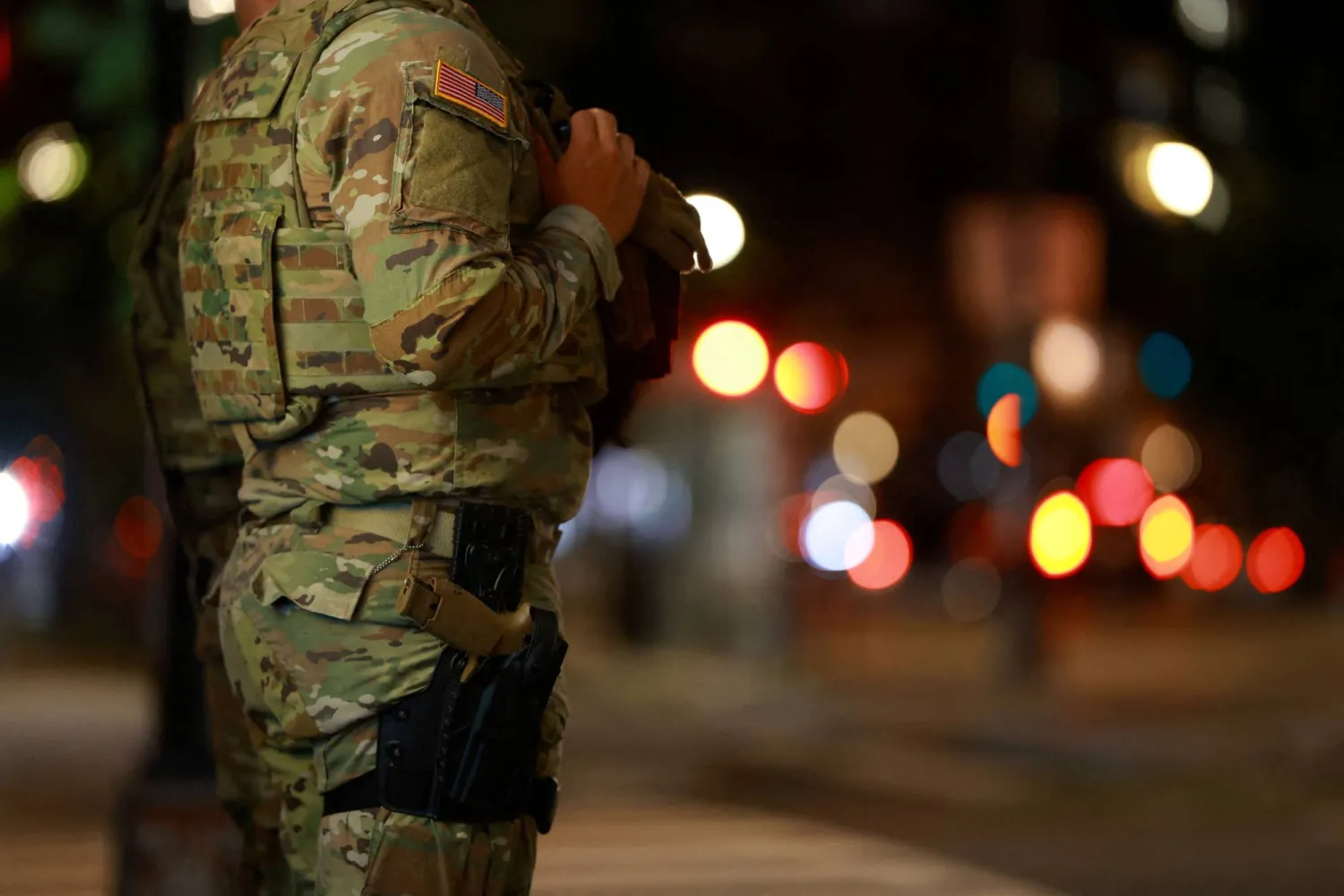
A member of the Ohio National Guard wears his sidearm while patrolling in the Logan Circle neighborhood, weeks after US President Donald Trump ordered National Guard and law enforcement to patrol the nation’s capital to assist in crime prevention, in Washington, D.C., US, August 24, 2025. REUTERS/Jose Luis Gonzalez
TT

Some National Guard Units in Washington are Now Carrying Firearms in Escalation of Trump Deployment

A member of the Ohio National Guard wears his sidearm while patrolling in the Logan Circle neighborhood, weeks after US President Donald Trump ordered National Guard and law enforcement to patrol the nation’s capital to assist in crime prevention, in Washington, D.C., US, August 24, 2025. REUTERS/Jose Luis Gonzalez

Some National Guard units patrolling the nation’s capital at the direction of President Donald Trump have started carrying firearms, an escalation of his military deployment that makes good on a directive issued late last week by his defense secretary.

A Defense Department official who was not authorized to speak publicly said some units on certain missions would be armed — some with handguns and others with rifles. The spokesperson said that all units with firearms have been trained and are operating under strict rules for use of force.

An Associated Press photographer on Sunday saw members of the South Carolina National Guard outside Union Station with holstered handguns.

A statement from the joint task force that has taken over policing in the nation’s capital said units began carrying their service weapons on Sunday and that the military's rules say force should be used “only as a last resort and solely in response to an imminent threat of death or serious bodily harm.” It said the force is committed to protecting “the safety and wellbeing” of Washington's residents.

The defense official who spoke to The Associated Press said only troops on certain missions would carry guns, and that would include those patrolling to establish a law enforcement presence throughout the capital. Those working in transportation or administration would likely remain unarmed.

Thousands of National Guard and federal law enforcement officers are now patrolling the district’s streets, drawing sporadic protests from local residents.

The development in Trump’s extraordinary effort to override the law enforcement authority of state and local governments comes as he is considering expanding the deployments to other Democratic-led cities, including Baltimore, Chicago and New York.

Earlier Sunday, the president responded to an offer by Maryland’s governor to join him in a tour of Baltimore by saying he might instead “send in the ‘troops.’”

Gov. Wes Moore, a Democrat, has criticized Trump's unprecedented flex of federal power aimed at combatting crime and homelessness in Washington. Moore last week invited Trump to visit his state to discuss public safety and walk the streets.

In a Truth Social post on Sunday, Trump said Moore asked “in a rather nasty and provocative tone,” and then raised the specter of repeating the National Guard deployment he made in Los Angeles over the objections of California's Democratic governor, Gavin Newsom.

"Wes Moore’s record on Crime is a very bad one, unless he fudges his figures on crime like many of the other ‘Blue States’ are doing," Trump wrote, as he cited a pejorative nickname he uses frequently for the California governor. “But if Wes Moore needs help, like Gavin Newscum did in L.A., I will send in the ‘troops,’ which is being done in nearby DC, and quickly clean up the Crime.”

Moore said he invited Trump to Maryland “because he seems to enjoy living in this blissful ignorance" about improving crime rates in Baltimore. After a spike during the pandemic that matched nationwide trends, Baltimore's violent crime rate has fallen. The 200 homicides reported last year were down 24% from the prior year and 42% since 2021, according to city data. Between 2023 and 2024, overall violent crime was down nearly 8% and property crimes down 20%.

“The president is spending all of his time talking about me,” Moore said on CBS's “Face the Nation” on Sunday. “I'm spending my time talking about the people I serve.”

Trump is “spouting off a bunch of lies about public safety in Maryland,” Moore said in a fundraising email.

In Washington, where Trump has surged National Guard troops and federal law enforcement officers, a patchwork of protests popped up throughout the city over the weekend, while some normally bustling corners were noticeably quiet. In some of the most populated areas, residents walked by small groups of national guardsmen, often talking among themselves. Videos of arrests and detainments circulated on social media.

Trump has said Chicago and New York are most likely his next targets, eliciting strong pushback from Democratic leaders in both states. The Washington Post reported Saturday that the Pentagon has spent weeks preparing for an operation in Chicago that would include National Guard troops and potentially active-duty forces.

Asked about the Post report, the White House pointed to Trump's earlier comments discussing his desire to expand his use of military forces to target local crime.

“I think Chicago will be our next,” Trump told reporters at the White House on Friday, adding, “And then we’ll help with New York.”

Trump has repeatedly described some of the nation’s largest cities — run by Democrats, with Black mayors and majority-minority populations — as dangerous and filthy. Baltimore Mayor Brandon Scott is Black, as is Moore. The District of Columbia and New York also have Black mayors.

The Rev. Al Sharpton, speaking during a religious event Sunday at Howard University in Washington, said the Guard's presence in the nation's capital was not about crime: "This is about profiling us.”

“This is laced with bigotry and racism,” he later elaborated to reporters. "Not one white mayor has been designated. And I think this is a civil rights issue, a race issue, and an issue of D.C. statehood.”

Illinois Gov. JB Pritzker, a Democrat, said there is no emergency warranting the deployment of National Guard troops in Chicago.

“Donald Trump is attempting to manufacture a crisis, politicize Americans who serve in uniform, and continue abusing his power to distract from the pain he’s causing families,” Pritzker wrote on X. “We’ll continue to follow the law, stand up for the sovereignty of our state, and protect Illinoisans.”

Chicago Mayor Brandon Johnson said the city doesn't need “a military occupation" and would sue to block one. He said there has been no communication from the White House about a possible military deployment.

“We’re not going to surrender our humanity to this tyrant," Johnson said Sunday on MSNBC. “I can tell you this, the city of Chicago has a long history of standing up against tyranny, resisting those who wish to undermine the interests of working people.”


US Treasury Chief Blames Commerce Dept for Failure in Nvidia Scandal

 US Treasury Secretary Scott Bessent speaks during the National Committee on US-China Relations 60th Anniversary Gala Dinner in New York City, US, November 10, 2026. (Reuters)
US Treasury Secretary Scott Bessent speaks during the National Committee on US-China Relations 60th Anniversary Gala Dinner in New York City, US, November 10, 2026. (Reuters)
TT

US Treasury Chief Blames Commerce Dept for Failure in Nvidia Scandal

 US Treasury Secretary Scott Bessent speaks during the National Committee on US-China Relations 60th Anniversary Gala Dinner in New York City, US, November 10, 2026. (Reuters)
US Treasury Secretary Scott Bessent speaks during the National Committee on US-China Relations 60th Anniversary Gala Dinner in New York City, US, November 10, 2026. (Reuters)

US Treasury Secretary Scott Bessent on Friday blamed the Commerce Department for failing to blacklist Megaspeed, the Singapore company at the center of a scandal that prompted Nvidia chief executive Jensen Huang to resign.

Speaking on CNBC, Bessent said Treasury, the Defense Department, the US Trade Representative's office and the State Department had backed adding Megaspeed to the Washington's trade blacklist, "for months."

"But Commerce has the pen," Bessent said. "You will have to ask them about their internal processes."

He said he was "frustrated" because President Donald Trump "made it very clear that China should not receive any Nvidia chips above H100s."

"Any leakage is very frustrating because it hurts our great companies, and in the AI race gives the Chinese an advantage," he said.

The remarks are a rare public rebuke of one cabinet department by another. Commerce is led by Secretary Howard Lutnick.

Megaspeed is suspected of helping Chinese firms get around US export controls by buying Nvidia chips for its data centers in Southeast Asia and routing them to China.

The company reportedly traded more than $4 billion worth of Nvidia chips over two years.

Its former director Alice Huang was this week identified in US media as an alleged Chinese intelligence asset who had a relationship with Jensen Huang. The two are not related. Beijing has denied the spying allegations.

Jensen Huang acknowledged an extramarital affair in a November 8 letter to Nvidia employees that did not name the woman involved and resigned his position on Thursday.

Nvidia's board has said it will investigate, and three US Congress committee chairs have asked him to attend a closed-door briefing on November 18.

Bessent said coverage of the affair had focused too much on Huang's private life.

"The story thus far has been on Jensen Huang's personal foibles," he said. "The real story here should be: Did Nvidia know their client, and was there a robust effort at Nvidia to make sure that there was no leakage."

He questioned whether Nvidia had been selling to "what were obviously pass-through shell companies."

"I think it's important that anyone at the company there be held accountable for that," Bessent said.

He said there was "a lot of leakage in the system" and that the administration was "constantly working to close that down."


UN Chief Urges Drastic Emissions Cuts as COP31 Wrestles with Fossil Fuels

UN Secretary-General Antonio Guterres speaks at a press conference on the fifth day of the COP31 annual UN climate conference in Antalya, Türkiye, 13 November 2026. (EPA)
TT

UN Chief Urges Drastic Emissions Cuts as COP31 Wrestles with Fossil Fuels

UN Secretary-General Antonio Guterres speaks at a press conference on the fifth day of the COP31 annual UN climate conference in Antalya, Türkiye, 13 November 2026. (EPA)

UN Secretary-General Antonio Guterres on Friday called for an "immediate and drastic reduction" in greenhouse gas emissions, as divisions over fossil fuels dominated the first week of COP31 climate talks in Türkiye.

Big fossil fuel producers and consumers at the talks are resisting any deal that would specify firm new targets or a shift away from oil, gas and coal, observers said as the first week of talks drew to a close.

That poses a challenge for summit host Türkiye and lead negotiator Australia, which have another week to land the kind of ambitious agreement climate advocates such as Guterres say is needed.

"The central question is in the hands of member states, particularly the big emitters. They must recognize the need for an immediate and drastic reduction in emissions to keep the 1.5 goal still possible by the end of the century," he said, referring to the warming limit countries had agreed to ‌pursue under the 2015 ‌Paris Agreement.

A UN report last month found the world is on course to exceed ‌the 1.5 ⁠degrees Celsius (2.7 ⁠degrees Fahrenheit) warming threshold, a limit scientists say should prevent the worst effects of climate change.

As temperatures have risen, this year has been marked by extreme heatwaves across Western Europe and a glacier collapse in Nepal that triggered a flood that killed more than 1,450 people. Thousands more are still missing.

'DISPROPORTIONATE INFLUENCE'

Major oil producers have traditionally resisted language constraining fossil fuels, while large developing economies such as India have opposed measures they say could limit their development and energy choices, a dynamic that has compromised the outcomes of past deals.

The world’s biggest oil consumer, the United States, meanwhile, has skipped the talks for the second year ⁠in a row under President Donald Trump, who has called global warming a hoax and promoted ‌continued use of fossil fuels.

"We must confront the disproportionate influence of the fossil ‌fuel lobby. The future of our planet cannot be negotiated on the terms of those profiting from its destruction," said Guterres, who is leaving ‌his job at the end of December after two five-year terms.

"But I remain hopeful. I've also seen something extraordinary over ‌these 10 years. Renewable energy has moved from the margins to the mainstream. The economics have changed. The technology has advanced. A cleaner, safer, and more secure energy future is in our hands. The question is whether we have the courage and speed to reach for it."

ELECTRIFICATION AND NO FIRM TARGETS

COP31 host Türkiye is striving to place a proposal to expand global electrification at the center of an eventual deal, saying the ‌plan will lead to emissions cuts by speeding the shift away from fossil fuel-powered cars, boilers and other equipment.

The proposal does not require the increased electricity use to come ⁠from renewable sources, although some ⁠countries, including last year’s COP host Brazil, are advocating for progress on a plan to require countries to more clearly map out their transition away from fossil fuels.

Katrine Petersen, an observer for the non-governmental organization E3G, said whether those measures survive the talks depends on conversations in the days to come.

"We've also heard quite clearly from countries like India, the G77, that they don't want any firm targets. They don't want any kind of technology or fuel-specific language," she said. "(These are) the kind of consistent and ongoing divides that we've seen from those different parties before."

Diana Acconcia, head of the EU delegation, said Europe backed the electrification goal.

"Electrification is, in a way, an inclusive agenda because it is non-prescriptive in a way on how the electrification is achieved," she said. "Of course, for the European Union electrification is to be achieved by clean sources of energy."

The Australian team, which is leading negotiations under a split presidency arrangement, spent the first few days of the summit gathering views on what should be included in a political text agreed by consensus that will be followed by all the negotiated technical points.

Australia is taking further submissions from countries until Saturday night, with a view to formulating a draft text early next week.


Europe’s Security Cannot Be Part of Ukraine Peace Talks, EU Leaders Say

13 November 2026, Ireland, Dublin: German Chancellor Friedrich Merz speaks during a press conference on the sidelines of the EU summit at the Convention Centre in Dublin. (dpa)
TT

Europe’s Security Cannot Be Part of Ukraine Peace Talks, EU Leaders Say

13 November 2026, Ireland, Dublin: German Chancellor Friedrich Merz speaks during a press conference on the sidelines of the EU summit at the Convention Centre in Dublin. (dpa)

EU leaders said on Friday that Europe's security structure should not be a subject for Ukraine-Russia peace negotiations, but they did not answer the question of who should speak for Europe in any future talks.

The Kremlin said on Friday that Russia would be open to European countries taking part in Ukraine peace talks if it saw they were ready to contribute to the peace process.

German Chancellor Friedrich Merz described the Kremlin's comments as "the same old game" and said that Europe and the United States agreed on a clear message.

"There will be no discussions about ‌Ukraine without ‌Ukraine, and no discussions about Europe without Europe. Furthermore, there is no need ‌to ⁠talk about European ⁠security architecture. We have that already," Merz told reporters during a summit of European Union leaders in Dublin.

Russian officials have called for a broad agreement on Europe's security architecture to be reached before tackling the specifics of the war. Before its invasion of Ukraine in 2022, Russia demanded the withdrawal of NATO forces from countries that joined the alliance after 1997. NATO rejected the demand.

US negotiator Jared Kushner said in Moscow on Thursday that he had begun discussions with European partners on ⁠the continent's security architecture.

EUROPE PRIORITIZES CEASEFIRE IN RUSSIA-UKRAINE WAR

EU foreign policy chief ‌Kaja Kallas said Russian calls for discussions about Europe's ‌security architecture risked diverting attention from the need for a ceasefire. Latvian Prime Minister Andris Kulbergs called such ‌discussions "a trap".

During a meeting on Thursday, leaders from Poland, the Baltics and Nordic states warned ‌against brainstorming with the US or Russia about Europe’s security architecture, according to a European diplomat and a European official.

Forty European countries, meeting as a broader group in Dublin on Thursday, signed a declaration saying that any matter affecting European security should be decided with the involvement of Europeans.

EU leaders broadly agreed that Europe ‌needed to speak with one voice, but did not settle on a single individual to do so. Merz said discussions would continue.

"There are ⁠established institutional forms ⁠of (EU) representation — Kaja Kallas, for instance, is part of this — but the E3 format has also proven very effective," he said, in reference to an informal security grouping of France, Germany and Britain, which is no longer an EU member but a prominent NATO ally.

"Moreover, we always include Italy and Poland," Merz added.

Representatives from Britain, France, Germany, Italy and the EU attended Russia-Ukraine talks in Abu Dhabi earlier this week, where both Moscow and Kyiv cited some progress, though there was no sign of a breakthrough on key issues such as territory.

Swedish Prime Minister Ulf Kristersson said Britain, one of Europe's top three military powers, certainly had to be included in any future talks and that the five countries plus EU institutions would make sense.

"I'm quite flexible on that, so I think what we actually say is more important than the exact configuration of the people in the room," he said.