


German Court Jails Hezbollah Supporter Over Videos Showing Weapons

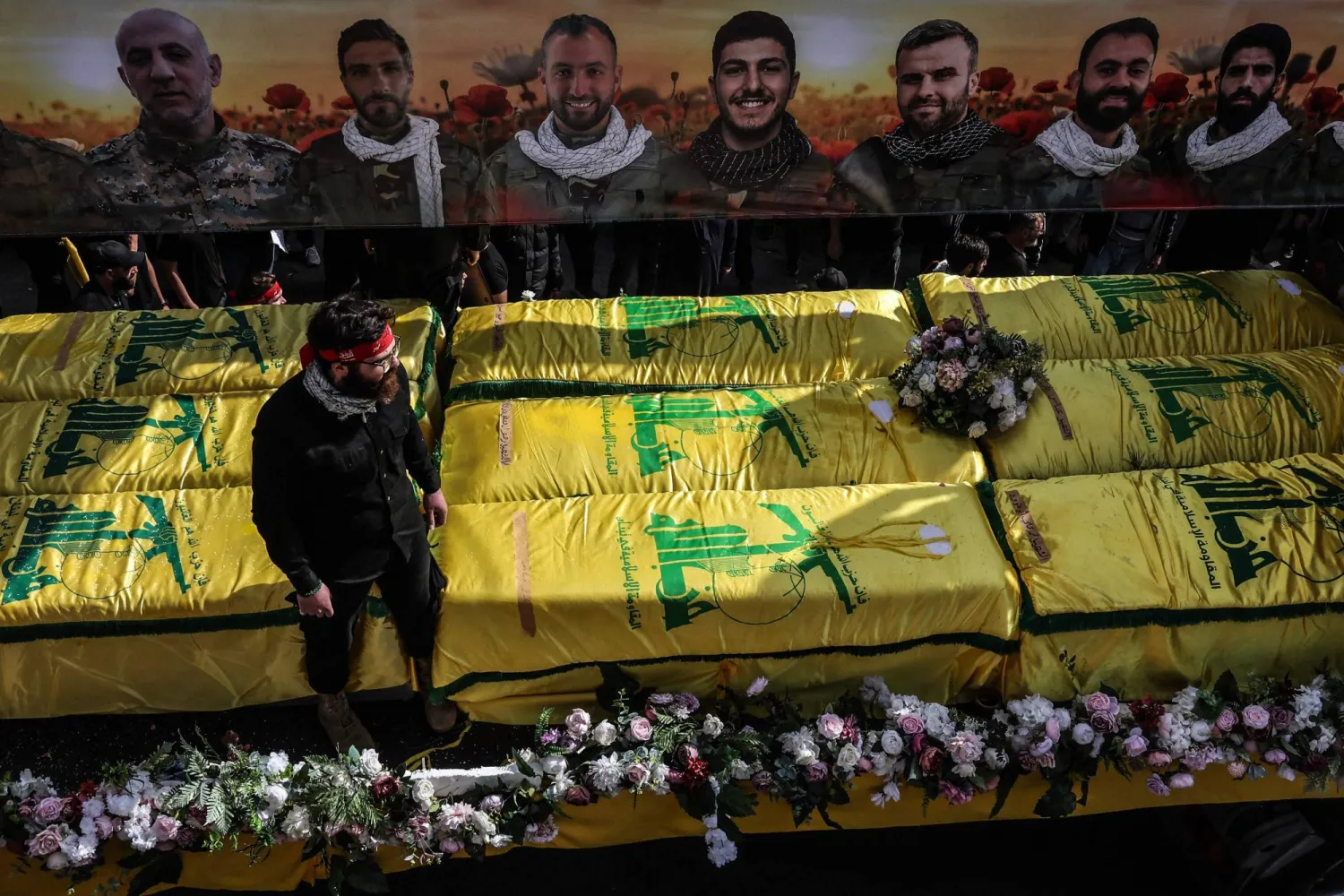
Coffins sit on a trailer beneath portraits of Hezbollah fighters killed before a 10-day ceasefire was agreed between the Iran-backed militant group and Israel during a mass funeral procession in the southern village of Kfar Sir on April 21, 2026. (AFP)
TT

German Court Jails Hezbollah Supporter Over Videos Showing Weapons

Coffins sit on a trailer beneath portraits of Hezbollah fighters killed before a 10-day ceasefire was agreed between the Iran-backed militant group and Israel during a mass funeral procession in the southern village of Kfar Sir on April 21, 2026. (AFP)

A German court on Friday sentenced a supporter of Lebanon's Hezbollah party to more than three years in jail Friday over for "illegal access to weapons" and social media posts supporting the group.

Earlier in the same trial the 30-year-old was acquitted on charges of actually fighting for Hezbollah and being a member of the group.

The court in Berlin gave him a sentence of three years and nine months over social media posts he made with videos taken during a trip to Lebanon in 2023.

In the videos he was seen handling rifles and anti-tank missiles and taking part in shooting practice.

The court found he also spread propaganda videos and displayed Hezbollah symbols, such as flags and scarves.

However, the court said that the videos in question showed that the accused had had no training in dealing with the weapons and that he had acted in a "partly amateurish" fashion.

His earlier claims to have fought with the group were made up in order to impress his friends, the court found.

Hezbollah's military wing is classed as a terrorist organization by the United States, the European Union and Britain.

Germany considers Hezbollah a "Shiite terrorist organization" and in 2020 banned Hezbollah from carrying out activities on its soil.



Merz Floats Sanctions Relief for Iran Peace Deal, Other EU Leaders Cautious

 Germany's Chancellor Friedrich Merz speaks during a press conference after taking part in an informal meeting of the European Council in Nicosia on April 24, 2026. (AFP)
Germany's Chancellor Friedrich Merz speaks during a press conference after taking part in an informal meeting of the European Council in Nicosia on April 24, 2026. (AFP)
TT

Merz Floats Sanctions Relief for Iran Peace Deal, Other EU Leaders Cautious

 Germany's Chancellor Friedrich Merz speaks during a press conference after taking part in an informal meeting of the European Council in Nicosia on April 24, 2026. (AFP)
Germany's Chancellor Friedrich Merz speaks during a press conference after taking part in an informal meeting of the European Council in Nicosia on April 24, 2026. (AFP)

German Chancellor Friedrich Merz suggested on Friday that the European Union could ease sanctions on Tehran as part of a comprehensive deal that would end the Iran war, but other EU leaders struck a more cautious note.

The 27-nation EU has imposed sanctions on Iran for years, including travel bans and asset freezes for senior officials and entities, in response to human rights violations, nuclear activities and military support for Russia.

US officials have suggested a ‌comprehensive deal covering Iran's ‌nuclear and missile programs and the ‌re-opening ⁠of the Strait of ⁠Hormuz could bring a lasting end to the US-Israeli war with Tehran, beyond the current ceasefire.

After an EU summit in Cyprus, Merz said the bloc could gradually ease sanctions on Iran in the event that a comprehensive agreement was reached.

European leaders have been largely sidelined in the current Middle ⁠East conflict but some European officials see ‌the bloc's sanctions as a possible ‌way for the EU to be involved in a diplomatic solution.

"The ‌easing of sanctions can be part of a process," ‌Merz told reporters after the Nicosia summit.

"No one has objected to that," he said of the summit deliberations. "It is, so to speak, part of the contribution we can make to advance this ‌process and, hopefully, lead to a permanent ceasefire."

But European Council President Antonio Costa, the chair ⁠of the summit, ⁠told a press conference after the end of the meeting: "It is too early to talk about relieving any kind of sanctions."

European Commission President Ursula von der Leyen said sanctions relief could only come after clear evidence of fundamental changes of course from Iran.

"We believe that sanctions relief should be conditional on verification of de-escalation, particularly on progress on the international effort to contain its nuclear threat, and on a change to the repression of its own people," she told the same press conference.


Key Go-Between Switzerland to Reopen Embassy in Iran

 Milad telecommunication tower is seen at left in a general view of a part of Tehran, Iran, Thursday, April 23, 2026. (AP)
Milad telecommunication tower is seen at left in a general view of a part of Tehran, Iran, Thursday, April 23, 2026. (AP)
TT

Key Go-Between Switzerland to Reopen Embassy in Iran

 Milad telecommunication tower is seen at left in a general view of a part of Tehran, Iran, Thursday, April 23, 2026. (AP)
Milad telecommunication tower is seen at left in a general view of a part of Tehran, Iran, Thursday, April 23, 2026. (AP)

Switzerland said Friday it had begun sending staff back to Tehran and would gradually reopen its embassy, enabling it to continue as a facilitator for diplomatic contacts between Washington and Tehran.

For decades, neutral Switzerland has played a central role in maintaining basic diplomatic contacts between Iran and the United States.

But the country temporarily closed its embassy on March 11 days after the Middle East war erupted with the first US-Israeli attacks on Iran.

The Swiss foreign ministry said four staff had returned and insisted the channel of communication between the US and Iran had been kept open even while the mission was shut.

"The decision to gradually reopen the embassy was taken after a risk analysis and in consultation with Iran and the United States, whose interests Switzerland represents under its protecting power mandate," the foreign ministry said in a statement.

Switzerland "is prepared to provide its good offices if the parties so wish and supports all diplomatic initiatives that contribute to de-escalation and a lasting peace".

Switzerland has represented US interests in Iran since Washington broke off relations with Middle Eastern country after the 1980 hostage crisis, which came a year after the Iranian revolution.

The Swiss embassy in Tehran handles all consular affairs between the United States and Iran, including passport requests, altering civil status and consular protection for US citizens in Iran.

Under the protecting power mandate, "Switzerland can either offer to act as a go-between on its own initiative or can fulfil this function at the request of the parties concerned, provided that all those involved agree", the foreign ministry says on its website.

A ceasefire has been in place since April 8 but prospective peace talks between senior US and Iranian envoys Pakistan are hanging in the balance.

Iran has all but closed the Strait of Hormuz in retaliation for the war, while the US has imposed a blockade of its own on Iranian ports.


Trump Dispatches Witkoff and Kushner to Pakistan for New Talks with Iran’s Foreign Minister

Pakistani soldiers stand guard on a street leading to the Red Zone area after tightened security measures ahead of the expected US-Iran peace talks in Islamabad on April 24, 2026. (AFP)
TT

Trump Dispatches Witkoff and Kushner to Pakistan for New Talks with Iran’s Foreign Minister

Pakistani soldiers stand guard on a street leading to the Red Zone area after tightened security measures ahead of the expected US-Iran peace talks in Islamabad on April 24, 2026. (AFP)

President Donald Trump is sending his envoys Steve Witkoff and Jared Kushner to Pakistan, the White House said Friday, just hours after Iran’s top diplomat headed to the South Asian nation where officials have been trying to get the United States and Iran to convene for a second round of ceasefire negotiations. 

The trip comes as much of the world is on edge over a war that has snarled crucial energy exports through the Strait of Hormuz, clouded the global economic picture and left thousands dead across the Middle East. 

White House press secretary Karoline Leavitt said in an interview on Fox News Channel that the two will have talks with Iranian Foreign Minister Abbas Araghchi on Saturday. 

“We’re hopeful that it will be a productive conversation and hopefully move the ball forward to a deal,” Leavitt said. 

She said Vice President JD Vance would not be traveling but that he remains “deeply involved.” She said he will be in the US, along with Secretary of State Marco Rubio and the president’s national security team, on “standby” to fly to Pakistan “if necessary.” 

Earlier Friday, Araghchi wrote on X that he was on his way to Pakistan, Oman and Russia on a trip focused on “bilateral matters and regional developments.” 

Islamabad has sought to reinject momentum into the negotiations between Iran and the United States, which did not resume this week as had been expected. 

Trump extends the Jones Act waiver for 90 days  

Separately Friday, the White House said President Donald Trump issued a 90-day extension to the Jones Act waiver, making it easier for non-American vessels to transport oil and natural gas. 

Trump first announced a 60-day waiver in March in a move intended to stabilize energy prices and ease oil and gas shipments to the US following the effective closure of the Strait of Hormuz. 

“New data compiled since the initial waiver was issued revealed that significantly more supply was able to reach US ports faster,” the White House post on social media said. 

The price of Brent crude oil, the international standard, retreated on the news, vacillating between $103 a barrel and more than $107 — still early 50% higher than where it was on Feb. 28, when the Iran war began. 

The squeeze on shipments through the strait has rippled through global maritime trade flows, including through the Panama Canal nearly halfway around the world. 

Pakistan forges ahead with diplomatic efforts  

Pakistan has been trying to get US and Iranian officials back to the table after Trump this week announced an indefinite extension of the ceasefire with Iran, honoring Islamabad's request for more time for diplomatic outreach. 

That hasn’t lowered tensions in the strait, a strategic waterway through which a fifth of the world’s oil and natural gas is shipped during peacetime. 

Iran has kept its stranglehold on traffic through the strait, attacking three ships earlier this week, while the US is maintaining a blockade on Iranian ports and Trump has ordered the military to “shoot and kill” small boats that could be placing mines. 

“Iran has an important choice, a chance to make a deal, a good deal, a wise deal,” US Defense Secretary Pete Hegseth told reporters on Friday. He said a second US aircraft carrier will join the blockade in a few days. 

Washington already has three aircraft carriers in the region; the USS George H.W. Bush in the Indian Ocean; the USS Abraham Lincoln in the Arabian Sea; and the USS Gerald R. Ford in the Red Sea. 

It is the first time since 2003 that three American carriers have been operating in the region simultaneously. The force includes 200 aircraft and 15,000 sailors and Marines, US Central Command said. 

A growing toll even as ceasefires hold  

Since the war began, at least 3,375 people have been killed in Iran, and more than 2,490 people in Lebanon, where new fighting between Israel and the Iran-backed Hezbollah group broke out two days after the war started, according to authorities. 

Additionally, 23 people have died in Israel and more than a dozen in Gulf Arab states. Fifteen Israeli soldiers in Lebanon and 13 US service members throughout the region have been killed. 

The UN peacekeeping force in southern Lebanon has also sustained casualties. UNIFIL said Friday that an Indonesian peacekeeper died of wounds sustained in an attack on his base on March 29, raising to six — four Indonesians and two French — the number of force members killed since the war erupted. 

Tensions linger in Lebanon despite extended truce 

The situation in Lebanon remained tense a day after Trump announced Israel and Lebanon had agreed to extend a ceasefire between Israel and Hezbollah by three weeks. Hezbollah has not participated in the diplomacy brokered by Washington. 

Israeli Prime Minister Benjamin Netanyahu, in a video statement released by his office on Friday, hailed “a process to achieve a historic peace between Israel and Lebanon.” 

Earlier, the Israeli army asked residents of the southern Lebanese village of Deir Aames to evacuate, saying Hezbollah was using the village to launch attacks against Israel. 

Israel's military said it downed a drone over Lebanon following the launch of a small surface-to-air missile by Hezbollah. The group, meanwhile, said it shot down an Israeli drone with a surface-to-air missile over the outskirts of the southern port city of Tyre.