

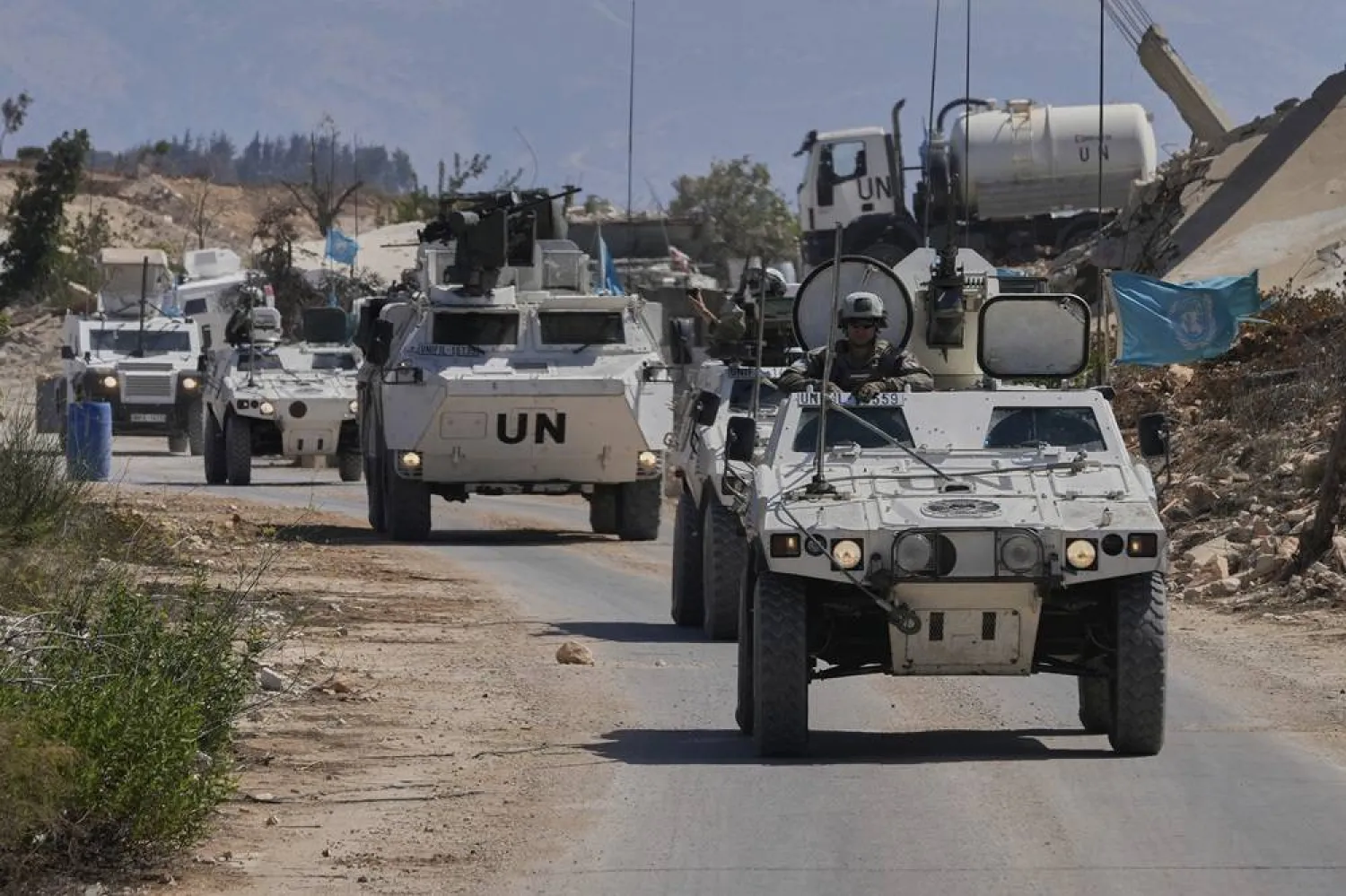

UN Security Council to Vote on Ending Peacekeeping Mission in Lebanon on Dec. 31, 2026

 French UN peacekeepers patrol the Lebanese-Israeli border in the village of Houla, southern Lebanon, Wednesday, Aug. 20, 2025. (AP)
French UN peacekeepers patrol the Lebanese-Israeli border in the village of Houla, southern Lebanon, Wednesday, Aug. 20, 2025. (AP)
TT

UN Security Council to Vote on Ending Peacekeeping Mission in Lebanon on Dec. 31, 2026

 French UN peacekeepers patrol the Lebanese-Israeli border in the village of Houla, southern Lebanon, Wednesday, Aug. 20, 2025. (AP)
French UN peacekeepers patrol the Lebanese-Israeli border in the village of Houla, southern Lebanon, Wednesday, Aug. 20, 2025. (AP)

The Security Council scheduled a vote Thursday on a resolution that would end the more than four-decade operation of the UN peacekeeping force in southern Lebanon on Dec. 31, 2026.

Two council diplomats said late Wednesday that the United States, which had been demanding that the force known as UNIFIL be terminated in a year, did not object to a French draft resolution with that end date in 16 months.

That signaled the resolution would be approved, but it was not clear whether the United States would vote in favor or abstain, the diplomats said, speaking on condition of anonymity because negotiations have been private, the Associated Press reported.

UNIFIL was created to oversee the withdrawal of Israeli troops from southern Lebanon after Israel’s 1978 invasion. Its mission was expanded following the monthlong 2006 war between Israel and the militant group Hezbollah.

The resolution would terminate UNIFIL’s mandate and halt its operations at the end of 2026. The process of withdrawing its 10,800 military and civilian personnel and equipment would start immediately in consultation with the Lebanese government, to be completed within a year.

The draft says the aim is to make the Lebanese government “the sole provider of security" in southern Lebanon north of the UN-drawn border with Israel known as the Blue Line. It calls on Israel to withdraw its forces from north of the Blue Line.

The multinational force has played a significant role in monitoring the security situation in southern Lebanon for decades, including during the Israel-Hezbollah war last year, but has drawn criticism from both sides and numerous US lawmakers, some of whom now hold prominent roles in President Donald Trump’s administration or wield new influence with the White House.

Trump administration political appointees came into office wanting to shut down UNIFIL as soon as possible and have secured major cuts in US funding for the force.

They regard the operation as a waste of money that is merely delaying the goal of eliminating Hezbollah’s influence and restoring full security control to the Lebanese armed forces. The government says its forces are not yet capable of assuming full control.

European nations, notably France and Italy, objected to winding down UNIFIL too quickly. They argued that ending the peacekeeping mission before the Lebanese army was able to fully secure the border area would create a vacuum that Hezbollah could easily exploit.

During the one-year withdrawal period, the draft resolution says UNIFIL is authorized to provide security and assistance to UN personnel, “to maintain situational awareness in the vicinity of UNIFIL locations,” and to contribute to the protection of civilians and safe delivery of humanitarian aid “within the limits of its capacities.”

The draft urges the international community “to intensify its support, including equipment, material and finance” to the Lebanese armed forces.



Yemen's Al-Alimi Urges Limiting Possession of Weapons to State to Focus on Confronting Houthis

Chairman of Yemen's Presidential Leadership Council (PLC) Dr. Rashad al-Alimi. (Saba)
TT

Yemen's Al-Alimi Urges Limiting Possession of Weapons to State to Focus on Confronting Houthis

Chairman of Yemen's Presidential Leadership Council (PLC) Dr. Rashad al-Alimi. (Saba)

Chairman of Yemen's Presidential Leadership Council (PLC) Dr. Rashad al-Alimi said on Sunday that his country has entered a new decisive phase in restoring state institutions and ending armed coups.

The process of handing over military camps in Hadhramaut and al-Mahra governorates to legitimate authorities is a step towards imposing state monopoly over weapons, he added.

He made his remarks during a meeting in Riyadh with British Ambassador to Yemen is Abda Sharif.

The formation of a supreme military council will help unify all armed forces and military and security formations under the defense and interior ministries, al-Alimi went on to say.

The formation of the committee sends a message that the state has not veered off its national priorities and that the process to hand over military camps was the right call in protecting the internal front, he stressed.

The move aims to protect the internal front and focus state efforts in confronting the Iran-backed Houthi coup either through peaceful means or war, he added.

He discussed with Sharif the latest local developments and efforts to restore order in the liberated governorates.

He hailed the positive role the UK has played in supporting Yemen's unity and legitimate authorities, as well as peace and humanitarian efforts.

Moreover, al-Alimi described as "brave" the Southern Transitional Council's decision to dissolve itself.

It marked a "pivotal moment that reflects a realization of the sensitivity of the current phase and the danger of sliding into internal conflicts that would weaken the internal front against the confrontation against the real threat," he said.

The next phase demands that all national, civilian and military forces align with the state and legitimate authorities and the rule of law, he demanded.

Al-Alimi also highlighted Saudi Arabia's central role in easing the escalation and sponsoring intra-southern Yemen dialogue. This is an extension of its economic and humanitarian support to Yemen.


Israel Army Issues Evacuation Warning for Lebanon Village ahead of Strikes

 Smoke rises after Israeli strikes following Israeli military's evacuation orders, in Chehour, southern Lebanon November 19, 2025. REUTERS/Ali Hankir
Smoke rises after Israeli strikes following Israeli military's evacuation orders, in Chehour, southern Lebanon November 19, 2025. REUTERS/Ali Hankir
TT

Israel Army Issues Evacuation Warning for Lebanon Village ahead of Strikes

 Smoke rises after Israeli strikes following Israeli military's evacuation orders, in Chehour, southern Lebanon November 19, 2025. REUTERS/Ali Hankir
Smoke rises after Israeli strikes following Israeli military's evacuation orders, in Chehour, southern Lebanon November 19, 2025. REUTERS/Ali Hankir

The Israeli army issued an evacuation warning on Sunday for the village of Kafr Hatta in southern Lebanon ahead of air strikes on Hezbollah targets in the area, AFP reported.

"The Israeli (army) will soon, and once again, strike terrorist Hezbollah military infrastructure in the village, in order to address the prohibited attempts it is making to rebuild its activities there," Arabic-language spokesman Colonel Avichay Adraee wrote on X, posting a map of the expected target.

The Lebanese army said Thursday that it had completed disarming Hezbollah south of the Litani river, the first phase of a nationwide plan. Kafr Hatta is located north of the river.


Sudan PM Announces Govt Return to Khartoum from Wartime Capital

File Photo: Some shops reopen despite extensive damage (Asharq Al-Awsat)
TT

Sudan PM Announces Govt Return to Khartoum from Wartime Capital

File Photo: Some shops reopen despite extensive damage (Asharq Al-Awsat)

Sudan's Prime Minister Kamil Idris announced on Sunday the government's return to Khartoum, after nearly three years of operating from wartime capital of Port Sudan, AFP reported.

"Today, we return, and the Government of Hope returns to the national capital," Idris told reporters in Khartoum, ravaged by the war between the army and the Rapid Support Forces.

"We promise you better services, better healthcare and the reconstruction of hospitals, the development of educational services... and to improve electricity, water and sanitation services," he said.