


New Wave: Sea Power Turned into Energy at Los Angeles Port

Supporters of the technology say wave energy is an endlessly renewable and always reliable source of power. Patrick T. Fallon / AFP
TT

New Wave: Sea Power Turned into Energy at Los Angeles Port

Supporters of the technology say wave energy is an endlessly renewable and always reliable source of power. Patrick T. Fallon / AFP

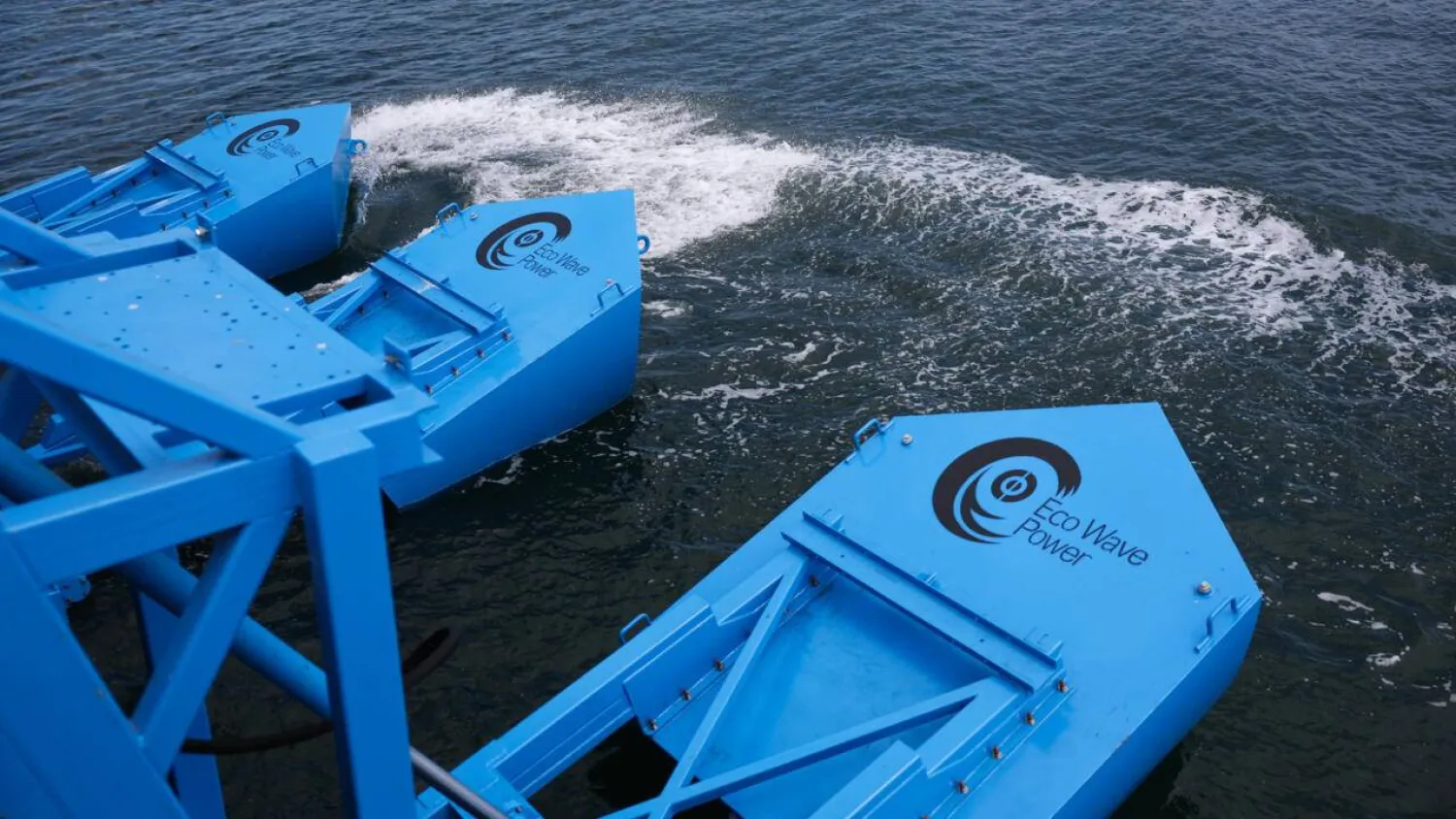
Floating blue paddles dance on the waves that lap a dock in the Port of Los Angeles, silently converting the power of the sea into useable electricity.

This innovative installation may hold one of the keys to accelerating a transition away from fossil fuels that scientists say is necessary if the world is to avoid the worst effects of climate change.

"The project is very simple and easy," Inna Braverman, co-founder of Israeli start-up Eco Wave Power, told AFP.

Looking a little like piano keys, the floaters rise and fall with each wave.

They are connected to hydraulic pistons that push a biodegradable fluid through pipes to a container filled with accumulators, which resemble large red scuba tanks.

When the pressure is released, it spins a turbine that generates electrical current.

If this pilot project convinces the California authorities, Braverman hopes to cover the entire 13-kilometer (eight-mile) breakwater protecting the port with hundreds of floaters that together would produce enough electricity to power 60,000 US homes.

Supporters of the technology say wave energy is an endlessly renewable and always reliable source of power.

Unlike solar power, which produces nothing at night, or wind power, which depends on the weather, the sea is always in motion.

And there is a lot of it.

- Tough tech -

The waves off the American West Coast could theoretically power 130 million homes -- or supply around a third of the electricity used every year in the United States, according to the US Department of Energy.

However wave energy remains the poor relation of other, better-known renewables, and has not been successfully commercialized at a large-enough scale.

The history of the sector is full of company shipwrecks and projects sunk by the brutality of the high seas. Developing devices robust enough to withstand the fury of the waves, while transmitting electricity via underwater cables to the shore, has proven to be an impossible task so far.

"Ninety-nine percent of competitors chose to install in the middle of the ocean, where it's super expensive, where it's breaking down all the time, so they can't really make projects work," Braverman said.

With her retractable dock-mounted device, the entrepreneur believes she has found the answer.

"When the waves are too high for the system to handle, the floaters just rise to the upward position until the storm passes, so you have no damage."

The design appeals to Krish Thiagarajan Sharman, a professor of mechanical engineering at the University of Massachusetts Amherst.

"The Achilles heel of wave energy is in the costs of maintenance and inspection," he told AFP.

"So having a device close to shore, where you can walk on a breakwater and then inspect the device, makes a lot of sense."

Sharman, who is not affiliated with the project and whose laboratory is testing various wave energy equipment, said projects tend to be suited to smaller-scale demands, like powering remote islands.

"This eight-mile breakwater, that's not a common thing. It's a rare opportunity, a rare location where such a long wavefront is available for producing power," he said.

- AI power demand -

Braverman's Eco Wave Power is already thinking ahead, having identified dozens more sites in the United States that could be suitable for similar projects.

The project predates Donald Trump's administration, but even before the political environment in Washington turned against renewables, the company was already looking beyond the US.

In Israel, up to 100 homes in the port of Jaffa have been powered by waves since December.

By 2026, 1,000 homes in Porto, Portugal should be online, with installations also planned in Taiwan and India.

Braverman dreams of 20-megawatt projects, a critical capacity needed to offer electricity at rates that can compete with wind power.

And, she said, the installations will not harm the local wildlife.

"There's zero environmental impact. We connect to existent man-made structures, which already disturb the environment."

Promises like this resonate in California, where the Energy Commission highlighted in a recent report the potential of wave energy to help the state achieve carbon neutrality by 2045.

"The amount of energy that we're consuming is only increasing with the age of AI and data centers," said Jenny Krusoe, founder of AltaSea, an organization that helped fund the project.

"So the faster we can move this technology and have it down the coastline, the better for California."



Benefit of Taking Magnesium Does Not Get Enough Attention

Nutrition experts recommended trying to get more of magnesium in our diet from food first (Harvard University)
TT

Benefit of Taking Magnesium Does Not Get Enough Attention

Nutrition experts recommended trying to get more of magnesium in our diet from food first (Harvard University)

Nutrition experts revealed that magnesium is often not given the same attention as other vitamins and minerals, although it plays a pivotal role in supporting the overall health of our body, especially improving blood sugar management and supporting neuro-psychological balance.

According to the US National Institutes of Health (NIH), magnesium is an abundant mineral in our body and it’s naturally present in many foods.

The mineral is required in more than 300 different reactions in our body, including those that regulate muscle and nerve function, blood sugar levels, and blood pressure.

“Magnesium plays a role in how our body handles sugar,” Scott Keatley, RD, co-owner of Keatley Medical Nutrition Therapy told Prevention magazine.

“It helps with the action of insulin, the hormone that controls blood sugar levels.” When you have enough magnesium in your body, insulin can work better and your body can manage blood sugar more effectively, Keatley said.

Also, stress can cause our body to use more magnesium than usual, which can limit our body’s ability to do other tasks with the nutrient, Keatley said.

“In addition, magnesium can help reduce the release of stress hormones like cortisol,” he said. “It’s like a natural chill pill that can help keep our body’s stress response in check.”

Magnesium helps regulate brain function and mood. It plays a role in releasing and using neurotransmitters, which are chemicals in our brain that affect our mood and emotions.

The mineral may help improve bone density and decrease fracture risk.
“Magnesium is stored in bones and is an important part of bone health,” said Deborah Cohen, DCN, an associate professor in the department of clinical and preventive nutrition sciences at Rutgers University School of Health Professions.

At baseline, magnesium can help to relax and widen your blood vessels, Keatley said. “This makes it easier for blood to flow and can help lower blood pressure,” he added. “It’s like making the highways wider so that traffic can move more smoothly.”

A 2025 review in hypertension found that magnesium seems to be beneficial for lowering blood pressure in people with high blood pressure and magnesium deficiency, but larger studies are needed.

There are a lot of foods that are high in magnesium. Nutrition experts recommended trying to get more of the nutrient in our diet from food first.

These are the most magnesium-rich foods, according to the NIH are: Pumpkin seeds, Chia seeds, almonds, spinach, cashews, peanuts, shredded wheat, soymilk, black beans, edamame, peanut butter, potato with skin, brown rice and plain yogurt.


SpaceX Prioritizes Lunar 'Self-growing City' over Mars Project

FILE - A SpaceX logo is displayed on a building, May 26, 2020, at the Kennedy Space Center in Cape Canaveral, Fla. (AP Photo/David J. Phillip, File)
TT

SpaceX Prioritizes Lunar 'Self-growing City' over Mars Project

FILE - A SpaceX logo is displayed on a building, May 26, 2020, at the Kennedy Space Center in Cape Canaveral, Fla. (AP Photo/David J. Phillip, File)

Elon Musk said on Sunday that SpaceX has shifted its focus to building a "self-growing city" on the moon, which could be achieved in less than 10 years.

SpaceX still intends to start on Musk's long-held ambition of a city on Mars within five to seven years, he wrote on his X social media platform, "but the overriding priority is securing the future of civilization and the Moon is faster."

Musk's comments echo a Wall Street Journal report on Friday, stating that SpaceX has told investors it would prioritize going to the moon and attempt a trip to Mars ⁠at a later time, targeting March 2027 for an uncrewed lunar landing.

As recently as last year, Musk said that he aimed to send an uncrewed mission to Mars by the end of 2026.

The US faces intense competition from China in the race to return humans to the moon this decade. Humans have not visited the lunar surface since the Apollo 17 mission in 1972. Less than a week ago, Musk announced that SpaceX ⁠acquired the artificial intelligence company he also leads, xAI, in a deal that values the rocket and satellite company at $1 trillion and the artificial intelligence outfit at $250 billion.

Proponents of the move view it as a way for SpaceX to bolster its plans for space-based data centers, which Musk sees as more energy efficient than terrestrial facilities as the demand for compute power soars with AI development.

SpaceX is hoping a public offering later this year could raise as much as $50 billion, which could make it the largest public offering in history.

On Monday, Musk said in response to a user on X that NASA will constitute less than 5% of SpaceX's revenue this year. SpaceX is ⁠a core contractor in NASA's Artemis moon program with a $4 billion contract to land astronauts on the lunar surface using Starship.

"Vast majority of SpaceX revenue is the commercial Starlink system," Musk added.

Earlier on Sunday, Musk shared the company's first Super Bowl ad, promoting its Starlink Wi-Fi service.

Even as Musk reorients SpaceX, he is also pushing his publicly traded company, Tesla, in a new direction.

After virtually building the global electric vehicles market, Tesla is now planning to spend $20 billion this year as part of an effort to pivot to autonomous driving and robots.

To speed up the shift, Musk said last month Tesla is ending production of two car models at its California factory to make room for manufacturing its Optimus humanoid robots.


Saudi Arabia Participates in Drafting the International AI Safety Report 2026

General view of Riyadh, Saudi Arabia. (SPA)
TT

Saudi Arabia Participates in Drafting the International AI Safety Report 2026

General view of Riyadh, Saudi Arabia. (SPA)

The Kingdom of Saudi Arabia, represented by the Saudi Data and Artificial Intelligence Authority (SDAIA), participated for the second consecutive year in the preparation of the International AI Safety Report 2026, reinforcing its international efforts to advance AI safety and support responsible innovation worldwide, the Saudi Press Agency said on Monday.

The report, emerging from the 2023 AI Safety Summit at Bletchley Park, provides a scientific assessment of advances in advanced AI systems, examines associated risks, and outlines practical approaches to strengthening safety standards and global governance, serving as a key reference for policymakers, regulators, and researchers.

The report is a comprehensive global document assessing AI risks and related challenges and serves as a trusted scientific reference to support regulatory policies and the development of governance frameworks for the safe and responsible use of advanced technologies.

The report was developed by a distinguished group of international scientists and experts in AI safety and technology governance, featuring specialists from prestigious universities and research centers, as well as representatives from over 30 countries and major international organizations, including the United Nations, the Organization for Economic Co-operation and Development, and the European Union.

The report highlights several key messages, notably the importance of keeping pace with the rapidly growing capabilities of AI through advanced regulatory and scientific frameworks, the need to invest in safety and technical compliance research to ensure systems remain under effective human oversight, and the promotion of international coordination to establish common standards supporting the safe and responsible use of advanced technologies.

It also emphasizes the need to consider economic and social dimensions to ensure the fair distribution of AI benefits and reduce inequality gaps.

Saudi Arabia’s participation in this international effort aligns with the objectives of Saudi Vision 2030, which aims to establish the Kingdom as a global hub for technological innovation while upholding the highest standards of responsibility and technical security.

It reflects the Kingdom’s commitment to actively shaping the global future of AI, promoting sustainable development, safeguarding community security, and enhancing international cooperation toward a safer, more stable technological future.