

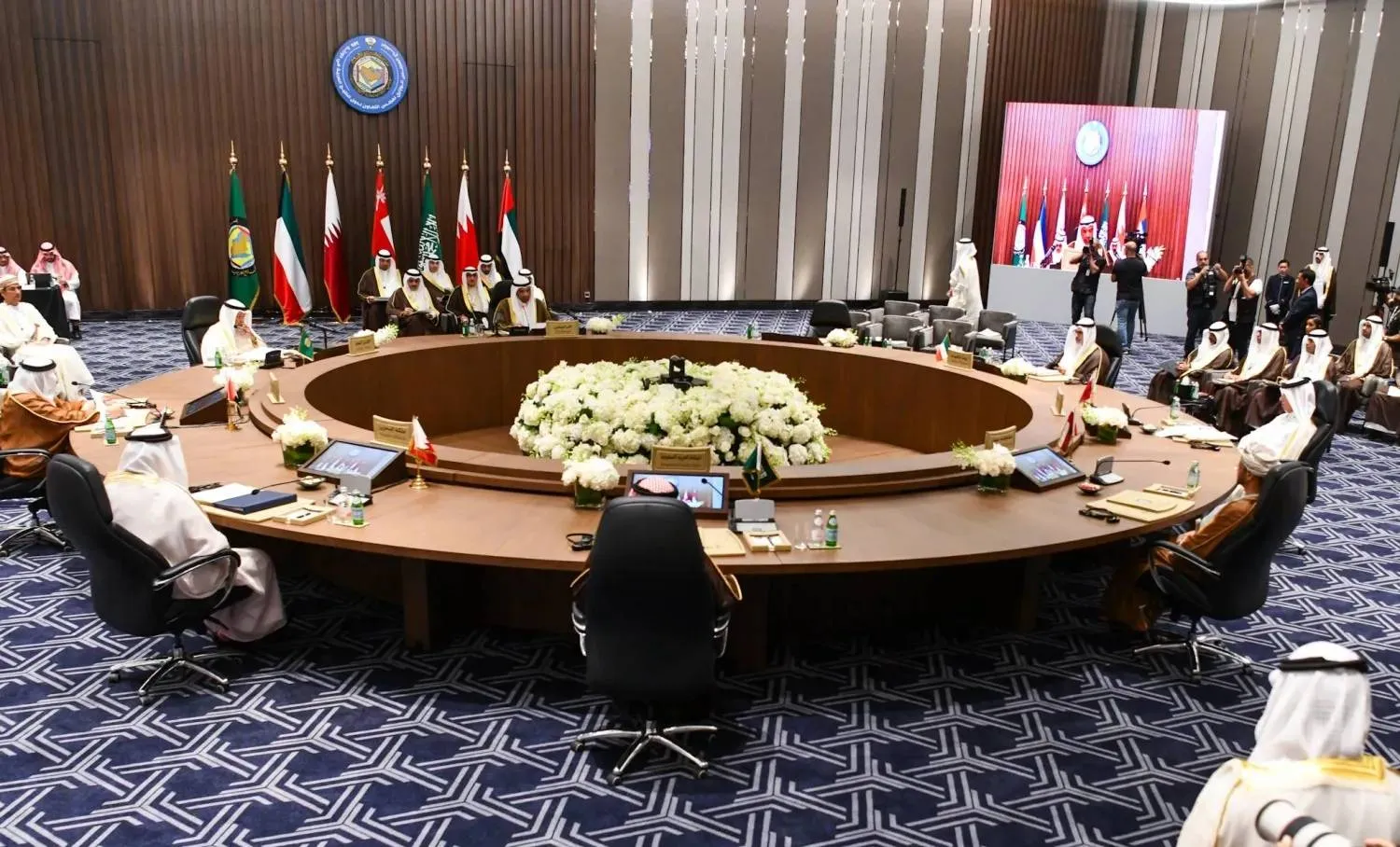

GCC Countries Demand Immediate Gaza Ceasefire, Underscore Two-State Solution

Officials are seen at the Ministerial Council of the Gulf Cooperation Council (GCC) in Kuwait on Monday. (KUNA)
TT

GCC Countries Demand Immediate Gaza Ceasefire, Underscore Two-State Solution

Officials are seen at the Ministerial Council of the Gulf Cooperation Council (GCC) in Kuwait on Monday. (KUNA)

The Ministerial Council of the Gulf Cooperation Council (GCC) called on Monday for an immediate and permanent ceasefire in Gaza, stressing the need to protect civilians and ensure the unimpeded delivery of humanitarian aid.

Holding its 165th meeting in Kuwait, the council condemned Israel’s crimes against the Palestinians and its siege on Gaza, while hailing the mediation efforts led by Qatar, Egypt and the United States.

The council strongly condemned “the crime of genocide committed by the Israeli forces against the people of the Gaza Strip, as well as the deliberate siege policy that has led to famine in Gaza.”

It also condemned “the policies of ethnic cleansing, collective punishment, the killing of civilians and journalists, torture, field executions, forced disappearance and displacement, and looting.”

It denounced “the continued destruction of residential areas, hospitals, schools, universities, mosques, churches, and infrastructure, which aims to displace the Gaza’s inhabitants and resettle it.”

It demanded that the international community take immediate action to stop these crimes committed by the Israeli government and take serious steps to prevent them and hold perpetrators accountable.

The council reiterated “its consistent positions and previous decisions on the centrality of the Palestinian cause, emphasizing the need to end the Israeli occupation and establish an independent Palestinian state on the 1967 borders with East Jerusalem as its capital, in accordance with the Arab Peace Initiative and international resolutions.”

The council praised the success of the high-level international conference on settling the Palestinian issue through peaceful solutions and implementing the two-state solution.

The conference, co-chaired by Saudi Arabia and France, was held from July 28-30 at the United Nations headquarters. It stressed support for all efforts aimed at ending the war in the Gaza Strip and achieving a just and sustainable settlement of the Palestinian issue through the two-state solution, unifying the Gaza Strip and the West Bank under the Palestinian Authority's umbrella, and ensuring stability and security for all countries in the region.

The council confirmed its support for the Global Coalition for the Implementation of the Two-State Solution and the efforts of Saudi Arabia and the participating countries in the conference to set a timeline for the establishment of an independent Palestinian state and the end of the Israeli occupation. It called on all countries that desire peace to join this initiative.

The council also commended the measures initiated by France, the United Kingdom, Portugal, Malta, Canada, Australia, New Zealand, and others to recognize the State of Palestine, which confirms the international community's consensus on the right of the Palestinian people to establish their independent state. The council called on all countries to promptly recognize the State of Palestine to help end the Israeli occupation and fulfill the legitimate rights of the brotherly Palestinian people.

Iraq

On Iraq, the ministerial council reaffirmed its consistent positions and previous decisions on the importance of regulating navigation in Khor Abdullah and Iraq's respect for the sovereignty of Kuwait and the integrity of its territories, islands, highlands, and all its maritime areas.

It also stressed the need to adhere to bilateral and international commitments, agreements, and all relevant UN resolutions, especially Security Council Resolution 833 concerning the demarcation of the land and maritime borders between Kuwait and Iraq.

The Council called for the completion of the maritime boundary demarcation between the two countries beyond maritime marker 162, in accordance with the rules and principles of international law and the 1982 United Nations Convention on the Law of the Sea.

Syria and Lebanon

Turning to Syria, the council welcomed the agreement reached to end the crisis in the Sweida governorate, stressing the need to protect the country’s unity and citizens. The council praised the commitment of Syrian President Ahmed al-Sharaa to hold all those responsible for abuses against Syrian citizens in Sweida accountable.

It also supported all efforts to establish security, state sovereignty, and the rule of law across all Syrian territories, while rejecting violence, sectarianism, and attempts to sow discord, incitement, and hatred.

The council also condemned the repeated Israeli violations against Syria and its blatant attacks against its sovereignty and stability. The council said these actions destabilize its security, unity, and territorial integrity, undermine the Syrian government's efforts to build a new Syria.

The council underlined its full support for the measures taken by the Syrian government to maintain security and stability and rejected any separatist calls aimed at dividing Syria.

On Lebanon, the council welcomed the announcement by Prime Minister Nawaf Salam of a cabinet decision to ensure that the possession of weapons is restricted to the state throughout the country, based on the Taif Accords and relevant international resolutions.

The council condemned the continued Israeli attacks on Lebanon, stressing the need to implement UN Security Council resolutions concerning Lebanon, especially Resolution 1701. It praised the mediation efforts of the United States in this regard and expressed its rejection of external statements and interference in the internal affairs of Lebanon.



Saudi Govt Rejects Any Attempts to Undermine Somalia’s Sovereignty

Custodian of the Two Holy Mosques King Salman bin Abdulaziz Al Saud chairs the Cabinet meeting in Riyadh. (SPA)
TT

Saudi Govt Rejects Any Attempts to Undermine Somalia’s Sovereignty

Custodian of the Two Holy Mosques King Salman bin Abdulaziz Al Saud chairs the Cabinet meeting in Riyadh. (SPA)

The Saudi government stressed on Tuesday the Kingdom’s rejection of any attempts “to create parallel entities that undermine Somalia's unity, territorial integrity, or national sovereignty.”

Custodian of the Two Holy Mosques King Salman bin Abdulaziz Al Saud chaired the Cabinet meeting that was held in Riyadh.

The Cabinet welcomed the outcomes of the Organization of Islamic Cooperation's extraordinary meeting on Somalia in Jeddah that stressed the Kingdom’s stance on Somalia.

The Cabinet reviewed recent high-level discussions between the Kingdom and various countries, focusing on regional developments, ongoing efforts to anchor security and peace, and the Kingdom's commitment to multilateral initiatives that drive global stability and foster collective responses to shared challenges.

The Cabinet reiterated the centrality of the Palestinian cause, stressing the Kingdom's unwavering support for a ceasefire in the Gaza Strip. These efforts aim to enable the Palestinian people to exercise their right to self-determination and to establish an independent state within the 1967 borders, with East Jerusalem as its capital.

The Cabinet commended the successful conclusion of the Gulf Shield 2026 joint military exercise, hosted by Saudi Arabia. Featuring the air and air defense forces of the Gulf Cooperation Council (GCC) and the GCC Unified Military Command, the exercise underscored the commitment to boosting regional defense cooperation and strengthening collective military readiness.

The Cabinet reviewed several high-profile economic events hosted by the Kingdom, specifically highlighting the Saudi-Japan Ministerial Investment Forum and the Saudi-Canadian Business and Investment Forum. The summits resulted in numerous memoranda of understanding across strategic sectors, including space, cybersecurity, ICT, manufacturing, education, finance, water, and agriculture.


Hadhramaut Figures: Saudi Arabia's Historic Stance Paves Way for New Phase of Stability

Sheikh Essam Al-Kathiri, Secretary-General of the Hadhramaut National Council. (Asharq Al-Awsat)
TT

Hadhramaut Figures: Saudi Arabia's Historic Stance Paves Way for New Phase of Stability

Sheikh Essam Al-Kathiri, Secretary-General of the Hadhramaut National Council. (Asharq Al-Awsat)

Several prominent figures from Yemen's Hadhramaut praised on Monday's Saudi Arabia's stance on the governorate that prevented it from sliding towards deeper unrest and instability.

The figures told Asharq Al-Awsat that the Kingdom's position was not limited to tackling the current crisis, but paves the way for a new phase of stability and development as parties prepare for a Riyadh conference on the southern issue.

The conference will mark a turning point in "rearranging" the political scene in the South, they remarked.

Hadhramaut is at a pivotal moment that demands united ranks that will come up with a unified vision that preserves the governorate's interests and allows it to play an effective role in any future political process, they added

Sheikh Essam Al-Kathiri, Secretary-General of the Hadhramaut National Council, told Asharq Al-Awsat that the Saudi Arabia's "historic" stance and determination over the December 3 developments prevented the governorate from slipping into chaos.

Hadhramaut may have escaped the crisis, but it has embarked on a new path towards progress and development, he stated.

The call for intra-south dialogue is a sign that a secure and stable future is on the horizon, he noted.

"We are already seeing these signs with Saudi Arabia's brotherly support," he remarked.

Another member of the council, Al-Hakam Abdullah al-Nahdi, told Asharq Al-Awsat that the support offered by Saudi Arabia, led by Custodian of the Two Holy Mosques King Salman bin Abdulaziz, Prince Mohammed bin Salman, Crown Prince and Prime Minister, and Defense Minister Prince Khalid bin Salman, will be "etched in Hadhramaut's memory and relayed to generations to come."

"Hadhramaut represents a natural strategic depth to the Kingdom and its security is indivisible from Saudi Arabia's," he added.

"Were it not for Saudi Arabia's stance, we would have been mired in chaos," he went on to say.

He said he was optimistic about the future as long as Saudi Arabia was by Hadhramaut's side, calling on the people to "seize this opportunity by rallying together and shunning division."


Somalia Cancels All UAE Deals

A meeting of the Somali government. (Somali National News Agency)
TT

Somalia Cancels All UAE Deals

A meeting of the Somali government. (Somali National News Agency)

Somalia's government said on Monday that it was annulling all agreements with the United Arab Emirates, including port deals and defense and ‌security cooperation, ‌citing ‌evidence ⁠the UAE had ‌undermined its national sovereignty. 

"The Council of Ministers has annulled all agreements concluded with the United Arab Emirates, ⁠including those involving federal governmental ‌institutions, affiliated entities, and ‍regional administrations ‍operating within the territory ‍of the Federal Republic of Somalia," a statement from Somalia's Council of Ministers said. 

"This decision applies to all agreements ⁠and partnerships relating to the ports of Berbera, Bosaso, and Kismayo ... (and) bilateral security and defense cooperation agreements," the statement added.