


Lebanese Army Completes Plan to Place Weapons Under State Control

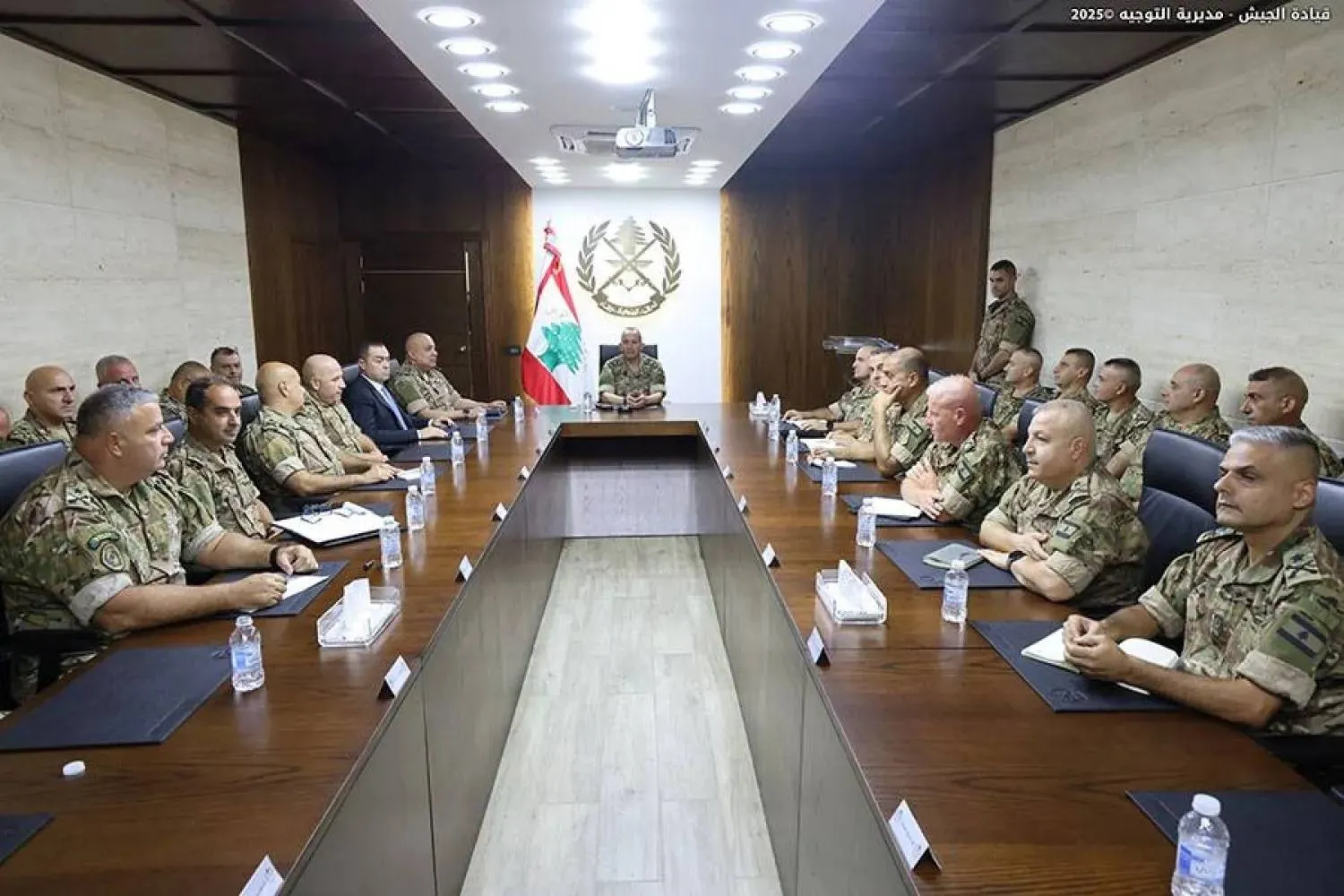
Army Commander General Rodolphe Haykal meets with senior staff, unit and battalion commanders, and a number of officers to discuss the exceptional phase in Lebanon (Army Command). 
TT

Lebanese Army Completes Plan to Place Weapons Under State Control

Army Commander General Rodolphe Haykal meets with senior staff, unit and battalion commanders, and a number of officers to discuss the exceptional phase in Lebanon (Army Command). 

The Lebanese Army has finalized a comprehensive plan, mandated by the Cabinet on August 5, to ensure that all weapons are brought under state authority by the end of this year. The strategy, completed more than two weeks ago, will be presented on Friday by Army Commander General Rodolphe Haykal.

The proposal has drawn significant domestic, regional, and international interest, and the army has kept its contents tightly guarded. However, sources told Asharq Al-Awsat that the plan is structured in stages, each with its own deadline. The Cabinet had explicitly requested that the disarmament process be completed by year’s end, but any delay in approving or launching the plan will inevitably affect the timeline.

Senior political sources did not rule out abandoning the deadlines altogether to ease “growing tensions within the Shiite community.” They suggested that Friday’s Cabinet session could mirror the standoffs of August 5 and 7, when ministers from the Shiite bloc refused to discuss the plan, citing continued Israeli attacks and occupation of Lebanese territory. In such a scenario, the ministers could withdraw, allowing the government to adopt the plan in their absence.

Designed for Implementation

According to the same sources, the army’s proposal assumes cooperation and coordination with Hezbollah to ensure smooth implementation, similar to arrangements south of the Litani River. This does not mean conceding to the status quo, they stressed; rather, the plan was drafted with the intention of being carried out, incorporating multiple scenarios to secure its success. It is built on the premise that Lebanon’s sole enemy is Israel.

Officials involved in the process acknowledge that the final word is political, not military. Without Israel’s engagement in the “step-for-step” approach outlined in the US proposal - whose objectives Lebanon has accepted - the plan risks remaining “ready but on hold” until Tel Aviv makes a reciprocal move.

Counting on US Mediation

Beirut continues to pin its hopes on US envoys Tom Barrack and Morgan Ortagus to secure concessions from Israel, which would make it easier to persuade Hezbollah to cooperate with the army’s plan.

Despite the hardline stance shown by the American delegation during its recent visit to Beirut, Barrack made notable comments afterward, saying he had urged Israeli Prime Minister Benjamin Netanyahu to give Lebanon “a chance, with some tolerance and understanding.”

Political Coordination

For now, direct coordination between the army and Hezbollah is limited to the area south of the Litani, where most operational tasks have already been completed. Hezbollah was not directly involved in drafting the plan, with the political leadership - particularly the presidency - handling this track, which has recently been reactivated.

At a special meeting with senior officers, Haykal acknowledged that the army is “entering a delicate phase, entrusted with sensitive missions,” and pledged to take the necessary steps to ensure success while preserving civil peace and domestic stability.

A Gradual Approach

Retired Brigadier General George Nader told Asharq Al-Awsat that the plan is designed for gradual implementation, beginning south of the Litani, as stipulated in the ceasefire resolution, and extending to all Lebanese territory. “Each phase comes with its own timetable, making the plan both geographically and temporally structured,” he explained.

Nader added that successful implementation requires Hezbollah’s prior approval to cooperate, along with intelligence data on weapons stockpiles, which would make the process “smooth and feasible.”



Israel Says US Gaza Executive Board Composition Against its Policy

FILE - A displacement camp sheltering Palestinians on a beach amid stormy weather is seen in Gaza City, Jan. 13, 2026. (AP Photo/Jehad Alshrafi, File)
TT

Israel Says US Gaza Executive Board Composition Against its Policy

FILE - A displacement camp sheltering Palestinians on a beach amid stormy weather is seen in Gaza City, Jan. 13, 2026. (AP Photo/Jehad Alshrafi, File)

Prime Minister Benjamin Netanyahu's office said on Saturday that this week's Trump administration announcement on the composition of a Gaza executive board was not coordinated with Israel and ran counter to government policy.

It said Foreign Minister Gideon Saar would raise the issue with US Secretary of State Marco Rubio.

The ⁠statement did not specify what part of the board's composition contradicted Israeli policy. An Israeli government spokesperson declined to comment.

The board, unveiled by the White House on Friday, includes Turkish Foreign Minister Hakan Fidan. Israel ⁠has repeatedly opposed any Turkish role in Gaza.

Other members of the executive board include Sigrid Kaag, the UN special coordinator for the Middle East peace process; an Israeli-Cypriot billionaire; and a minister from the United Arab Emirates.

Washington this week also announced the start of the second phase of President ⁠Donald Trump's plan, announced in September, to end the war in Gaza. This includes creating a transitional technocratic Palestinian administration in the enclave.

The first members of the so-called Board of Peace - to be chaired by Trump and tasked with supervising Gaza's temporary governance - were also named. Members include Rubio, billionaire developer Steve Witkoff and Trump's son-in-law Jared Kushner.


Sisi Says he Values Trump Offer to Mediate Egypt-Ethiopia Dispute on GERD

FILE PHOTO: US President Donald Trump points as he attends a meeting with oil industry executives, at the White House in Washington, D.C., US, January 9, 2026. REUTERS/Evelyn Hockstein/File Photo
TT

Sisi Says he Values Trump Offer to Mediate Egypt-Ethiopia Dispute on GERD

FILE PHOTO: US President Donald Trump points as he attends a meeting with oil industry executives, at the White House in Washington, D.C., US, January 9, 2026. REUTERS/Evelyn Hockstein/File Photo

Egyptian President Abdel Fattah al-Sisi said he valued an offer by US President Donald Trump to mediate ⁠a dispute over Nile River waters between Egypt and Ethiopia.

In a post on ⁠X, Sisi said on Saturday that he addressed Trump's letter by affirming Egypt's position and concerns about the country's water ⁠security in regards to Ethiopia's Grand Ethiopian Renaissance Dam (GERD).

"I am ready to restart US mediation between Egypt and Ethiopia to responsibly resolve the question of 'The Nile Water Sharing' once and for all," Trump wrote to Sisi in the letter that was also posted on Trump’s Truth Social account.

Addis Ababa's September 9 inauguration of GERD has been a source of anger ⁠in Cairo, which is downstream on the Nile.

Ethiopia sees the $5 billion dam on a tributary of the Nile as central to its economic ambitions.

Egypt says the dam violates international treaties and could cause both droughts ⁠and flooding.

Sudan, another ​downstream country, has expressed concern about the regulation and safety of ⁠its own water supplies and dams.

Sudan's army leader Abdel Fattah al-Burhan also welcomed Trump's mediation offer on Saturday.


Kurds Say Sharaa's Decree Falls Short, Syrian Government Forces Enter Deir Hafer

Syrian army convoys enter the Deir Hafer area in the eastern Aleppo countryside, Syria, after the Kurdish-led Syrian Democratic Forces (SDF) announced the handover of the area west of the Euphrates to the Syrian government, 17 January 2026. EPA/AHMAD FALLAHA
TT

Kurds Say Sharaa's Decree Falls Short, Syrian Government Forces Enter Deir Hafer

Syrian army convoys enter the Deir Hafer area in the eastern Aleppo countryside, Syria, after the Kurdish-led Syrian Democratic Forces (SDF) announced the handover of the area west of the Euphrates to the Syrian government, 17 January 2026. EPA/AHMAD FALLAHA

Syria's Kurds on Saturday said a presidential decree recognizing the minority's rights and making Kurdish an official language fell short of their expectations as Syrian government forces entered the outskirts of a northern town.

In a statement, the Kurdish administration in Syria's north and northeast said the decree issued by President Ahmed al-Sharaa on Friday was "a first step, however it does not satisfy the aspirations and hopes of the Syrian people".

It added that "rights are not protected by temporary decrees, but... through permanent constitutions that express the will of the people and all components" of society.

Al-Sharaa’s decree affirmed that Syrian citizens of Kurdish origin are an integral and original part of the Syrian people, and that their cultural and linguistic identity is an inseparable component of Syria’s inclusive national identity.

The decree commits the state to protecting cultural and linguistic diversity and guarantees Kurdish citizens the right to preserve their heritage, arts, and mother tongue within the framework of national sovereignty.

It recognizes Kurdish as a national language and allows it to be taught in public and private schools in areas where Kurds make up a significant proportion of the population.

It also grants Syrian nationality to all residents of Kurdish origin living on Syrian territory, including those previously unregistered, while ensuring full equality in rights and duties.

The decree further designates Nowruz, celebrated annually on March 21, as an official public holiday.

Syrian government forces entered the outskirts of the northern town of Deir Hafer Saturday morning after the command of Kurdish-led fighters said it would evacuate the area in an apparent move to avoid conflict.

This came after deadly clashes erupted earlier this month between government troops and the US-backed and Kurdish-led Syrian Democratic Forces in the city of Aleppo, Syria’s largest.

It ended with the evacuation of Kurdish fighters from three neighborhoods taken over by government forces.

An Associated Press reporter saw on Saturday government tanks, armored personnel carriers and other vehicles, including pickup trucks with heavy machine-guns mounted on top of them, rolling toward the town of Deir Hafer from nearby Hamima after bulldozers removed barriers. There was no SDF presence on the edge of the town.

Meanwhile, the Syrian military said Saturday morning its forces were in full control of Deir Hafer, captured the Jarrah airbase east of the town, and were working on removing all mines and explosives. It added that troops would also move toward the nearby town of Maskana.

On Friday night, after government forces started pounding SDF positions in Deir Hafer, the Kurdish-led fighters’ top commander Mazloum Abdi posted on X that his group would withdraw from contested areas in northern Syria. Abdi said SDF fighters would relocate east of the Euphrates River starting 7 a.m. (0400 gmt) Saturday.

The easing of tension came after US military officials visited Deir Hafer on Friday and held talks with SDF officials in the area.

The United States has good relations with both sides and has urged calm.