

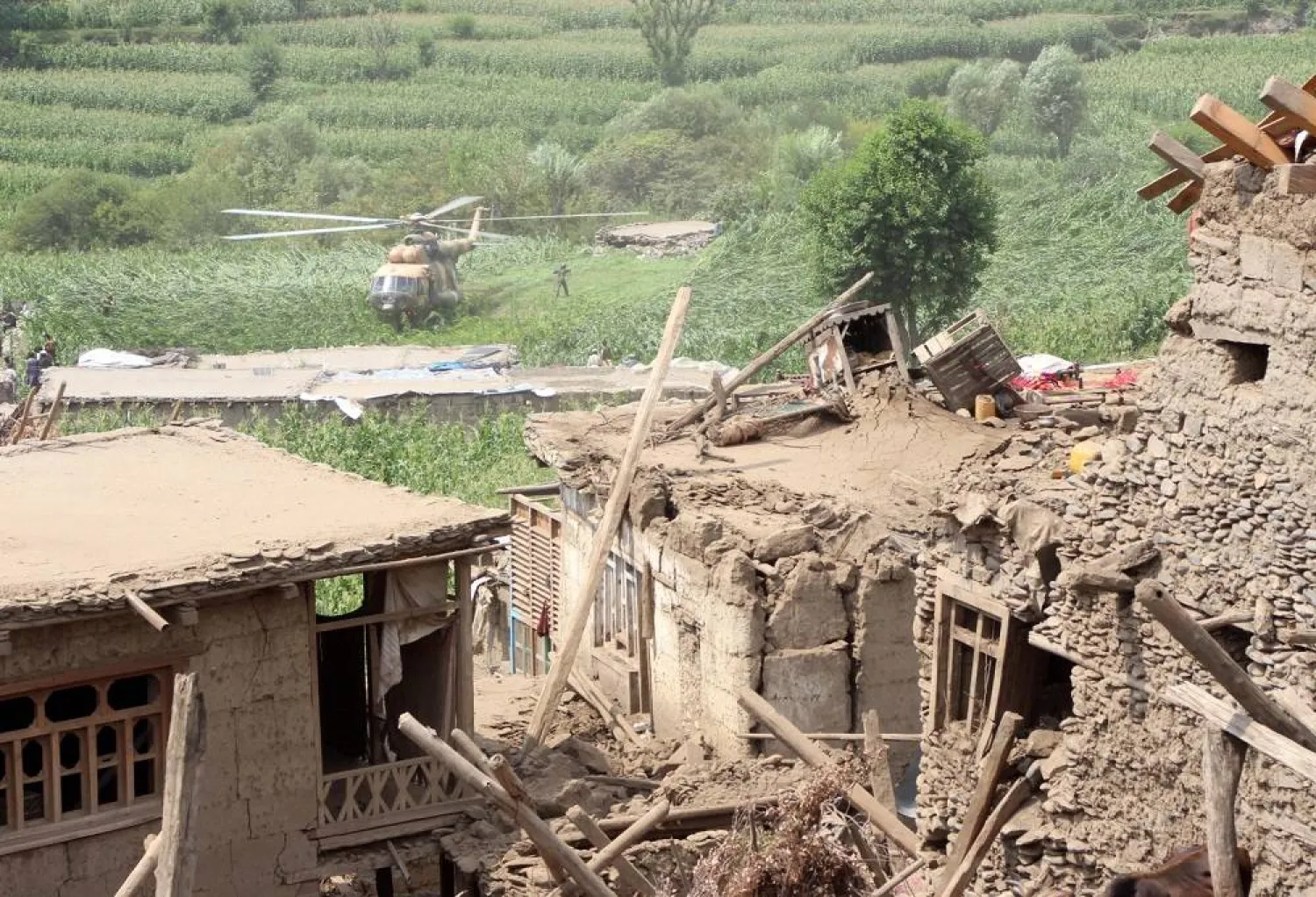

Afghanistan Airdrops Commandos to Rescue Earthquake Survivors 

A rescue helicopter takes off to airlifted injured persons to a hospital, after an earthquake in Kunar, Afghanistan, 02 September 2025 (issued 03 September 2025). (EPA)
TT

Afghanistan Airdrops Commandos to Rescue Earthquake Survivors 

A rescue helicopter takes off to airlifted injured persons to a hospital, after an earthquake in Kunar, Afghanistan, 02 September 2025 (issued 03 September 2025). (EPA)

Afghanistan airdropped commandos on Wednesday to pull survivors from the rubble of homes in mountainous eastern areas ravaged by earthquakes this week that have killed 1,400, as it ramped up efforts to deliver food, shelter and medical supplies.

The first earthquake of magnitude 6, one of Afghanistan's deadliest in recent years, unleashed widespread damage and destruction when it struck the provinces of Kunar and Nangarhar around midnight on Sunday at a shallow depth of 10 km (6 miles).

A second quake of magnitude 5.5 on Tuesday evening caused panic and interrupted rescue efforts as it sent rocks sliding down mountains and cut off roads to villages in remote areas.

Dozens of commando forces were being airdropped at sites where helicopters cannot land, to help carry the injured to safer ground, Ehsanullah Ehsan, the head of disaster management in Kunar, said in a text message.

Authorities have set up a camp to coordinate supplies and emergency aid, while two centers were overseeing transfer of the injured, burial of the dead and the rescue of survivors, Ehsan added.

Earlier, rescuers used helicopters to ferry the wounded to hospitals, battling with mountainous terrain and harsh weather to reach quake-hit villages along the border with Pakistan, where the tremors flattened mudbrick homes.

The toll stands at 1,411 deaths, 3,124 injuries and more than 5,400 destroyed homes, the Taliban administration said. The United Nations has warned the toll could rise, with people trapped under rubble.

ENTIRE HOUSEHOLDS WIPED OUT

In some villages in Kunar province, entire households were wiped out. Survivors sifted through rubble looking for families, carried bodies on woven stretchers and dug graves with pickaxes.

"Two of my children have not yet been pulled out from under the rubble," said Mir Salam Khan, who lives in Mazar Dara village in Kunar, adding that his daughter and son remained buried. "On Monday, my dead wife was taken out from under the rubble, but my children are still beneath it."

Ruhila Mateen from Aseel, a humanitarian tech platform that has teams on the ground, said conditions were worsening by the hour for survivors, with women and children especially vulnerable.

"This is not only a crisis of collapsed buildings but of survival itself. Families are fractured, children are in the cold, and survivors have nothing left," Mateen said.

A Reuters journalist, who arrived in Mazar Dara before Tuesday's tremors, saw every home had been damaged or destroyed, while people dug through rubble in the desperate search for those still trapped.

The second earthquake levelled homes that had been only partially damaged by the first, residents said.

Resources for rescue and relief work are tight in the impoverished nation of 42 million people, which has received limited global help after the disaster.

The country has been badly hit by US President Donald Trump's funding cuts to foreign aid, while donor frustration over the Taliban's policies toward women and curbs on aid workers have worsened its isolation.

Flimsy or poorly-built homes made of dry masonry, stone and timber gave little protection from the quakes, in ground left unstable by days of heavy rain, the UN Office for the Coordination of Humanitarian Affairs (OCHA).

The agency, which is pulling together the global disaster effort, called for emergency shelter, food assistance and sanitation facilities, along with drinking water, critical medical supplies and other items.

An official of international group Doctors without Borders (MSF), which distributed trauma kits at two hospitals in the affected areas, also called for more humanitarian assistance.

"We saw many patients treated in the corridors and health workers in need of supplies," said Dr. Fazal Hadi, MSF's deputy medical coordinator in Afghanistan, adding that the hospitals had been working at full capacity even before the quake.

Afghanistan is prone to deadly earthquakes, particularly in the Hindu Kush mountain range, where the Indian and Eurasian tectonic plates meet.



NATO: Ukraine Still Receiving Arms Despite Mideast War

NATO Secretary General Mark Rutte via Reuters/File
TT

NATO: Ukraine Still Receiving Arms Despite Mideast War

NATO Secretary General Mark Rutte via Reuters/File

Ukraine is still getting essential defense equipment despite the war in the Middle East, which is depleting stockpiles in Europe and the United States, NATO Secretary General Mark Rutte said Thursday.

"The good news is that essential equipment into Ukraine continues to flow," he told reporters. That included American-made Patriot missile interceptors, which Ukraine desperately needs, he added, AFP reported.

The PURL program, launched last year, allows Ukraine to receive US equipment financed by European countries.

Some 75 percent of the missiles used by Patriot batteries in Ukraine have been supplied through the program, and 90 percent of the munitions used by other air-defense systems, Rutte added.

Rutte called on European countries to increase their own production capacity.

"They need to produce more extra production lines, extra shifts, opening new factories. The money is there," he said.


Germany FM Says 'Encouraging' if US Speaking Directly to Iran

German Foreign Minister Johann Wadephul. (Reuters: File Photo)
TT

Germany FM Says 'Encouraging' if US Speaking Directly to Iran

German Foreign Minister Johann Wadephul. (Reuters: File Photo)

Germany's foreign minister Thursday said it was encouraging if the United States was talking directly to Iran to end the war in the Middle East, but Washington should make its intentions clear.

"I hear that there are signs that the US is speaking directly to Iran. I think that this is encouraging and this is welcome," Johann Wadephul told reporters before heading into the meeting of G7 foreign ministers outside Paris, AFP reported.

With US Secretary of State Marco Rubio set to join the discussions from Friday, he added: "For the German government it is of great importance to know precisely what our American partners are intending."


US Envoy Witkoff Says Iran is Seeking an Off-ramp

US Special Envoy Steve Witkoff speaks during a cabinet meeting at the White House in Washington, DC, US, March 26, 2026. REUTERS/Evelyn Hockstein
TT

US Envoy Witkoff Says Iran is Seeking an Off-ramp

US Special Envoy Steve Witkoff speaks during a cabinet meeting at the White House in Washington, DC, US, March 26, 2026. REUTERS/Evelyn Hockstein

The United States has sent Iran a "15-point action list" as a basis for negotiations to end the current conflict, US Special Envoy Steve Witkoff said on Thursday, adding that there are signs that Tehran was interested in making a deal.


Witkoff, speaking during a cabinet meeting at the White House, said that the nascent talks could be successful if the Iranians realize there were no good alternatives - a realization Tehran might be coming to, he argued, Reuters reported.


"We will see where things lead, and if we can convince Iran that this is the inflection point with no good alternatives for them other than more death and destruction," Witkoff told reporters.


"We have strong signs that this is a possibility."


Witkoff said Pakistan had been acting as a mediator, confirming statements from Pakistani officials.