

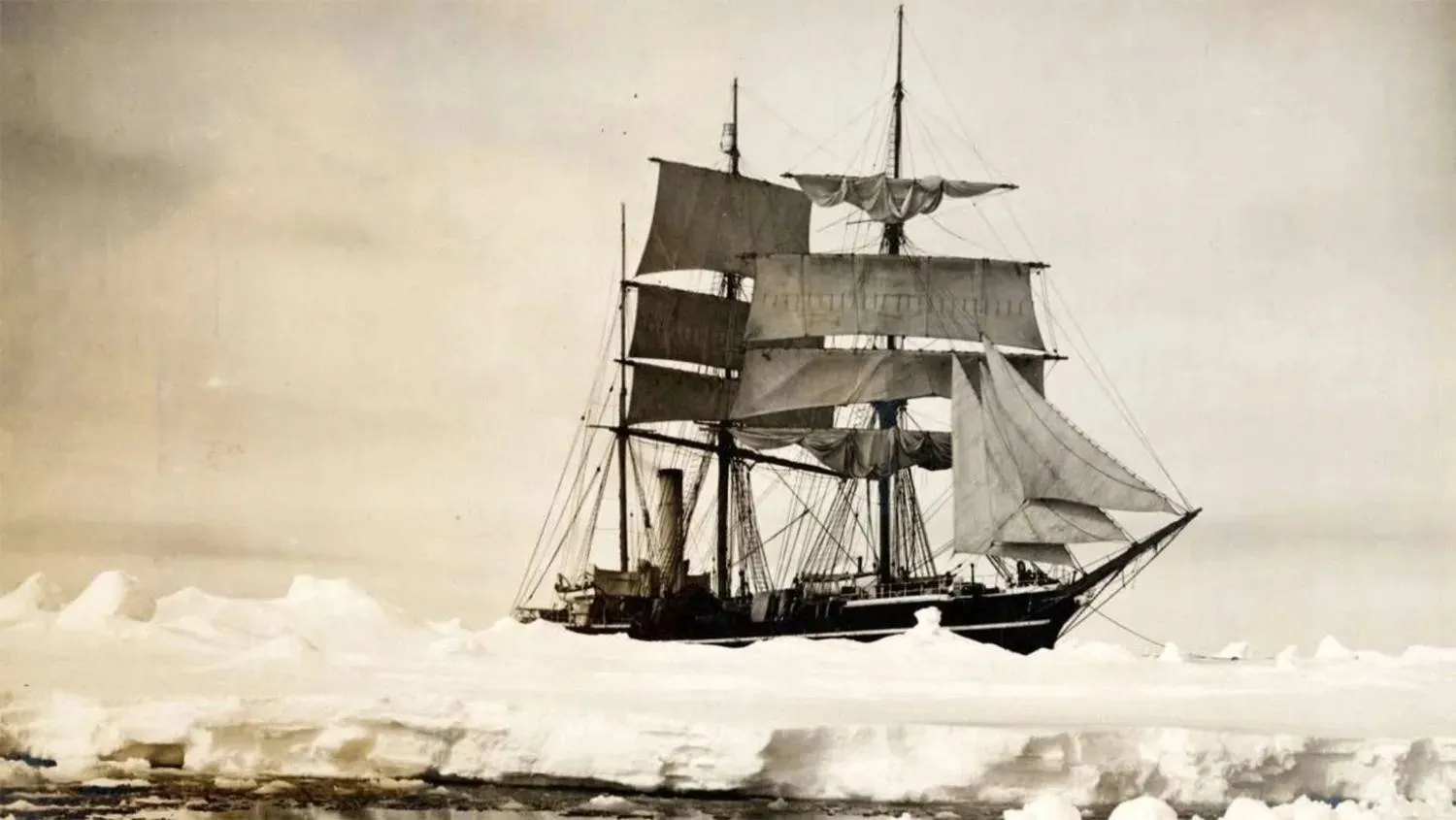

Photos of Captain Scott’s Famous Polar Shipwreck as Never Seen Before

The Terra Nova is forever entwined in the tragic tale of Captain Scott and his men. (Getty Images)
TT

Photos of Captain Scott’s Famous Polar Shipwreck as Never Seen Before

The Terra Nova is forever entwined in the tragic tale of Captain Scott and his men. (Getty Images)

One of the most famous polar shipwrecks has been filmed in detail on the sea floor for the first time.

The Terra Nova carried Captain Scott and his men on their doomed expedition to reach the South Pole more than a century ago.

The British party lost the race to the pole and died on their return journey in 1912.

The footage shows the Terra Nova colonized with sea life, but key features of the wooden ship are still visible including its wheel, winch and mast, according to BBC.

The wreck lies 170m down off the coast of Greenland. After the polar expedition with Scott, the ship continued in service and eventually sank in 1943 while carrying supplies to US bases during World War Two.

The Terra Nova was discovered in 2012 by the Schmidt Ocean Institute, but the new expedition has been the first opportunity to record extensive footage of the wreck.

“To be able to see these significant parts of the wreck, it was truly awe inspiring,” said Leighton Rolley, Science Systems Manager at REV Ocean. “The wheel was sat there perfectly intact amongst the debris of the aft section of the wreck.”

He said, “When you think of the people who have stood there, maneuvered the Terra Nova through ice, like Captain Scott... It was like, wow, if that ship's wheel could talk, it could tell an amazing history.”

The Terra Nova was one of the finest polar vessels of its time and sailed for 60 years.

The ship was 57m long with a wooden hull that was a meter thick in places to help it break through the sea ice.

Captain Scott's men embarked to Antarctica in 1910. A comprehensive scientific program was planned for the Terra Nova expedition - along with the goal of being the first to reach the South Pole.

Scott, along with Edward Wilson, Henry Bowers, Lawrence Oates and Edgar Evans, were attempting to make history.

After trekking hundreds of miles, the British party reached the pole in January 1912, but they found they had been beaten by a Norwegian team led by Roald Amundsen.

A black flag, planted by Amundsen, is now on display at the Scott Polar Research Institute (SPRI) in Cambridge along with other items from the Terra Nova.

“Their hearts must have sunk seeing this black flag against the whiteness of Antarctica,” said David Waterhouse, curator of the polar museum at SPRI.

The deflated British party began their arduous return journey to their base. But they encountered unusually bad weather, and Edgar Evans died after falling while descending a glacier.

Several weeks later Captain Oates left the men's tent. His last words were recorded in Scott's journal: “I'm just going outside and may be some time.” He was never seen again.

Scott, Bowers and Wilson continued on and made a final camp, but trapped by a freezing blizzard with dwindling supplies, all three perished.

A search expedition discovered their last camp just 11 miles from a resupply depot that would have provided them with food and fuel.

The Terra Nova played a crucial role in breaking the news of their death.

“In January 1913, the Terra Nova arrived at Cape Evans in the Antarctic to pick up the shore party, and they were expecting to pick up Captain Scott and his pole party at the same time,” explained Naomi Boneham, an archivist at SPRI.

“But when they arrived they found out the sad news.”

The ship's log records that the men had died from “exposure and want.”

The vessel sailed on to New Zealand, where the tragic end of the Terra Nova expedition was announced to the world.




Annual Orchids Show Brings Vivid Color to Chicago Winter

Orchids adorn a Volkswagen Beetle as finishing touches are placed on the 12th annual Chicago Botanic Garden Orchid Show, Friday, Feb. 6, 2026, in Glencoe, Ill. (AP)
TT

Annual Orchids Show Brings Vivid Color to Chicago Winter

Orchids adorn a Volkswagen Beetle as finishing touches are placed on the 12th annual Chicago Botanic Garden Orchid Show, Friday, Feb. 6, 2026, in Glencoe, Ill. (AP)

A soft layer of white snow blankets the grounds of the Chicago Botanic Garden. The air is chilly, the sky gray.

Inside, however, the air is warm and lights illuminate more than 10,000 vividly colored orchids. Staff members move in and out of greenhouses, preparing to open the garden’s 12th annual Orchid Show on Saturday.

This year’s theme is “Feelin’ Groovy" with several installations calling back to the 1970s, including a yellow Volkswagen Beetle filled with orchids.

“It’s just a really great way to get out of the winter cold and come into our greenhouses,” said Jodi Zombolo, associate vice president of visitor events and programs. “I think people are really looking for something to kind of bring happiness and something that they will enjoy and find whimsy in.”

The orchid family is one of the largest in the plant world and some of the species in the show are rare, exhibits horticulturist Jason Toth said. One example is the Angraecum sesquipedale, also known as Darwin’s orchid, on display in the west gallery.

Toth said the orchid led Darwin to correctly conclude that pollinators have adapted in order to reach down the flower's very long end.

"It has a great story and it’s quite remarkable-looking,” said Toth.

Elsewhere, massive, gnarly roots dangle from purple, pink and yellow Vanda orchids in the south greenhouse. These epiphytic orchids grow on the surface of trees instead of in soil.

“I think everyone’s tired of the winter,” said Toth. “So having some kind of flower show at this point is what we’re all craving. And 'Orchids' fits the bill.”

The show is expected to draw 85,000 visitors this year.


UK Zoo Says Tiny Snail ‘Back from Brink’ of Extinction

This photo taken on February 2, 2026 shows a greater Bermuda snail, which is part of a breeding program, sitting under a microscope at Chester Zoo in Chester, north-west England. (AFP)
TT

UK Zoo Says Tiny Snail ‘Back from Brink’ of Extinction

This photo taken on February 2, 2026 shows a greater Bermuda snail, which is part of a breeding program, sitting under a microscope at Chester Zoo in Chester, north-west England. (AFP)

A minuscule snail once thought to have disappeared has been saved from the edge of extinction, a British zoo said Saturday.

The greater Bermuda land snail had not been spotted for years until a cluster of shells was caught slithering through an alleyway in the capital Hamilton in 2014.

Some were flown to Chester Zoo, where experts spent years building up the population before they released thousands back into the wild in 2019.

Unique to Bermuda, this type of snail traces its lineage back over a million years -- a relic of the island's ancient ecosystem.

Now "we can officially say the species is back from the brink", said Chester Zoo in a statement sent to AFP.

The snail "once thought lost has officially been saved from extinction by experts in Chester Zoo, London Zoo, and Bermuda," it said.

They confirmed this after a study in the Oryx biodiversity conservation journal found that six colonies of the re-wilded snails had settled successfully on the archipelago.

"The fact that the snails are firmly established in six areas is massive," said Gerardo Garcia, animal and plant director at Chester Zoo.

From specially designed pods in northwest England, they are now breeding and roaming freely in Bermuda, he said.

"Being able to say that the snails are now safe from extinction is amazing ... and something that conservationists might get to say once or maybe twice in their whole career."

At one point, keeper Katie Kelton said the zoo housed around 60,000 snails.

It was "a lot of snails to look after ... a lot of chopping lettuce, sweet potato and carrot," she told AFP.

- Conservation 'success' story -

The snails faced many threats, including habitat loss, pesticide use, and the cannibalistic "wolf snail".

They were rescued in a process Garcia described as "a war game" with growing numbers tracked by flags pinned across a map of Bermuda.

While they cannot say the species is safe forever, he noted they now knew how to rebuild the population quickly and effectively.

But long-term recovery, he said, would go hand in hand with nature regeneration projects carried out by the Bermudian government.

Chester Zoo has now turned its attention to the lesser Bermuda land snail -- even smaller and much harder to breed.

These snails, which can reach about 23 millimeters (0.9 inches) in length, may now be extinct in the wild.

"We're considering things like seasonality, how long it takes a colony to establish and the complexity of their environments," said expert Iri Gill.

But their experience with the greater Bermuda snail should point them "in the right direction", she said.

"These snails are tiny, but this has been one of the biggest success stories in conservation."


SpaceX Delays Mars Plans to Focus on 2027 Moon Landing

FILE PHOTO: SpaceX headquarters is shown in Hawthorne, California, US June 5, 2025. REUTERS/Daniel Cole/File Photo
TT

SpaceX Delays Mars Plans to Focus on 2027 Moon Landing

FILE PHOTO: SpaceX headquarters is shown in Hawthorne, California, US June 5, 2025. REUTERS/Daniel Cole/File Photo

Elon Musk's SpaceX told investors it will prioritize going to the moon first and attempt a trip to Mars at a later time, the Wall Street Journal reported on Friday, citing sources.

The company will target March 2027 ‌for a ‌lunar landing without ‌astronauts ⁠on board, the ‌report added. The news comes after SpaceX agreed to acquire xAI in a deal that values the rocket and satellite company at $1 trillion and the artificial intelligence outfit ⁠at $250 billion.

SpaceX did not immediately respond ‌to a Reuters request ‍for comment. Musk said ‍last year that he aimed ‍to send an uncrewed mission to Mars by the end of 2026.

SpaceX is developing its next-generation Starship rocket, a stainless steel behemoth designed to be fully reusable and ⁠serve an array of missions including flights to the moon and Mars.

The United States faces intense competition this decade from China in its effort to return astronauts to the moon, where no humans have gone since the final US Apollo mission in ‌1972.