


Israeli Military Says It Controls 40% of Gaza City, Plans to Expand Operation in Coming Days

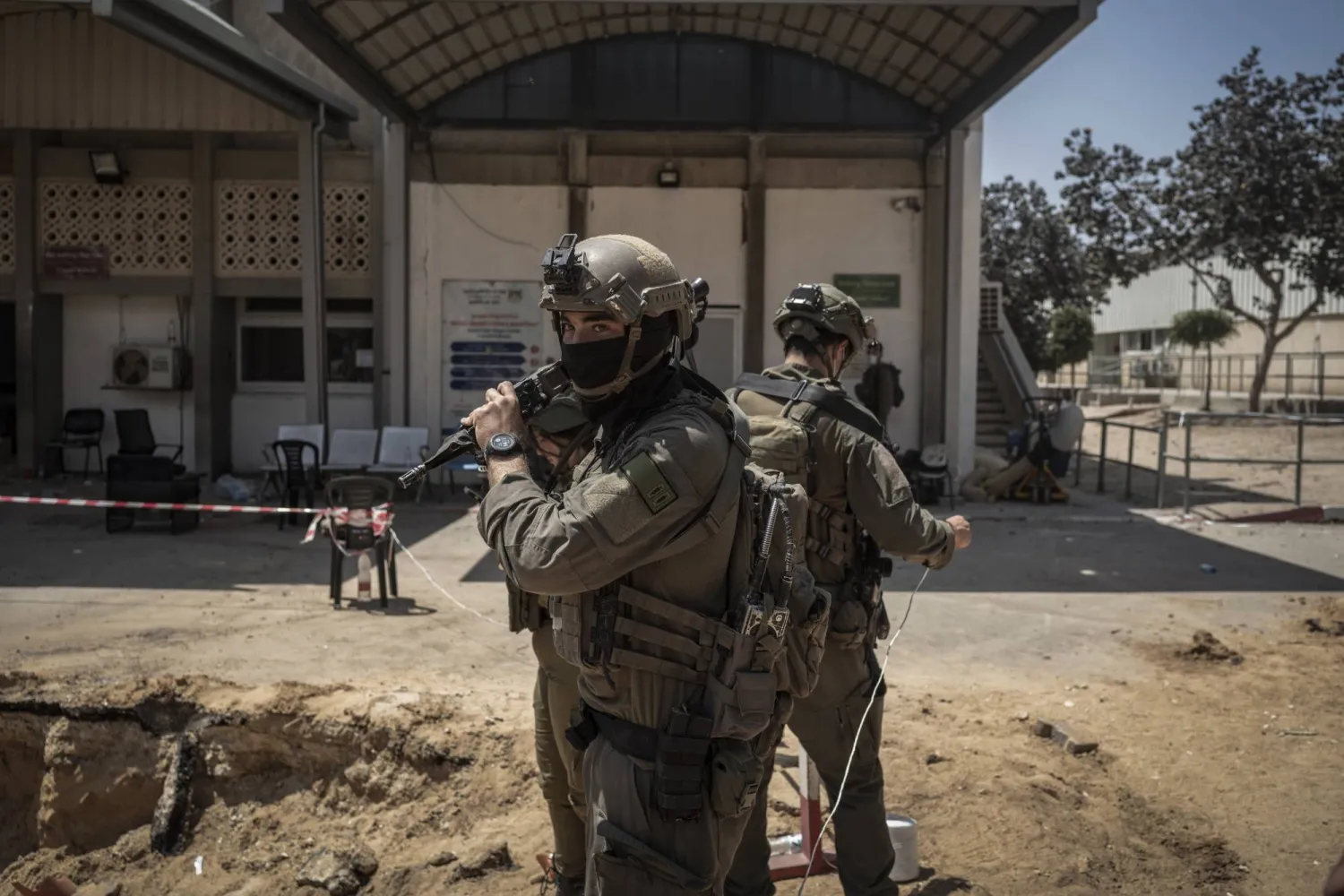
FILED - 08 June 2025, Palestinian Territories, Khan Yunis: Israeli soldiers stand guard at the European Hospital in Khan Yunis, where the Israeli military discovered a tunnel believed to be the site of Hamas military chief Muhammad Sinwar's death last month. Photo: Ilia Yefimovich/dpa
TT

Israeli Military Says It Controls 40% of Gaza City, Plans to Expand Operation in Coming Days

FILED - 08 June 2025, Palestinian Territories, Khan Yunis: Israeli soldiers stand guard at the European Hospital in Khan Yunis, where the Israeli military discovered a tunnel believed to be the site of Hamas military chief Muhammad Sinwar's death last month. Photo: Ilia Yefimovich/dpa

Israel controls 40% of Gaza City, a military spokesperson said on Thursday, as its bombardment forced more Palestinians from their homes there, while thousands of residents defied Israeli orders to leave, remaining behind in the ruins in the path of Israel's latest advance.

Gaza health authorities said Israeli fire across the enclave had killed at least 53 people on Thursday, mostly in Gaza City, where Israeli forces have advanced through the outer suburbs and are now a few kilometers (miles) from the city center.

"We continue to damage Hamas' infrastructure. Today we hold 40% of the territory of Gaza City," Israeli military spokesperson Brigadier General Effie Defrin told a news conference, naming the Zeitoun and Sheikh Radwan neighborhoods. "The operation will continue to expand and intensify in the coming days."

"We will continue to pursue Hamas everywhere," he said, adding that the mission will only end when Israel's remaining hostages are returned and Hamas' rule ends.

Defrin confirmed that army Chief of Staff Eyal Zamir told cabinet ministers that without a day-after plan, they would have to impose military rule in Gaza. Far-right members of Prime Minister Benjamin Netanyahu’s government have been pushing for Israel to impose military rule in Gaza and establish settlements there, which Netanyahu has so far ruled out.

Israel launched the offensive in Gaza City on August 10, in what Netanyahu says is a plan to defeat Hamas in the part of Gaza where Israeli troops fought most heavily in the war's initial phase.

The campaign has prompted international criticism because of the humanitarian crisis in the area and has provoked unusual levels of concern within Israel, including accounts of tension over strategy between some military commanders and political leaders.

"This time, I am not leaving my house. I want to die here. It doesn't matter if we move out or stay. Tens of thousands of those who left their homes were killed by Israel too, so why bother?" Um Nader, a mother of five from Gaza City, told Reuters via text message.

Residents said Israel bombarded Gaza City's Zeitoun, Sabra, Tuffah, and Shejaia districts from ground and air. Tanks pushed into the eastern part of the Sheikh Radwan district northwest of the city center, destroying houses and causing fires in tent encampments.

In a heavy bombardment in the Tuffah neighborhood, medics said five houses were damaged by Israeli strikes that killed eight people and wounded dozens more.

"The Israeli occupation targeted a gathering of civilians and several homes in the Mashahra area of the Tuffah neighborhood — a fire belt that completely destroyed four buildings," said Mahmoud Bassal, spokesperson of the territory's civil emergency service.

"Even if the Israeli occupation issues warnings, there are no places that can accommodate the civilians; there are no alternate places for the people to go to."

There was no immediate Israeli comment on those reports. The Israeli military has said it is operating on the outskirts of the city to dismantle Hamas’ tunnels and locate weapons.

Much of Gaza City was laid to waste in the war's initial weeks in October-November 2023. About a million people lived there before the war, and hundreds of thousands are believed to have returned to live among the ruins, especially since Israel ordered people out of other areas and launched offensives elsewhere.

Israel, which has now told civilians to leave Gaza City again for their safety, says 70,000 have done so, heading south. Palestinian officials say less than half that number have left and many thousands still lie in the path of Israel's advance.

'MOST DANGEROUS DISPLACEMENT' OF THE WAR

Displacement could further endanger the most vulnerable, including many children suffering from malnutrition, said Amjad al-Shawa, head of the Palestinian NGOs Network, an umbrella group of Palestinian NGOs that coordinates with the UN and international humanitarian agencies.

"This is going to be the most dangerous displacement since the war started," said Shawa. "People's refusal to leave despite the bombardment and the killing is a sign that they have lost faith."

Palestinian and UN officials say nowhere is safe in Gaza, including areas Israel designates humanitarian zones.

Health officials in Gaza say 370 people, including 131 children, have died of malnutrition and starvation caused by acute food shortages, mostly in recent weeks. Israel says it is taking measures to improve humanitarian conditions in Gaza, including increasing aid into the enclave.

The war began on October 7, 2023, when gunmen led by Hamas attacked southern Israel, killing some 1,200 people, most of them civilians, and taking 251 hostages into Gaza.

Israel's offensive has since killed more than 63,000 Palestinians, most of them civilians, according to local health officials, and left much of the territory in ruins.

Prospects for a ceasefire and a deal to release the remaining 48 hostages, 20 of whom are thought to still be alive, appear dim.

Two Democratic US senators - Chris Van Hollen and Jeff Merkley - told reporters after a week-long trip to assess the situation in Gaza and the West Bank: "Based on our conversations and our observations, we came away with the inexplicable conclusion that the Netanyahu government is engaged in a campaign of ethnic cleansing in Gaza and slow-motion ethnic cleansing in the West Bank."


8 Arab and Islamic Countries Deeply Concerned About Deteriorating Humanitarian Situation in Gaza

Nanaa Abu Jari cooks outside her tent after it was flooded by rainwater in Nuseirat, central Gaza Strip, Friday, Jan. 2, 2026. (AP Photo/Abdel Kareem Hana)
TT

8 Arab and Islamic Countries Deeply Concerned About Deteriorating Humanitarian Situation in Gaza

Nanaa Abu Jari cooks outside her tent after it was flooded by rainwater in Nuseirat, central Gaza Strip, Friday, Jan. 2, 2026. (AP Photo/Abdel Kareem Hana)

The foreign ministers of eight Arab and Islamic countries, including Saudi Arabia, Egypt and Qatar urged on Friday the international community to pressure Israel to lift constraints on the distribution of aid in the Gaza Strip.

In a joint statement the eight countries “expressed their deepest concern regarding the deteriorating humanitarian situation in the Gaza Strip, which has been exacerbated by severe, harsh, and unstable weather conditions, including heavy rainfall and storms, and compounded by the continued lack of sufficient humanitarian access, acute shortages of essential life-saving supplies, and the slow pace of the entry of essential materials required for the rehabilitation of basic services and the establishment of temporary housing.”

They "urged the international community to pressure Israel, as the occupying power, to immediately lift the constraints on the entry and distribution of essential supplies" to Gaza.

The statement also called for the immediate delivery of humanitarian aid in the Palestinian enclave through the UN and its agencies, the rehabilitation of infrastructure and hospitals, and the opening of the Rafah Crossing in both directions as stipulated in US President Donald Trump’s Comprehensive Plan.

The Rafah border crossing was set to be reopened under the ceasefire in effect in Gaza since October, but has so far remained closed.

Friday’s statement “commended the tireless efforts of all United Nations organizations and agencies, especially UNRWA, as well as humanitarian international NGOs, in continuing to assist Palestinian civilians and deliver humanitarian assistance under extremely difficult and complex circumstances.”

The eight countries “demanded that Israel ensure the UN and international NGOs are able to operate in Gaza and the West Bank in a sustained, predictable, and unrestricted manner, given their integral role in the humanitarian response in the Strip.”

“Any attempt to impede their ability to operate is unacceptable,” they added.


MSF Calls Israeli Ban a 'Grave Blow' to Gaza Aid

Nanaa Abu Jari cooks outside her tent after it was flooded by rainwater in Nuseirat, central Gaza Strip, Friday, Jan. 2, 2026. (AP Photo/Abdel Kareem Hana)
TT

MSF Calls Israeli Ban a 'Grave Blow' to Gaza Aid

Nanaa Abu Jari cooks outside her tent after it was flooded by rainwater in Nuseirat, central Gaza Strip, Friday, Jan. 2, 2026. (AP Photo/Abdel Kareem Hana)

International charity Doctors Without Borders Friday condemned a "grave blow to humanitarian aid" after Israel revoked the status it needs to operate in Gaza for refusing to share Palestinian staff lists.

Israel on Thursday confirmed it had banned access to the Gaza Strip to 37 foreign humanitarian organizations for refusing to share lists of their Palestinian employees.

Doctors Without Borders (MSF), which has 1,200 staff members in the Palestinian territories, the majority of them in Gaza, said in a statement that "denying medical assistance to civilians is unacceptable under any circumstances".

The medical organization argued that it had "legitimate concerns" over new Israeli requirements for foreign NGO registration, specifically the disclosing of personal information about Palestinian staff.

According to AFP, it pointed to the fact that 15 MSF staff had been "killed by Israeli forces", and that access to any given territory should not be conditional on staff list disclosure.

"Demanding staff lists as a condition for access to territory is an outrageous overreach," the charity said.

MSF also denounced "the absence of any clarity about how such sensitive data will be used, stored, or shared", charging that Israeli forces "have killed and wounded hundreds of thousands of civilians" in Gaza during the course of the war.

It also charged that Israel had "manufactured shortages of basic necessities by blocking and delaying the entry of essential goods, including medical supplies".

Israel controls and regulates all entry points into Gaza, which is surrounded by a wall that began to be built in 2005.

Felipe Ribero, MSF head of mission in the Palestinian territories, told AFP that all of its operations were still ongoing in Gaza.

"We are supposed to leave under 60 days, but we don't know whether it will be three or 60 days" before Israeli authorities force MSF to leave, he said.

Prominent humanitarian organizations hit by the Israeli ban include the Norwegian Refugee Council (NRC), World Vision International and Oxfam, according to an Israeli ministry list.

The ban, which came into effect on December 31, 2025 at midnight, has triggered widespread international condemnation.

Israel says the new regulation aims to prevent bodies it accuses of supporting terrorism from operating in the Palestinian territories.

MSF says it currently supports one in five hospital beds in Gaza and assists one in three mothers in the territory, and urged the Israeli authorities to meet to discuss the ban.


Sources to Asharq Al-Awsat: National Shield Forces Control Al-Khasha Camp

National Shield forces are seen in Hadhramaut. Photo: National Shield forces
TT

Sources to Asharq Al-Awsat: National Shield Forces Control Al-Khasha Camp

National Shield forces are seen in Hadhramaut. Photo: National Shield forces

Sources confirmed that the National Shield forces, led by the Governor of Hadhramaut in Yemen, have taken control of the “37th Strategic Brigade Camp” in the Al-Khasha area.

Field sources told Asharq Al-Awsat that the National Shield forces tightened their grip on Al-Khasha camp after clashes with the Southern Transitional Council (STC) forces, which subsequently retreated.

The sources added that National Shield forces continue to secure and completely clear the areas adjacent to the camp.

According to military sources in Hadhramaut, STC forces “had positioned themselves in areas on the outskirts of the camp early on, fearing airstrikes.”

“These forces were dealt with,” and efforts are underway to secure the area, the sources said.

They confirmed that National Shield forces will continue advancing toward Seiyun to liberate the remaining camps and areas.

Those forces, “with support from brothers in the Kingdom (Saudi Arabia), are proceeding according to clear plans to secure all military camps in the governorates of Hadhramaut and Al-Mahrah.”

The forces “are now present in some areas on the outskirts of Seiyun.”

The sources did not confirm reports about the withdrawal of STC forces from the First Military Region in Seiyun.

“Some STC forces are stationed at Seiyun Hospital and the Republican Palace, while the rest of the locations have been completely evacuated and their forces have withdrawn toward Al-Qatn," they added.
