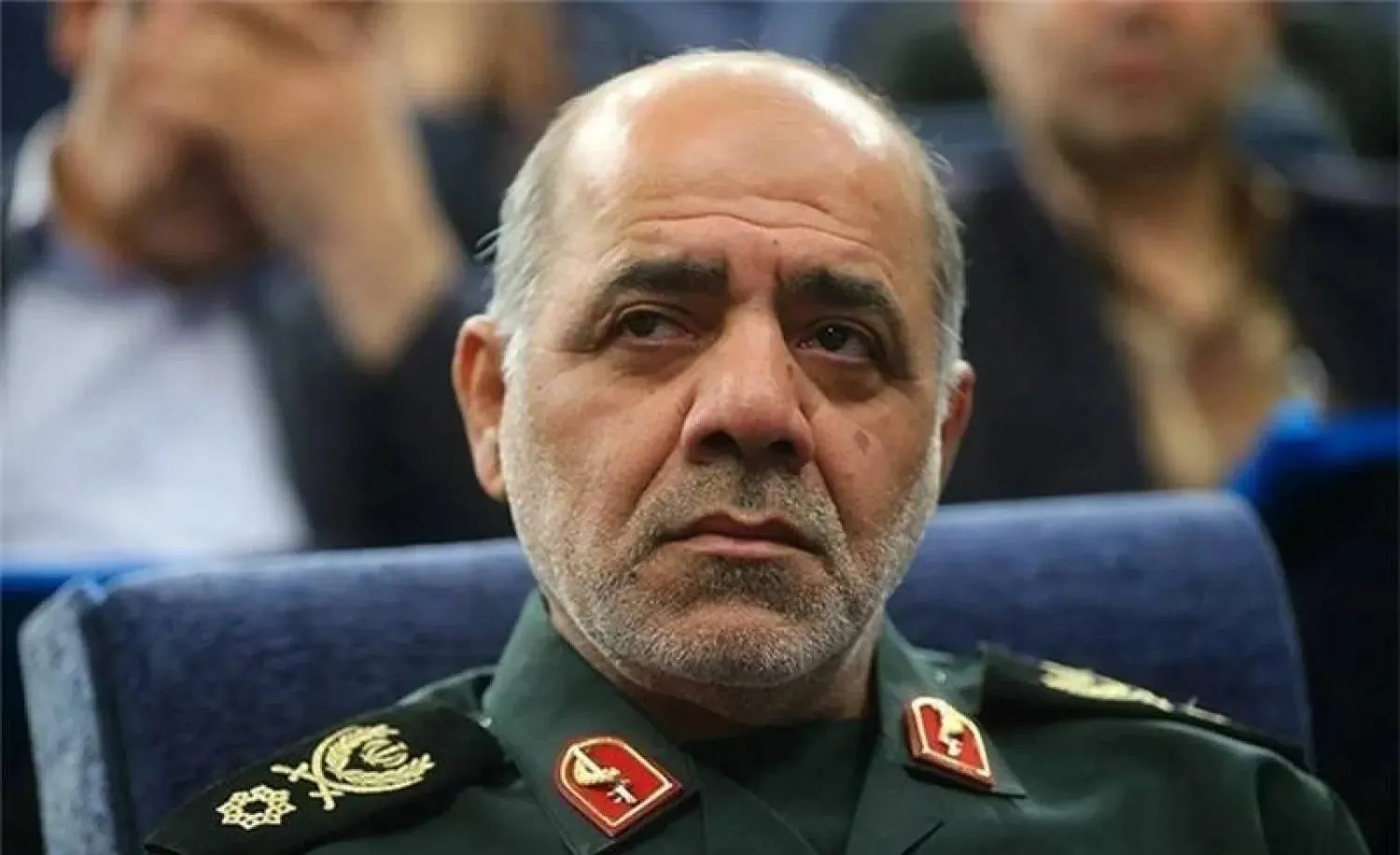
Since the latest war erupted in Lebanon, evidence has mounted of a direct role by Iran’s Revolutionary Guards in managing the fight alongside Hezbollah. But the scale and nature of that role, and the number of Iranians involved, remain unclear.
With no precise figures available, several accounts point to the presence of Iranian personnel and officers in Lebanon during the war, both in command roles and on the battlefield.
Revolutionary Guards officers in the battle
In March, Prime Minister Nawaf Salam moved to curb what was seen as the Revolutionary Guards’ chaotic access to Beirut.
He asked the authorities to take the necessary steps to prevent any military or security activity by members of the Revolutionary Guards in Lebanon ahead of their deportation. The Cabinet also decided to reinstate visa requirements for Iranians entering Lebanon.
One of the strongest signs of Revolutionary Guards' involvement was the killing of Guards officers in an Israeli strike on the Ramada Hotel in Beirut’s Raouche district on March 8.
Iran announced the deaths in a letter to the UN secretary-general. Iran’s permanent representative to the United Nations, Amir Saeid Iravani, said four Iranian diplomats had been killed in the attack. They were later mourned in Iran as Revolutionary Guards officers.
Information in Beirut indicated that the Iranians entered the capital using genuine Lebanese passports issued under different names. Additional passports belonging to others linked to the Revolutionary Guards were found inside the targeted room.
That prompted MP Ghada Ayoub to file a report with the Public Prosecutor’s Office at the Court of Cassation, requesting an investigation into information alleging that Lebanese passports had been issued under false names or in violation of legal procedures to people linked to armed groups.
The report also cited evidence that Lebanese travel documents were used to conceal the real identities of Revolutionary Guards personnel.
Other reports also pointed to a direct Iranian presence in the fighting.
During the battle over what is known as the Ali al-Taher Heights, media outlets quoted a senior Israeli security source as saying on Monday that several Iranian officers were in the area in southern Lebanon. The source said they held key positions in managing the battle and coordinating operations on the Lebanese front.
According to that information, one main reason behind Iran’s insistence on halting the Israeli ground operation there was concern for the lives of those officers, or fear they could be captured if the field advance continued.
At the same time, media outlets and online platforms in the past two days circulated posts attributed to the Revolutionary Guards offering salaries of up to $1,000 to those willing to fight alongside Hezbollah.
The posts were seen as another sign of the scale of Iranian involvement in the war in Lebanon.
“One front and a joint operations room”
Retired Brig. Gen. Hassan Jouni, a military expert, said the organic relationship between Hezbollah and Iran makes it difficult to separate the Lebanese and Iranian fronts.
“What happened in the war clearly showed that the two fronts were managed as one front, within a joint operations room and under a unified operational plan aimed at scattering and exhausting Israeli air-defense systems,” he told Asharq Al-Awsat.
He said that the pattern reflected unified battle management and decision-making. It showed, he added, that the confrontation was not two separate fronts, but one linked theater of operations coordinated directly by Iran and Hezbollah.
From operations rooms to the battlefield
While the presence of Iranian officers in operations rooms now appears settled, the number of Iranian fighters on the ground remains unclear.
Political analyst Kassem Kassir, who is close to Hezbollah, stirred controversy two days ago when he spoke of 50,000 Iranian fighters taking part in the war in Lebanon and 10,000 of them being killed. The remarks triggered surprise and questions in Lebanon.
Kassir later said his comments were made in response to accounts portraying the war as a direct Iranian-Israeli confrontation on Lebanese soil. He said the exaggerated figures were meant to show how unrealistic such claims were.
“The exaggeration in the figures I mentioned is proof that the matter is not true,” he told Asharq Al-Awsat.
Political analyst Ali al-Amine offered a different reading. He said the latest war had carried, from the start, the character of an Iranian-Israeli confrontation on Lebanese soil. He pointed first to the Revolutionary Guards officers killed in the Beirut hotel.
“After the assassination of Hezbollah’s first-tier leaders in 2024, foremost among them Hezbollah Secretary-General Hassan Nasrallah, along with a number of elite commanders and Radwan Force leaders, a major vacuum emerged inside the party’s command structure,” al-Amine told Asharq Al-Awsat.
“That required Revolutionary Guards leaders and officers to come to Lebanon to manage the battle and oversee operations. They were not ordinary fighters, but high-level specialized officers who took charge of command, coordination and field axes.”
He said the Revolutionary Guards and Hezbollah have an intertwined organizational and military structure, not merely an alliance between two separate partners.
Non-Lebanese bodies in the south
Al-Amine also spoke of a large number of non-Lebanese fighters in the south.
“After the ceasefire, operations began to recover bodies from southern villages, but in some areas, residents were initially asked not to go there,” he said.
“The scale of destruction was one main reason. But there was another reason: a large number of bodies under the rubble of homes. It emerged that some of the dead were not Lebanese, including Iranians and Palestinians from the camps, in addition to information about Iraqis who took part in the battles.”
He said the Iranians, as a core part of battle management, were not only in operations rooms but also present on some field axes.
At the same time, he said, there was a broad blackout on the scale of human losses. Hezbollah no longer publishes detailed death notices as it did in the past, he said, limiting itself to announcing the deaths of senior figures. That raised questions about the real number of dead and the identities of some of them.
He said body-recovery operations were being carried out only by Hezbollah and the Islamic Health Association, while the Red Cross was kept away.
“If that indicates anything, it is that there are people whose real identities or nationalities are not meant to be revealed, or who are not meant to be included on the official lists of Lebanese dead,” he said.
1,000 Hezbollah dead and 500 missing
Kassir, however, denied that Hezbollah faced a shortage of fighters. He said the nature of the current battle no longer required the same numbers as previous stages, and that Hezbollah had enough fighters to carry out its missions.
Hezbollah does not announce its death toll and has stopped issuing death notices since the start of this war. Kassir estimated that about 1,000 Hezbollah fighters had been killed in the latest war, with about 500 more missing.
He said the death of any Iranian fighters or officers in battle could not be hidden. The announcement of the deaths of the four Iranian officers at the Raouche hotel, he said, proved that any similar Iranian losses would have been officially announced.