

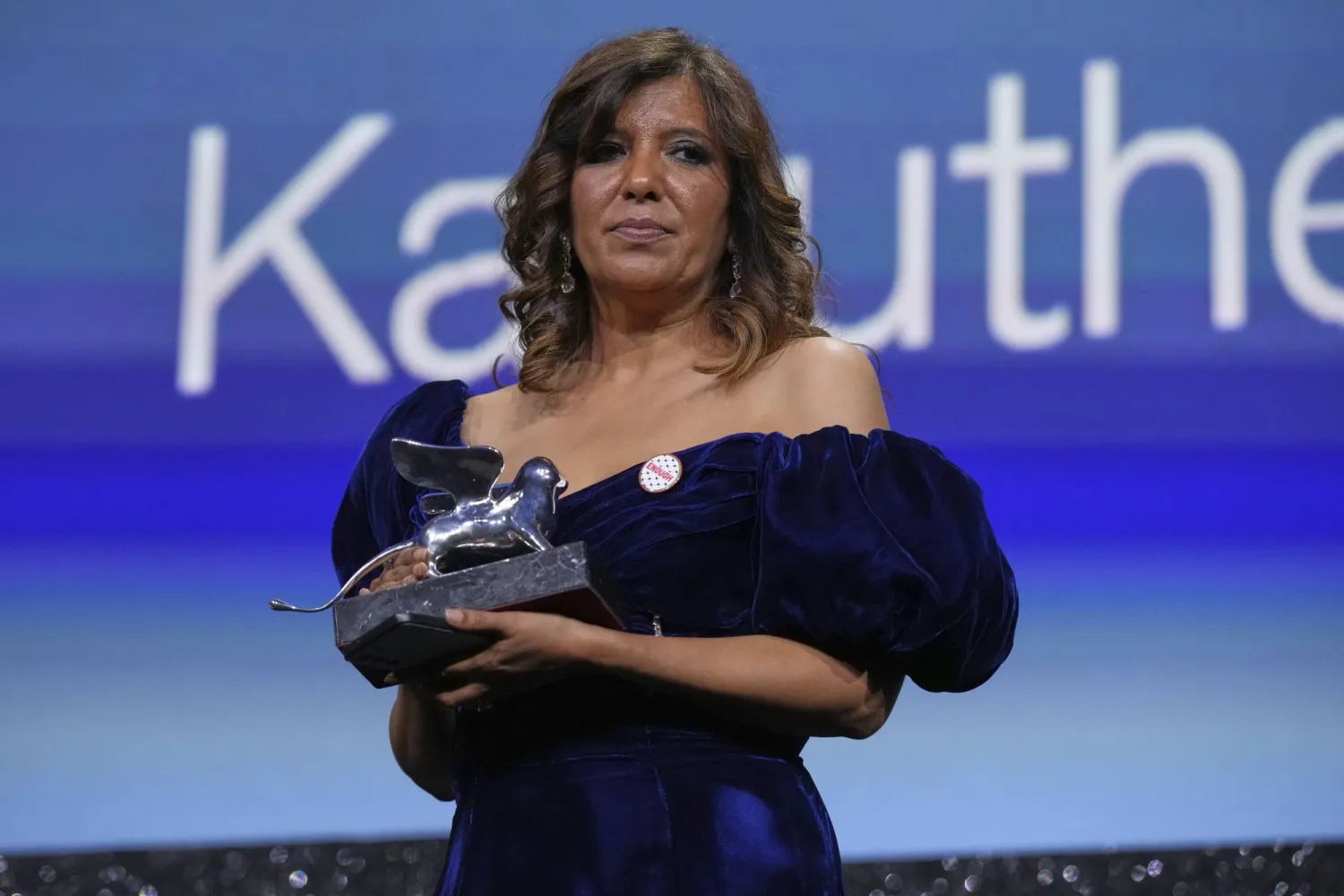

‘The Voice of Hind Rajab’ Wins Silver Lion at the Venice Film Festival

Director Kaouther Ben Hania accepts the grand jury prize for 'The Voice of Hind Rajab' during the awards ceremony of the 82nd edition of the Venice Film Festival in Venice, Italy, on Saturday, Sept. 6, 2025. (Photo by Alessandra Tarantino/Invision/AP)
TT

‘The Voice of Hind Rajab’ Wins Silver Lion at the Venice Film Festival

Director Kaouther Ben Hania accepts the grand jury prize for 'The Voice of Hind Rajab' during the awards ceremony of the 82nd edition of the Venice Film Festival in Venice, Italy, on Saturday, Sept. 6, 2025. (Photo by Alessandra Tarantino/Invision/AP)

“Father Mother Sister Brother,” Jim Jarmusch’s quietly humorous relationship triptych, won the top prize at the Venice Film Festival Saturday. The film about the relationships between adult children, and with their parents, stars Adam Driver, Vicky Krieps and Cate Blanchett.

It was an upset win over some of the festival’s bigger hits, including “The Voice of Hind Rajab,” which won the runner-up award, and Park Chan-wook’s “No Other Choice,” which left empty-handed.

“All of us here who make films are not motivated by competition,” Jarmusch said. “But I truly appreciate this unexpected honor.”

He thanked the festival for “appreciating our quiet film.” He said he related to Japanese filmmaker Akira Kurosawa who once said, while accepting an honor from the Academy Awards at an advanced age, that he was worried he still didn’t know what he was doing.

“I’m learning each time,” Jarmusch said.

Kaouther Ben Hania’s devastating Gaza docudrama “The Voice of Hind Rajab” won the Silver Lion, the runner-up prize. The film is about attempt to rescue a 6-year-old girl from a bullet ridden call in Gaza City in January 2024 and uses the real audio from her call to the Palestine Red Crescent Society.

The film premiered later in the festival, but its impact was not dulled. It received a 22-minute standing ovation after its premiere. She dedicated her award to the Red Crescent and “to all those who have risked everything to save lives in Gaza. They are the real heroes.”

Ben Hania in her remarks also called for an end to “this unbearable situation” in Gaza.

“Enough is enough,” she said.

She added: "The voice of Hind is the voice of Gaza itself. Her voice will continue to echo until accountability is real, until justice is served.”

Venice's acting, directing and other winners The Alexander Payne-led jury named Chinese actor Xin Zhilei best actress for leading Cai Shangjun’s “The Sun Rises on Us All,” a story about a love triangle set in the world of sweatshops in Guangzhou. Italian actor Toni Servillo won best actor for playing a president at the end of his term in Paolo Sorrentino's “La Grazia.”

Benny Safdie took the best director prize for his Mark Kerr MMA biopic “The Smashing Machine,” which has kicked off Oscar buzz for its star, Dwayne Johnson.

“I never thought I’d be up here,” Safdie said. “To be here amongst the giants of the past and the giants here this year, it just blows my mind.”
He also thanked his subject, Kerr, and his stars Emily Blunt and Dwayne Johnson.

“You truly performed with no net, and we jumped off a cliff together,” Safdie said of Johnson.

Valérie Donzelli and Gilles Marchand were recognized with best screenplay for their gig economy drama “At Work,” a French film about a successful photographer who gives up everything to focus on writing, and ends up in poverty.

The special jury prize went to Italian filmmaker Gianfranco Rosi for his lyrical Naples documentary “Below the Clouds.”

They also singled out Swiss actor Luna Wedler with the Marcello Mastroianni Award, which goes to a young actor, for her turn in the film “Silent Friend,” a poetic three-part story about a ginkgo tree in a medieval university town in Germany.

“Nebraska” filmmaker Payne presided over the main competition jury, which included Brazilian actor Fernanda Torres, Iranian director Mohammad Rasoulof, French director Stéphane Brizé, Italian director Maura Delpero, Chinese actor Zhao Tao and Romanian director Cristian Mungiu. The international group selected a particularly diverse batch of winners.

Winners spotlight wars in Gaza and Ukraine Winners for the horizons sidebar, a discovery section led by French filmmaker Julia Ducournau, were announced first. “En El Camino,” about the world of long-haul trucking in Mexico from filmmaker David Pablos, won best film. Anuparna Roy was emotional accepting the best director prize for her debut feature, “Songs of Forgotton Trees,” about two migrant women in Mumbai.

Roy, who is Indian, devoted part of her remarks to the conflict in Gaza.
“Every child deserves peace, freedom, liberation, and Palestine is no exception,” Roy said. “I stand beside Palestine. I might upset my country but it doesn’t matter to me anymore.”

Armani Beauty’s audience award winning filmmaker Maryam Touzani (“Calle Málaga”) also used her remarks to spotlight Gaza.

“How many mothers have been made childless,” she said. “How many more until this horror is brought to an end? We refuse to lose our humanity.”

“Aftersun” filmmaker Charlotte Wells handed out the debut film prize to Nastia Korkia for “Short Summer,” who spoke about the ongoing war in Ukraine. Her film is a loosely autobiographical account of a child living with her grandparents during the Chechen war.

“I very much hope that we will keep our eyes wide-open and that we will find the strength to stop the war,” Korkia said.

Honoring Armani The ceremony also included a tribute to the late Giorgio Armani, who died Thursday, with a standing ovation from the audience. Armani Beauty is a longtime sponsor of the festival.

“Thank you, Giorgio Armani, for teaching us that creativity lives in the spaces where disciplines meet - fashion, cinema, art, new materials, architecture - just as happens every day here at the Venice Biennale,” Italian architect Carlo Ratti said.

Oscars impact This year’s main competition lineup included many possible Oscar heavyweights, though most of Hollywood's flashiest offerings came up short at the awards. Kathryn Bigelow set off a warning shot about nuclear weapons and the apparatus of decision-making with her urgent, and distressingly realistic, thriller “A House of Dynamite.”

Guillermo del Toro unveiled his “Frankenstein,” a sumptuously gothic interpretation of the Mary Shelley classic, with Oscar Isaac portraying Victor Frankenstein as a romantic madman and Jacob Elodri, naive and raw, as the monster. Emma Stone and Jesse Plemons were strange and fierce as kidnapped and kidnapper in Yorgos Lanthimos’s provocative “Bugonia.” While they didn't prevail at the festival's awards, the films could still go on to be in the broader awards conversation.

Since 2014, the Venice Film Festival has hosted four best picture winners, including “The Shape of Water,” “Birdman,” “Spotlight” and “Nomadland.” Last year, they had several eventual Oscar-winning films in the lineup, including Brady Corbet’s “The Brutalist,” which won three including best actor for Adrien Brody, Walter Salles’ best international feature winner “I’m Still Here,” and the animated short “In the Shadow of the Cypress.”

The previous Golden Lion winner, Pedro Almodóvar’s English-language debut “The Room Next Door,” a smash at Venice with an 18-minute standing ovation, received no Oscar nominations.




Swiss Author Erich von Daeniken Dies at 90

Erich von Daeniken, co-founder and co-owner of Mystery Park, poses in front of the Panorama Tower at Mystery Park in Interlaken, Wednesday, April 23, 2003. (Gaetan Ball)/Keystone via AP, File)
TT

Swiss Author Erich von Daeniken Dies at 90

Erich von Daeniken, co-founder and co-owner of Mystery Park, poses in front of the Panorama Tower at Mystery Park in Interlaken, Wednesday, April 23, 2003. (Gaetan Ball)/Keystone via AP, File)

Swiss author Erich von Daeniken, who helped popularize the idea that astronauts from outer space visited Earth ​to help lay the foundations for human civilization, has died aged 90.

Swiss media including national broadcaster SRF reported his death, and a note on his website said it occurred on Saturday, The AP news reported.

Von Daeniken rose to ‌prominence with ‌his 1968 book "Chariots of ‌the ⁠Gods?" ​which posited ‌that structures such as the pyramids of Ancient Egypt, Britain's Stonehenge and Peru's Nazca lines were too advanced for their time, and needed outside help.

"In my opinion, ancient structures were made ⁠by humans, not by the extraterrestrials, but it was ‌the extraterrestrials who guided them, ‍who them, ‍who gave them the knowledge how to ‍do it," von Daeniken says in a video on his YouTube channel.

His theories were controversial with historians, scientists and fellow ​writers. But they were popular, and his books, which included "The Gods were ⁠Astronauts", sold nearly 70 million copies worldwide, appearing in more than 30 languages, SRF said.

Von Daeniken argued that ancient religions, myths and art contained evidence that millennia ago, the ancestors of modern humans had made contact with advanced extraterrestrial beings who appeared godlike to them and enabled them to progress.

One ‌day, von Daeniken said, those beings would return.


Massive Iconic Iceberg 'on Verge of Complete Disintegration'

Iceberg A23a has turned blue and is “on the verge of complete disintegration,” NASA said. This photo was taken on December 26, 2025 (NASA)
TT

Massive Iconic Iceberg 'on Verge of Complete Disintegration'

Iceberg A23a has turned blue and is “on the verge of complete disintegration,” NASA said. This photo was taken on December 26, 2025 (NASA)

One of the largest and oldest icebergs ever tracked by scientists has turned blue and is “on the verge of complete disintegration,” NASA said on Thursday.

A23a, a massive wall of ice that was once twice the size of Rhode Island, is drenched in blue meltwater as it drifts in the South Atlantic off the eastern tip of South America, NASA said in a new release, according to CBS News.

A NASA satellite captured an image of the fading berg the day after Christmas, showing pools of blue meltwater on its surface. A day later, an astronaut aboard the International Space Station captured a photograph showing a closer view of the iceberg, with an even larger melt pool.

The satellite image suggests that the A23a has also “sprung a leak,” NASA said, as the weight of the water pooling at the top of the berg punched through the ice.

Scientists say all signs indicate the so-called “megaberg” could be just days or weeks from totally disintegrating as it rides currents that are pushing it toward even warmer waters.

Warmer air temperatures during this season could also speed up A23a's demise in an area that ice experts have dubbed a “graveyard” for icebergs.

“I certainly don't expect A-23A to last through the austral summer,” retired University of Maryland, Baltimore County scientist Chris Shuman said in a statement.

Blue and white linear patterns visible on A23a are likely related to striations, which are ridges that were scoured hundreds of years ago when the iceberg was part of the Antarctic bedrock, NASA said.

“The striations formed parallel to the direction of flow, which ultimately created subtle ridges and valleys on the top of the iceberg that now direct the flow of meltwater,” said Walt Meier, a senior research scientist at the National Snow & Ice Data Center.

The berg detached from Antarctica in 1986. It remained stuck for over 30 years before finally breaking free in 2020.

According to current estimates from the US National Ice Center, in early January 2026, the berg's area is 1,182 square kilometers -- still larger than New York City but a fraction of its initial size.


Scores of Homes Razed, One Dead in Australian Bushfires

Smoke rises from a burning forest on a hillside behind a home near Longwood as bushfires continue to burn under severe fire weather conditions in Longwood, Victoria, Australia, January 9, 2026. AAP/Michael Currie via REUTERS
TT

Scores of Homes Razed, One Dead in Australian Bushfires

Smoke rises from a burning forest on a hillside behind a home near Longwood as bushfires continue to burn under severe fire weather conditions in Longwood, Victoria, Australia, January 9, 2026. AAP/Michael Currie via REUTERS

Bushfires have razed hundreds of buildings across southeast Australia, authorities said Sunday, as they confirmed the first death from the disaster.

Temperatures soared past 40C as a heatwave blanketed the state of Victoria, sparking dozens of blazes that ripped through more than 300,000 hectares (740,000 acres) combined.

Fire crews tallied the damage as conditions eased on Sunday. A day earlier, authorities had declared a state of disaster.

Emergency Management Commissioner Tim Wiebusch said over 300 buildings had burned to the ground, a figure that includes sheds and other structures on rural properties, AFP reported.

More than 70 houses had been destroyed, he said, alongside huge swathes of farming land and native forest.

"We're starting to see some of our conditions ease," he told reporters.

"And that means firefighters are able to start getting on top of some of the fires that we still have in our landscape."

Police said one person had died in a bushfire near the town of Longwood, about two hours' drive north of state capital Melbourne.

"This really takes all the wind out of our sails," said Chris Hardman from Forest Fire Management Victoria.

"We really feel for the local community there and the family, friends and loved ones of the person that is deceased," he told national broadcaster ABC.

Photos taken this week showed the night sky glowing orange as the fire near Longwood tore through bushland.

"There were embers falling everywhere. It was terrifying," cattle farmer Scott Purcell told ABC.

Another bushfire near the small town of Walwa crackled with lightning as it radiated enough heat to form a localized thunderstorm.

Hundreds of firefighters from across Australia have been called in to help.

Australian Prime Minister Anthony Albanese said he was talking with Canada and the United States for possible extra assistance.

Millions have this week sweltered through a heatwave blanketing much of Australia.

High temperatures and dry winds combined to form some of the most dangerous bushfire conditions since the "Black Summer" blazes.

The Black Summer bushfires raged across Australia's eastern seaboard from late 2019 to early 2020, razing millions of hectares, destroying thousands of homes and blanketing cities in noxious smoke.

Australia's climate has warmed by an average of 1.51C since 1910, researchers have found, fueling increasingly frequent extreme weather patterns over both land and sea.

Australia remains one of the world's largest producers and exporters of gas and coal, two key fossil fuels blamed for global heating.