

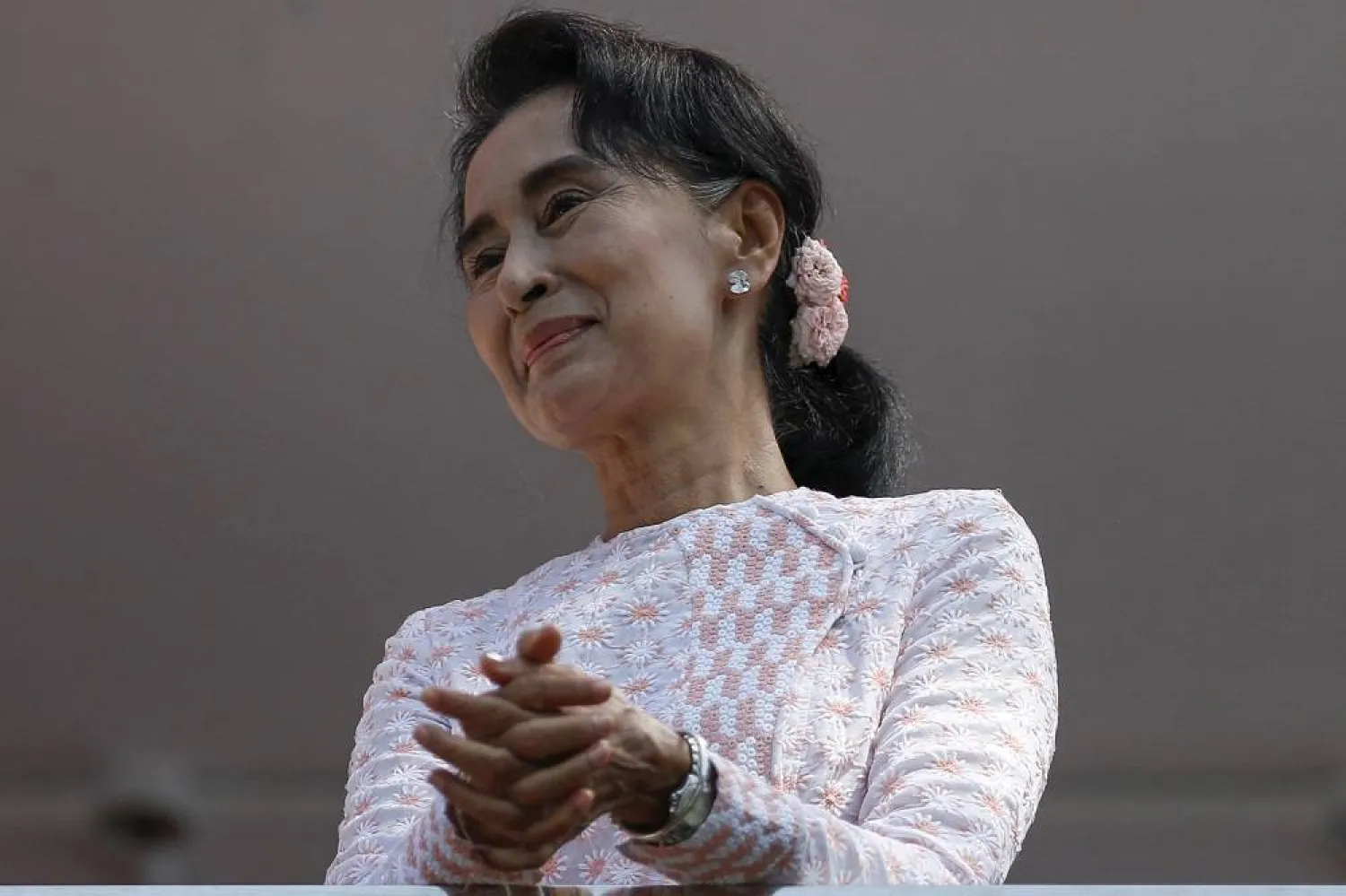

Myanmar’s Suu Kyi Health Worsening in Military Custody, Son Says 

Myanmar's National League for Democracy party leader Aung San Suu Kyi looks at supporters after speaking about the general elections in Yangon, Myanmar November 9, 2015. (Reuters)
TT

Myanmar’s Suu Kyi Health Worsening in Military Custody, Son Says 

Myanmar's National League for Democracy party leader Aung San Suu Kyi looks at supporters after speaking about the general elections in Yangon, Myanmar November 9, 2015. (Reuters)

Myanmar's detained former leader Aung San Suu Kyi is suffering from worsening heart problems and needs urgent medical attention, her son said on Friday, in an appeal for her immediate release from "cruel and life-threatening" custody.

Kim Aris told Reuters that his 80-year-old mother, in military custody since a 2021 coup that deposed her government, had asked to see a cardiologist about a month ago, but he had been unable to determine whether her request had been granted.

"Without proper medical examinations ... it is impossible to know what state her heart is in," he said by phone from London. "I am extremely worried. There is no way of verifying if she is even alive."

The Nobel Peace Prize laureate has also suffered from bone and gum issues, Aris said, adding that it was likely she had been injured in an earthquake in March that killed more than 3,700 people. In a Facebook video, he appealed for Suu Kyi and all political prisoners in Myanmar to be released.

Military spokesman Zaw Min Tun told state media on Saturday evening that reports about her health were intended to distract from military chief Min Aung Hlaing's visit to China where he met with President Xi Jinping and attended a military parade.

"Daw Aung San Suu Kyi's health is good. They are fabricating this information because we are in China and our Myanmar leader is doing so many activities and they want to hide this news," he said on MRTV.

Myanmar has been gripped by violence since the military takeover in February 2021, which prompted mass rallies that were crushed by brutal force, sparking a widespread armed uprising.

Suu Kyi, a long-standing symbol of Myanmar's pro-democracy movement, is serving a 27-year sentence for offenses including incitement, corruption and election fraud, all of which she denies.

One of her last public appearances was in court in May 2021, a few months after the coup, when pictures aired by state television showed her sitting upright in the dock, with her hands in her lap and wearing a surgical mask.

DECADES IN DETENTION

The military justified its takeover on the basis of what it said was widespread fraud in an election that Suu Kyi's party won by a landslide, although election monitors found no evidence of cheating.

Foreign governments and rights groups have consistently called for her release.

Starting in late December, the military-backed interim government plans to hold new elections in multiple phases, the first polls since the one that triggered the coup.

Anti-junta groups, including Suu Kyi's party, are either boycotting or are barred from running, with only military-backed and approved parties participating. Western governments have criticized the vote as a move to entrench the generals' power.

Born in 1945 to Myanmar's independence hero, General Aung San, who was assassinated when she was an infant, Suu Kyi has spent nearly two decades in detention, including some 15 years under house arrest at her colonial-style family home on Yangon's Inya Lake, as ordered by a previous junta.

Educated at Oxford University, she married British scholar Michael Aris in 1972 and had two sons with him, before returning to Myanmar in 1988 to care for her ailing mother.

That is also when she joined nationwide protests against military rule, forming the National League for Democracy party and rising to become Myanmar's most prominent pro-democracy leader.



EU's Kallas Floats Black Sea Model to Unblock Strait of Hormuz

European Union foreign policy chief Kaja Kallas speaks with the media as she arrives for a meeting of EU foreign ministers and representatives of the Gulf Cooperation Council at the European Council building in Brussels, Thursday, March 5, 2026. (AP Photo/Virginia Mayo)
TT

EU's Kallas Floats Black Sea Model to Unblock Strait of Hormuz

European Union foreign policy chief Kaja Kallas speaks with the media as she arrives for a meeting of EU foreign ministers and representatives of the Gulf Cooperation Council at the European Council building in Brussels, Thursday, March 5, 2026. (AP Photo/Virginia Mayo)

EU foreign policy chief Kaja Kallas said on Monday she had discussed with the United Nations the idea of freeing up transport of oil and gas through the Strait of Hormuz by replicating a deal that gets grain out of Ukraine during wartime.

Arriving at a meeting of EU foreign ministers in Brussels, Kallas said she had spoken to UN Secretary General Antonio Guterres about the idea to unblock the strait, currently choked off due to the Iran war, said Reuters.

"I had talks with ‌Antonio Guterres ‌about whether it was possible to also have ‌the ⁠same kind of ⁠initiative like we had (with) the Black Sea Initiative," Kallas said.

Iran has effectively shut the Strait of Hormuz, amid the US-Israeli war on Iran, now in its third week. Iranian forces have attacked ships in the narrow channel between Iran and Oman, choking off a fifth of global oil supply in the biggest disruption ⁠ever. Kallas said the closure of the strait was "really ‌dangerous" for energy supplies to Asia ‌but was also a problem for the production of fertilizers.

"And if there ‌is a lack of fertilizers this year, there's going to ‌be also food deprivation next year," Kallas said. She did not provide any more details. Kallas said ministers would also discuss whether it was possible to change the mandate of the EU's small Middle East naval mission, ‌Aspides, which currently focuses on protecting ships in the Red Sea from Yemen's Houthi rebel group.

"It ⁠is in ⁠our interest to keep the Strait of Hormuz open and that's why we are also discussing what we can do in this regard from the European side," she said. Asked about the skepticism expressed by German Foreign Minister Johann Wadephul on whether Aspides could be useful in the Strait of Hormuz, Kallas said: "Of course we need to also have the member states on board."

"If the member states say that we are not doing anything with this, then of course it's their decision, but we have to discuss how we help to keep the Strait of Hormuz open."


US Marines Sent to Middle East, Join 2-Week-Old War in Iran

A Marine Expeditionary Unit during training in Okinawa, Japan, last year. (Chang W. Lee/The New York Times) 
TT

US Marines Sent to Middle East, Join 2-Week-Old War in Iran

A Marine Expeditionary Unit during training in Okinawa, Japan, last year. (Chang W. Lee/The New York Times) 

By Thomas Gibbons-Neff and Eric Schmitt


The deployment of about 2,500 Marines to the Middle East represents a new phase in the two-week-old war in Iran, as Iranian forces increase their attacks on the Strait of Hormuz.

The unit, officially known as the 31st Marine Expeditionary Unit, according to two US defense officials, will be in an unusual position given the problem vexing the Pentagon: the Iranian military’s ability to mine the strait, a narrow waterway through which a fifth of the world’s oil passes.

US airstrikes have forced the Iranians to forego their larger naval vessels and deploy fast boats carrying mines that can evade aircraft. These boats would likely launch from an archipelago of islands closer to the strait.

With the arrival of the 31st Marine Expeditionary Unit from the Indo-Pacific region in the coming days, the Pentagon will be able to quickly launch raids onto the islands with infantry Marines who will have logistics and air support, said a retired senior defense official with knowledge of the unit’s capabilities.

That raises the risk of escalation. Trump has been quick to authorize smaller-scale military operations — such as the raid to capture President Nicolás Maduro of Venezuela in January — that have possible short-term payoffs but could be disastrous if things go wrong.

Trump announced on social media on Friday that the US military had conducted a large bombing raid on Kharg Island, a key port and Iran’s oil export hub.

Trump said that the raid had “totally obliterated” military forces on the island, but that he had directed the Pentagon not to damage its oil infrastructure, “for reasons of decency.”

The global price of oil has surged by 40% since the United States and Israel began the war with Iran late last month.

Though their numbers are relatively small compared to the 50,000 US troops already in the region, Marine Expeditionary Units are valued by military commanders because they can rapidly put detachments of troops and vehicles on the ground.

In the Strait of Hormuz, the Marines could also conduct counter-drone operations with jamming vehicles placed on their ships, escort tankers and other merchant ships, the retired senior defense official added.

Marine Expeditionary Units typically deploy with several ships, including a short-deck amphibious assault ship that can carry MV-22 Ospreys, transport helicopters and attack jets like the F-35 Joint Strike Fighter. Other vessels carry infantry Marines, their supporting artillery and amphibious assault vehicles for ship-to-shore landings.

With an East Coast expeditionary unit supporting the war in Venezuela and the 31st Marine Expeditionary Unit deploying to the Middle East (the 31st is usually based out of Okinawa, Japan), there will be no quick response force to aid operations in the Pacific theater, including Korea and Taiwan, the former senior US defense official said.

That leaves another gap in US defenses atop the repositioning of critical air defenses from South Korea to the Middle East.

In the past, Marine Expeditionary Units, known colloquially as “America’s 9-1-1 force,” have been deployed to combat zones, evacuated embassies and conducted counter-piracy operations. Marines from the 15th Marine Expeditionary Unit were some of the first conventional US forces on the ground during the US invasion of Afghanistan in 2001.


*The New York Times


Why France is Bolstering Military Presence in the Middle East, as Macron Prepares for Postwar Talks

France's President Emmanuel Macron delivers a speech during a joint press conference with Ukraine's President Volodymyr Zelensky (unseen) following talks focused on the support from France and European partners to help Ukraine defend itself, and on ways to increase pressure on Russia, at the Elysee Presidential Palace in Paris on March 13, 2026. (Photo by Ludovic MARIN / POOL / AFP)
TT

Why France is Bolstering Military Presence in the Middle East, as Macron Prepares for Postwar Talks

France's President Emmanuel Macron delivers a speech during a joint press conference with Ukraine's President Volodymyr Zelensky (unseen) following talks focused on the support from France and European partners to help Ukraine defend itself, and on ways to increase pressure on Russia, at the Elysee Presidential Palace in Paris on March 13, 2026. (Photo by Ludovic MARIN / POOL / AFP)

France's government is bolstering the country's military presence in the Middle East, dispatching its aircraft carrier and other warships, while President Emmanuel Macron engages with key players in the conflict, including Iran, in a bid to position Paris for future diplomatic talks.

Macron said that France’s military involvement is strictly “defensive” and aims to avoid making the country a party to the war, The Associated Press said.

He reaffirmed that position after one French soldier was killed Thursday in a drone attack in Iraq.

“We are not at war with anyone,” Macron said.

Still, the large-scale deployment of the French navy — which he described as “unprecedented” — has made France the European nation with the most prominent presence in the region.

Visiting the Charles de Gaulle aircraft carrier last week, Macron said that its presence in the Mediterranean demonstrates “France’s strength: a balancing power, a force for peace.”

Here’s what to know about Macron' strategy.

France’s large naval deployment Macron announced the deployment to the eastern Mediterranean and the wider Middle East of eight warships, two helicopter carriers and the nuclear-powered aircraft carrier Charles de Gaulle with its 20 Rafale fighter jets.

The French frigate Languedoc arrived off Cyprus, a fellow European Union member, to bolster anti-drone and anti-missile defenses. Cyprus and France signed a new strategic partnership in December. Macron also said that two French frigates have been dispatched to the Red Sea to help ensure maritime security and freedom of navigation.

Macron said that the warship deployment is intended to allow France “to respond to emergency situations” and evacuate French nationals if necessary.

France has more than 400,000 citizens in the Middle East — more than any other European country — including more than half in Israel and over 60,000 in the United Arab Emirates.

Other European nations, including Spain, Italy, the Netherlands and Greece, have deployed frigates in the region.

The French navy’s swift deployment contrasts with the United Kingdom's delay in sending the HMS Dragon destroyer, which left Portsmouth, England, on March 10.

UK opposition parties have accused Prime Minister Keir Starmer's government of moving too slowly to protect British bases in Cyprus and allies in the Middle East. The UK government also has sent Typhoon and F-35 fighter jets, helicopters and air defense systems to the region to help intercept Iranian missiles and drones.

Defending Gulf allies France has key defense agreements with several countries in the region, including Qatar, Kuwait and the UAE, where it maintains a permanent base in Abu Dhabi. France's military, which has air and naval forces there, doubled the number of Rafale fighter jets stationed on site to 12.

French authorities acknowledged that Rafale jets intercepted drones targeting the UAE since the beginning of the war.

“We stand by the side of our allies and our friends,” Macron said during his visit to the Charles de Gaulle. “There have been some interceptions that have continued in recent days.”

“We do so within the framework of our partnerships,” he said, without providing further details.

French forces are also deployed in Jordan and Iraq.

On Thursday, one French soldier was killed and several others injured in a drone attack in the region of Irbil, in northern Iraq. They were training Iraqi units as part of a multinational counterterrorism mission in the country.

Former President François Hollande, who led France from 2012 to 2017, said that it was important for France to show it can protect its nationals and reassure its partners, but warned of the risks.

“We must be careful — it’s always a risky operation — to make sure our warships are not targeted,” Hollande said. “Because if they are attacked, we have to fire back.”

Historic ties with Lebanon Macron is leading a diplomatic effort to try to halt the conflict in Lebanon, where at least 850 people have been killed and hundreds of thousands displaced as the Hezbollah militant group entered a new round of fighting with Israel. Macron urged Hezbollah to stop fighting and called on Israel to renounce any ground offensive.

France supports the Lebanese military as authorities have pledged to “take control” of positions held by Hezbollah and assume full responsibility for security in the country, Macron said. Hezbollah’s arsenal notably includes exploding drones, similar to the ones used by Iran.

France has traditionally been a key supporter of Lebanon, a former French protectorate, and maintains 800 troops in the UN peacekeeping force there. The French government provided the country with armored vehicles and operational military support.

France sent 60 tons of emergency aid to Lebanon last week on a humanitarian flight to Beirut, authorities said. The shipment included medicines, medical equipment, a mobile health unit, shelter materials, basic necessities and infant formula.

Maintaining contact with Iran Macron was the first Western leader to speak with Iranian President Masoud Pezeshkian since the war began.

He said he urged Iran to halt strikes against countries in the region. Since the phone call on March 8, this appeal had gone unanswered.

Macron stressed that “a diplomatic solution” is needed to end the escalation and said that he and Pezeshkian agreed to remain in contact.

Macron also spoke with Israeli Prime Minister Benjamin Netanyahu and US President Donald Trump, though there were no signs of de-escalation.

France hopes diplomatic efforts could bear fruit once the most intense phase of the conflict subsides, which could take weeks or months.

Macron is also promoting an international effort to secure the Strait of Hormuz, a key energy corridor, so oil, gas and goods can flow freely again “when circumstances permit.” He has suggested countries could use warships to escort tankers and container ships once fighting eases.

Political analyst Bertrand Badie, an international relations professor at Sciences Po Paris, said Macron has long sought to assert France’s role on the global stage.

With low approval ratings at home and about a year left in his term, Macron may have the most to gain among European leaders by pursuing diplomacy, Badie said.

“At this point, we are forced to scale back our expectations — drastically,” he said. “From a diplomatic standpoint, what leverage does France really have?”

“My assessment is that this crisis cannot be resolved by French remedies,” Badie said. “There is no point in having any illusions.”