


Why France is Bolstering Military Presence in the Middle East, as Macron Prepares for Postwar Talks

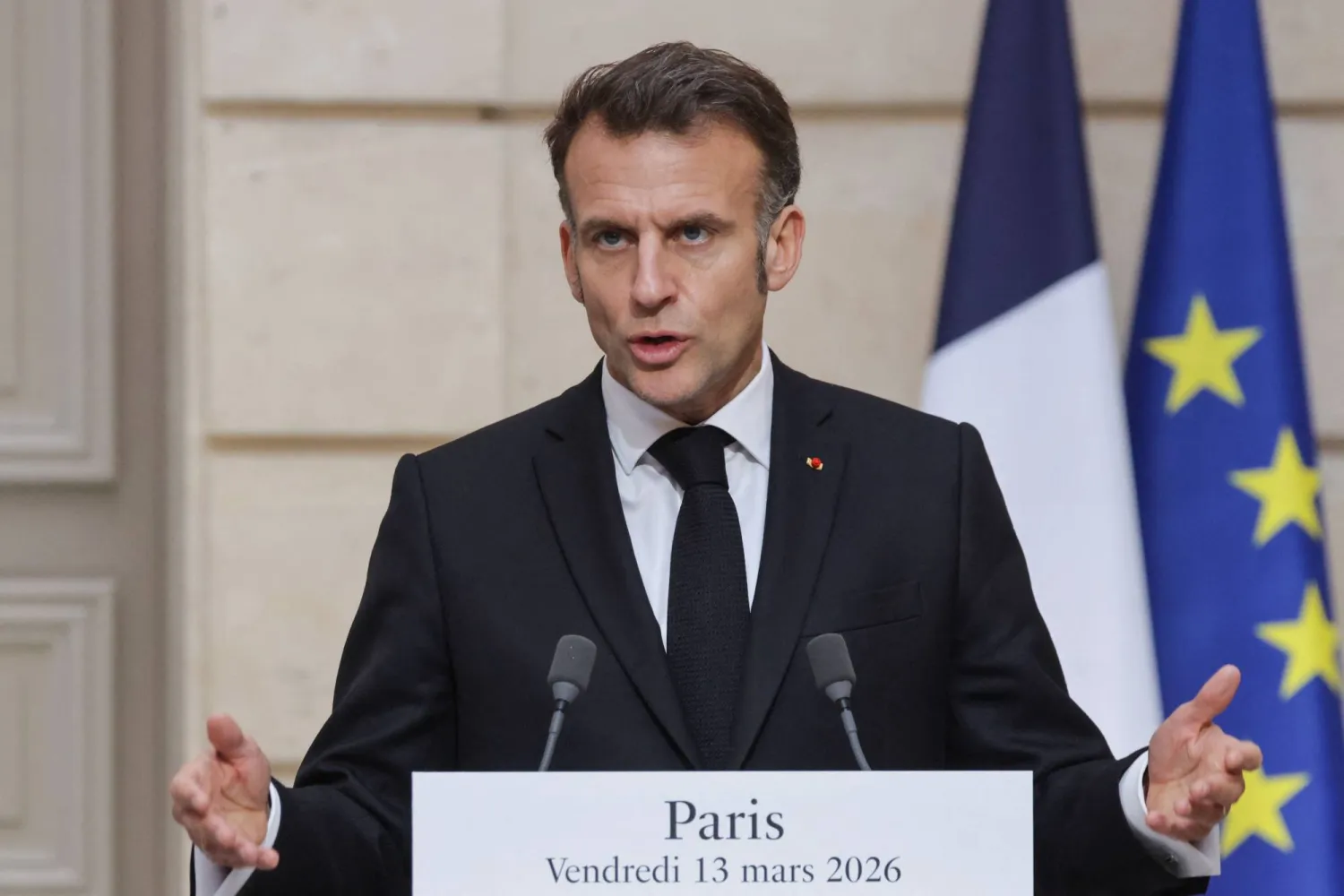
France's President Emmanuel Macron delivers a speech during a joint press conference with Ukraine's President Volodymyr Zelensky (unseen) following talks focused on the support from France and European partners to help Ukraine defend itself, and on ways to increase pressure on Russia, at the Elysee Presidential Palace in Paris on March 13, 2026. (Photo by Ludovic MARIN / POOL / AFP)
TT

Why France is Bolstering Military Presence in the Middle East, as Macron Prepares for Postwar Talks

France's President Emmanuel Macron delivers a speech during a joint press conference with Ukraine's President Volodymyr Zelensky (unseen) following talks focused on the support from France and European partners to help Ukraine defend itself, and on ways to increase pressure on Russia, at the Elysee Presidential Palace in Paris on March 13, 2026. (Photo by Ludovic MARIN / POOL / AFP)

France's government is bolstering the country's military presence in the Middle East, dispatching its aircraft carrier and other warships, while President Emmanuel Macron engages with key players in the conflict, including Iran, in a bid to position Paris for future diplomatic talks.

Macron said that France’s military involvement is strictly “defensive” and aims to avoid making the country a party to the war, The Associated Press said.

He reaffirmed that position after one French soldier was killed Thursday in a drone attack in Iraq.

“We are not at war with anyone,” Macron said.

Still, the large-scale deployment of the French navy — which he described as “unprecedented” — has made France the European nation with the most prominent presence in the region.

Visiting the Charles de Gaulle aircraft carrier last week, Macron said that its presence in the Mediterranean demonstrates “France’s strength: a balancing power, a force for peace.”

Here’s what to know about Macron' strategy.

France’s large naval deployment Macron announced the deployment to the eastern Mediterranean and the wider Middle East of eight warships, two helicopter carriers and the nuclear-powered aircraft carrier Charles de Gaulle with its 20 Rafale fighter jets.

The French frigate Languedoc arrived off Cyprus, a fellow European Union member, to bolster anti-drone and anti-missile defenses. Cyprus and France signed a new strategic partnership in December. Macron also said that two French frigates have been dispatched to the Red Sea to help ensure maritime security and freedom of navigation.

Macron said that the warship deployment is intended to allow France “to respond to emergency situations” and evacuate French nationals if necessary.

France has more than 400,000 citizens in the Middle East — more than any other European country — including more than half in Israel and over 60,000 in the United Arab Emirates.

Other European nations, including Spain, Italy, the Netherlands and Greece, have deployed frigates in the region.

The French navy’s swift deployment contrasts with the United Kingdom's delay in sending the HMS Dragon destroyer, which left Portsmouth, England, on March 10.

UK opposition parties have accused Prime Minister Keir Starmer's government of moving too slowly to protect British bases in Cyprus and allies in the Middle East. The UK government also has sent Typhoon and F-35 fighter jets, helicopters and air defense systems to the region to help intercept Iranian missiles and drones.

Defending Gulf allies France has key defense agreements with several countries in the region, including Qatar, Kuwait and the UAE, where it maintains a permanent base in Abu Dhabi. France's military, which has air and naval forces there, doubled the number of Rafale fighter jets stationed on site to 12.

French authorities acknowledged that Rafale jets intercepted drones targeting the UAE since the beginning of the war.

“We stand by the side of our allies and our friends,” Macron said during his visit to the Charles de Gaulle. “There have been some interceptions that have continued in recent days.”

“We do so within the framework of our partnerships,” he said, without providing further details.

French forces are also deployed in Jordan and Iraq.

On Thursday, one French soldier was killed and several others injured in a drone attack in the region of Irbil, in northern Iraq. They were training Iraqi units as part of a multinational counterterrorism mission in the country.

Former President François Hollande, who led France from 2012 to 2017, said that it was important for France to show it can protect its nationals and reassure its partners, but warned of the risks.

“We must be careful — it’s always a risky operation — to make sure our warships are not targeted,” Hollande said. “Because if they are attacked, we have to fire back.”

Historic ties with Lebanon Macron is leading a diplomatic effort to try to halt the conflict in Lebanon, where at least 850 people have been killed and hundreds of thousands displaced as the Hezbollah militant group entered a new round of fighting with Israel. Macron urged Hezbollah to stop fighting and called on Israel to renounce any ground offensive.

France supports the Lebanese military as authorities have pledged to “take control” of positions held by Hezbollah and assume full responsibility for security in the country, Macron said. Hezbollah’s arsenal notably includes exploding drones, similar to the ones used by Iran.

France has traditionally been a key supporter of Lebanon, a former French protectorate, and maintains 800 troops in the UN peacekeeping force there. The French government provided the country with armored vehicles and operational military support.

France sent 60 tons of emergency aid to Lebanon last week on a humanitarian flight to Beirut, authorities said. The shipment included medicines, medical equipment, a mobile health unit, shelter materials, basic necessities and infant formula.

Maintaining contact with Iran Macron was the first Western leader to speak with Iranian President Masoud Pezeshkian since the war began.

He said he urged Iran to halt strikes against countries in the region. Since the phone call on March 8, this appeal had gone unanswered.

Macron stressed that “a diplomatic solution” is needed to end the escalation and said that he and Pezeshkian agreed to remain in contact.

Macron also spoke with Israeli Prime Minister Benjamin Netanyahu and US President Donald Trump, though there were no signs of de-escalation.

France hopes diplomatic efforts could bear fruit once the most intense phase of the conflict subsides, which could take weeks or months.

Macron is also promoting an international effort to secure the Strait of Hormuz, a key energy corridor, so oil, gas and goods can flow freely again “when circumstances permit.” He has suggested countries could use warships to escort tankers and container ships once fighting eases.

Political analyst Bertrand Badie, an international relations professor at Sciences Po Paris, said Macron has long sought to assert France’s role on the global stage.

With low approval ratings at home and about a year left in his term, Macron may have the most to gain among European leaders by pursuing diplomacy, Badie said.

“At this point, we are forced to scale back our expectations — drastically,” he said. “From a diplomatic standpoint, what leverage does France really have?”

“My assessment is that this crisis cannot be resolved by French remedies,” Badie said. “There is no point in having any illusions.”



Europeans Seek Clarity About Trump’s Iran War Aims Before Agreeing to His Warship Demands

European Union High Representative for Foreign Affairs and Security Policy Kaja Kallas arrives ahead of a Foreign Affairs Council meeting at the Council of the European Union in Brussels, Belgium, 16 March 2026. (EPA)
TT

Europeans Seek Clarity About Trump’s Iran War Aims Before Agreeing to His Warship Demands

European Union High Representative for Foreign Affairs and Security Policy Kaja Kallas arrives ahead of a Foreign Affairs Council meeting at the Council of the European Union in Brussels, Belgium, 16 March 2026. (EPA)

European countries on Monday sought more details about US President Donald Trump's plans for the war on Iran and warned that NATO must not become involved it, as they weighed whether to agree to his call to send warships to help shore up security in the Gulf.

The cool response to Trump’s demand reflects wide caution about the US-Israeli war among allies kept in the dark before, and largely since, it was launched on Feb. 28.

Trump has asked partners, including France, China, Japan, South Korea and Britain, to help secure the Strait of Hormuz for global shipping. He said the United States was talking to “about seven” countries, but he wouldn’t say which ones and gave no indication of when such a coalition might be formed.

UK Prime Minister Keir Starmer insisted Britain “will not be drawn into the wider war,” and said British troops should only be sent into action that is legal and has “a proper thought-through plan.” But his country is considering other forms of help in conjunction with allies.

In an interview with the Financial Times, Trump also warned that “if there’s no response or if it’s a negative response, I think it will be very bad for the future of NATO.”

German Chancellor Friedrich Merz said that “NATO is a defensive alliance, not an interventionist one. And that is precisely why NATO has no business being involved here.” He said he hopes that NATO allies “will treat one another with the necessary respect within the alliance.”

Merz agreed that “this Iranian regime must come to an end,” but he said that "based on all the experience we have gained in previous years and decades, bombing it into submission is, in all likelihood, not the right approach.”

EU debates Trump's demand

Many are keen to know when the war will end.

At a meeting in Brussels, where European Union foreign ministers gathered to discuss Trump's demand, German Foreign Minister Johann Wadephul said it's important for the US and Israel to define “when they consider the military aims of their deployment to have been reached.”

“We need more clarity here,” Wadephul told reporters.

Estonian Foreign Minister Margus Tsahkna also said that US allies in Europe want to understand Trump’s “strategic goals. What will be the plan?”

Polish Foreign Minister Radek Sikorski invited the Trump administration to go through the proper channels.

“If there is a request via NATO, we will of course out of respect and sympathy for our American allies consider it very carefully,” he said. Sikorski made a reference to Article 4 of NATO's founding treaty, which allies can invoke if they believe their territory or security is under threat.

Acting in Europe's interests

Still, EU foreign policy chief Kaja Kallas said that “it is in our interest to keep the Strait of Hormuz open."

Kallas had urged the 27 member countries to expand the EU's Operation Aspides naval mission to protect shipping in the Red Sea up into the Persian Gulf. But after chairing the meeting, she said there had been “no appetite” to boost its mandate.

But Kallas said the EU would closely monitor threats to maritime security also in the Red Sea, where Aspides operates with three warships. “The risk that the Houthis get involved is real. So we must remain vigilant,” she said.

Yemen’s Iran-backed Houthi militants have so far remained on the sidelines of the war even as it has spread across the Middle East, raising questions about why, and perhaps when, the battle-hardened militants might join the fight.

It was not immediately clear whether some European countries might go it alone and form a “coalition of the willing” to provide military support on an ad hoc basis.

The war in Iran has driven up energy prices worldwide, with Brent crude up more than 40%. The conflict has also disrupted the wider global supply chain beyond oil, affecting things like pharmaceuticals from India, semiconductors from Asia and oil-derived products like fertilizers that come from the Middle East.

Cargo ships are stuck in the Gulf or making a much longer detour around the southern tip of Africa. Planes carrying air cargo out of the Middle East are grounded. And the longer the war drags on, the more likely that there will be shortages and price increases on a wide range of goods.

France has said it is working with countries — French President Emmanuel Macron mentioned partners in Europe, India and Asia — on a possible mission to escort ships through the strait but has stressed it must be when “the circumstances permit,” when fighting has subsided.

French senior officials, speaking anonymously on ongoing talks, said the Netherlands, Italy and Greece had shown interest and that Spain might be involved in some way.

Starmer said Britain is discussing with the US and allies in Europe and the Gulf the possibility of using its mine-hunting drones already in the region.


Trump on Iran: We Don’t Know Their Leaders

US President Donald Trump speaks during a meeting with trustees of the John F. Kennedy Center for Performing Arts in the East Room of the White House in Washington, DC, USA, 16 March 2026. (EPA)
TT

Trump on Iran: We Don’t Know Their Leaders

US President Donald Trump speaks during a meeting with trustees of the John F. Kennedy Center for Performing Arts in the East Room of the White House in Washington, DC, USA, 16 March 2026. (EPA)

President Donald Trump said on Monday that he believes Iran wants to make a deal to end the US-Israeli conflict with Tehran but that it is unclear who is actually leading Iran.

"We don't know who their leader is. We ‌have people ‌wanting to negotiate. We have ‌no ⁠idea who they ⁠are," Trump told reporters during a White House event.

After Iran's supreme leader, Ali Khamenei, was killed in the initial strikes of the war, Tehran announced his ⁠son, Mojtaba Khamenei, had been ‌named as ‌his successor.

Pentagon chief Pete Hegseth said ‌last week the new leader ‌was believed to have been wounded in a strike. He has not been seen publicly.

"A lot of people ‌are saying that he's badly disfigured. They're saying that he lost ⁠his ⁠leg ... and he's been hurt very badly. Other people are saying he's dead," Trump said.

Oman has attempted multiple times to open a line of communication between the United States and Iran, but the White House made it clear it is not interested at this juncture, Reuters reported on Saturday.


Middle East War ‘Not a Matter for NATO’, Says Germany’s Merz

 German Chancellor Friedrich Merz, attends a joint press conference with the Prime Minister of the Netherlands, Rob Jetten after their meeting at the chancellery in Berlin, Germany, Monday, March 16, 2026. (AP)
German Chancellor Friedrich Merz, attends a joint press conference with the Prime Minister of the Netherlands, Rob Jetten after their meeting at the chancellery in Berlin, Germany, Monday, March 16, 2026. (AP)
TT

Middle East War ‘Not a Matter for NATO’, Says Germany’s Merz

 German Chancellor Friedrich Merz, attends a joint press conference with the Prime Minister of the Netherlands, Rob Jetten after their meeting at the chancellery in Berlin, Germany, Monday, March 16, 2026. (AP)
German Chancellor Friedrich Merz, attends a joint press conference with the Prime Minister of the Netherlands, Rob Jetten after their meeting at the chancellery in Berlin, Germany, Monday, March 16, 2026. (AP)

Chancellor Friedrich Merz on Monday said the war in the Middle East started by US-Israeli strikes on Iran was "not a matter for NATO" and Germany would not be taking part in it.

"It has been clear at all times that this war is not a matter for NATO," Merz said, adding that the US and Israel "did not consult us prior to this war".

"There was never a joint decision on whether to intervene. That is why the question of how Germany might contribute militarily does not arise. We will not do so," Merz said at a press conference alongside his Dutch counterpart Rob Jetten.

US President Donald Trump on Sunday called for nations including South Korea, France, China and Britain to help ensure safe passage in the Strait of Hormuz, which Iran has declared closed to US and US-allied traffic.

He later upped the pressure on NATO allies, telling the Financial Times newspaper that the alliance faced a "very bad" future if its members did not do their bit to reopen the strait.

Merz ruled out Germany sending ships to the Strait of Hormuz.

"For as long as the war continues, we will not be involved in ensuring free passage in the Strait of Hormuz by military means," he said.

Merz's spokesman Stefan Kornelius earlier also said the war had "nothing to do with NATO".

"NATO is an alliance for the defense of territory" and "the mandate to deploy NATO is lacking", Kornelius told a regular press briefing.

At a separate briefing on Monday, Defense Minister Boris Pistorius said Germany wanted all those involved to prevent "further military escalation".

"There will be no military participation" from Germany but Berlin is prepared to support diplomatic efforts to "to ensure safe passage through the Strait of Hormuz", he said.

"We have a situation which we did not provoke... This war started without any consultations," Pistorius added.

Germany's main responsibility is "for the eastern flank and the high north", he said, and "we stay committed to that but we can't be anywhere in the world".

"What does Donald Trump expect from a handful of European frigates in the Strait of Hormuz that the mighty US navy cannot manage alone? This is the question I find myself asking," Pistorius said.