
Sotheby’s Strikes Alliance with Ascendant Art Fair in Manhattan

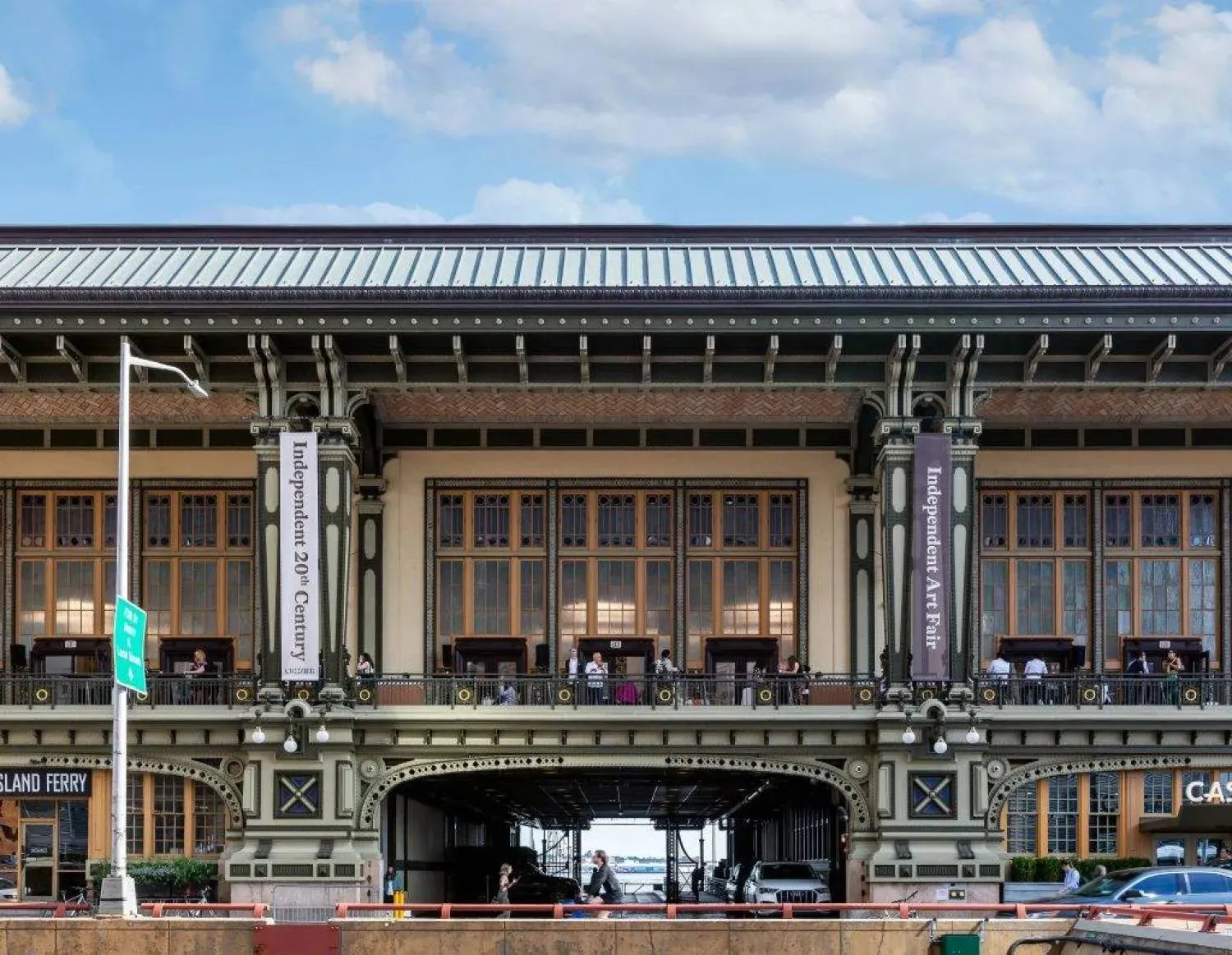
The Independent 20th Century art fair has been held in the Battery Maritime Building in Manhattan. (The New York Times)
TT

Sotheby’s Strikes Alliance with Ascendant Art Fair in Manhattan

The Independent 20th Century art fair has been held in the Battery Maritime Building in Manhattan. (The New York Times)

Sotheby’s and Independent announced on Monday that they have entered into a multiyear commitment that will bring Independent 20th Century art fair — focused on art made between 1900 and 2000 — to the Breuer building in Manhattan starting in 2026.

The agreement represents a first-of-its-kind partnership between notable players in the auction and art fair sectors. It is also an indication of how differently Sotheby’s New York headquarters may approach public programming after the company officially takes up residence in the Modernist landmark at 945 Madison Avenue this November.

“When we acquired the Breuer, we knew it would open a whole world of possibilities, but we didn’t know what they were,” Charles Stewart, Sotheby’s chief executive, said in a group interview on Sept. 3. “This is one of those possibilities that’s come about because of this architectural icon.”

Independent 20th Century will debut at the Breuer from Sept. 24 to 27, 2026, with more than 50 exhibiting galleries — a 50% increase in size compared to the four editions of the fair staged at Casa Cipriani inside the Battery Maritime Building.

Although Sotheby’s and Independent declined to disclose further terms of the deal, both companies confirmed that other prospects under discussion include additional programming and exhibitions.

“None of us at this table are interested in a landlord-tenant relationship; we’re interested in going beyond what fairs can be,” Elizabeth Dee, Independent’s founder and creative director, said during the interview with Stewart; Independent’s chief operating officer, Sofie Scheerlinck; and the gallerist Alma Luxembourg, who is also a member of Independent 20th Century’s founding committee.

“We got in a room, started talking about all the things that are working and not working in culture, and we’re all aligned in terms of how to work together to move forward and innovate,” Dee said.

Although its effect on Sotheby’s bottom line will be minimal, the pact has tangible value to the company. Madeline Lissner, Sotheby’s global head of fine art, said working with Independent will help position the company as “more than an auction house,” and the Breuer as a cultural hub that attracts attention “for moments that are not just selling-focused,” as the company is also seeking to do with its new locations in Hong Kong and Paris.

The financial ups and downs of Sotheby’s and Patrick Drahi, the French-Israeli telecom billionaire who acquired the auction house in a take-private deal in 2019, have received particular attention amid the art market’s larger struggles.

Sotheby’s reported $2.2 billion in auction sales in the first half of 2025, a decrease of 4% compared to the same period a year earlier. Its $4.6 billion in auction sales in 2024 represented a year-over-year decline of 28%.

Sotheby’s sold a stake of between 25% and 30% to ADQ, Abu Dhabi’s sovereign wealth fund, last fall, in a deal valued at $1 billion.

The auction house then trimmed its work force by around 4%, it said Sunday.

A slew of contemporary galleries have permanently closed since that time, while four art fairs have canceled or postponed forthcoming editions.

An alliance between an auction house and an art fair — and by extension, the galleries who show there — has been a long time coming. Ever since the 1973 evening auction of contemporary artworks owned by the New York taxi magnates Robert and Ethel Scull, at what was then Sotheby Parke Bernet, auction houses and galleries have operated less and less as occupants of distinct sectors of the art trade than as competitors whose specialties increasingly overlap in shared territory.

The best known example is the two-part evening auction in 2008 at Sotheby’s London in which Damien Hirst bypassed his galleries to sell more than $200 million worth of his new art directly to buyers.

But the door swung in the opposite direction, too.

In 2020, for instance, the late real estate tycoon Donald Marron’s collection of Modern and postwar artworks, estimated to be worth $450 million, was sold jointly by Acquavella Galleries, Gagosian and Pace Gallery rather than an auction house.

These milestone events were natural outgrowths of longer-running processes, as major auction houses built up robust private-sales departments, and public auction prices increasingly influenced the demand for new works by the same artists in galleries.

Independent offers two annual fairs by invitation; the second, a larger contemporary fair simply called Independent, is held in New York each May. It will also double its square footage by moving to Pier 36, an event venue at 299 South Street.

Compared with Art Basel, a storied competitor in Switzerland that typically includes about 300 galleries, there were 82 exhibitors at the most recent edition of Independent in May 2025, and the company employs only eight full-time staff members.

On the other side, partnering with Sotheby’s could unlock the resources of a multinational corporation that draws Modern art buyers who typically acquire at auction. But will the fair have to trade in some of the autonomy that has underwritten Independent’s success?

“Sotheby’s will not have any curatorial voice within our exhibition,” Dee said when asked. “Why would we, after 17 years, not want to pursue a curatorial vision in the Breuer building?” She added, “Why would we want to become a part of the monoculture we’re fighting against?”

Conceived as the first custom-designed site for the Whitney Museum of American Art in 1966, the Breuer temporarily hosted exhibitions by the Metropolitan Museum of Art, 2016-20, and the Frick Collection, 2021-24.

Sotheby’s only stewards works of art for, at most, a few months at a time and all in the service of passing them on to new owners at the highest prices the market will bear.

Both Sotheby’s and Independent believe this distinguished setting matters to how buyers see and value works of art.

Under the architecture firm Herzog & de Meuron, in partnership with PBDW Architects, parts of the Breuer’s interiors are being remodeled to function largely as permanent exhibition spaces, a boon for Independent’s galleries and a sharp counterpoint to the cubicle format of the average art fair.

The venue change will also lower exhibiting galleries’ costs by an average of 25% compared with Independent 20th Century’s most recent edition, Scheerlinck said.

Dee cautions that doubling the fairs’ footprints will not mean doubling its exhibitor capacity. Doing so would improve the organization’s margins but would cut against its quality-over-quantity ethos.

“If it were a pure numbers game, we would stuff the Breuer and we would stuff Pier 36, but we’re not going to,” Scheerlinck said, “while being very mindful of course that everyone has to survive.”

Joe Nahmad, the founder of Nahmad Contemporary gallery, who is also on Independent 20th Century’s founding committee, said that “what excites me about this new wave on the Upper East Side is how architecture and world-class exhibitions will be coming together to make the historic feel contemporary.”

Whether the experience will “spark passion in a new generation of collectors,” as Nahmad predicted, is still to be seen.

*The New York Times


Saudi Culture Ministry Launches UK-KSA Arabian Peninsula Cultural Research Fellowships

The Saudi flag. Asharq Al-Awsat
TT

Saudi Culture Ministry Launches UK-KSA Arabian Peninsula Cultural Research Fellowships

The Saudi flag. Asharq Al-Awsat

The Ministry of Culture has launched the UK-KSA Arabian Peninsula Cultural Research Fellowships in partnership with Effat University and the National Archives of the United Kingdom, to support archival-based research, advance cultural inquiry on the Arabian Peninsula, and strengthen collaboration between researchers and institutions in Saudi Arabia and the United Kingdom.

The program includes a 10-week research residency at the National Archives of the United Kingdom, where participants receive hands-on training in archival methods and gain access to a wide range of archival collections and cultural institutions across the UK. It supports diverse areas of cultural research related to the Arabian Peninsula.

This initiative aligns with the Ministry of Culture’s strategic vision for advancing cultural research, reflecting its commitment to fostering both local and international collaboration and promoting meaningful cultural exchange.

The fellowship is open to researchers and cultural heritage specialists capable of conducting independent research in English, regardless of their professional level.


Culture Ministry Signs Partnership with Guildhall School of Music & Drama for Riyadh University of Arts

Culture Ministry Signs Partnership with Guildhall School of Music & Drama for Riyadh University of Arts
TT

Culture Ministry Signs Partnership with Guildhall School of Music & Drama for Riyadh University of Arts

Culture Ministry Signs Partnership with Guildhall School of Music & Drama for Riyadh University of Arts

The Ministry of Culture signed on Thursday a partnership with Guildhall School of Music & Drama for Riyadh University of Arts (RUA)’s College of Music. The partnership aims to further develop cultural and artistic talent and drive cultural exchange.

Under the terms of the partnership, Guildhall School will work with RUA to co-design undergraduate, postgraduate and research programs spanning music performance, production and education, in addition to training and capability development opportunities for RUA’s faculty body.

The programs will help cultivate and support Saudi talent across a wide range of musical disciplines, as well as provide students with a firm understanding of creative processes, research pathways and professional skills.

Founded in 1880, Guildhall School is a vibrant, international community of musicians, actors and production artists. Ranked as number one in Arts, Drama and Music by the Complete University Guide 2025, and in the top three in the world for Music by the QS World University Rankings 2025, Guildhall delivers world-class professional training in partnership with distinguished artists, companies and ensembles, SPA reported.

The partnership with Guildhall School sits within a series of partnerships for the Riyadh University of Arts and its colleges with leading international institutions to co-design academic programs, collaborate in research, and offer enriching programs in cultural education and development.

In December 2025, RUA announced partnerships between their College of Film and the University of Southern California’s (USC) School of Cinematic Arts (SCA); between SOAS University of London and their College of Heritage and Civilization Studies; AMDA College of the Performing Art and RUA’s College of Theater and Performing Art; and between ESSEC Business School and RUA’s College of Cultural Management. A further agreement was signed with the Royal College of Art (RCA) and RUA’s College of Architecture and Design and College of Visual Arts and Photography in January 2026.

Riyadh University of Arts was established by royal decree and is headquartered in Riyadh. Its Board of Trustees is chaired by Minister of Culture Prince Bader bin Abdullah bin Farhan. The university is dedicated to advancing education in the fields of culture and the arts, serving as a cornerstone for creative learning and cultural innovation. It aims to empower students with the knowledge, skills, and vision needed to shape the future of Saudi Arabia’s creative economy.

The university will launch its programs in phases, gradually expanding to cover a wide range of fields and specialized disciplines. It will offer a comprehensive academic portfolio that supports continuous education across the arts and culture sectors, including short courses, diplomas, bachelor’s degrees, higher diplomas, master’s degrees, and PhDs.


Czech ‘Arks’ Help Preserve Ukraine’s Cultural Heritage

A photo taken in Prague's National Museum shows a 3D scanner in the Archa III (Ark Project) truck on March 24, 2026 in Prague, Czech Republic. (AFP)
TT

Czech ‘Arks’ Help Preserve Ukraine’s Cultural Heritage

A photo taken in Prague's National Museum shows a 3D scanner in the Archa III (Ark Project) truck on March 24, 2026 in Prague, Czech Republic. (AFP)

The National Museum in Prague on Tuesday unveiled a van containing a 3D scanning device that will soon travel to war-ravaged Ukraine to help preserve its cultural artifacts.

The Archa (Ark) III is a Volkswagen van comprising a studio equipped with a robot and three cameras to create precise models of endangered historic items in Ukraine, which has been battling a full-scale Russian invasion since 2022.

"Archa III is a unique mobile digitization device enabling us to create high-quality 3D images of endangered artifacts and collection items out in the field," National Museum director Michal Lukes told reporters.

He added the scanners could handle both tiny objects and more sizeable items even inside museums.

"In this way, we can create precise digital copies of items that can then serve for documentation and research purposes, but also for restoration, potential reconstruction, or the production of copies," he added.

Museum staff will drive the van to Kyiv in early April and hand it over to Ukrainian partners under the project carried out in cooperation with the foundation of Czech billionaire Karel Komarek.

It follows an Archa I container equipped to conserve and restore books and an Archa II van digitizing two-dimensional items, which Prague sent to Ukraine earlier.

The foundation, which worked on the first two "Arks" with other institutions, said they have so far handled almost 40,000 pages of documents, such as historic newspapers retrieved from the Regional Scientific Library in Kherson.

"The van comprises an autonomous robotic system designed for photogrammetry and 3D output," said the museum's IT director Martin Soucek.

Speed is crucial, and the robot moving along three axes can generate thousands of high-quality photographs within minutes.

"It then uses the photographs to create a hyper-realistic model with high detail, a so-called digital twin," Soucek added.

The project also involves expert training and a website on which the scanned artifacts will be exhibited.

Vitalii Usatyi, the charge d'affaires at the Ukrainian embassy in Prague, hailed the van for being able to work across Ukraine, "including regions exposed to risks related to the Russian aggression".

"This is crucial for preserving cultural heritage," he added.

A recent UNESCO report said that 523 cultural sites had been verified as damaged as of March 11, including 153 religious sites, 273 buildings of historical or artistic interest, 39 museums, 33 monuments, 20 libraries, four archaeological sites and one archive.