



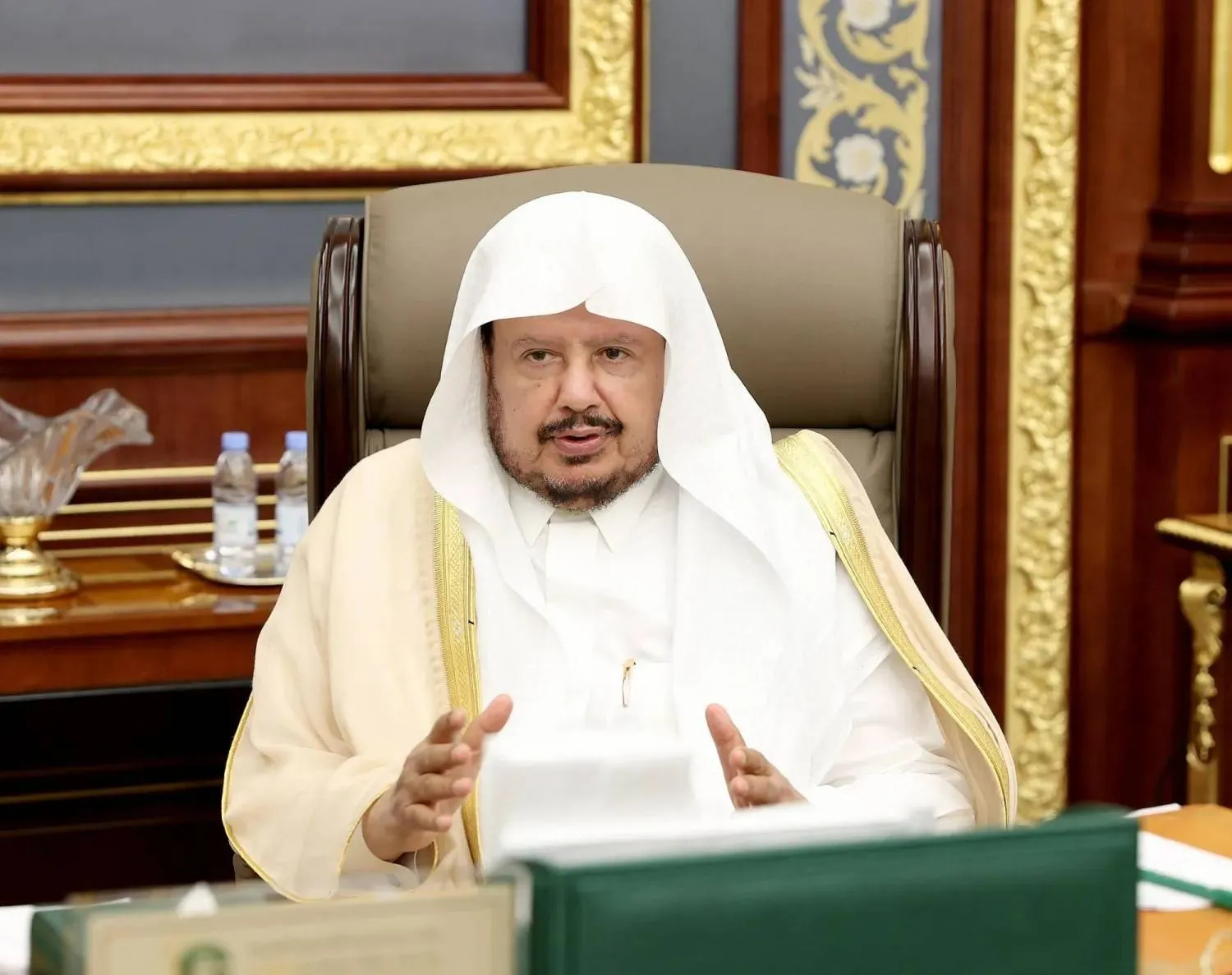

Saudi Arabia’s annual royal speech lays out a comprehensive roadmap for the kingdom’s domestic and foreign policies, reflects its political stability and economic growth, and underscores reforms under Vision 2030, the head of the Shura Council said.
Sheikh Dr. Abdullah bin Mohammed Al Al-Sheikh, chairman of the advisory body, said the address highlights Saudi Arabia’s “firm positions” on regional and international issues, including support for just causes, service to Islam and Muslims, and the promotion of global peace and security.
Crown Prince Mohammed bin Salman, who is also prime minister of Saudi Arabia, will deliver the speech on behalf of King Salman on Wednesday to open the second year of the Shura’s ninth session.
In an interview with Asharq al-Awsat newspaper at his Riyadh office ahead of the event, Al-Sheikh expressed “deepest gratitude” to King Salman and Crown Prince Mohammed for their support of the Shura Council, which he said had enabled it to perform its legislative and oversight roles “as a key partner in the state.”
A program of action
Al-Sheikh said the annual royal address is more than a statement of principles: “It is a program of action that sets out national priorities, strategic directions and development objectives.”
He said the council regards the speech as a guiding reference in shaping its agenda, debates and resolutions. “It helps determine the focus of work across political, economic, social and development fields,” he said, adding that the council seeks to translate its content into studies, decisions and oversight that support state programs and initiatives.
The chairman said past royal addresses had had “a profound impact” on the council’s performance in previous sessions, and that this year’s would serve as a “beacon” for upcoming work, reinforcing the council’s role in institutional governance and the kingdom’s current phase of transformation.
Legislative and oversight record
Reviewing the first year of the ninth session, Al-Sheikh said the Shura had achieved “prominent national accomplishments,” adopting 462 resolutions during 41 regular sessions. These included 180 decisions related to government performance reports, 50 on draft laws and regulations, and 225 on international agreements and memoranda of understanding.
Among the draft laws considered were statutes on statistics, financial oversight, copyright protection, sports, and the charter of an international center for artificial intelligence ethics.
The council also approved five member-proposed initiatives under Article 23 of its statute, including amendments on educational materials and a draft law for the care of gifted students. Al-Sheikh said these reflected the “vitality” of the council’s legislative role and its contribution to the kingdom’s broader legal framework.
Committee work and ministerial engagement
The Shura’s 15 specialist committees formed the backbone of its work, he said, studying 477 topics in the past year, including 197 government performance reports, 42 draft laws and regulations, 223 agreements, and six member-proposed initiatives. The committees held 315 meetings and hosted 248 government officials to answer questions.
Ministers regularly attend Shura sessions under Article 22 of the council’s statute, which allows its chairman to request their presence. Al-Sheikh said officials present performance reports, take members’ questions directly, and engage in “transparent and in-depth discussions” that sometimes include citizens’ concerns.
In one session, he said, the council received more than 10,000 public questions and proposals, showing the trust citizens place in the institution as a link between society and government.
Public participation and transparency
Citizens can also submit petitions directly via the council’s online portal, which are then referred to committees for study. Al-Sheikh said the council has expanded its media and digital presence to encourage wider participation, and praised what he called the “distinguished engagement” of Saudi and regional media.
He emphasized that council decisions are formally submitted to the king under Article 17 of its statute. If the cabinet and council agree, they become law with the king’s approval. If they differ, the matter is returned to the council for review before the king makes the final decision. “This preserves the council’s independence while ensuring alignment with the kingdom’s strategic policies,” he said.
Vision 2030 alignment
Since the launch of Vision 2030, the kingdom’s sweeping plan to diversify its economy away from oil, the Shura has sought to align its legislative and oversight work with the vision’s goals, Al-Sheikh said.
Committees have given special attention to ensuring recommendations support reforms such as enhancing economic efficiency, strengthening the private sector, balancing the budget, supporting digital government, and modernizing legislation.
He said the council’s work on investment, exports and economic liberalization had bolstered the resilience of the Saudi economy, helping it adapt to global changes and advance its national transformation.
Balancing speed with quality
The chairman said the council had automated much of its workflow and introduced performance indicators to track progress. “We combine the speed and responsiveness demanded by the times with the depth and rigor required for sound parliamentary work,” he said.
The council is also placing strong emphasis on digital transformation, using electronic systems to manage its sessions and reports, and reviewing draft laws on artificial intelligence and new technologies. “This ensures our legislative role keeps pace with the accelerating global shift towards digitization,” Al-Sheikh said.
Parliamentary diplomacy
Al-Sheikh highlighted the council’s role in “parliamentary diplomacy,” describing it as an essential channel for conveying Saudi Arabia’s positions abroad in harmony with its official foreign policy.
The Shura is active in international bodies such as the Inter-Parliamentary Union, the Arab Parliament, the Asian Parliament and the G20’s legislative track, and maintains friendship committees with numerous countries.
In the past year, the council conducted 146 diplomatic activities, including 41 reciprocal visits, 42 international delegations and 63 friendship committee meetings.
“These efforts reinforce Saudi Arabia’s balanced foreign policy, which is built on stability, peace and justice,” Al-Sheikh said. “They highlight the kingdom’s credibility and influence, which our counterparts frequently acknowledge.”
He said the council’s international activities complement official diplomacy, strengthen bilateral ties, and promote cooperation in areas ranging from politics to economic development.
“Through its legislative, oversight and diplomatic roles, the Shura Council remains a solid national institution that serves the kingdom, supports its reform plans and projects its positions on the regional and global stage,” Al-Sheikh said.


