


South Korea Sends Plane to Fetch Detained Workers from US

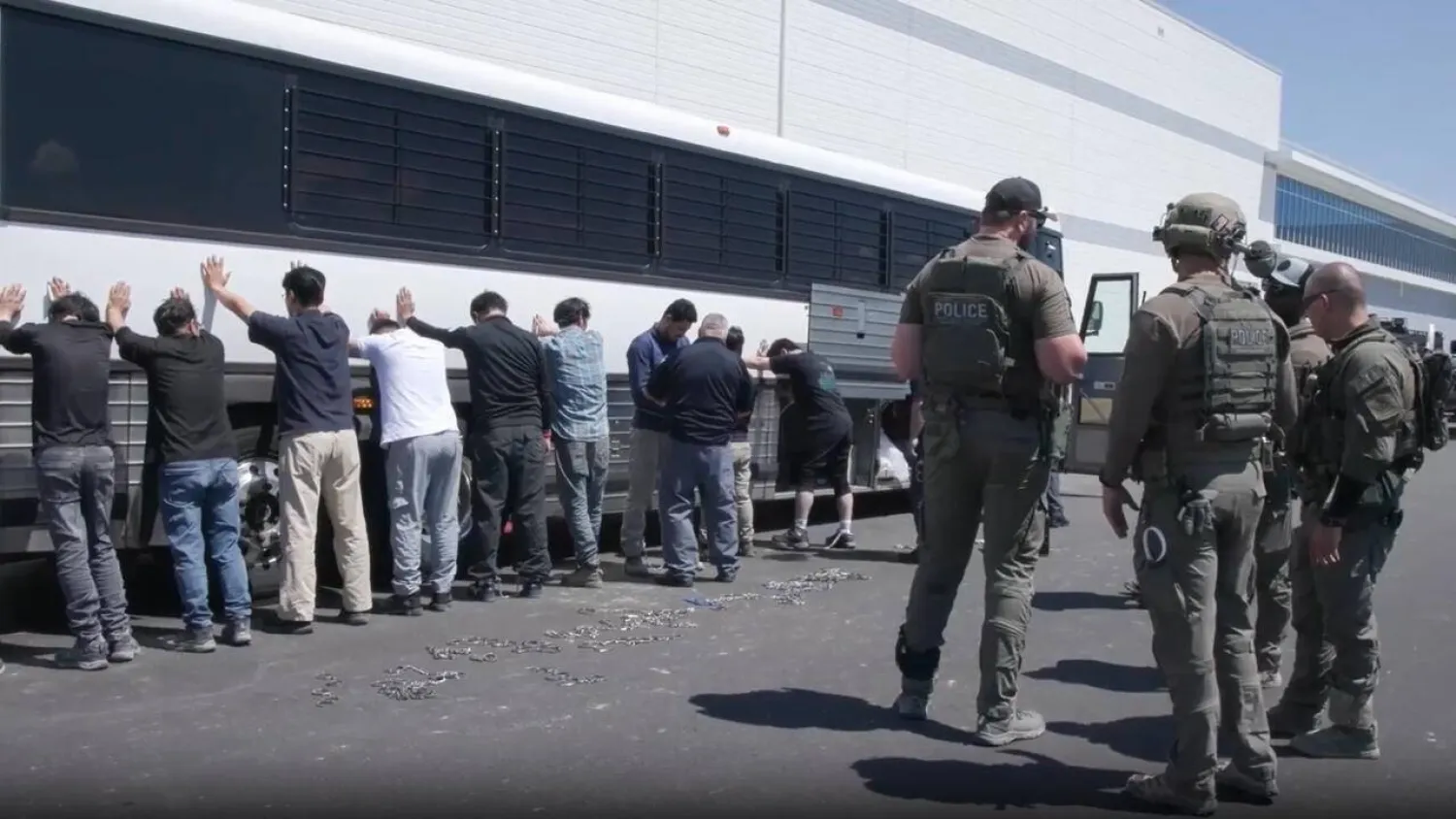
US Immigration and Customs Enforcement (ICE) agents conduct an operation at a Hyundai-LG electric vehicle battery plant in Ellabell, Georgia, on September 4, 2025. HANDOUT / US Immigration and Customs Enforcement/AFP/File
TT

South Korea Sends Plane to Fetch Detained Workers from US

US Immigration and Customs Enforcement (ICE) agents conduct an operation at a Hyundai-LG electric vehicle battery plant in Ellabell, Georgia, on September 4, 2025. HANDOUT / US Immigration and Customs Enforcement/AFP/File

A chartered plane departed Seoul for the United States Wednesday to repatriate hundreds of South Korean workers detained in an immigration raid, flag carrier Korean Air told AFP.

South Koreans made up the majority of people arrested at a Hyundai-LG battery plant under construction in the US state of Georgia last week, according to immigration agents.

The operation was the largest single-site raid conducted under US President Donald Trump's immigration crackdown, according to an investigating agent.

A Korean Air Boeing 747-8I, which seats over 350 passengers, left from Seoul Wednesday, a company representative told AFP.

"The chartered plane left around 10:20 am for the US," said the spokeswoman.

"A timeline for the return flight has not been finalized," she added.

Local media broadcast footage showing what they described as the chartered plane taking off from Incheon International Airport.

Citing diplomatic sources, Yonhap news agency reported that the plane would leave the United States with the workers at 3:30 am Thursday (1830 GMT Wednesday).

Seoul's foreign minister Cho Hyun headed to Washington on Monday for further talks, calling the mass detention of South Koreans a "grave situation" and pledging to secure the workers' swift return "in good health".

Before departing, Cho told South Korean MPs that "a tentative agreement" had been reached with US authorities to ensure the detained workers would not face penalties, such as a five-year ban on re-entry.

"I can tell you that negotiations are going well," he said.

In addition to being a key US security ally, South Korea is Asia's fourth-biggest economy and a major automaker and electronics producer, and its companies have multiple plants in the United States.

Seoul has also heeded Washington's repeated call during tariff negotiations for global investment in the United States.

The site of the raid is a $4.3 billion joint venture between two South Korean firms –- Hyundai and LG Energy Solution –- to build a battery cell manufacturing facility in Georgia.

Experts said most of the detained South Korean workers were likely to hold visas that do not allow for hands-on construction work.


Israel Sees Spike in Suicide Among Troops

Israeli soldiers stand on tanks, amid the conflict between Israel and Hamas, near the Israel-Gaza border, in southern Israel, January 1, 2024. REUTERS/Violeta Santos Moura/File Photo
TT

Israel Sees Spike in Suicide Among Troops

Israeli soldiers stand on tanks, amid the conflict between Israel and Hamas, near the Israel-Gaza border, in southern Israel, January 1, 2024. REUTERS/Violeta Santos Moura/File Photo

Israel is grappling with a dramatic increase in post-traumatic stress disorder and suicide among its troops after its two-year assault on Gaza, precipitated by the October 7, 2023, Hamas attack on southern Israel.

Recent reports by the Defense Ministry and by health providers have detailed the military's mental health crisis, which comes as fighting persists in Gaza and Lebanon and as tensions flare with Iran, according to Reuters.

The Gaza war quickly expanded with cross-border fire between Israel and Lebanon's Hezbollah, and saw hundreds of thousands of soldiers and reservists deployed across both fronts in some of the heaviest fighting in the country's history.

Israeli forces have killed more than 71,000 Palestinians in Gaza and 4,400 in southern Lebanon, according to Gazan and Lebanese officials, and Israel says more than 1,100 service members have been killed since October 2023.

The war has left much of Gaza destroyed and its 2 million people overwhelmingly lack proper shelter, food or access to medical and health services.

Palestinian mental health specialists have said Gazans are suffering “a volcano” of psychological trauma, with large numbers now seeking treatment, and children suffering symptoms such as night terrors and an inability to focus.

Post-Trauma Cases UP 40% Among Soldiers
Israeli studies show the war has taken its toll on the mental health of soldiers carrying out Israel's stated war aims of eliminating Hamas in Gaza, retrieving hostages there and disarming Hezbollah.

Some soldiers who came under attack when their military bases were invaded by Hamas on October 7 are also struggling.

Israel's Defense Ministry said it has recorded a nearly 40% increase in PTSD cases amongst its soldiers since September 2023, and predicts the figure will increase by 180% by 2028. Of the 22,300 troops or personnel being treated for war wounds, 60% suffer from post-trauma, the ministry said.

It has expanded the health care provided to those dealing with mental health issues, expanded the budget, and said there was an increase of about 50% in the use of alternative treatments.

The country's second-largest healthcare provider, Maccabi, said in its 2025 annual report that 39% of Israeli military personnel under its treatment had sought mental health support while 26% had voiced concerns about depression.

Several Israeli organizations like NGO HaGal Sheli, which uses surfing as a therapy technique, have taken on hundreds of soldiers and reservists suffering from PTSD. Some former soldiers have therapy dogs.

Feeling Guilty
Ronen Sidi, a clinical psychologist who directs combat veteran research at Emek Medical Center in northern Israel, said soldiers were generally grappling with two different sources of trauma.

One source was related to “deep experiences of fear” and “being afraid to die” while deployed in Gaza and Lebanon and even while at home in Israel.

Many witnessed the Hamas assault on southern Israel - in which the militants also took around 250 hostages back into Gaza - and its aftermath firsthand.

Sidi said the second source is from moral injury, or the damage done to a person's conscience or moral compass from something they did.

“A lot of (soldiers') split-second decisions are good decisions,” which they take under fire, “but some of them are not, and then women and children are injured and killed by accident, and living with the feeling that you have killed innocent people... is a very difficult feeling and you can't correct what you have done,” he said.

One reservist, Paul, a 28-year-old father of three, said he had to leave his job as a project manager with a global firm because “the whistles of the bullets” above his head lingered with him even after returning home.

Paul, who declined to give his last name over privacy concerns, said he deployed in combat roles in Gaza, Lebanon and Syria.

Although fighting has abated in recent months, he said he lives in a constant state of alert.

“I live that way every day,” Paul said.

Untreated Trauma
A soldier seeking state support for their mental health must appear before a defense ministry assessment committee which determines the severity of their case and grants them official recognition.

That process can take months and can deter soldiers from seeking help, some trauma professionals said.

Israel's Defense Ministry said it provides some immediate help to soldiers once they start the evaluation process and has increased this effort since the war began.

An Israeli parliamentary committee found in October that 279 soldiers had attempted suicide in the period from January 2024 to July 2025, a sharp increase from previous years.

The report found that combat soldiers comprised 78% of all suicide cases in Israel in 2024.

The risk of suicide or self-harm increases if trauma is untreated, said Sidi, the clinical psychologist.

“After October 7 and the war, the mental health institutions in Israel are overwhelmed completely, and a lot of people either can't get therapy or don't even understand the distress that they are feeling has to do with what they have experienced.”

For soldiers, the chance of seeing combat remains high. Israel's military remains deployed in over half of Gaza and fighting has persisted there despite a US-backed truce in October, with more than 440 Palestinians and three Israeli soldiers killed.

Its troops still occupy parts of southern Lebanon, as the Lebanese army presses on with disarming Hezbollah under a separate US-brokered deal.

In Syria, Israeli troops have occupied an expanded section of the country's south since the ouster of former leader Bashar al-Assad.

As tensions flare with Iran and the US threatens to intervene, Israel could also find itself in another violent confrontation with Tehran, after last June's 12-day war.


First Flight of Deported Venezuelan Migrants Arrives in Caracas after Maduro's Capture

A migrant participating in the government's program Great Mission Return to the Homeland, waves upon arrival at Maiquetia International Airport, in Venezuela 16 January 2026. EPA
TT

First Flight of Deported Venezuelan Migrants Arrives in Caracas after Maduro's Capture

A migrant participating in the government's program Great Mission Return to the Homeland, waves upon arrival at Maiquetia International Airport, in Venezuela 16 January 2026. EPA

A flight with 231 Venezuelan migrants deported from the US city of Phoenix arrived Friday to their home country, nearly two weeks after the United States captured former President Nicolás Maduro and took him to New York to face drug trafficking charges.

The Eastern Airlines plane arrived at an airport outside the capital, Caracas, marking the resumption of flights after Washington — according to Venezuelan officials — unilaterally suspended direct deportation air transfers in mid-December, The Associated Press reported.

The previous direct flight from the US was on Dec. 10.

Return flights for deported migrants had been regularized since late March as part of the transfers agreed upon by both governments.

The transfers were successively affected amid heightened tensions since US military forces began to execute a series of deadly attacks against boats suspected of smuggling drugs in international waters of the Caribbean and Pacific Ocean, including several vessels that they claim departed from Venezuela.

Maduro maintained at all times that US President Donald Trump could order military action to try to overthrow him.

The flight’s arrival comes 13 days after Maduro was captured along with his wife, Cilia Flores, during a military intervention in Caracas. Subsequently, he was transferred to US territory, where both appeared on Jan. 5 before a New York court to face narcoterrorism charges. Both have pleaded not-guilty.


Putin in Contact with Israel, Iran Leaders to Help 'De-escalate', Says Kremlin

Russian President Vladimir Putin takes part in a ceremony to receive letters of credence from newly appointed foreign ambassadors at the Grand Kremlin Palace in Moscow on January 15, 2026. (Photo by Ramil Sitdikov / POOL / AFP)
TT

Putin in Contact with Israel, Iran Leaders to Help 'De-escalate', Says Kremlin

Russian President Vladimir Putin takes part in a ceremony to receive letters of credence from newly appointed foreign ambassadors at the Grand Kremlin Palace in Moscow on January 15, 2026. (Photo by Ramil Sitdikov / POOL / AFP)

Russian President Vladimir Putin on Friday held phone calls with the leaders of Israel and Iran, the Kremlin said, offering mediation amid large-scale protests in Iran that have raised fears of a military confrontation in the region. 

Independent monitors say Iranian security forces have killed thousands in a forceful response to nationwide anti-government protests -- a crackdown that prompted threats of military action by the United States, Israel's key ally. 

Iran and Israel fought a brief war in June that saw unprecedented Israeli attacks on Iranian military and nuclear facilities. The United States had briefly joined those strikes, hitting three major Iranian nuclear sites. 

On Friday, Russia announced Putin was in contact with both Israeli Prime Minister Benjamin Netanyahu and Iranian President Masoud Pezeshkian in a bid to cool tensions between the two rivals. 

"The situation in the region is highly tense, and the president continues his efforts to facilitate de-escalation," Kremlin spokesman Dmitry Peskov said. 

Moscow is a close ally of Iran. It has also strived for good relations with Israel, though those ties became strained amid Russian criticsm of Israel's actions in Gaza since October 7, 2023. 

In a call with Israel's Netanyahu on Friday, the Kremlin said Russia had expressed its "readiness to continue its mediation efforts." 

It did not clarify what current efforts were being undertaken or comment on the protests in Iran. 

Moscow had previously offered mediation during the June war. 

Peskov said that Moscow would announce "the results of our telephone conversation with the Iranian President very soon." 

Netanyahu said Sunday that he hoped Iran would soon be freed from what he described as the "yoke of tyranny", amid the protests. 

However, the rallies appear to have diminished over the last few days in the face of repression and a week-long internet blackout. 

Iran has repeatedly accused the United States and Israel of inciting the unrest and trying to undermine the Islamic republic's national unity.
