


Iran, IAEA Announce New Cooperation Agreement

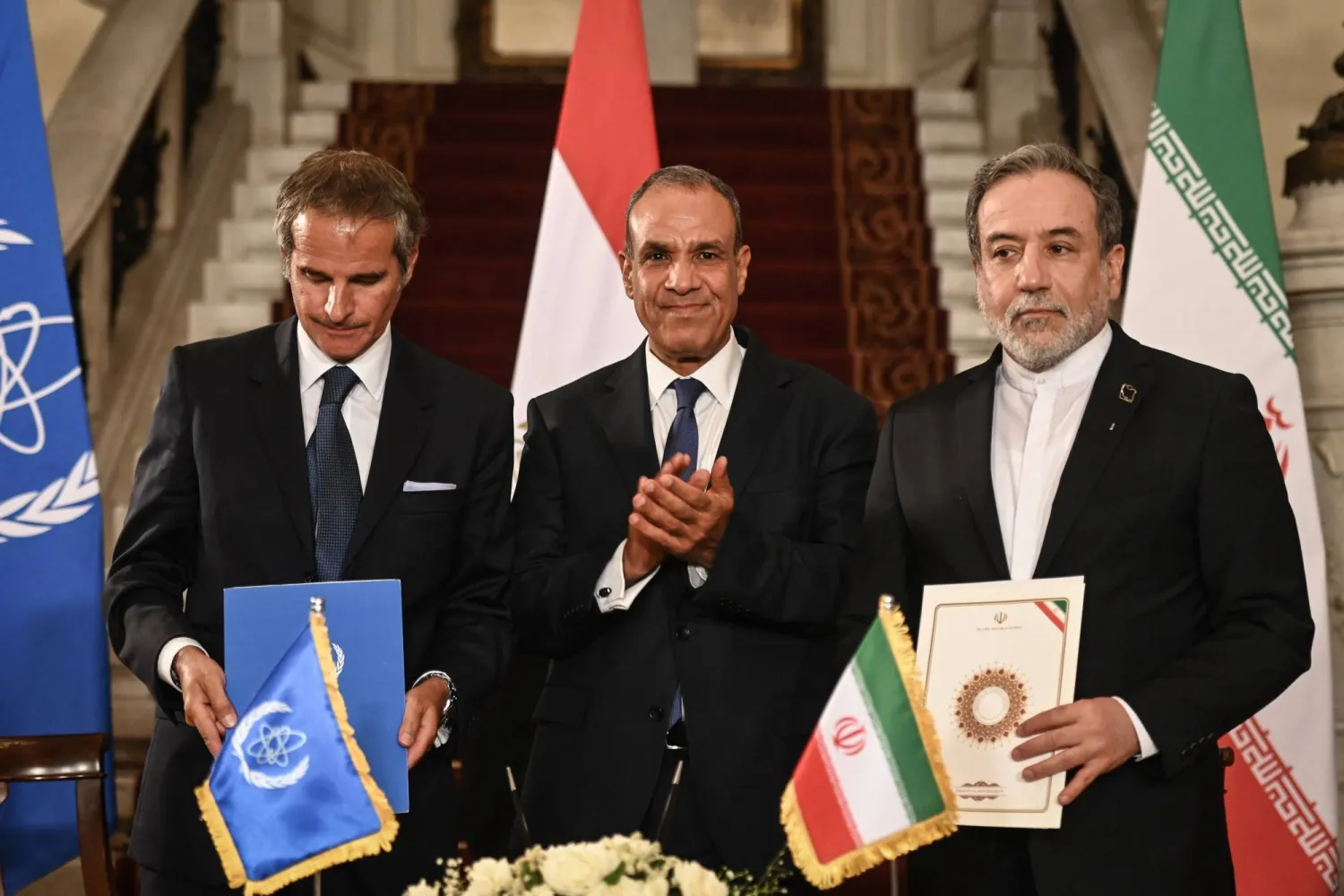
09 September 2025, Egypt, Cairo: Director General of the International Atomic Energy Agency (IAEA) Rafael Grossi (L) and Iranian Foreign Minister Abbas Araghchi (R), sign an agreement on practical modalities to resume nuclear inspections on the Iranian nuclear program, in presence of Egyptian Foreign Minister Badr Abdelatty (C) at Tahrir Palace in Cairo. Photo: Stringer/dpa
TT

Iran, IAEA Announce New Cooperation Agreement

09 September 2025, Egypt, Cairo: Director General of the International Atomic Energy Agency (IAEA) Rafael Grossi (L) and Iranian Foreign Minister Abbas Araghchi (R), sign an agreement on practical modalities to resume nuclear inspections on the Iranian nuclear program, in presence of Egyptian Foreign Minister Badr Abdelatty (C) at Tahrir Palace in Cairo. Photo: Stringer/dpa

Egyptian Foreign Minister Badr Abdelatty announced on Tuesday that the International Atomic Energy Agency and Iran agreed on a new cooperation framework, after Tehran suspended cooperation with the agency following the 12-day war with Israel, which saw Israeli and US strikes on Iranian nuclear facilities.

“In Cairo today, I agreed with Iran’s Foreign Minister (Abbas) Araghchi on practical modalities to resume inspection activities in Iran. This is an important step in the right direction,” Grossi said on X.

For the past three months, Egypt has been mediating between Iran and the UN nuclear watchdog to resolve their dispute after Tehran suspended cooperation with the IAEA.

Foreign Ministry spokesman Tamim Khallaf said Abdelatty received Araghchi on Tuesday and the two men addressed ways to strengthen bilateral relations, regional developments, and cooperation between Iran and IAEA.

Khallaf told Asharq Al-Awsat that Cairo has facilitated cooperation between Iran and the agency during the past period and “will continue its tireless diplomatic efforts towards reaching satisfactory agreements on the Iranian nuclear file and achieving the interests of all parties and restoring trust.”

Abdelatty met with his Iranian counterpart in Cairo on Tuesday to discuss developing bilateral relations and the latest developments in the Iranian nuclear file. Later, Grossi joined the two ministers.

Following the meeting, Egypt’s FM stressed the importance of continuing efforts to create conditions for a “satisfactory and sustainable” settlement between Iran and the IAEA that considers the interests of all parties and contributes to de-escalation, restoring trust, and creating a supportive climate for regional security and stability.

Tuesday’s talks came as the IAEA Board of Governors kicked off their meetings in Vienna early this week.

On Monday, Grossi said talks between Iran and the IAEA do not alter Iran's duty to allow verification measures such as inspections as a party to the nuclear Non-Proliferation Treaty.

“There is still time, but not much. Always enough when there is good faith and a clear sense of responsibility,” Grossi said in a statement to a quarterly meeting of the IAEA's 35-nation Board of Governors.

But Araghchi affirmed during his meeting with Abdelatty that Iran and the IAEA have agreed to enhance their cooperation in a way that respects Iranian sovereignty and protects the security of the Iranian people, noting that his country will not compromise its nuclear policy or rights again.

Mohammed Abbas Naji, the Iranian expert at the Al-Ahram Center for Political and Strategic Studies, told Asharq Al-Awsat that through its efforts, Egypt is seeking to prevent a new war between Tehran and Israel.

“The visit of Grossi and Araghchi to Cairo suggests a progress between both sides for reaching a satisfactory deal, especially after Iran affirmed that a cooperation framework could be announced in Cairo soon,” Naji said.

Meanwhile, Egyptian expert on Iranian affairs, Ali Atef said Egypt’s efforts to facilitate cooperation between Iran and the IAEA aim to strengthen regional stability and prevent a nuclear arms race.

Egypt has used its diplomatic weight and its geopolitical position to reach a nuclear deal between Iran and the West, he noted.

Tuesday’s agreement comes against the backdrop of an ongoing threat by European powers to re-impose wide-ranging sanctions against Iran that were lifted under a 2015 nuclear deal between Iran and major powers.

Those European powers - France, Britain and Germany, known as the E3 – have initiated the so-called “snapback” process that is due to run until late this month. They have said they will only hold off on completing it if Iran allows inspections to resume, accounts for its highly enriched uranium stockpile and holds nuclear talks with the United States.

Iran’s Foreign Ministry spokesman Esmail Baghaei said on Tuesday that the main purpose of the meeting between Araghchi and Grossi is to “finalize negotiations on new protocols for Iran-IAEA cooperation in implementing safeguards obligations.”

The protocols have been developed taking into account recent attacks on Iranian nuclear sites, parliamentary legislation, and considerations from Iran’s Supreme National Security Council, Baghaei said.

He added that the framework is now in its final stages.

Last June, soon after the US and Israeli attacks, Iran's parliament passed a law suspending cooperation with the IAEA and stipulating that any inspections must be approved by Iran's Supreme National Security Council.



EU Executive Arm, Russia and Thailand Asked to Join Trump's Board of Peace for Gaza

US President Donald Trump - The AP news.
TT

EU Executive Arm, Russia and Thailand Asked to Join Trump's Board of Peace for Gaza

US President Donald Trump - The AP news.

The European Union's executive arm, Russia and Thailand on Monday were the latest to be asked to join US President Donald Trump's new Board of Peace that will supervise the next phase of the Gaza peace plan, as a top Israeli official said the initiative is “bad for Israel” and should be scrapped, The AP news reported.

Kremlin spokesman Dmitry Peskov said Russian President Vladimir Putin received the invitation and that the Kremlin is now "studying the details" and would seek clarity of “all the nuances” in contacts with the US. The Thai Foreign Ministry said it was also invited and that it was reviewing the details.

European Commission spokesperson Olof Gill confirmed that Ursula von der Leyen, the president of the commission, received an invitation and would be speaking to other EU leaders about Gaza. Gill didn't say whether the invitation has been accepted, but that the commission wants "to contribute to a comprehensive plan to end the Gaza conflict.”

It's unclear how many leaders have been invited to join the board. But a Trump reference in the invitation letters that the body would “embark on a bold new approach to resolving global conflict" suggested it could act as a rival to the UN Security Council, the most powerful body of the global organization created in the wake of World War II.

Israeli far-right Finance Minister Bezalel Smotrich on Monday dismissed the Board of Peace as a raw deal for Israel and called for its dissolution.

“It is time to explain to the president that his plan is bad for the State of Israel and to cancel it," Smotrich said at a ceremony inaugurating the new Yatziv settlement in the occupied West Bank. "Gaza is ours, its future will affect our future more than anyone else’s. We will take responsibility for what happens there, impose military administration, and complete the mission.”

Smotrich even suggested that Israel renew a full-scale offensive on Gaza to destroy Hamas if it doesn't abide by a “short ultimatum for real disarmament and exile.”

On Saturday, the office of Israeli Prime Minister Benjamin Netanyahu said the formation of the committee wasn’t coordinated with the Israeli government and “is contrary to its policy.”

The US is expected to announce its official list of members in the coming days, likely during the World Economic Forum meeting in Davos, Switzerland.

Board members will oversee an executive committee that will be in charge of implementing the tough second phase of the Gaza peace plan that includes the deployment of an international security force, disarmament of Hamas and reconstruction of the war-devastated territory.

A $1 billion contribution secures permanent membership on the board with the money going to rebuild Gaza, according to a US official who spoke on condition of anonymity about the charter, which hasn't been made public. A three-year appointment has no contribution requirement.

But details of how this will also work remain murky. British Prime Minister Keir Starmer said Monday the UK is talking to allies about the Board of Peace. Although the UK hasn't said whether Starmer has been formally invited to join, he said it's necessary to proceed with the Gaza peace plan's second phase and that his country has "indicated willingness, to play our part, and we will.”

Running Gaza Egypt’s top diplomat on Monday met with the leader of the newly appointed committee of Palestinian technocrats who will be running Gaza’s day-to-day affairs during the second phase of the peace plan.

Foreign Minister Bader Abdelatty met with Ali Shaath, a Palestinian engineer and former official with the Western-backed Palestinian Authority, who was named last week as chief commissioner of the National Committee for the Administration of Gaza

Abdelatty expressed the Egyptian government’s “complete support” to the committee and affirmed its role in running Gaza’s daily affairs until the Palestinian Authority takes over the territory, a statement from the Egyptian ministry said following the meeting.

He also underscored “the importance of preserving the unity of the Palestinian territories, ensuring geographical and administrative continuity between the Gaza Strip and the West Bank.”

More aid getting through but situation still fragile The UN World Food Program on Monday said it has “significantly expanded” its operations across Gaza 100 days into the ceasefire, reaching more than a million people each month with hot meals, bread bundles and food parcels. But it warned the situation remains “extremely fragile” even as critical progress has been made in pushing back famine.

It noted that malnutrition has been prevented for 200,000 pregnant and breastfeeding women, as well as children under 5, while school snacks are reaching 235,000 children in 250 temporary schools.

Still, the most recent Integrated Food Security Phase Classification (IPC) analysis in December indicates that 77% the population is facing crisis levels food insecurity with over 100,000 people experiencing catastrophic levels of hunger.

The WFP said access to nutritious food such as fresh fruit, vegetables and dairy is limited with most families still can't afford more commercial goods entering Gaza.

Palestinian teen shot dead Israeli forces killed a Palestinian teenager in southern Gaza, hospital authorities said Monday.

Hussein Tawfiq Abu Sabalah, 17, was shot in the Muwasi area of Rafah Monday morning, according to Nasser Hospital. It wasn’t immediately clear whether he crossed into or came close to an Israeli-controlled area.

More than 460 people have been killed by Israeli fire and their bodies brought to hospitals since the ceasefire went into effect, according to Gaza's Health Ministry. The ministry, which is part of Hamas-led government, maintains detailed casualty records that are seen as generally reliable by UN agencies and independent experts.


Russia Hits Energy System in Several Regions of Ukraine, Kyiv Says

Local residents gather around a bonfire during an outdoor party to keep warm as many apartments remain without heating in Kyiv on January 18, 2026, amid the Russian invasion of Ukraine. (AFP)
TT

Russia Hits Energy System in Several Regions of Ukraine, Kyiv Says

Local residents gather around a bonfire during an outdoor party to keep warm as many apartments remain without heating in Kyiv on January 18, 2026, amid the Russian invasion of Ukraine. (AFP)

Russia launched a barrage of drone strikes on Ukraine's energy infrastructure overnight on Monday, cutting off power in five regions ​across the country amid freezing temperatures and high demand, Ukrainian officials said.

The Ukrainian air force said that Russian troops had launched 145 drones. Air defense units shot down 126 of them, it said.

"As of this morning, consumers in Sumy, Odesa, Dnipropetrovsk, Kharkiv, and Chernihiv regions are without power," the energy ministry said in a statement. "Emergency repair ‌work is ‌underway if the security situation ‌allows."

In ⁠the ​southern ‌Odesa region, energy and gas infrastructure was damaged, the regional governor said, adding that one person was hurt in the attack.

DTEK, Ukraine's largest private energy company, said its energy facility in Odesa was "substantially" damaged, knocking out power for 30,800 households.

A local power grid company in northern Chernihiv region said that ⁠five important energy facilities were damaged, leaving tens of thousands of consumers ‌without power.

Russia also hit Ukraine's second-largest ‍city of Kharkiv with missiles ‍on Monday morning, significantly damaging a critical infrastructure facility, ‍Mayor Ihor Terekhov said.

Moscow has stepped up a winter campaign of strikes on the Ukrainian energy system, including generation, electricity transmission and gas production facilities, amid freezing temperatures that complicate repair works.

The ​attacks have caused long blackouts.

"Being without electricity for more than 16 hours is awful," Serhii Kovalenko, ⁠CEO of energy distribution company Yasno, said on Facebook late on Sunday. "And it's not because of the energy companies, but because of cynical attacks by the enemy, who is trying to create a humanitarian disaster."

Ukraine declared an energy emergency last week as its grid crumbled due to accumulated wartime damage and a new targeted wave of Russian bombardments.

Energy Minister Denys Shmyhal said on Monday the government would implement projects to improve electricity transmission from the western part ‌of the country to its power-hungry east.


‘Not Right’ for Iran to Attend Davos Summit After Deadly Protests, Say Organizers

Iranian Foreign Minister Abbas Araghchi speaks in a joint press briefing with his Iraqi counterpart Fuad Hussein in Tehran, Iran, Sunday, Jan. 18, 2026. (AP)
TT

‘Not Right’ for Iran to Attend Davos Summit After Deadly Protests, Say Organizers

Iranian Foreign Minister Abbas Araghchi speaks in a joint press briefing with his Iraqi counterpart Fuad Hussein in Tehran, Iran, Sunday, Jan. 18, 2026. (AP)

Iran's foreign minister will not be attending the Davos summit in Switzerland this week, the organizers said Monday, stressing it would not be "right" after the recent deadly crackdown on protesters in Iran.

Abbas Araghchi had been scheduled to speak on Tuesday during the annual gathering of the global elite at the upscale Swiss ski resort town.

But activists have been calling on the World Economic Forum organizers to disinvite him amid what rights groups have called a "massacre" in his country.

"The Iranian Foreign Minister will not be attending Davos," the World Economic Forum said on X.

"Although he was invited last fall, the tragic loss of lives of civilians in Iran over the past few weeks means that it is not right for the Iranian government to be represented at Davos this year," it added.

Demonstrations sparked by anger over economic hardship exploded into protests late December in what has been widely seen as the biggest challenge to the Iranian leadership in recent years.

The rallies subsided after a government crackdown under the cover of a communications blackout that started on January 8.

Norway-based Iran Human Rights says it has verified the deaths of 3,428 protesters killed by security forces, confirming cases through sources within the country's health and medical system, witnesses and independent sources.

The NGO warned that the true toll is likely to be far higher. Media cannot independently confirm the figure and Iranian officials have not given an exact death toll.