

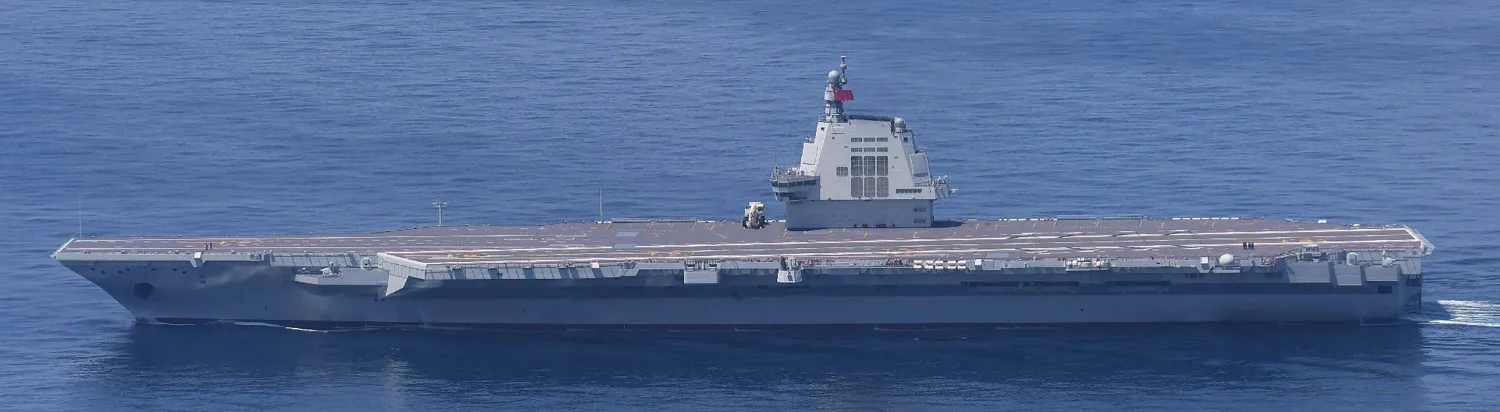

China’s Newest Aircraft Carrier Sails Through Taiwan Strait into South China Sea 

This handout photo taken by Japan's Ministry of Defense on September 11, 2025 and received via Jiji Press on September 12, 2025 shows China's third and newest aircraft carrier, the Fujian, sailing in the East China Sea. (AFP / Japan's Ministry of Defense via Jiji Press) 
TT

China’s Newest Aircraft Carrier Sails Through Taiwan Strait into South China Sea 

This handout photo taken by Japan's Ministry of Defense on September 11, 2025 and received via Jiji Press on September 12, 2025 shows China's third and newest aircraft carrier, the Fujian, sailing in the East China Sea. (AFP / Japan's Ministry of Defense via Jiji Press) 

China's most advanced aircraft carrier, the Fujian, recently sailed through the Taiwan Strait and into the South China Sea - both very sensitive waterways - as part of its sea trials.

The Chinese navy said in a statement on Friday that the journey was made to conduct scientific research trials and training missions. First unveiled in 2022, the country's third aircraft carrier began sea trials last year and has yet to formally enter service.

"This cross-regional trial and training exercise for the Fujian is a routine arrangement in the carrier's construction process and is not directed at any specific target," it added.

The sailing comes as US Marines and Japanese counterparts stage a fortnight of exercises on the nearby island of Okinawa with the Typhon missile system and other advanced anti-ship weapons. The exercises are due to run until September 25.

Japan's defense ministry said late on Thursday that the Fujian had entered the East China Sea, sailing southwest toward Taiwan, accompanied by two Chinese missile destroyers.

Taiwan's defense ministry said it has been monitoring the situation with joint intelligence surveillance and has taken appropriate measures.

China has, over the past five years or so, stepped up its military presence around Taiwan, including staging war games, to assert its sovereignty claims.

Taiwan's government rejects Beijing's sovereignty, saying only the island's people can decide their future.

China considers the Taiwan Strait to be its territorial waters. Taiwan, the United States and many of its allies say it is an international waterway.

The South China Sea has been another site of increased Chinese military activity. China claims most of the sea - claims that are contested by many countries including the Philippines and Vietnam.

The Fujian, designed and built domestically, is larger and more advanced than the Shandong, commissioned in late 2019, and the Liaoning, which China bought second-hand from Ukraine in 1998.

With a flat deck and electro-magnetic catapults to launch aircraft, the Fujian is expected to host a larger and wider range of planes than the other two carriers - including early-warning aircraft and, eventually, China's first carrier-capable stealth jet fighters.

Regional security analysts and military attaches are watching the Fujian's trials closely, in part to see how effectively China's navy can coordinate full-blown carrier operations with escort ships and submarines.



Iran Reportedly Informed that US Plans to Resume Action

A member of Iran's Revolutionary Guard salutes while riding on a float displaying drones during the state-organized "Janfada," or "Sacrifice for Iran," military-style parade in Tehran, Iran, Friday, Sept. 18, 2026. (AP Photo/Vahid Salemi)
TT

Iran Reportedly Informed that US Plans to Resume Action

A member of Iran's Revolutionary Guard salutes while riding on a float displaying drones during the state-organized "Janfada," or "Sacrifice for Iran," military-style parade in Tehran, Iran, Friday, Sept. 18, 2026. (AP Photo/Vahid Salemi)

Iran received information that the United States, with the backing of some regional countries, was preparing to resume actions against ⁠Iran, the country's central military ⁠command said in a statement on Sunday, according to ⁠state media.

The military said that any US attack would trigger sustained strikes on US bases and interests in the region, the report ⁠added, ⁠warning that regional countries supporting US aggression against Iran would be considered parties to the conflict.

This came after US President Donald Trump cut short a weekend at Camp David to return unexpectedly to the White House on Saturday.

Iranian parliament speaker ⁠Mohammad Bagher Ghalibaf said on Sunday that Tehran will not reopen the Strait of Hormuz until its conditions are met and US commitments are ⁠implemented.


Iran Says Strait of Hormuz will Remain Closed Until its Conditions Are Met

FILE PHOTO: Vessels near the Strait of Hormuz, as seen from Musandam, Oman, August 31, 2026. REUTERS/Stringer/File Photo
TT

Iran Says Strait of Hormuz will Remain Closed Until its Conditions Are Met

FILE PHOTO: Vessels near the Strait of Hormuz, as seen from Musandam, Oman, August 31, 2026. REUTERS/Stringer/File Photo

Iran will not ​reopen the Strait of Hormuz until its conditions are ‌met ‌and ​US ‌commitments are ⁠implemented, ​parliament speaker ⁠Mohammad Bagher Ghalibaf said on Sunday according to ⁠the semi-official ‌Fars ‌news ​agency.

Iran ‌must ‌both fight and negotiate, Ghalibaf said, ‌adding that Tehran would use military ⁠force ⁠to push back its enemies and diplomacy to consolidate battlefield gains when ​the ​time is right.

His comments came as US President Donald Trump cut short a weekend at Camp David to return unexpectedly to the White House on Saturday.

There was no explanation from the administration why Trump was no longer returning on Sunday from Camp David, a secluded presidential complex in rural Maryland, as had been previously announced.


Seoul: NKorea Fires 2 Projectiles Into East Sea

People sit near a television screen showing a news broadcast with file footage of a North Korean missile test, at a train station in Seoul on September 20, 2026. (Photo by Lillian SUWANRUMPHA / AFP)
TT

Seoul: NKorea Fires 2 Projectiles Into East Sea

People sit near a television screen showing a news broadcast with file footage of a North Korean missile test, at a train station in Seoul on September 20, 2026. (Photo by Lillian SUWANRUMPHA / AFP)

North Korea fired two projectiles into the sea off its eastern coast on Sunday, including at least one ballistic missile, South Korea's defense ministry said.

The incidents came days after Pyongyang reasserted its status as a nuclear-armed state and rejected a United Nations resolution demanding it halt its nuclear activities.

South Korea's military said the first launch at around 3:00 pm (0600 GMT) was a ballistic missile fired from near the city of Wonsan that flew around 450 kilometers (280 miles) into the East Sea, a body of water also called the Sea of Japan.

There were no immediate details on the second launch, which Seoul's defense ministry confirmed soon after 6:00 pm.

"Our military detected a ballistic missile launched from the Wonsan area of North Korea towards the East Sea," South Korea's Joint Chiefs of Staff said after the initial launch.

"South Korean and US authorities are conducting a detailed analysis to determine... exact specifications," it said, according to AFP.

The office of the Japanese prime minister said on X that both projectiles were suspected to be ballistic missiles.
Tokyo lodged a "stern protest" with North Korea over the launch and condemned it as a threat to regional peace and security, Japan's Kyodo news agency cited the government as saying.

South Korea's presidential National Security Office convened an emergency security meeting following the first launch and assessed its impact on national security, the presidential office said.

The government called on Pyongyang to "immediately cease" its ballistic missile launches, describing Sunday's firing as a "grave act" that violated UN Security Council resolutions.

The incidents came eight days after North Korea fired multiple short-range ballistic missiles towards the East Sea as part of what it later described as a joint firepower drill.

That exercise involved long-range artillery and missiles, with the weapons "hitting the targets with 100 percent hit accuracy", state media reported.

North Korea accused "hostile forces" of seeking to end the country's nuclear program during this week's General Conference of the International Atomic Energy Agency (IAEA).

A foreign ministry spokesperson said the IAEA resolution "has no effect on the DPRK's position as a nuclear weapons state", using the acronym for North Korea's official name.

The North's status as a nuclear power is "guaranteed by the actual nuclear deterrent and irreversibly and permanently fixed by the supreme law of the state", the spokesperson said.

Kim Yo Jong, the powerful sister of the North Korean leader, recently said the country's nuclear-armed status was "absolute", and called those hoping for its denuclearization "idiots".

US President Donald Trump said in August that North Korea possessed 57 "very powerful" nuclear weapons, while South Korea has put the figure at between 80 and 120.