
Türkiye Wary of Israeli Threat Following Airstrike on Hamas in Qatar

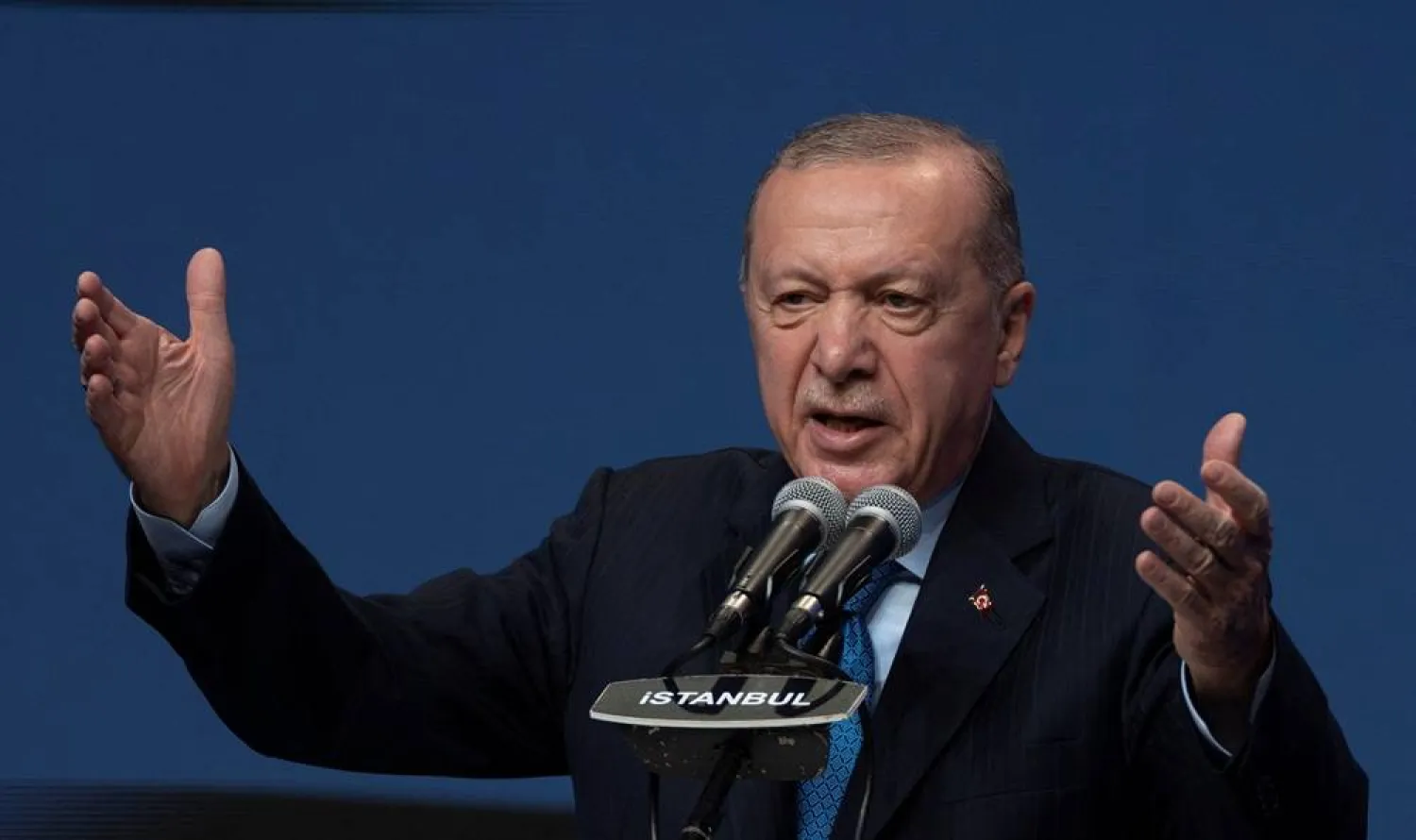
Turkish President Recep Tayyip Erdogan addresses his supporters during a meeting in Istanbul, Türkiye, September 13, 2025. (Reuters)
TT

Türkiye Wary of Israeli Threat Following Airstrike on Hamas in Qatar

Turkish President Recep Tayyip Erdogan addresses his supporters during a meeting in Istanbul, Türkiye, September 13, 2025. (Reuters)

An Israeli strike on a meeting of Hamas officials in Qatar has cast a cloud of growing concern across Türkiye that it could be the next target.

Turkish Defense Ministry spokesman Rear Adm. Zeki Akturk warned in Ankara on Thursday that Israel would “further expand its reckless attacks, as it did in Qatar, and drag the entire region, including its own country, into disaster.”

Israel and Türkiye were once strong regional partners, but ties between the countries ran into difficulties from the late 2000s and have reached an all-time low over the war in Gaza sparked by the Oct. 7, 2023, Hamas-led attack in southern Israel. Tensions also have risen as the two countries have competed for influence in neighboring Syria since the fall of Bashar al-Assad’s government last year.

Turkish President Recep Tayyip Erdogan has been a long-standing supporter of the Palestinian cause and of the Palestinian group Hamas. The Turkish president has criticized Israel, and particularly Prime Minister Benjamin Netanyahu, with strident rhetoric since the start of the Gaza war, accusing Israel of genocide and likening Netanyahu to Nazi leader Adolf Hitler.

Hamas officials regularly visit Türkiye and some have taken up residence there. Israel previously accused Türkiye of allowing Hamas to plan attacks from its territory, as well as carrying out recruitment and fundraising.

After Israel’s attacks on the territory of Iran, Syria, Yemen and now Qatar, Ankara is bound to be concerned by Israel’s ability to freely use the airspace of neighboring states.

“Israel’s ability to conduct strikes with seeming impunity, often bypassing regional air defenses and international norms, sets a precedent that deeply worries Ankara,” said Serhat Suha Cubukcuoglu, director of Trends Research and Advisory’s Türkiye program.

Türkiye sees these attacks as a “broader Israeli strategy to establish a fragmented buffer zone of weak or pacified states around it,” he added.

Türkiye has superior military might In crossing a previously unthinkable line by attacking Qatar, a close American ally that has been serving as a mediator in Gaza ceasefire talks, Israel also has raised the question of how far it will go in pursuing Hamas targets.

Through its NATO membership, Türkiye would seem to have a greater degree of protection against Israeli attack.

Türkiye also boasts significantly greater military might, with its armed forces second in size only to the US among NATO countries and an advanced defense industry.

As tensions rise, Türkiye has boosted its defenses. During Israel’s attacks on Iran’s nuclear facilities in June, Erdogan announced an increase in missile production. Last month he formally inaugurated Türkiye’s “Steel Dome” integrated air defense system, while projects such as the KAAN fifth-generation fighter have been fast-tracked.

Ozgur Unluhisarcikli, director of the German Marshall Fund in Ankara, said an Israeli airstrike on the territory of a NATO member would be “extremely unlikely,” but small-scale bomb or gun attacks on potential Hamas targets in Türkiye by Israeli agents could be a distinct possibility.

Cubukcuoglu, meanwhile, said the Qatar attack could harden Ankara’s support for Hamas.

“This resonates with Turkish anxieties that Israel may eventually extend such operations to Turkish territory,” he said. “The Turkish government calculates that abandoning Hamas now would weaken its regional influence, while standing firm bolsters its role as a defender of Palestinian causes against Israeli aggression.”

Tensions could play out in Syria While attention is focused on tensions surrounding the war in Gaza and Türkiye’s relations with Hamas, Unluhisarcikli warned the greater danger may be in Syria, where he described Israel and Türkiye as being “on a collision course.”

“To think that targeting Turkish troops or Turkish allies or proxies in Syria would be to go too far is wishful thinking,” he said.

Since Syrian opposition factions unseated Assad in December, rising tensions between Türkiye and Israel have played out there. Ankara has supported the new interim government and sought to expand its influence, including in the military sphere.

Israel views the new government with suspicion. It has seized a UN-patrolled buffer zone in southern Syria, launched hundreds of airstrikes on Syrian military facilities and positioned itself as the protector of the Druze religious minority against the authorities in Damascus.

Tensions also could spill into the wider eastern Mediterranean, with Israel potentially drawing closer to Greece and Greek Cypriots to challenge Türkiye’s military presence in northern Cyprus.

Türkiye mixes deterrence and diplomacy Türkiye appears to be pursuing a mixture of military deterrence and diplomacy in Syria aimed at defusing tensions to avoid a direct conflict with Israel.

Turkish and Israeli officials held talks in April to establish a “de-escalation mechanism” in Syria. The move followed Israeli strikes on a Syrian airbase that Türkiye had been purportedly planning to use. Netanyahu said at the time that Turkish bases in Syria would be a “danger to Israel.”

Ankara and Damascus last month signed an agreement on Türkiye providing military training and advice to Syria’s armed forces.

Erdogan also may hope Washington would take a hard line against any Israeli military incursions.

While Netanyahu has sought support from US President Donald Trump in the faceoff with Türkiye, Trump instead lavished praise on Erdogan for “taking over Syria” and urged Netanyahu to be “reasonable” in his dealings with Turkey.

But as the strike in Qatar showed, having strong relations with Washington is not necessarily a safeguard against Israel.

The Qatar attack showed there was “no limit to what the Israeli government can do,” Unluhisarcikli said.

Rare Precedents for Lebanon-Israel Talks

US Secretary of State Marco Rubio (C), alongside US State Department Counselor Michael Needham (2L) and US Ambassador to Lebanon Michel Issa (2R), speaks during a meeting with Lebanon's Ambassador to the US Nada Hamadeh Moawad (out of frame) and Israeli Ambassador to the US Yechiel Leiter (out of frame) at the State Department in Washington, DC, on April 14, 2026. (AFP)
TT

Rare Precedents for Lebanon-Israel Talks

US Secretary of State Marco Rubio (C), alongside US State Department Counselor Michael Needham (2L) and US Ambassador to Lebanon Michel Issa (2R), speaks during a meeting with Lebanon's Ambassador to the US Nada Hamadeh Moawad (out of frame) and Israeli Ambassador to the US Yechiel Leiter (out of frame) at the State Department in Washington, DC, on April 14, 2026. (AFP)

There are few precedents for the direct talks between Lebanese and Israeli officials that began in Washington on Tuesday.

- 1949, Fragile armistice -

The first Arab-Israeli war began on May 15, 1948, the day after the declaration of the establishment of the State of Israel.

Five countries -- Egypt, Syria, Jordan, Lebanon and Iraq -- had rejected a UN plan adopted in November 1947 to partition Palestine into Jewish and Arab states and went to war against the new state.

In 1949, Israel and neighboring countries signed armistice agreements, but they collapsed with the start of the 1967 Arab-Israeli War.

- 1983, Unimplemented agreement -

Israel invaded Lebanon on June 6, 1982, in an operation it dubbed "Peace for Galilee" that was initially aimed at expelling Palestinian fighters, but which resulted in a nearly 18-year Israeli occupation.

On May 17, 1983, Lebanon and Israel signed an agreement on the withdrawal of Israeli forces from Lebanon after four-and-a-half months of direct talks with US participation.

The deal was scrapped less than a year later, in March 1984, under pressure from Syria and its allies in Lebanon.

- 1991-93, Washington talks -

A series of bilateral negotiations between Israel and Syria, Lebanon, and a joint Jordanian-Palestinian delegation was launched in late 1991, following the Madrid conference on Middle East peace.

Ten rounds of bilateral talks were held in Washington over 20 months until 1993, but failed to produce results.

- 2022, Maritime border deal -

After years of US mediation, Lebanon and Israel reached an agreement on October 27, 2022, which demarcated their maritime border and set the terms for sharing offshore gas resources in the eastern Mediterranean.

There was no direct contact between the two sides, with the deal formalized through separate exchanges of letters with the United States.

- 2024, Fragile ceasefire -

A November 2024 ceasefire sought to end more than a year of fresh hostilities between Israel and Hezbollah, but Israeli forces kept up strikes in Lebanon, saying they aimed to prevent Hezbollah from rebuilding its capabilities.

In December 2025, civilian officials for the first time joined Lebanese and Israeli military representatives in ceasefire-monitoring meetings in southern Lebanon, led by the US and also involving France and the United Nations peacekeeping force.

The talks marked the first direct discussions between the two sides in decades.


What Does a ‘Blockade of the Blockade’ in the Strait of Hormuz Mean?

Ships and a boat in the Strait of Hormuz on April 12, 2026 (Reuters)
TT

What Does a ‘Blockade of the Blockade’ in the Strait of Hormuz Mean?

Ships and a boat in the Strait of Hormuz on April 12, 2026 (Reuters)

When Iran moved to close the Strait of Hormuz, it did not physically seal the waterway — for example, by fully mining it. Instead, it barred ships and oil tankers belonging to Gulf littoral states, as well as vessels from countries it considers adversaries, chiefly the United States and Israel, from transiting the strait.

At the same time, Tehran allowed its own tankers to pass, maintaining exports of about 1.5 million barrels per day to global markets.

In effect, Iran imposed a selective blockade on the Strait of Hormuz, closing it to much of the world while keeping it open for its own trade.

By contrast, US President Donald Trump’s proposal to impose a naval blockade on the strait and all Iranian ports would amount to a “blockade of the blockade.” Such a move would deny Iran access to the waterway altogether, halting both its oil and non-oil exports and dealing a severe blow to its economy.

Iran’s Gains and Losses

Oil prices surged after traffic through the strait was disrupted, rising from about $75–$80 a barrel before the February conflict to roughly $120–$126 at peak wartime levels.

With exports of around 1.5 million barrels per day, Iran is estimated to have earned an additional $60 million a day from higher prices. However, because about 90 percent of its crude is sold to China at discounted rates, the net additional gain is likely closer to $45 million a day.

These figures reflect incremental revenue. At an assumed average price of $100 a barrel, Iran’s total oil income would reach roughly $150 million a day, or about $4.5 billion a month, revenues that would be cut off under a full naval blockade.

Such a “blockade of the blockade” would likely push oil prices even higher. But its impact would extend beyond Iran. China, which buys the bulk of Iranian crude, would be among the most affected.

According to Pakistani diplomatic sources, Beijing played a key role in persuading Tehran at the last minute to accept a two-week truce announced on April 7 by Donald Trump. Some analysts believe that if China’s energy supplies are threatened, it could again press Iran to make concessions in talks with Washington aimed at ending the conflict.

Rerouting Shipping Traffic

Iran’s restrictions did more than limit access; they reshaped how ships moved through the strait.

Rather than formally altering internationally recognized shipping lanes, Iran imposed operational controls that effectively redirected maritime traffic. Vessels permitted to transit were steered toward routes closer to Iran’s coastline, particularly between Qeshm and Larak islands, instead of the traditional channels running between Abu Musa and the Greater and Lesser Tunb islands.

This shift created a de facto controlled corridor near Iranian shores without any formal declaration of new navigation routes.

In many cases, passage became contingent on prior coordination with Iranian authorities, permits, or even transit fees, marking a sharp departure from the previously unrestricted flow of traffic.

Iran has allowed “friendly” or neutral vessels to pass under certain conditions, while blocking those it deems hostile. It has also deployed drones, naval mines and fast attack craft to monitor and, when necessary, intercept ships that fail to comply.

The risks have forced many shipping companies to reroute vessels around the Cape of Good Hope or adopt longer, more secure paths, including routes closer to Iranian-controlled waters.

Before the conflict, roughly 130 to 150 ships transited the Strait of Hormuz each day. During the crisis, that number dropped sharply to about five vessels, or fewer, a day.


Baby Born in Tent on a Beirut Roadside Struggles to Survive, Her Family Displaced by War

Haifa Kenjo, who fled Israeli airstrikes on the southern suburbs of Beirut, holds her 15-day-old daughter Shiman inside the tent she uses as a shelter and where she gave birth to her in Beirut, Sunday, April 12, 2026. (AP Photo/Emilio Morenatti)
TT

Baby Born in Tent on a Beirut Roadside Struggles to Survive, Her Family Displaced by War

Haifa Kenjo, who fled Israeli airstrikes on the southern suburbs of Beirut, holds her 15-day-old daughter Shiman inside the tent she uses as a shelter and where she gave birth to her in Beirut, Sunday, April 12, 2026. (AP Photo/Emilio Morenatti)

All that newborn Shiman knows of the world is a flimsy tent along Beirut’s waterfront — the stench of mildewed blankets, stings of swarming insects and screams of Israeli warplanes striking the Lebanese capital.

As of Monday, she was 16 days old after being born here in the mud, said her mother, Haifa Kenjo.

Kenjo, 34, was nine months pregnant when Israeli attacks on Beirut’s southern suburbs of Dahiyeh sent her, her husband and their 2-year-old son, Khalid, running for their lives in sandals and pajamas. They had no time to bring anything as explosions shook the house, they said — not clothes, not cash.

They took refuge in a donated tent near downtown Beirut and secured the tarp with rocks as the wind threatened to rip it from the ground.

Of the more than 1 million people uprooted in Lebanon by this latest war between Israel and the Iran-backed Hezbollah, 13,500 are pregnant and more than 1,500 are expected to deliver in the next month, the United Nations’ sexual and reproductive health agency said this week, warning that many struggle to access adequate maternal care.

When life had been normal, Kenjo pictured giving birth at Beirut's main public hospital, where she delivered Khalid. She is originally from Syria, and although she has spent almost half her life in the Lebanese capital and married a Lebanese man, she must pay to access the country’s public hospitals, where Lebanese mothers can give birth for free.

When her water broke and she went into labor on March 28, she called an ambulance and her husband scraped together the $40 admission fee. But the $500 they needed to deliver Shiman at the hospital was buried in the ruins of their home, razed the week before in an Israeli airstrike.

They returned to the tent, called a midwife and prayed.

Umm Ali, the midwife, said she did her best, but the tent was filthy. The rain seeped inside. They washed tiny Shiman with bottled water.

Kenjo had no milk in her breasts to give her child. Infant formula costs more than her husband makes in a day installing water tanks.

She knows her baby is hungry. Volunteers passing out food in the displacement camp gave her just enough formula for the next few days.

Shiman doesn’t cry like a normal infant. She coughs. Her skin is cold and clammy, pockmarked with insect bites.

“She is so precious,” Kenjo said, stroking her baby girl. “But for her we have nothing. We have less than zero.”