

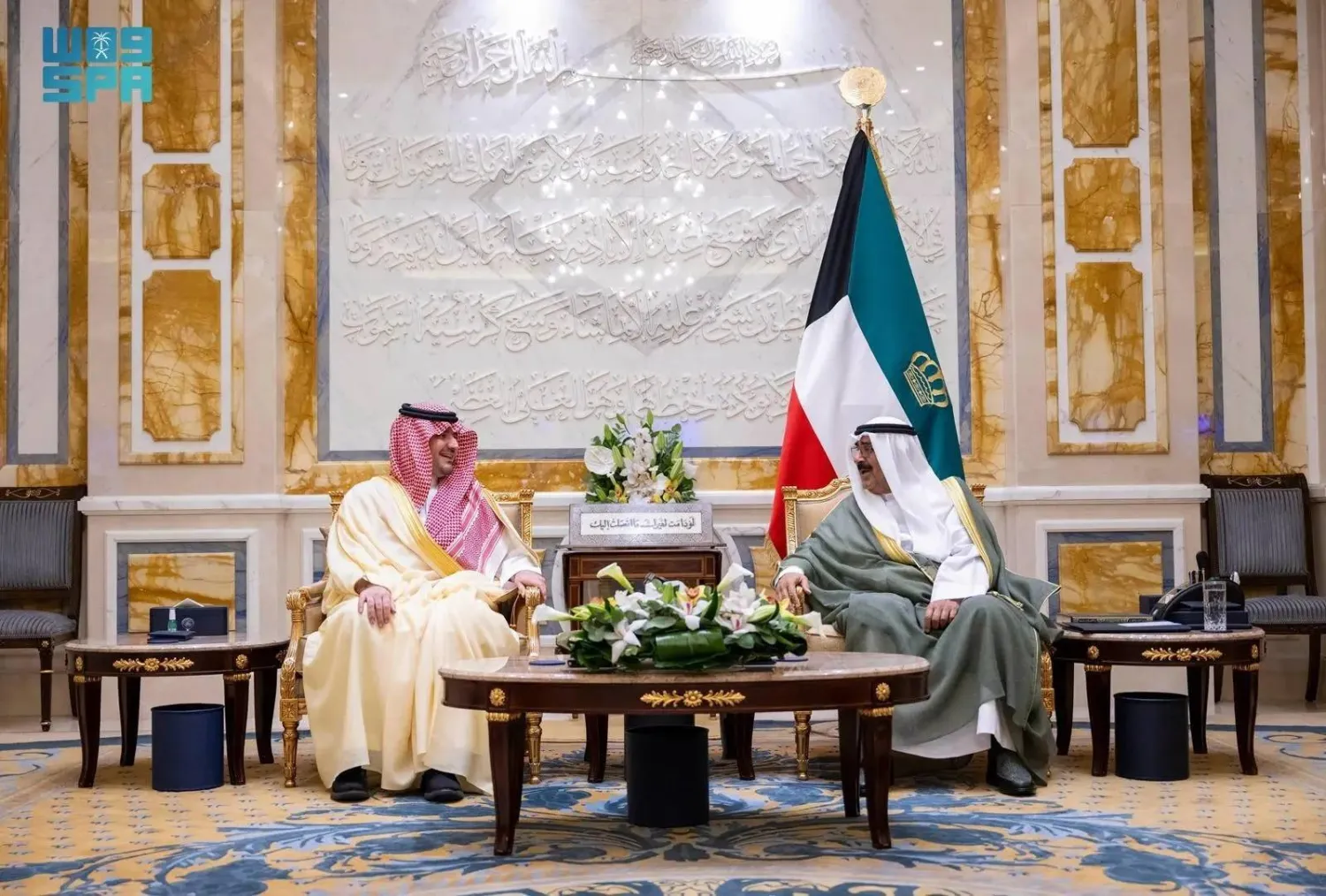

Emir of Kuwait Hails his Country's Historic Ties with Saudi Arabia

Emir of Kuwait Sheikh Meshal Al-Ahmad Al-Jaber Al-Sabah and Saudi Minister of Interior Prince Abdulaziz bin Saud bin Naif bin Abdulaziz meet on Sunday. (SPA)
TT

Emir of Kuwait Hails his Country's Historic Ties with Saudi Arabia

Emir of Kuwait Sheikh Meshal Al-Ahmad Al-Jaber Al-Sabah and Saudi Minister of Interior Prince Abdulaziz bin Saud bin Naif bin Abdulaziz meet on Sunday. (SPA)

Emir of Kuwait Sheikh Meshal Al-Ahmad Al-Jaber Al-Sabah received in Kuwait on Sunday Saudi Minister of Interior Prince Abdulaziz bin Saud bin Naif bin Abdulaziz.

The minister conveyed the greetings of Custodian of the Two Holy Mosques King Salman bin Abdulaziz Al Saud and Prince Mohammed bin Salman bin Abdulaziz Al Saud, Crown Prince and Prime Minister, along with their wishes of continued progress and prosperity to the Emir and to the government and people of Kuwait.

Sheikh Meshal expressed his deep appreciation to the leadership of the Kingdom of Saudi Arabia, praising the strength of the historic relations between Saudi Arabia and Kuwait and the bonds of brotherhood and cooperation that unite their peoples.

Crown Prince of Kuwait Sheikh Sabah Khaled Al-Hamad Al-Sabah and Saudi Minister of Interior Prince Abdulaziz bin Saud bin Naif bin Abdulaziz meet on Sunday. (SPA)

During the meeting, they reviewed relations and the ongoing security cooperation between the two brotherly countries.

Crown Prince of Kuwait Sheikh Sabah Khaled Al-Hamad Al-Sabah also received Prince Abdulaziz bin Saud for talks on bilateral relations.

Discussions tackled areas of cooperation and joint coordination, particularly on security issues.

Prince Abdulaziz bin Saud later met with Prime Minister Sheikh Ahmad Abdullah Al-Ahmad Al-Sabah and his Kuwaiti counterpart and First Deputy Prime Minister Sheikh Fahad Yousef Saud Al-Sabah. 

Prince Abdulaziz bin Saud said the meeting with Sheikh Fahad came in implementation of the directives of King Salman and Crown Prince Mohammed to boost security cooperation between their countries. 

The officials reviewed the historic fraternal bilateral relations and their continued development in various fields, particularly the ongoing security cooperation between the Saudi and Kuwaiti ministries of interior. 

The meeting reviewed a number of issues related to the exchange of information and expertise, cooperation in combating organized crime, strengthening the security training system, and developing human capacities, as well as joint work in employing the latest security technologies and systems.  

It addressed coordination in the field of border security and efforts to bolster joint monitoring in a manner that contributes to safeguarding the security and stability of both countries. 

The ministers commended the ongoing work within the Military and Security Coordination Committee, stressing their keenness to strengthen joint security cooperation to meet the aspirations of the leaderships of the two countries. 

Prince Abdulaziz bin Saud reviewed a presentation on the Kuwaiti Ministry of Interior's efforts to enhance security, combat crime, and adopt modern technological systems across its security departments. 


Saudi Hajj Minister Inspects Readiness of Mina Camps Ahead of Hajj

Saudi Minister of Hajj and Umrah Tawfig Al-Rabiah during his inspection tour on Tuesday. (SPA)
TT

Saudi Hajj Minister Inspects Readiness of Mina Camps Ahead of Hajj

Saudi Minister of Hajj and Umrah Tawfig Al-Rabiah during his inspection tour on Tuesday. (SPA)

Saudi Minister of Hajj and Umrah Tawfig Al-Rabiah inspected on Tuesday the readiness of the camps in Mina ahead of the Hajj, as part of field tours to assess service levels.

He noted that preparations began early, boosting camp readiness and operational efficiency through coordinated efforts among relevant entities.

New electronic systems have been introduced this year to monitor pilgrim movement and regulate entry and exit from the camps, alongside the installation of signage at entrances and exits indicating departure and return times and other instructions, he revealed.

The measures support crowd management and bolster pilgrim safety, aligning with the ministry’s efforts to ensure full readiness and advance the goals of Saudi Vision 2030 and the Pilgrim Experience Program.

The General Presidency for Religious Affairs at the Grand Mosque and the Prophet’s Mosque welcomed the first groups of pilgrims arriving to perform the Hajj.

The presidency emphasized on Tuesday its commitment to leveraging its religious and scholarly resources to serve pilgrims and provide guidance and instruction to help them perform the Hajj rituals in accordance with correct Prophetic teachings.

The presidency's staff, including scholars, preachers, and translators, welcomed pilgrims, guided them, and responded to their inquiries.

The services were delivered through various platforms, including interactive screens, printed materials, and direct guidance, reflecting the Two Holy Mosques’ scholarly and outreach mission to promote the values of moderation and tolerance and to foster intercultural dialogue among Muslims.


Qatar Warns Against Internationalizing Strait of Hormuz Crisis

Advisor to the Qatari Prime Minister and Official Spokesperson for the Ministry of Foreign Affairs Dr. Majed bin Mohammed Al Ansari. Asharq Al-Awsat
TT

Qatar Warns Against Internationalizing Strait of Hormuz Crisis

Advisor to the Qatari Prime Minister and Official Spokesperson for the Ministry of Foreign Affairs Dr. Majed bin Mohammed Al Ansari. Asharq Al-Awsat

Advisor to the Qatari Prime Minister and Official Spokesperson for the Ministry of Foreign Affairs Majed Al Ansari has said that any closure of the Strait of Hormuz would transform the regional crisis into a global one.

He stressed on Tuesday that the strait is connected to the energy sector, supply and logistics chains, export and re-export operations.

“The impact of closing the strait would be felt even at the household level and basic services in countries thousands of kilometers away from the region," Al Ansari warned.

He also stressed that ensuring that the strait remains open to navigation is a shared international responsibility, expressing Qatar's commitment to its international partners and its continued role as a reliable partner in the energy sector, while continuing coordination to ensure maritime security and market stability

“Reaching solutions to this crisis represents a priority for Qatar's national security and national interests and those of its partners,” he said.

Al Ansari affirmed that Qatar continues to maintain ongoing communication with various parties, including the United States, to follow developments and to support efforts aimed at reaching a peaceful solution to end the crisis.

During the Ministry's weekly media briefing, Al Ansari stressed Qatar's full support for the efforts undertaken by Pakistan, which is mediating between Iran and the US.

Regarding Lebanon, Al Ansari affirmed Qatar's firm position in supporting the unity and sovereignty of Lebanon, condemning violations and attacks that resulted in casualties and large-scale displacement, and welcoming the ceasefire as an initial step toward de-escalation.

He also stressed the need for full adherence to the ceasefire.

“All regional crises can only be resolved through the negotiating table,” he added.


Gulf Underscores Support for Lebanon’s Security, Stability

Secretary-General of the Gulf Cooperation Council Jasem Mohamed Albudaiwi speaks at the symposium in Riyadh on Tuesday. (GCC)
TT

Gulf Underscores Support for Lebanon’s Security, Stability

Secretary-General of the Gulf Cooperation Council Jasem Mohamed Albudaiwi speaks at the symposium in Riyadh on Tuesday. (GCC)

Secretary-General of the Gulf Cooperation Council Jasem Mohamed Albudaiwi stressed on Tuesday the council’s firm support for Lebanon and everything that can bolster its security, stability and sovereignty.

Albudaiwi sponsored a symposium on GCC relations with Lebanon, “Challenges and Drivers”, organized by the Political Affairs and Negotiations Sector at the General Secretariat in Riyadh. The event was attended by a number of ambassadors to Saudi Arabia, as well as officials and experts.

Albudaiwi said GCC countries “view Lebanon as an integral part of its Arab surroundings and an important pillar of regional stability.”

“Relations between the GCC countries and Lebanon are historic and robust, built and consolidated on many foundations and bonds, foremost among them the bond of brotherhood, which has remained unchanged despite all developments and circumstances,” he stressed.

The leaders of GCC countries have repeatedly underlined the need for the full implementation of United Nations Security Council resolution 1701 in Lebanon. They have also repeatedly expressed their support for Lebanon’s state institutions, added Albudaiwi.

“The GCC welcomes the steps taken by the government to extend the state’s control over all Lebanese territory and ensure that arms are held exclusively by the state, as an indispensable foundation for restoring stability and building trust with the Arab and international communities,” he went on to say.

“During our visits to Beirut and our meetings with Lebanese leaders, we were keen to convey a clear message that the GCC countries will remain an active partner in supporting Lebanon and its recovery,” he remarked.

He acknowledged the complex challenges Lebanon is currently facing, which require concerted international efforts to support and assist it.

He noted that the recent war between Israel and Hezbollah, which resulted in the displacement of more than a million people and left more than 2,000 dead, places Lebanon before a major humanitarian and security challenge.

Albudaiwi stressed the importance of strengthening cooperation with the international community and regional organizations to support the capabilities of the Lebanese army, control borders, and combat smuggling and illicit activities, “to restore Lebanon’s position as a trusted partner within its Arab and international surroundings.”

“GCC countries will remain by Lebanon’s side,” he declared.

“Lebanon’s future begins from within, through the will of its people and their ability to build a strong and stable state,” he stressed.

He expressed confidence that Lebanon “is capable of overcoming its crises and returning to its natural role within its Arab surroundings, with the support of its brothers and friends, the determination of its people, and the wisdom of its leadership.”
