

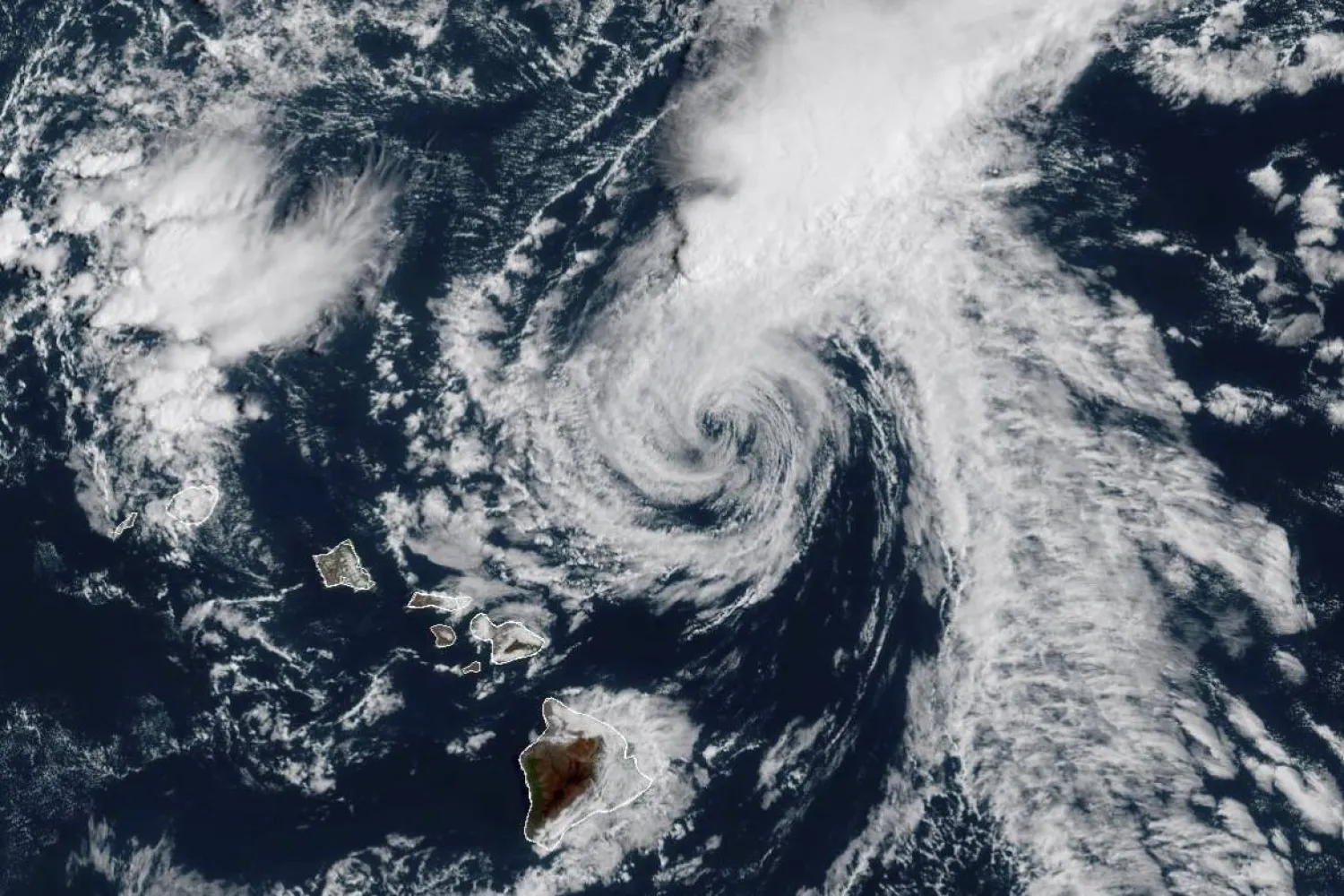

Many Ask Where the Hurricanes Are This Season as the Atlantic Remains Quiet 

This GOES-West GeoColor satellite image taken Tuesday, Sept. 9, 2025 and provided by NOAA, shows Hurricane Kiko churning north of Hawaii. (NOAA via AP)
TT

Many Ask Where the Hurricanes Are This Season as the Atlantic Remains Quiet 

This GOES-West GeoColor satellite image taken Tuesday, Sept. 9, 2025 and provided by NOAA, shows Hurricane Kiko churning north of Hawaii. (NOAA via AP)

Not a single named storm has formed in the Atlantic Ocean in nearly three weeks, even though it’s the peak of hurricane season.

“Where the heck are the Atlantic #hurricanes?” Philip Klotzbach, a meteorologist at Colorado State University, wrote recently on X.

Many are wondering the same thing.

Tropical Storm Fernand was the last named storm to form this season. It was short-lived, forming on Aug. 23 and dissipating on Aug. 28 while remaining over open water.

This is only the second time that no named storms have formed during the peak of the Atlantic hurricane season since modern record-keeping began in 1950, according to Ernesto Rodríguez, meteorologist in charge of the National Weather Service forecast office in San Juan, Puerto Rico.

“Usually, conditions during this period are prime,” he said.

The quietest peak running from Aug. 29 to Sept. 15 was recorded in 1992, after Hurricane Andrew devastated Florida.

Why it's so quiet

Three factors are to blame, or cheer.

One, a strong vertical wind shear, which refers to a change in wind speed or direction with altitude. It has increased thanks to a cyclonic circulation in the mid-upper troposphere, which is the lowest region of the Earth’s atmosphere.

Two, persistent dry and stable air across the tropical Atlantic.

And three, a drop in the amount of rainfall in West Africa, where tropical waves form during the hurricane season.

“This is pretty positive, especially for us in Puerto Rico,” Rodríguez said.

The US territory is still rebuilding from Hurricane Maria, which hit the island as a powerful Category 4 storm on Sept. 20, 2017.

The lack of storms prompted experts at Colorado State University to publish an explanatory report earlier this month.

“There has been considerable discussion amongst meteorologists, the media and the general public about the recent quiet period for Atlantic hurricane activity,” the report stated, which called it “quite remarkable.”

Not in the clear

Forecasters say the US could still see a busy season in the second half of September and the first part of October.

A cluster of storms currently located hundreds of miles east of the Caribbean is forecast to become a named storm in upcoming days, although it’s expected to turn away from the region and remain over open water, possibly as a powerful hurricane.

Another cluster of storms is swirling behind it, but so far, it only has a 20% chance of formation.

“From Sept. 15 to Oct. 15, conditions will be pretty prime,” Rodríguez said.

He noted that ocean temperatures remain warm, which provides fuel to storms.

What history says

Up to 80% of hurricane activity in the Atlantic occurs in August and September, but this year has seen only six named storms.

“One of the issues plaguing the Atlantic this hurricane season has been insufficient instability,” according to the report by Colorado State University.

The National Oceanic and Atmospheric Administration had predicted an above-normal season with 13 to 18 named storms. Of those, five to nine were forecast to become hurricanes, including two to five major hurricanes, which pack winds of 111 mph or greater.

Erin strengthened into this year’s first Atlantic hurricane in August, reaching Category 5 status as it bypassed land. No other hurricanes have formed since then.

A typical hurricane season in the Atlantic, which runs from June 1 to Nov. 30, will yield 14 named storms, of which seven strengthen into hurricanes and three become major hurricanes, according to NOAA.

“The conga line of tropical waves exiting Africa that hits its peak by late August and September — is a little late to the party this season,” wrote hurricane specialist and storm surge expert Michael Lowry in his most recent report.



Mummified Cheetahs Found in Saudi Caves Shed Light on Lost Populations

This undated image provided by Communications Earth and Environment shows the mummified remains of a cheetah. (Ahmed Boug/Communications Earth and Environment via AP)
TT

Mummified Cheetahs Found in Saudi Caves Shed Light on Lost Populations

This undated image provided by Communications Earth and Environment shows the mummified remains of a cheetah. (Ahmed Boug/Communications Earth and Environment via AP)

Scientists have uncovered the mummified remains of cheetahs from caves in northern Saudi Arabia.

The remains range from 130 years old to over 1,800 years old. Researchers excavated seven mummies along with the bones of 54 other cheetahs from a site near the city of Arar.

Mummification prevents decay by preserving dead bodies. Egypt's mummies are the most well-known, but the process can also happen naturally in places like glacier ice, desert sands and bog sludge.

The new large cat mummies have cloudy eyes and shriveled limbs, resembling dried-out husks.

“It’s something that I’ve never seen before,” said Joan Madurell-Malapeira with the University of Florence in Italy, who was not involved with the discovery.

Researchers aren’t sure how exactly these new cats got mummified, but the caves’ dry conditions and stable temperature could have played a role, according to the new study published Thursday in the journal Communications Earth and Environment.

They also don't know why so many cheetahs were in the caves. It could have been a denning site where mothers birthed and raised their young.

Scientists have uncovered the rare mummified remains of other large cats, including a saber-toothed cat cub in Russia.

It's uncommon for large mammals to be preserved to this degree. Besides being in the right environment, the carcasses also have to avoid becoming a snack for hungry scavengers like birds and hyenas.

Cheetahs once roamed across most of Africa and parts of Asia, but now live in just 9% of their previous range and haven't been spotted across the Arabian Peninsula for decades. That’s likely due to habitat loss, unregulated hunting and lack of prey, among other factors.

In a first for naturally mummified large cats, scientists were also able to peek at the cheetahs' genes and found that the remains were most similar to modern-day cheetahs from Asia and northwest Africa. That information could help with future efforts to reintroduce the cats to places they no longer live.


Vonn Launches Social Media Search Mission After Ski Pole Goes Missing

 US' Lindsey Vonn crosses the finish line to win the Women's Downhill event of the FIS Alpine Ski World Cup in Altenmarkt Zauchensee, Austria, on January 10, 2026. (AFP)
US' Lindsey Vonn crosses the finish line to win the Women's Downhill event of the FIS Alpine Ski World Cup in Altenmarkt Zauchensee, Austria, on January 10, 2026. (AFP)
TT

Vonn Launches Social Media Search Mission After Ski Pole Goes Missing

 US' Lindsey Vonn crosses the finish line to win the Women's Downhill event of the FIS Alpine Ski World Cup in Altenmarkt Zauchensee, Austria, on January 10, 2026. (AFP)
US' Lindsey Vonn crosses the finish line to win the Women's Downhill event of the FIS Alpine Ski World Cup in Altenmarkt Zauchensee, Austria, on January 10, 2026. (AFP)

Lindsey Vonn may be dominating World Cup downhills at 41, but even the US speed queen is not immune to missing equipment.

Vonn took to social media on Thursday with an unusual plea after losing a ski pole in Tarvisio, Italy, ahead of this weekend's World Cup event.

"Someone took ‌my pole ‌in the parking ‌lot ⁠today in ‌Tarvisio. If you have seen it, please respond to this. Thank you," Vonn wrote on X, posting a photo of the matching pole complete with her initials on the ⁠hand strap.

Vonn, a favorite for the speed events ‌at next month's Milano-Cortina ‍Olympics, retired ‍from the sport in 2019 and ‍had a partial knee replacement in April 2024 but returned to competition later that year and has been enjoying a fairy-tale comeback that has defied age and expectation.

Already the oldest ⁠World Cup winner of all time, Vonn continued her astonishing, age-defying form with a downhill victory in Zauchensee, Austria last week.

That triumph marked Vonn's fourth podium from four downhills this season, cementing her lead in the World Cup standings and her status as the woman to ‌beat at next month's Olympics.


ISS Crew Splashes Down on Earth After Medical Evacuation

FILE - This photo provided by NASA shows the Moon's shadow covering portions of Canada and the US during a total solar eclipse as seen from the International Space Station on Monday, Aug. 8, 2024. (NASA via AP, File)
TT

ISS Crew Splashes Down on Earth After Medical Evacuation

FILE - This photo provided by NASA shows the Moon's shadow covering portions of Canada and the US during a total solar eclipse as seen from the International Space Station on Monday, Aug. 8, 2024. (NASA via AP, File)

Four International Space Station (ISS) crewmembers splashed down in the Pacific Ocean early Thursday, video footage from NASA showed, after a medical issue prompted their mission to be cut short.

American astronauts Mike Fincke and Zena Cardman, Russian cosmonaut Oleg Platonov and Japan's Kimiya Yui landed off the coast of San Diego about 12:41 am (0841 GMT), marking the first-ever medical evacuation from the ISS.