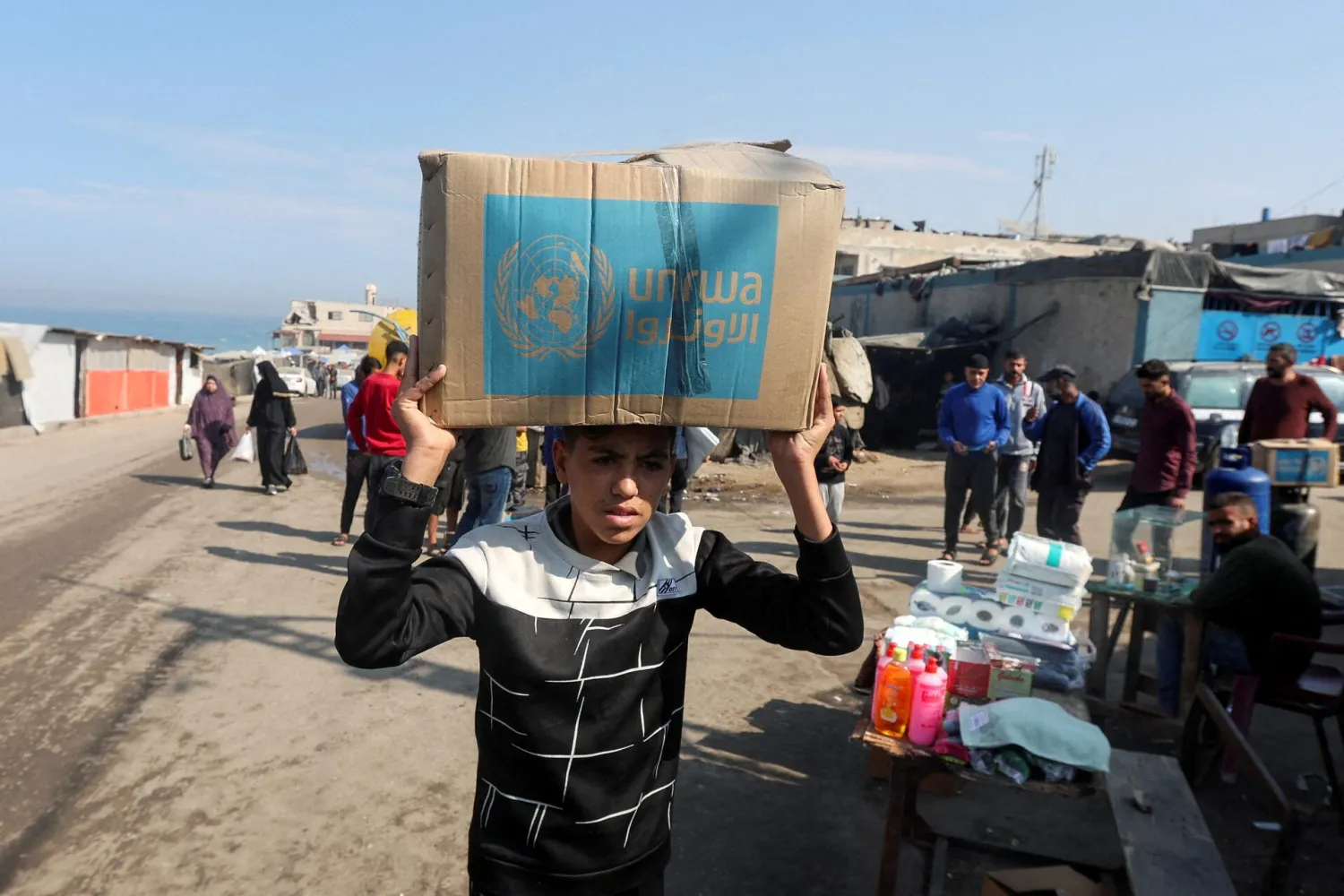

The United Nations Relief and Works Agency for Palestine Refugees (UNRWA) has warned it faces an “existential threat” as its financial deficit climbs to $200 million by year’s end, raising fears the agency could collapse.
“UNRWA is on the brink of financial breakdown. Without closing this gap, we will not be able to continue providing essential services to millions of refugees,” said Tamara Alrifai, UNRWA’s Director of External Relations and Communications, in an interview with Asharq Al-Awsat during her visit to Riyadh.
Saudi Arabia remains a cornerstone of UNRWA’s political and financial support, she stated, stressing its long-standing role as a regional power advocating for a political resolution to the refugee issue.
Since 2012, Riyadh has contributed $153 million to UNRWA’s core budget, while the Saudi Fund for Development has provided over $600 million in project support.
“We ask the Kingdom to continue backing UNRWA’s mission politically and financially, as this support is irreplaceable at a time when some seek to liquidate the refugee cause,” Alrifai added.
Describing the humanitarian crisis in Gaza, Alrifai said all UNRWA services remain operational despite the war, but their nature has shifted: schools now serve as shelters, while medical teams deliver around 15,000 consultations daily. Since the conflict began in 2023, UNRWA’s health services have provided more than 9 million consultations.
Alrifai noted that 90% of Gaza is now designated a “red zone” due to ongoing Israeli military operations, with seven shelters and two health centers directly hit.
“The most urgent need today is a ceasefire. There is no safe place in Gaza. An entire generation has been out of school for two years, and while we try to provide basic education in shelters or online, we are facing deep psychological scars that will only become apparent later,” she warned.
Meanwhile, 12,000 Palestinian staff continue their duties under perilous conditions, delivering clean water, managing waste to prevent disease, and sustaining emergency relief operations.
In the occupied West Bank, UNRWA schools remain open except in areas where Israeli authorities have displaced refugee communities. Alrifai criticized Israeli efforts to restrict UNRWA’s work through legislation and visa denials for international staff, but insisted services persist thanks to Palestinian employees and UN mandates.
Monthly, the agency spends $50 to 60 million to operate across Palestine, Lebanon, Syria, and Jordan. However, US and Swedish funding suspensions have created a severe gap. Arab contributions, once 20% of the budget, have dropped to just 3% this year.
“UNRWA faces a dual existential crisis: political attempts to undermine its mandate as the custodian of Palestinian refugee history, and a financial crisis threatening its survival. We hold an archive documenting the displacement of 700,000 Palestinians in 1946-48, and today we serve 5.9 million refugees. That places us at the heart of the Palestinian question,” Alrifai said.
She hoped that the UN General Assembly will renew UNRWA’s mandate for another three years, expecting broad support despite attempts to discredit the agency.
Addressing the funding freeze linked to allegations that some staff were involved in the October 7 attacks, Alrifai said: “An independent investigation found no evidence for these claims. We also strengthened neutrality mechanisms, which restored international confidence.”
She confirmed that 14 of 16 donor countries that suspended aid have resumed funding, with the exceptions of the United States and Sweden.