

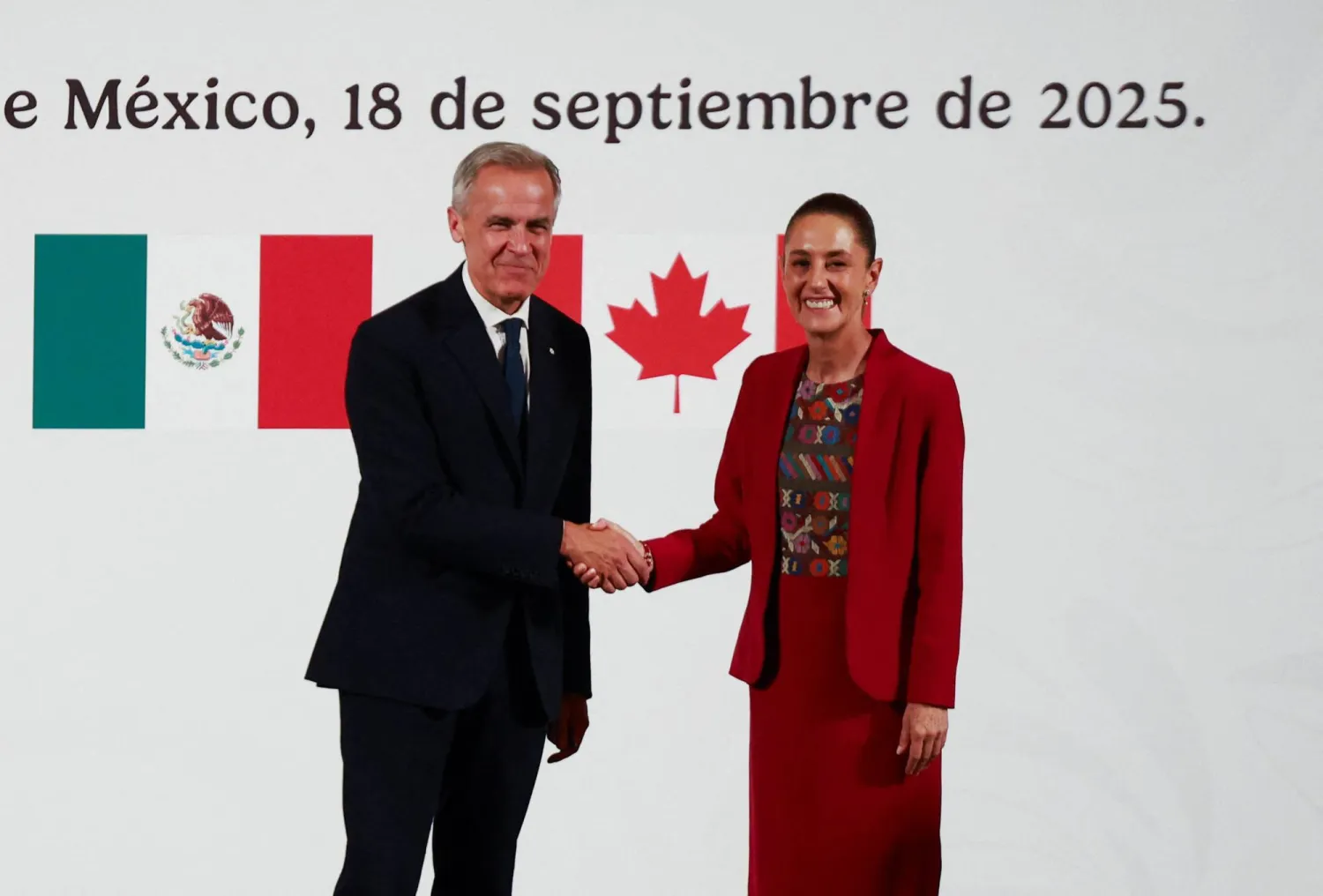

Leaders of Canada and Mexico Vow Closer Economic Ties in the Face of Trump Trade Uncertainty 

Mexican President Claudia Sheinbaum and Canadian Prime Minister Mark Carney shake hands as they hold a press conference at the National Palace, in Mexico City, Mexico September 18, 2025. (Reuters)
TT

Leaders of Canada and Mexico Vow Closer Economic Ties in the Face of Trump Trade Uncertainty 

Mexican President Claudia Sheinbaum and Canadian Prime Minister Mark Carney shake hands as they hold a press conference at the National Palace, in Mexico City, Mexico September 18, 2025. (Reuters)

Canadian Prime Minister Mark Carney and President Claudia Sheinbaum promised Thursday to strengthen trade relations in the face of US tariff threats and pushed to keep the most important free trade agreement in the Western Hemisphere alive in the lead-up to negotiations next year.

Their meeting came during Carney's first visit to Mexico as Canada's leader and at a moment of economic tension for the region. The two leaders shook hands and strode side-by-side into the presidential palace in Mexico City earlier in the day. Despite not being present, US President Donald Trump and wider economic uncertainty were front and center in the visit.

“North America is the economic envy of the world, is the most competitive economic region of the world, and part of the reason for that is the cooperation between Canada and Mexico,” Carney said in a press conference following the meeting. “We complement the United States. We make them stronger. We are all stronger together.”

Key to Carney and Sheinbaum's meeting was the United States-Mexico-Canada trade pact, or USMCA, which is up for review in 2026.

Decades of free trade among the three nations has inextricably intertwined their economies: More than 75% of Canada’s exports and more than 80% of Mexico’s go to the US.

Trump’s ongoing and constantly evolving trade threats have put the countries’ political and business leaders on edge, as many scramble for more stable trade alternatives.

“Trump looms over this visit. Mexico and Canada now share a common threat from the US,” said Nelson Wiseman, professor emeritus at the University of Toronto.

On Thursday, Carney said he expects “much greater amounts of trade, much greater amounts of investment” between the Mexico and Canada. Sheinbaum said the two countries had agreed to a plan that what would “bring a new era of further strengthening economic ties” between the two nations.

Sheinbaum has said they want to increase bilateral trade in different sectors through the free-trade agreement and do so through maritime routes, which would avoid those goods having to pass through the United States.

Seeking improved relations

Carney was also looking to improve relations with Mexico during his two-day visit after some of Canada’s provincial premiers talked last year about cutting Mexico out of any new free trade deal with the US.

Trump lumped Canada in with Mexico on fentanyl smuggling and promised sweeping tariffs on both countries. Ontario Premier Doug Ford said then that Trump comparing Canada to the Mexico was “the most insulting thing I’ve ever heard from our friends and closet allies, the United States of America.”

Canadian Sen. Peter Boehm, who represented the Canadian government when Sheinbaum was sworn in as Mexico’s president last year, said the comments by the premiers, which he deemed out of their lane, upset the Mexicans.

“The Mexicans are particularly sensitive on these matters and there was concern about that, no doubt,” Boehm, who has been pushing closer relations between the two governments, said.

He said relations recently improved, noting Mexico appreciated Carney inviting Sheinbaum to the G7 summit in Alberta in June.

On Thursday, the two leaders promised new rounds of bilateral meetings in the coming months, and greater collaboration on security issues, agriculture, energy, finance, health, the environment and more.

“At this hinge moment. Canada is deepening our relationships with our long-standing partners,” Carney said. “Mexico is central to those missions.”

Mexico is Canada’s third-largest trading partner after the US and China. Canada was Mexico’s fifth-largest trading partner in 2024. But trade with the US remains paramount for both countries and preserving the free trade pact will be critical.

Trump looms over visit

Mexico and Canada have had different approaches to manage the negotiations with Trump’s administration but both countries want to increase bilateral commerce within the North American treaty.

Sheinbaum said the countries are already setting up teams and reviewing the agreement with the hopes of keeping trilateral free trade in place.

“Their priority is to strategize on how to deal with Trump and the coming renegotiation of the USMCA. Carney and Sheinbaum now recognize that tag-teaming Trump may be more effective than competing for separate deals with Trump, although they are still angling for them," said Wiseman, the professor.

That trade agreement has largely shielded the vast majority of Mexican and Canadian goods from the punishing duties. Canadian and Mexican companies can claim preferential treatment under the USMCA.

But Trump has some sector-specific tariffs, known as 232 tariffs, that are having an impact. There is a 50% tariff on steel and aluminum imports. Sheinbaum noted that the lack of tariffs on many goods was a sign of the economic ties between the countries, but noted she hoped to offset especially steel tariffs.

Despite that, Carney and Sheinbaum highlighted the importance of the US and the importance of unity between the three countries. They dodged questions about provocations by Trump and any tensions with the American leader, threading the word “optimism” throughout the press conference.

“USMCA is a testament to if Mexico, Canada and the United States work together, we can create prosperity, face global challenges successfully and position ourselves as the most dynamic region in the world,” Sheinbaum said.



Venture Capital Records Two Historic Milestones, Reinforces Saudi Arabia’s Regional Leadership

Venture Capital Records Two Historic Milestones, Reinforces Saudi Arabia’s Regional Leadership
TT

Venture Capital Records Two Historic Milestones, Reinforces Saudi Arabia’s Regional Leadership

Venture Capital Records Two Historic Milestones, Reinforces Saudi Arabia’s Regional Leadership

The Saudi Venture Capital Company (SVC) announced on Sunday that Saudi Arabia’s venture capital ecosystem achieved two historic leaps in 2025, in terms of total investment value and number of transactions, further reinforcing the Kingdom’s position as the leading venture capital market in the Middle East for the third consecutive year.

This performance reflects the tangible impact of Saudi Vision 2030 and the structural economic transformation taking place across the Kingdom.

In a statement, the SVC said that the Saudi market recorded its highest-ever number of venture capital transactions, reaching 254 deals in 2025, alongside a record investment value of $1.66 billion during the year.

This compares to approximately $60 million in 2018, representing a 25-fold increase in venture capital investment since the establishment of SVC and the emergence of its role as a market maker within the ecosystem.

CEO and Board Member of SVC Dr. Nabeel Koshak said: “What we are witnessing today in Saudi Arabia’s venture capital sector is the direct result of the unlimited support provided by the Kingdom’s wise leadership across all sectors.”

“This support has been translated into a deliberate and well-calibrated economic transformation, moving private capital into a more mature and impactful phase. These figures reflect the strength of the Saudi economy, the clarity of national vision, and the growing confidence of investors, confirming that venture capital has become a core pillar of growth and economic diversification,” he added.

He stressed that the 25-fold growth in investment since 2018, together with the record-breaking figures for both investment value and deal volume, underscores the maturity of the Saudi venture capital market.

“Venture capital today is enabling the creation of scalable companies, generating high-quality jobs, and transforming innovation into sustainable economic value, fully aligned with the objectives of Saudi Vision 2030,” he said.


Türkiye to Ink 33 bcm Natural Gas Import Deal with Azerbaijan, Minister Says

Türkiye's Energy Minister Alparslan Bayraktar talks during a meeting in Ankara, Türkiye, September 14, 2023. (Turkish Energy Ministry Press Office/PPO/Handout via Reuters)
TT

Türkiye to Ink 33 bcm Natural Gas Import Deal with Azerbaijan, Minister Says

Türkiye's Energy Minister Alparslan Bayraktar talks during a meeting in Ankara, Türkiye, September 14, 2023. (Turkish Energy Ministry Press Office/PPO/Handout via Reuters)

Türkiye has reached a new long-term agreement to import a total of 33 bcm natural gas from Azerbaijan, Energy ‌Minister Alparslan ‌Bayraktar ‌said ⁠on Sunday in ‌a televised interview.

Under the deal, Türkiye will receive 2.25 billion cubic meters of ⁠gas per year ‌for 15 ‍years ‍from Azerbaijan's Absheron field, ‍totaling 33 billion cubic meters, Bayraktar said. Deliveries via pipeline are set to begin in ⁠2029.

He added that final negotiations were concluded on Friday and that the agreement was expected to be signed shortly.


Saudi Arabia Approves Annual Borrowing Plan with $58 Billion Financing Needs

The logo of Saudi Arabia’s Ministry of Finance (Asharq Al-Awsat)
TT

Saudi Arabia Approves Annual Borrowing Plan with $58 Billion Financing Needs

The logo of Saudi Arabia’s Ministry of Finance (Asharq Al-Awsat)

Saudi Arabia has approved its annual borrowing plan for the 2026 fiscal year, setting projected financing needs at about $58 billion as the Kingdom seeks to fund its budget deficit while maintaining long-term debt sustainability.

The plan was endorsed by Finance Minister Mohammed Al-Jadaan, who also chairs the board of the National Debt Management Center, following approval by the center’s board. It outlines key developments in public debt during 2025, initiatives to deepen the domestic debt market, and the financing strategy and guiding principles for 2026. It also includes the issuance calendar for the kingdom’s local riyal-denominated sukuk program for 2026.

According to the plan, total financing requirements for 2026 are estimated at around SAR 217 billion ($57.9 billion). These will be used to cover the projected budget deficit of about SAR 165 billion ($44 billion), as set out in the Ministry of Finance’s budget statement for the year, as well as the repayment of maturing debt principal amounting to roughly SAR 52 billion ($13.9 billion).

In a statement, the National Debt Management Center said the strategy prioritizes preserving public debt sustainability, expanding the investor base, and diversifying funding sources at home and abroad. This will be pursued through a combination of public and private channels, including the issuance of bonds and sukuk and the use of loans at competitive and reasonable costs.

The plan also points to an expanded use of alternative government financing tools, including project and infrastructure financing, and greater reliance on export credit agencies in 2026 and over the medium term. These measures will be implemented within carefully structured risk-management frameworks to support the Kingdom’s broader economic and fiscal objectives.