


Spain’s Top Diplomat Dismisses Israeli Leader’s Vow of No Palestinian State, Saying It Will Happen 

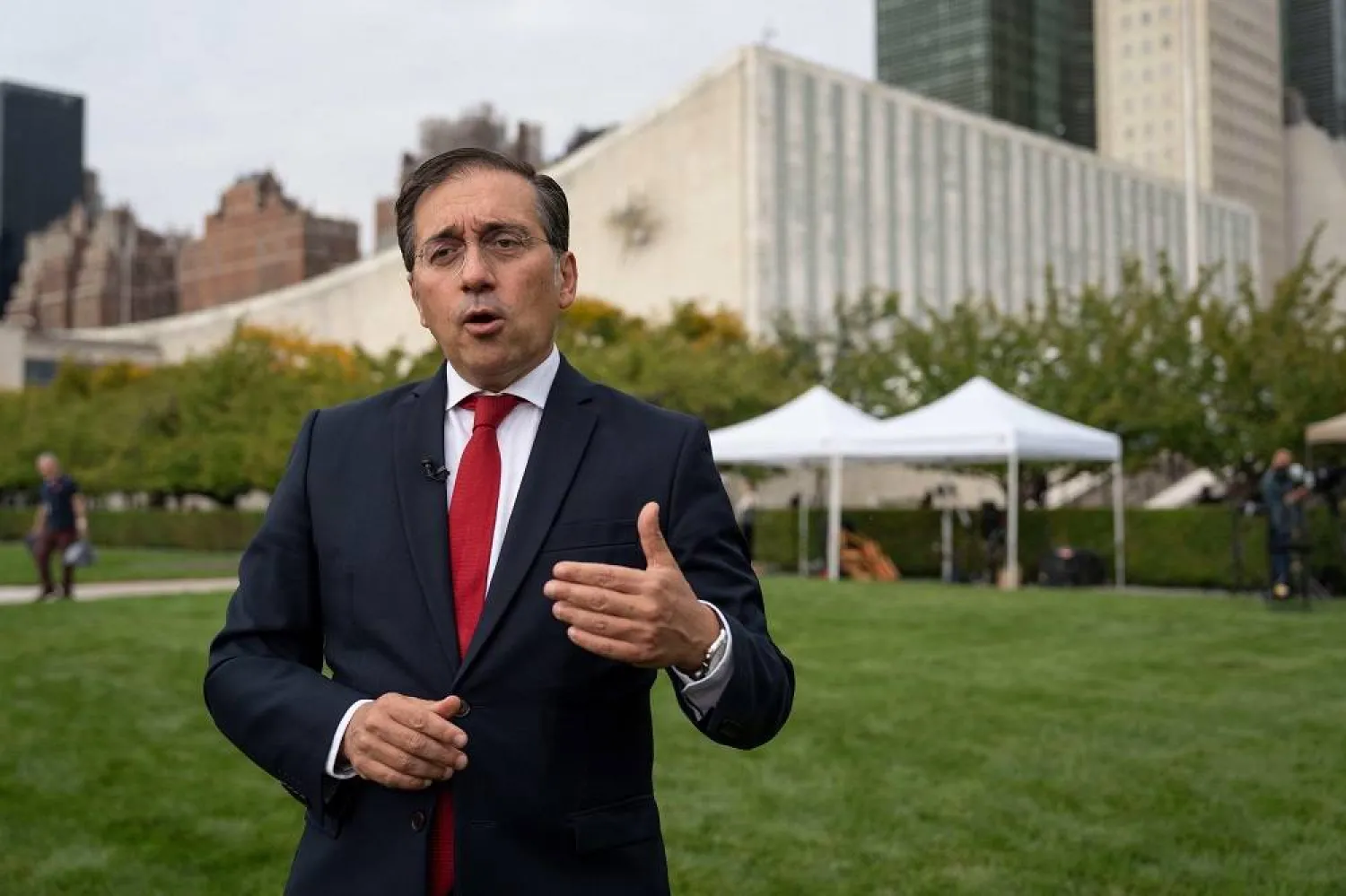
Spain's Minister of Foreign Affairs José Manuel Albares speaks during an interview at United Nations headquarters, Monday, Sept. 22, 2025. (AP)
TT

Spain’s Top Diplomat Dismisses Israeli Leader’s Vow of No Palestinian State, Saying It Will Happen 

Spain's Minister of Foreign Affairs José Manuel Albares speaks during an interview at United Nations headquarters, Monday, Sept. 22, 2025. (AP)

Spain’s top diplomat dismissed Israeli Prime Minister Benjamin Netanyahu’s statement that there will never be a Palestinian state, saying Israelis will one day want to live side by side in peace with Palestinians.

Foreign Minister José Manuel Albares said in an interview with The Associated Press on Monday that “a real wave” of countries have recognized the state of Palestine since Spain, Ireland and Norway did in May 2024 and an overwhelming number support a two-state solution to the nearly 80-year Israeli-Palestinian conflict.

“The day that everyone will have recognized the state of Palestine, we will have to move forward,” he said at the United Nations. “I’m sure that we will find someday the right people for peace on the Israel side, in the same way that we have found it in the Palestinian side" in the Palestinian Authority.

Spain has been in the forefront in pressuring Israel to end the war in Gaza sparked by Hamas’ surprise invasion of southern Israel on Oct. 7, 2023, criticizing “the atrocities” and “endless killing” it is committing in the territory.

Albares spoke before a UN General Assembly meeting at its annual gathering of world leaders. At the meeting, the Palestinians expected 10 recent and new countries to formally recognize the state of Palestine, adding to the list of more than 145 nations that already have.

France, Luxembourg, Belgium and others did so at the meeting, even after Netanyahu reiterated his vow that there will never be a Palestinian state. Weekend recognitions came from the United Kingdom, Canada and Australia.

The Spanish minister called Hamas “a terrorist organization” that doesn’t want a two-state solution. “So let’s put aside the extremists, and let’s look for the people that want a peaceful and secure coexistence.”

Albares said Spain has staked out one of the strongest positions against Israel’s actions in Gaza because “we cannot accept that the natural way for the people in the Middle East to relate is through war, through violence.”

Israel has the right to peace, stability, security and a state and so do the Palestinians, he said. “I don’t see why they should be condemned to be eternally a people of refugees."

Albares said that it was impossible for Spain, as a democratic country that believes in human rights, to have a “normal relation with Israel” while “this endless war continues.”

In recent weeks, Spain ratcheted up its opposition to Israel's actions in Gaza. Spanish Prime Minister Pedro Sánchez called the war a “genocide” earlier this month when he announced plans to formalize an arms embargo and block Israel-bound fuel deliveries from passing through Spanish ports. Netanyahu accused Sánchez of a “blatant genocidal threat.”

The following week, pro-Palestine protesters for whom the government expressed its support disrupted the final leg of an international cycling competition in Madrid due to the presence of a team with ties to Israel.

In the incident's aftermath, Sánchez called for Israel to be banned from all international sporting events while the war continues. A diplomatic tit-for-tat ensued in which both countries banned ministers and Israeli leaders accused the Spanish government of being “antisemitic.”

Albares said that in pressuring Israel to end the war in Gaza, Spain is defending the principles that underpin the creation of the United Nations after World War II — peace, justice, human rights and human dignity.

On another contentious issue, the minister defended Spain's refusal to spend 5% of its gross domestic product on defense as US President Donald Trump demanded. At a NATO conference in June, the Sánchez government was the only NATO member to say it would not increase spending to that level.

“We are going to meet the targets and the commitments that are needed for Euro-Atlantic security within NATO,” Albares said. “We said in order to meet them we don't need the 5%, we can do it with 2.1%. We have already reached the 2% target.”

Citing Spain's military deployments along Europe's eastern flank including “a historical peak” of 3,000 soldiers among its contributions to European security, he said, “We are a very committed ally to transatlantic security."

Albares said the US is a “historic, natural ally” of Spain and Europeans. “Let's keep doing it in the same way. But, of course, we need two for a tango," he said. What's clear, Albares said, is that Europe must increasingly take its destiny into its own hands whether it's ramping up internal trade or security.

Looking at broader challenges from the severity of wars to poverty, climate change and artificial intelligence advancements with no guardrails, Albares said the only answer to address them is by all countries working together — the multilateral approach that underpins the UN mission.

“At the end,” he said, “cooperation is always much ... stronger than confrontation.”


Road Accident in Nigeria Kills at Least 30 People

FILE PHOTO: A police vehicle of Operation Fushin Kada (Anger of Crocodile) is parked on Yakowa Road, as schools across northern Nigeria reopen nearly two months after closing due to security concerns, following the mass abductions of school children, in Kaduna, Nigeria, January 12, 2026. REUTERS/Nuhu Gwamna/File Photo
TT

Road Accident in Nigeria Kills at Least 30 People

FILE PHOTO: A police vehicle of Operation Fushin Kada (Anger of Crocodile) is parked on Yakowa Road, as schools across northern Nigeria reopen nearly two months after closing due to security concerns, following the mass abductions of school children, in Kaduna, Nigeria, January 12, 2026. REUTERS/Nuhu Gwamna/File Photo

At least 30 people have been killed and an unspecified number of people injured in a road accident in northwest Nigeria, authorities said.

The accident occurred Sunday in Kwanar Barde in the Gezawa area of Kano state and was caused by “reckless driving” by the driver of a truck-trailer, Gov. Abba Yusuf said in a statement. He did not specify what other vehicles were involved.

Yusuf described the accident as “heartbreaking and a great loss” to the affected families and the state. He did not provide more details of the accident, said The Associated Press.

Africa’s most populous country recorded 5,421 deaths in 9,570 road accidents in 2024, according to data by the country’s Federal Road Safety Corps.

Experts say a combination of factors including a network of bad roads, lax enforcement of traffic laws and indiscipline by some drivers produce the grim statistics.

In December, boxing heavyweight champion Anthony Joshua was in a deadly car crash that injured him and killed Sina Ghami and Latif “Latz” Ayodele, two of his friends, in southwest Nigeria.

Adeniyi Mobolaji Kayode, Joshua’s driver, was charged with dangerous and reckless driving and his trial is scheduled to begin later this month.


US Vice President Vance Heads to Armenia, Azerbaijan to Push Peace, Trade

US Vice President JD Vance speaks during the Critical Minerals Ministerial at the State Department in Washington, DC, US, February 4, 2026. (Reuters)
TT

US Vice President Vance Heads to Armenia, Azerbaijan to Push Peace, Trade

US Vice President JD Vance speaks during the Critical Minerals Ministerial at the State Department in Washington, DC, US, February 4, 2026. (Reuters)

US Vice President JD Vance will visit Armenia and Azerbaijan this week to push a Washington-brokered peace agreement that could transform energy and trade routes in the strategic South Caucasus region.

His two-day trip to Armenia, which begins later on Monday, comes just six months after the Armenian and Azerbaijani leaders signed an agreement at the White House seen as the first step towards peace after nearly 40 years of war.

Vance, the first US vice president to visit Armenia, is seeking to advance the Trump Route for International Peace and Prosperity (TRIPP), a proposed 43-kilometre (27-mile) corridor that would run across southern Armenia and give Azerbaijan a direct route to its exclave ‌of Nakhchivan ‌and in turn to Türkiye, Baku's close ally.

"Vance's visit should ‌serve ⁠to reaffirm the ‌US's commitment to seeing the Trump Route through," said Joshua Kucera, a senior South Caucasus analyst at Crisis Group.

"In a region like the Caucasus, even a small amount of attention from the US can make a significant impact."

The Armenian government said on Monday that Vance would hold talks with Prime Minister Nikol Pashinyan and that both men would then make statements, without elaborating.

Vance will then visit Azerbaijan on Wednesday and Thursday, the White House has said.

Under the agreement signed last year, ⁠a private US firm, the TRIPP Development Company, has been granted exclusive rights to develop the proposed corridor, with Yerevan ‌retaining full sovereignty over its borders, customs, taxation and security.

The ‍route would better connect Asia to Europe ‍while - crucially for Washington - bypassing Russia and Iran at a time when Western countries are ‍keen on diversifying energy and trade routes away from Russia due to its war in Ukraine.

Russia has traditionally viewed the South Caucasus as part of its sphere of influence but has seen its clout there diminish as it is distracted by the war in Ukraine.

Securing US access to supplies of critical minerals is also likely to be a key focus of Vance's visit.

TRIPP could prove a key transit corridor for the vast mineral wealth of ⁠Central Asia - including uranium, copper, gold and rare earths - to Western markets.

CLOSED BORDERS, BITTER RIVALS

In Soviet times the South Caucasus was criss-crossed by railways and oil pipelines until a series of wars beginning in the 1980s disrupted energy routes and shuttered the border between Armenia and Türkiye, Azerbaijan's key regional ally.

Armenia and Azerbaijan were locked in bitter conflict for nearly four decades, primarily over the mountainous region of Nagorno-Karabakh, an internationally recognized part of Azerbaijan that broke away from Baku's control as the Soviet Union fell apart in 1991.

Azerbaijan and Armenia fought two wars over Karabakh before Baku finally took it back in 2023. Karabakh's entire ethnic Armenian population of around 100,000 people fled to Armenia. The two neighbors have made progress in recent months on normalizing relations, including restarting ‌some energy shipments.

But major hurdles remain to full and lasting peace, including a demand by Azerbaijan that Armenia change its constitution to remove what Baku says contains implicit claims on Azerbaijani territory.


Adviser to Iran's Supreme Leader to Visit Oman on Tuesday

FILED - 06 February 2009, Bavaria, Munich: Ali Larijani, then chairman of the Iranian parliament, speaks at the 45th Munich Security Conference in Munich. Photo: Andreas Gebert/dpa
TT

Adviser to Iran's Supreme Leader to Visit Oman on Tuesday

FILED - 06 February 2009, Bavaria, Munich: Ali Larijani, then chairman of the Iranian parliament, speaks at the 45th Munich Security Conference in Munich. Photo: Andreas Gebert/dpa

Ali Larijani, an adviser to Iran's Supreme Leader Ali Khamenei, will visit Oman accompanied by a delegation on Tuesday, the ‌semi-official Tasnim news ‌agency reported ‌on ⁠Monday.

American and ‌Iranian diplomats held indirect talks in Oman last week, aimed at reviving diplomacy amid a US ⁠naval buildup near Iran and ‌Tehran's vows ‍of a ‍harsh response if ‍attacked.

"During this trip, (Larijani) will meet with high-ranking officials of the Sultanate of Oman and discuss the latest regional ⁠and international developments and bilateral cooperation at various levels," Tasnim said.

The date and venue of the next round of talks are yet to be announced.
