

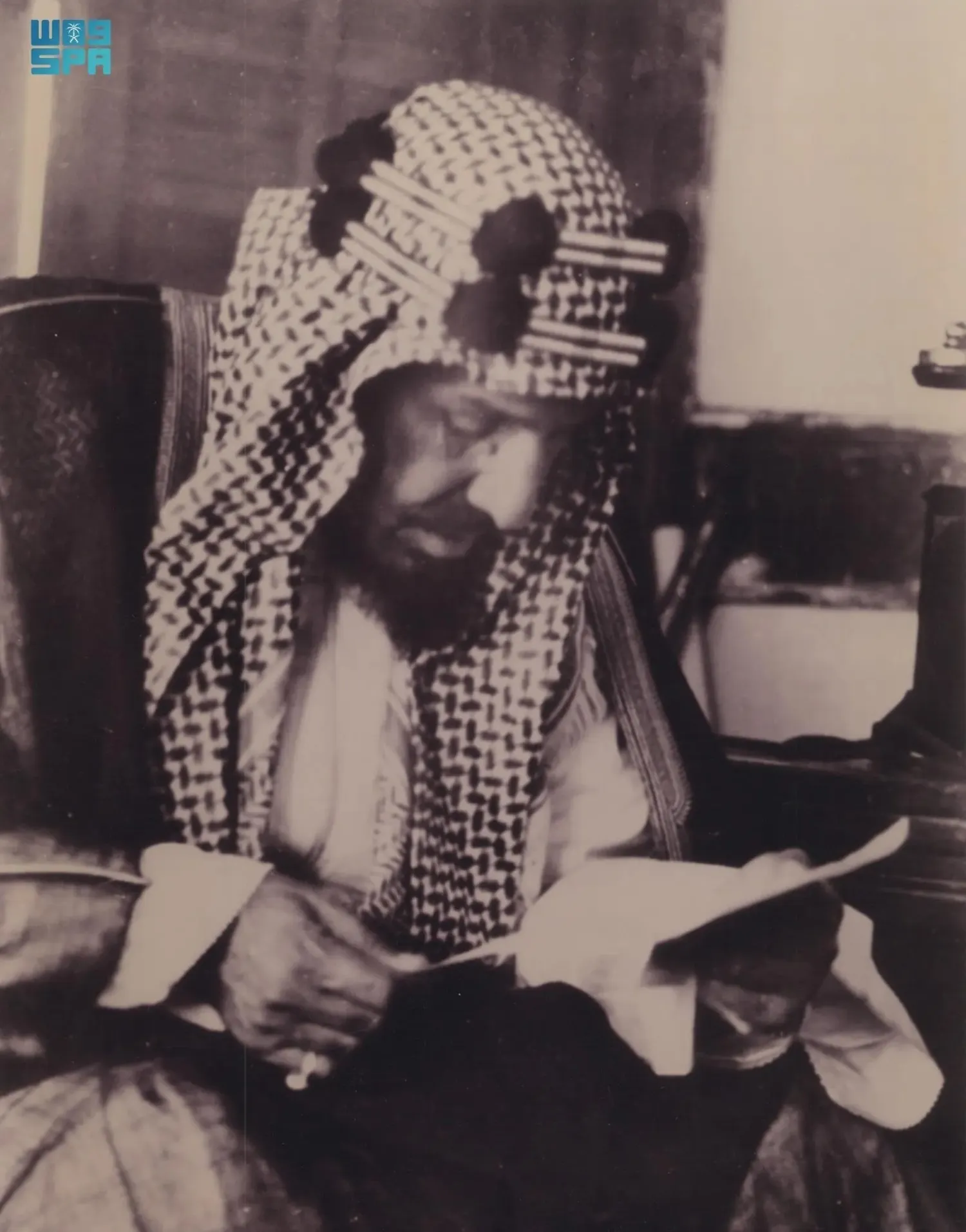

King Abdulaziz and the Saudis Who Built His State

King Abdulaziz bin Abdulrahman Al Saud. (SPA)
TT

King Abdulaziz and the Saudis Who Built His State

King Abdulaziz bin Abdulrahman Al Saud. (SPA)

This year marks 95 years since Saudi Arabia’s first National Day was celebrated in 1930, a reminder of the formidable task that faced King Abdulaziz as he forged a modern state out of disparate regions.

One of the founder’s most distinctive traits, historians say, was his insistence on choosing men of talent, regardless of their origin or tribal affiliation. The strategy gave the kingdom a pool of administrators, diplomats and advisers at a time when resources were scarce and few Saudis had access to formal schooling.

The historical record, however, has often highlighted non-Saudi advisers such as Hafez Wahba, Yusuf Yassin, Fuad Hamzah, Khalid al-Qurqani and Rushdi Malhas. Their memoirs and visibility in foreign media have ensured a lasting presence in the narrative. By contrast, many Saudi contemporaries left few writings, rarely gave interviews, and kept state secrets to their graves.

That silence, scholars argue, has led to an incomplete picture of the kingdom’s formative years. A corrective is now underway, aimed at restoring balance by spotlighting Saudi statesmen whose contributions were no less significant.

Asharq Al-Awsat has compiled sketches of some of those men — advisers, ministers, Shura Council members and envoys — whose work helped shape Abdulaziz’s reign from his capture of Riyadh in 1902 until his death in 1953.

Ahmed bin Abdullah bin Thunayan

Born and educated in Türkiye, bin Thunayan spoke Turkish, French and English. He joined Abdulaziz around 1911 as the king’s first political adviser and took part in military campaigns. He supervised the withdrawal of Ottoman troops from al-Ahsa and represented Najd in negotiations with Britain that led to the Treaty of Darin in 1915. He also accompanied Prince Faisal on his first trip to Europe in 1919 and attended the al-Muhammara conference in 1922. He died in Riyadh the following year.

Abdullah bin Mohammed al-Fadl

A native of Unaizah, al-Fadl studied in India, where he absorbed political currents under British rule and mastered Urdu and English. He served as Abdulaziz’s representative in Aden and became one of Prince Faisal’s closest aides in the Hejaz, eventually rising to deputy head of the Shura Council and deputy chairman of the Council of Deputies.

Mohammed Sharaf bin Ahmad Adnan al Ghaleb

Educated in Egypt and Türkiye, Adnan returned to Makkah after its capture by Abdulaziz in 1924. He became an adviser to the viceroy of the Hejaz, served on the Shura Council, and was later appointed its chairman. His career spanned advisory, legislative and oversight roles, including a seat on the inspection and reform committee.

Abdulrahman bin Hassan al-Qusaibi

Born in al-Ahsa, al-Qusaibi learned English and French while trading between Bahrain, India, Europe and Africa. Abdulaziz named him representative in Bahrain and entrusted him with sensitive negotiations. He was later appointed minister plenipotentiary and minister of state.

Ibrahim bin Mohammed bin Muammar

Born in Kuwait, educated in India, al-Muammar spoke English, Urdu and Persian. He entered Abdulaziz’s service in 1912 and became one of his early intelligence chiefs. He led the royal court in 1926, was posted to Iraq in 1933, and earned lasting fame for insisting that the Saudi flag never be lowered in mourning — a principle later enshrined by law.

Hamza bin Ibrahim Gouth

From Medina, Gouth studied under the Rashidis before joining Abdulaziz in 1922. He represented Najd at the Kuwait conference in 1924 and was later posted to Iraq and Iran. Abdulaziz reportedly chose him as ambassador to Tehran because of his lineage, name and origins in Medina — qualities the king believed would resonate in Iran.

Mohammed Sharaf bin Rida al-Yahya

Educated by private tutors and scholars of Makkah, al-Yahya became the first head of the kingdom’s finance administration after the Hejaz was annexed. He served as adviser, Shura member, minister of state and deputy chairman of the Council of Deputies.

Abdulaziz bin Hamoud bin Zaid

A Hail native educated in Istanbul, bin Zaid negotiated unsuccessfully with Abdulaziz on behalf of the Rashidis before later joining the king’s service. He held posts in Amman, Jerusalem, Damascus and Beirut, often leading boundary negotiations with northern tribes. His long career in diplomacy earned him respect for his negotiating skills.

Mohammed bin Abdulqader Mughayribi Ftaih

A graduate of Istanbul’s American University and Lausanne, Mughayribi spoke six languages including English, French and Italian. He advised the Rashidis before joining Abdulaziz after the fall of the Hejaz. He sat on the Shura Council and played roles in education and Islamic endowment committees.

Saleh bin Abu Bakr Shatta

A scholar from a family originally from Makkah, Shatta became the kingdom’s first director of education. He held advisory and Shura posts and was deputy head of the council.

Abdullah bin Abdulaziz bin Uthman

Born in Kuwait, bin Uthman joined Abdulaziz in the 1920s and rose to head the royal court in 1932, coinciding with the proclamation of the Kingdom of Saudi Arabia. He remained in the post until Abdulaziz’s death, overseeing the court’s administrative system and accompanying the king on travels.

Abdulaziz bin Mohammed al-Otaiqi

Educated in Cairo, al-Otaiqi worked in education and media before joining Abdulaziz. He became adviser, Shura member and acting head of foreign affairs.

Abdulwahhab bin Ahmad Nayeb al-Haram

A scholar of Makkah, Nayeb al-Haram studied law in Türkiye before returning to oversee finances in Asir. He became head of Makkah’s municipality, Shura member, and later head of religious endowments.

Mohammed bin Abdulaziz bin Dughaythir

Raised in al-Zubair, bin Dughaythir joined the royal court in 1926 and headed the new telegraph bureau. As Abdulaziz’s communications chief, he became one of the king’s closest confidants and a witness to decades of state-building.

Rashid bin Nasser bin Layla

A Hail native, bin Layla once represented the Rashidis in Istanbul but later joined Abdulaziz, serving as adviser, Shura member, and envoy to Iraq and Syria.

Fawzan bin Sabiq al-Sabiq

From Buraydah, al-Sabiq studied in Najd, Bahrain, Iraq and India. He was Abdulaziz’s representative in Damascus and Cairo during the 1920s, working unofficially when Egyptian authorities withheld recognition. His ties later helped secure American oil exploration after he introduced engineer Karl Twitchell to Abdulaziz. He became minister in Cairo until retiring in 1946.

Abdullah bin Suleiman al-Hamdan

Al-Hamdan rose from clerk in Abdulaziz’s court in 1920 to become the kingdom’s first finance minister in 1932. He negotiated the 1933 concession with Standard Oil of California and later secured higher oil revenues by imposing taxes in 1951. He remained in office until 1954. Historians credit him with keeping the state afloat through the Great Depression and the Second World War.

Restoring balance to history

The careers of these men reflect Abdulaziz’s far-sighted approach: he invested in schools and missions abroad, sought capable aides wherever he could find them, and entrusted them with sensitive responsibilities despite scarce resources.

Historians say preserving their stories is vital to understanding how the kingdom’s institutions were built. For Saudi Arabia, now nearly a century removed from its first National Day, revisiting their legacies offers a fuller picture of how the founder selected his men and laid the groundwork for the state’s transformation.


NAUDI Chairman to Asharq Al-Awsat: Ukraine Aims to Resume, Expand Defense Cooperation with Saudi Arabia

Chairman of the National Association of Ukrainian Defense Industries (NAUDI) Serhii Pashynskyi. (Asharq Al-Awsat)
TT

NAUDI Chairman to Asharq Al-Awsat: Ukraine Aims to Resume, Expand Defense Cooperation with Saudi Arabia

Chairman of the National Association of Ukrainian Defense Industries (NAUDI) Serhii Pashynskyi. (Asharq Al-Awsat)

Chairman of the National Association of Ukrainian Defense Industries (NAUDI) Serhii Pashynskyi revealed that Kyiv was counting on Saudi Arabia to achieve peace and stability in Ukraine given its role as a “significant and authoritative regional leader”.

In an interview to Asharq Al-Awsat, he said: “We aim in the near future to define concrete plans for the renewal and further expansion of Ukrainian-Saudi defense cooperation.”

He made his remarks as NAUDI took part in the World Defense Show 2026 in Riyadh.

“We are open to considering opportunities for establishing joint ventures, developing specific technologies, and localizing production on the territory of Saudi Arabia. We are ready to deepen cooperation that has been actively developing since 2014,” Pashynskyi said.

“Our participation in World Defense Show 2026 has a clear objective: to demonstrate the technological capability of Ukraine’s defense sector, which has undergone real testing in wartime conditions. At the joint NAUDI stand, we present our latest developments with confirmed combat experience, share practical insights into their operational use, and discuss tactics of employment,” he explained.

“Today, member companies of the Association already maintain dozens of international contracts in the format of industrial cooperation, and the geography of our partnerships continues to expand. This is precisely the message we seek to convey to our international and regional partners,” he stated.

Saudi-Ukrainian military cooperation

Commenting on military cooperation between Saudi Arabia and Ukraine, he said: “Prior to the full-scale invasion, there was active and effective cooperation between Ukraine’s defense-industrial complex and the Kingdom’s defense institutions and companies.”

“We are interested in restoring these contacts. In line with the position of Ukrainian President Volodymyr Zelenskyy, regarding controlled exports, we aim in the near future to define concrete plans for the renewal and further expansion of Ukrainian-Saudi defense cooperation,” he went on to say.

Moreover, Pashynskyi revealed that an official intergovernmental agreement between the Ukrainian and Saudi governments on cooperation in the field of defense was signed in Kyiv on February 5, 2020, and duly approved by the respective governments.

“The agreement establishes a comprehensive legal framework for bilateral defense interaction. It covers cooperation between the defense industries of both countries, military education and personnel training, exchange of information in the field of defense technologies, transfer of specific military technologies and equipment, including electronic, radar, and telecommunications systems, as well as issues related to defense medical support,” he explained.

“Ukraine highly values the principled and consistent position of Saudi Arabia, which is based on unwavering respect for the provisions of the UN Charter and the fundamental principles of international law, particularly with regard to ensuring territorial integrity and protecting state sovereignty,” he added.

“An important moral and humanitarian component of Ukrainian-Saudi relations is the Kingdom’s sincere solidarity with the Ukrainian people, which is reflected in the humanitarian assistance provided, particularly to support internally displaced persons,” he told Asharq Al-Awsat.

Ukrainian products at the World Defense Show

Elaborating on the Ukrainian products displayed at the World Defense Show, Pashynskyi said: “NAUDI member companies produce a full spectrum of defense products, from 7-inch FPV drones to the Bohdana self-propelled artillery system, which is physically displayed at the exhibition.”

“Ukraine has become a global pioneer in the mass combat use of FPV drones, as well as in the development and deployment of maritime unmanned platforms. We possess unique and extremely valuable experience in operating these systems under real combat conditions,” he stressed. “The private sector accounts for more than 70% of Ukraine’s total defense-industrial production.”

Among the key exhibits are the Bohdana self-propelled howitzer, manufactured in significant quantities by the company Ukrainian Armor and actively employed in combat operations; the Varta armored vehicle; the Protector unmanned ground system; the MAC maritime drone; reconnaissance UAVs Shark, PD-2, mini Shark, and Furia; the Krechet air defense command-and-control system; heavy drones Kazhan and Shmavik; UAV munitions produced by UBM; FPV drones manufactured by General Cherry; and electronic warfare systems developed by Piranya Tech.

Preserving lives

Pashynskyi revealed that more than 50% of the needs of Ukraine’s Defense Forces are currently met by the domestic defense-industrial complex, from FPV drones to cruise missiles, 155-mm artillery systems, ammunition, electronic warfare (EW) and electronic intelligence (ELINT) systems.

“According to last year’s results, NAUDI member companies supplied the Defense Forces with products worth approximately EUR 4 billion,” he said. “Since 2022, the industry has undergone large-scale relocation and deployment of new production facilities. Today, Ukraine is without exaggeration one of the world’s leaders in the pace of weapons and ammunition production.”

“Our primary priority is preserving the lives of service members. That is why special emphasis is placed on unmanned systems that enhance soldier effectiveness without replacing the soldier,” he continued.

“A key advantage is the direct connection with frontline units. This allows manufacturers to receive real-time feedback and rapidly modernize their solutions. While R&D processes in other countries may take years, for Ukrainian companies the path from concept to serial production often takes just 3 to 6 months.”

“Some companies have increased FPV drone production from several thousand units in 2023 to over 500,000 units in 2025 and these are not isolated cases,” Pashynskyi revealed.


Saudi Leadership Congratulates President of Iran on National Day 

Custodian of the Two Holy Mosques King Salman bin Abdulaziz Al Saud and Prince Mohammed bin Salman bin Abdulaziz Al Saud, Crown Prince and Prime Minister. (SPA)
TT

Saudi Leadership Congratulates President of Iran on National Day 

Custodian of the Two Holy Mosques King Salman bin Abdulaziz Al Saud and Prince Mohammed bin Salman bin Abdulaziz Al Saud, Crown Prince and Prime Minister. (SPA)

Custodian of the Two Holy Mosques King Salman bin Abdulaziz Al Saud sent on Wednesday a cable of congratulations to Iran’s President Masoud Pezeshkian on his country's National Day.

King Salman wished the president continued good health and happiness, and the government and people of Iran steady progress and prosperity.

Prince Mohammed bin Salman bin Abdulaziz Al Saud, Crown Prince and Prime Minister, sent Pezeshkian a similar cable on the occasion.


Qatar Emir, Trump Discuss De-escalation as Larijani Heads to Doha 

A handout photo made available by Iran's Supreme National Security Council office shows Secretary of the Supreme National Security Council Ali Larijani (C) arriving in Muscat, Oman, 10 February 2026. (EPA/ Iran's Supreme National Security Council office / Handout)
TT

Qatar Emir, Trump Discuss De-escalation as Larijani Heads to Doha 

A handout photo made available by Iran's Supreme National Security Council office shows Secretary of the Supreme National Security Council Ali Larijani (C) arriving in Muscat, Oman, 10 February 2026. (EPA/ Iran's Supreme National Security Council office / Handout)

Qatar's Emir Sheikh Tamim bin Hamad al-Thani and US President Donald Trump discussed efforts for regional de-escalation and stability in a phone call, the Emiri Diwan said on Wednesday, as Washington and Tehran pursue diplomatic solutions to Iran's nuclear program.

They underscored the importance of continued coordination and consultation on issues of mutual interest, as well as supporting diplomatic efforts aimed at resolving crises through dialogue and peaceful means, said Qatar’s state news agency QNA.

The call comes ahead of a meeting between Trump and Benjamin Netanyahu where ‌the Israeli ‌prime minister is expected ‌to ⁠press him to widen ⁠US talks with Iran to include curbs on Tehran's missile arsenal and other security threats beyond its nuclear program.

Qatar has been engaging in diplomatic efforts with regional allies to ease tensions between ⁠Washington and Tehran to avert the ‌threat of a ‌military confrontation between the longtime adversaries.

Ali Larijani, an ‌adviser to Iran's Supreme Leader ‌Ali Khamenei, arrived in Qatar on Wednesday and was expected to meet with Sheikh Tamim, as Washington and Tehran prepare to resume ‌negotiations.

The two countries held indirect talks in Oman last week, which ⁠a ⁠spokesperson for Iran's foreign ministry said had allowed Tehran to gauge Washington's seriousness and showed enough consensus for diplomacy to continue.

Doha has also been mediating between Israel and Hamas in the Gaza war, alongside the US and Egypt.
