
Iran’s President Blasts US, Israeli Attacks for Dealing ‘Grievous Blow’ to Peace as Sanctions Loom

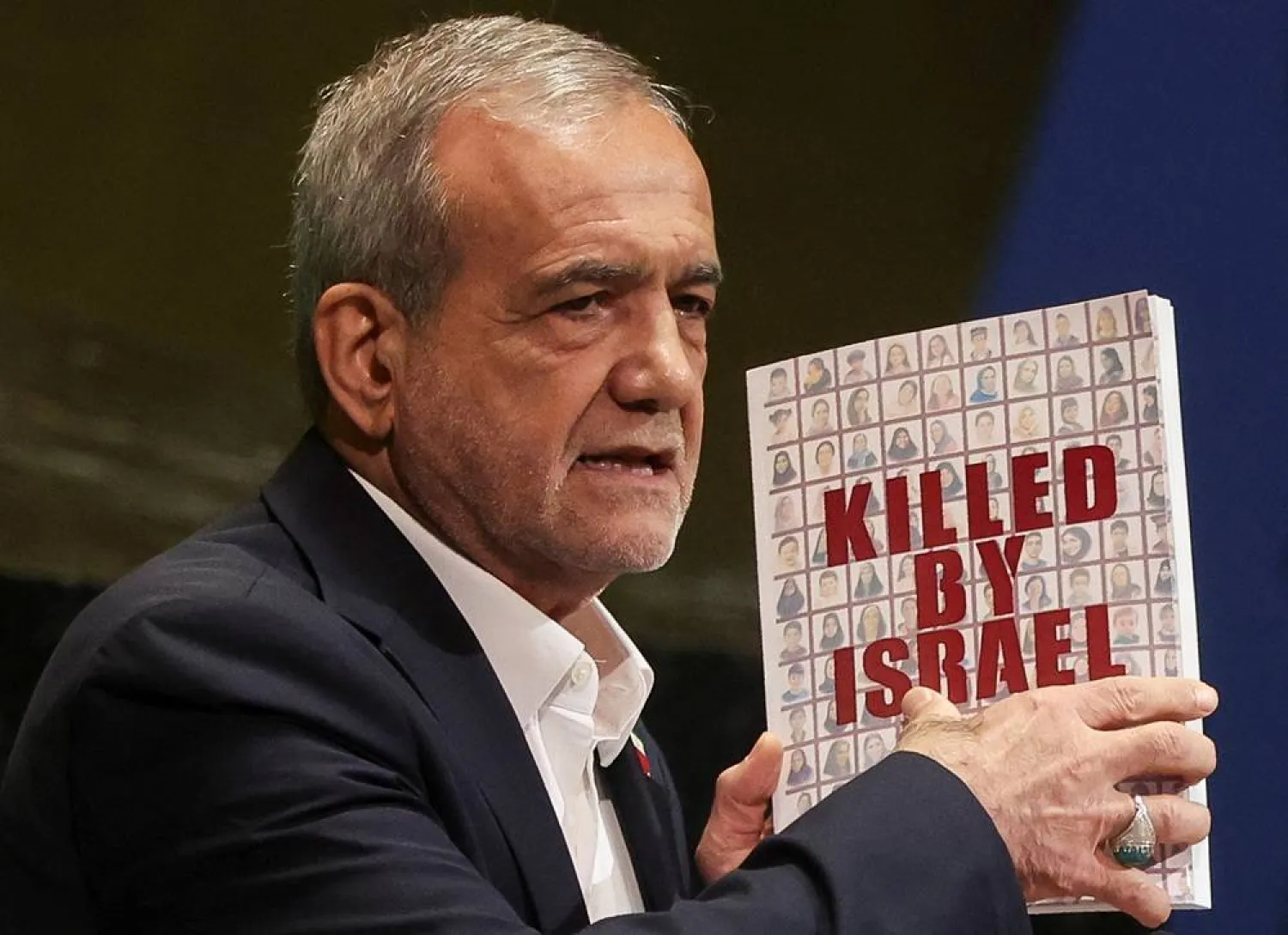
 Iran's President Masoud Pezeshkian holds a book as he addresses the 80th United Nations General Assembly (UNGA) at the UN headquarters in New York, US, September 24, 2025. (Reuters)
Iran's President Masoud Pezeshkian holds a book as he addresses the 80th United Nations General Assembly (UNGA) at the UN headquarters in New York, US, September 24, 2025. (Reuters)
TT

Iran’s President Blasts US, Israeli Attacks for Dealing ‘Grievous Blow’ to Peace as Sanctions Loom

 Iran's President Masoud Pezeshkian holds a book as he addresses the 80th United Nations General Assembly (UNGA) at the UN headquarters in New York, US, September 24, 2025. (Reuters)
Iran's President Masoud Pezeshkian holds a book as he addresses the 80th United Nations General Assembly (UNGA) at the UN headquarters in New York, US, September 24, 2025. (Reuters)

Addressing the world's leaders, Iranian President Masoud Pezeshkian on Wednesday blamed the United States and Israeli attacks for “dealing a grievous blow” to peace negotiations as Tehran braces for the reinstatement of sanctions in the next week, barring a last-minute diplomatic breakthrough. Hours before his speech, Iran's rial currency fell to a new all-time low. 

Pezeshkian's remarks before the UN General Assembly are the first in a global forum since the 12-day Israel-Iran war over the summer that saw the assassination of many of the country’s highest military and political leaders and broke down weeks of negotiations with the United States. 

“Ladies and gentlemen, you all bore witness that this past June, my country was subjected to a savage aggression and flagrant contravention of the most elementary principles of international law,” said the president, who within Iran’s political landscape is considered a moderate politician. 

Pezeshkian is in New York as Tehran seeks to engage in last-minute talks with European nations to stop the coming reimposition of UN sanctions on Iran over its nuclear program. But before even landing in the US, any diplomatic efforts planned by Pezeshkian and Iran's foreign minister, Abbas Araghchi, were overshadowed when Supreme Leader Ali Khamenei rejected any direct nuclear talks with America in a speech on Tuesday. 

“The US has announced the results of the talks in advance,” he said. “The result is the closure of nuclear activities and enrichment. This is not a negotiation. It is a diktat, an imposition.” 

A deadline is coming for sanctions to resume  

France, Germany and the United Kingdom triggered the so-called “snapback mechanism” to reinstate sanctions — barring a last-minute accord — over Iran’s failure to comply with conditions of a 2015 nuclear deal aimed at preventing Tehran from developing nuclear weapons. 

“Snapback” was designed to be veto-proof at the UN It started a 30-day window for the resumption of sanctions, which ends Sunday, unless the West and Iran reach a diplomatic agreement. 

European nations have said that they would be willing to extend the deadline if Iran resumes direct negotiations with the US over its nuclear program, allows UN nuclear inspectors access to its nuclear sites, and accounts for the more than 400 kilograms (880 pounds) of highly enriched uranium that the UN watchdog says it has. Iran is the only nation in the world that enriches uranium up to 60% — a short, technical step away from weapons-grade levels — that doesn’t have a weapons program. 

But Pezeshkian used his UN speech to criticize the E3 for having operated in “bad faith” for years to dictate Iranian compliance with a deal that the US abandoned in 2018. “They falsely presented themselves as parties of good standing to the agreement, and they disparaged Iran’s sincere efforts as insufficient," he said. 

If no diplomatic deal is found this week, the sanctions will automatically “snapback” on Sunday. That would again freeze Iranian assets abroad, halt arms deals with Tehran and penalize any development of Iran’s ballistic missile program, among other measures, further squeezing the country’s reeling economy. 

Nuclear maneuvering continues  

Earlier this month, the UN nuclear watchdog and Iran signed an agreement mediated by Egypt to pave the way for resuming cooperation, including on ways of relaunching inspections of Iran’s nuclear facilities. However, that agreement has yet to fully take hold. 

In July, Pezeshkian had signed a law adopted by his country’s parliament suspending all cooperation with the International Atomic Energy Agency. That followed Israel’s 12-day war with Iran in June, during which Israel and the US bombed Iranian nuclear sites. 

Iran has long insisted its program is peaceful, though Western nations and the Vienna-based IAEA assess that Tehran had an active nuclear weapons program until 2003. Khamenei again said Tuesday that Iran doesn’t seek atomic bombs. 

However, he added, “Science will not be demolished by threats and bombing.” 

At the General Assembly, Pezeshkian said: “I hereby declare once more before this assembly that Iran has never sought and will never seek to build a nuclear bomb. We do not seek nuclear weapons.” 


NATO: Ukraine Still Receiving Arms Despite Mideast War

NATO Secretary General Mark Rutte via Reuters/File
TT

NATO: Ukraine Still Receiving Arms Despite Mideast War

NATO Secretary General Mark Rutte via Reuters/File

Ukraine is still getting essential defense equipment despite the war in the Middle East, which is depleting stockpiles in Europe and the United States, NATO Secretary General Mark Rutte said Thursday.

"The good news is that essential equipment into Ukraine continues to flow," he told reporters. That included American-made Patriot missile interceptors, which Ukraine desperately needs, he added, AFP reported.

The PURL program, launched last year, allows Ukraine to receive US equipment financed by European countries.

Some 75 percent of the missiles used by Patriot batteries in Ukraine have been supplied through the program, and 90 percent of the munitions used by other air-defense systems, Rutte added.

Rutte called on European countries to increase their own production capacity.

"They need to produce more extra production lines, extra shifts, opening new factories. The money is there," he said.


Germany FM Says 'Encouraging' if US Speaking Directly to Iran

German Foreign Minister Johann Wadephul. (Reuters: File Photo)
TT

Germany FM Says 'Encouraging' if US Speaking Directly to Iran

German Foreign Minister Johann Wadephul. (Reuters: File Photo)

Germany's foreign minister Thursday said it was encouraging if the United States was talking directly to Iran to end the war in the Middle East, but Washington should make its intentions clear.

"I hear that there are signs that the US is speaking directly to Iran. I think that this is encouraging and this is welcome," Johann Wadephul told reporters before heading into the meeting of G7 foreign ministers outside Paris, AFP reported.

With US Secretary of State Marco Rubio set to join the discussions from Friday, he added: "For the German government it is of great importance to know precisely what our American partners are intending."


US Envoy Witkoff Says Iran is Seeking an Off-ramp

US Special Envoy Steve Witkoff speaks during a cabinet meeting at the White House in Washington, DC, US, March 26, 2026. REUTERS/Evelyn Hockstein
TT

US Envoy Witkoff Says Iran is Seeking an Off-ramp

US Special Envoy Steve Witkoff speaks during a cabinet meeting at the White House in Washington, DC, US, March 26, 2026. REUTERS/Evelyn Hockstein

The United States has sent Iran a "15-point action list" as a basis for negotiations to end the current conflict, US Special Envoy Steve Witkoff said on Thursday, adding that there are signs that Tehran was interested in making a deal.


Witkoff, speaking during a cabinet meeting at the White House, said that the nascent talks could be successful if the Iranians realize there were no good alternatives - a realization Tehran might be coming to, he argued, Reuters reported.


"We will see where things lead, and if we can convince Iran that this is the inflection point with no good alternatives for them other than more death and destruction," Witkoff told reporters.


"We have strong signs that this is a possibility."


Witkoff said Pakistan had been acting as a mediator, confirming statements from Pakistani officials.