

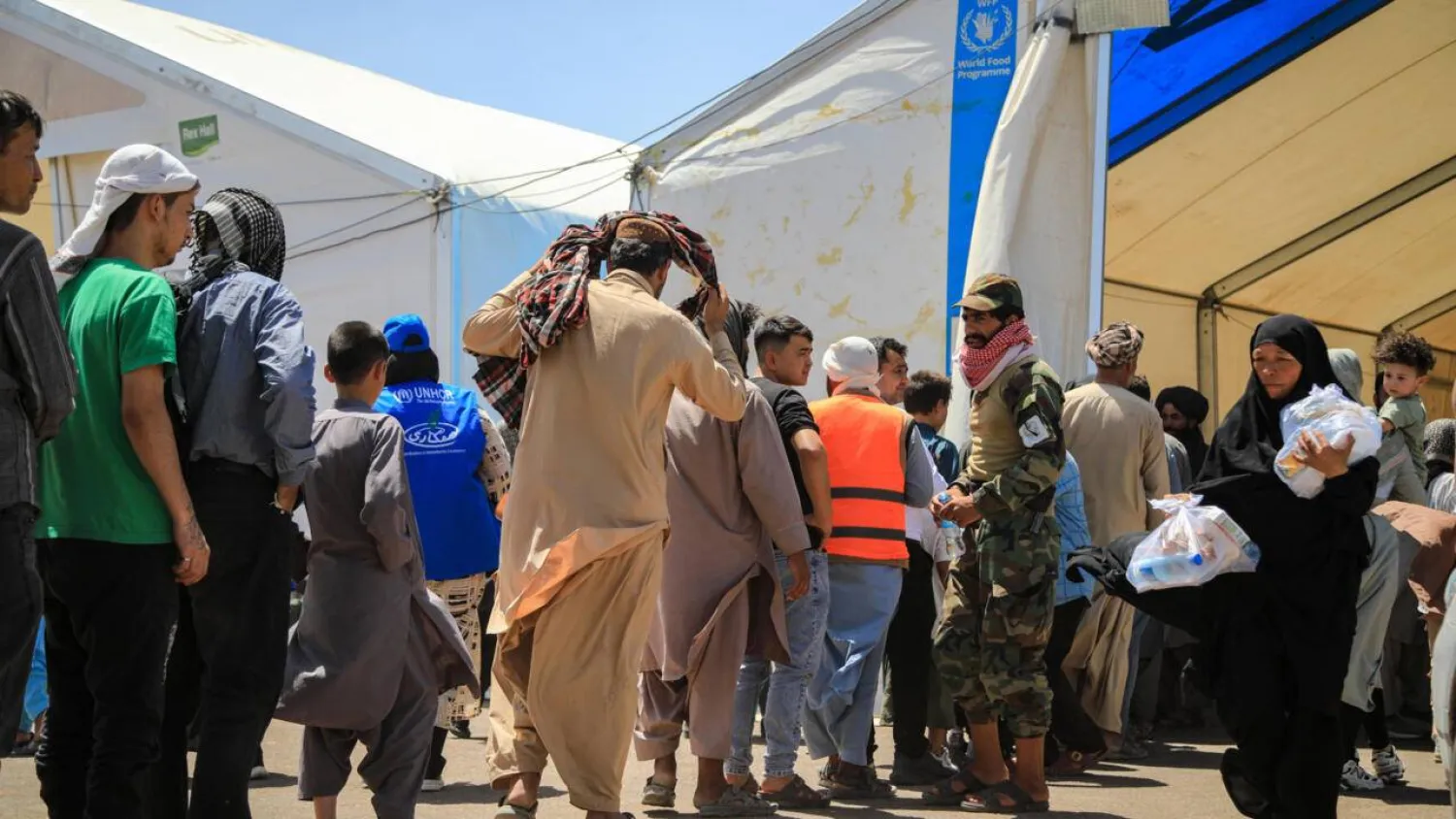

Return of Millions of Afghans Fuels Terror Potential

Newly arrived Afghan migrants from Iran queue to receive food packages at the Islam Qala border crossing in Herat. Mohsen KARIMI / AFP
TT

Return of Millions of Afghans Fuels Terror Potential

Newly arrived Afghan migrants from Iran queue to receive food packages at the Islam Qala border crossing in Herat. Mohsen KARIMI / AFP

A massive spike in millions of migrants forced back into impoverished Afghanistan by Pakistan and Iran could fuel ISIS militancy, diplomatic and security sources fear.

Around 2.6 million Afghans have returned since January, including many who have spent decades abroad or who are setting foot in Afghanistan for the first time.

"The risk that ISIS Khorasan sees these newly arrived Afghans as a potential recruitment pool is high," Hans-Jakob Schindler, a former coordinator of the UN committee monitoring militant groups, told AFP.

Security in Afghanistan has vastly improved since the Taliban won their insurgency against the Nato-backed government and returned to power in 2021.

However, the local branch of ISIS -- a rival extremist group with a foothold in eastern Afghanistan -- carries out periodic attacks and remains a threat to Taliban rule and the wider region.

"Since August 2021, the group has continued to recruit disgruntled Taliban as well as Afghans that are not part of the new regime," Schindler said.

The UN warned in July of a "permissive environment for a range of terrorist groups... posing a serious threat to the security of Central Asian and other countries".

It said the most serious threat is from the ISIS group, with 2,000 fighters, who have carried out deadly attacks in Russia, Iran and Pakistan in the past few years.

While the Pakistani Taliban, a separate but closely linked group to the Afghan Taliban, has triple the fighters, it is focused on a campaign against the Pakistan government's security forces.

Islamabad has consistently accused Afghanistan's rulers of giving safe haven to militant groups.

The Taliban government has repeatedly claimed that there are "no longer any terrorist organisations" operating in Afghanistan.

'Foreigners' in their own country

The UN High Commissioner for Refugees (UNHCR) has predicted that up to four million Afghans could return to the country by the end of the year.

Upon arrival, "they face enormous challenges, without jobs, housing, or access to basic services," notes Indrika Ratwatte, the UN's humanitarian coordinator in the country.

"They may become vulnerable to negative coping mechanisms, including exploitation by armed groups."

According to the World Bank, nearly half of Afghanistan's 48 million people live below the poverty line, and nearly a quarter of 15-29 year-olds are unemployed.

"We already know that some Afghans join terrorist groups not out of conviction, but out of 'economic necessity,'" a European diplomatic source told AFP.

Afghans who have spent decades abroad are considered outsiders when they arrive in Afghanistan, said Amina Khan of the Institute for Strategic Studies (ISSI) in Islamabad.

Some will hold resentment towards Pakistan, which took away their businesses and properties.

"They're the perfect fodder for these transnational terrorist groups that are operating within the region," she said.

'Ticking time bomb'

According to Moscow, Afghanistan is home to approximately 23,000 fighters from 20 different organizations.

"The greatest concern is the activity of the Afghan branch of (ISIS)... which has training camps, mainly in the east, north, and northeast of the country," noted Russian Security Council Secretary Sergei Shoigu at the end of August.

In July, a year after ISIS killed 149 people in a mass shooting at a Moscow music venue, Russia became the first -- and only -- country to recognize the Taliban government.

It said the decision would boost regional security and the "fight against the threats of terrorism".

"Many foiled attacks in Europe between 2023 and 2025 have been linked back to the (ISIS)," Schindler said.

For many European countries, the "risk of a kind of ticking time bomb for Europe is real" the European diplomatic source added.

The only way to stop these recruitments is to "build a dignified future" for migrants, thanks to foreign aid, argues Ratwatte.

But the humanitarian sector has been lacerated by funding cuts since US President Donald Trump took power in January.



Israel Grants Special Status to Soldiers Who Died by Suicide During War on Gaza

Israeli soldiers mourn reservist Master sergeant Asaf Cafri, 26, who was killed in Israel's ground operation in the Gaza Strip, during his funeral. (AP)
TT

Israel Grants Special Status to Soldiers Who Died by Suicide During War on Gaza

Israeli soldiers mourn reservist Master sergeant Asaf Cafri, 26, who was killed in Israel's ground operation in the Gaza Strip, during his funeral. (AP)

The Israeli army and the Defense Ministry announced that they will grant the special status of “died after service” to soldiers who served in the war on Gaza and other fronts and died by suicide within up to two years after their discharge.

The designation aims at expanding support for families and make them eligible for a monthly stipend from the Defense Ministry for two years, according to a report Tuesday by Israel's Yedioth Ahronoth newspaper.

The army said the approach to recognition would be “broad and compassionate,” and that officials may later consider extending the two-year period.

The policy follows the work of a special committee, which examined how the military and state respond to the families of regular and reserve service members who took their own lives after completing service, in circumstances that may be linked to their military duty.

The committee recommended that such individuals be buried in civilian cemeteries with civilian headstones, but with military accompaniment, including a commander’s eulogy, the presence of soldiers and initial family support.

According to the Israeli army, personnel officials would verify within hours of a death that the individual had served in its forces within the previous two years, either as a combat or noncombat soldier.

Military support would continue for seven days through the mourning period, the newspaper said.

Afterward, the Defense Ministry’s standard recognition committee, together with the Israeli army, would examine the circumstances to determine whether there was a connection between the apparent causes of the suicide and the individual’s military service during the war.

The review would include consultations with commanders and assessments of the soldier’s service record.

“If a link is established, the individual would not be recognized as an Israeli army fallen soldier or as a disabled veteran who died of service-related injuries,” the committee said.

Instead, it noted, “they would receive the designation of having ‘died after service,’ entitling their family to a monthly allowance and long-term support from the Defense Ministry.”

The committee included mental health professionals, legal advisers and senior officials from the Defense Ministry’s Families and Commemoration Department. Its recommendations focus on systemic policy rather than individual cases.

The Israeli army said the decision to grant the new status reflects an effort to preserve the formal designation of fallen soldiers while still providing assistance to families whose loved ones died after service.

It said factors considered in each case will include length and nature of service, exposure to unusual or traumatic events, proximity between discharge and death and other personal circumstances.

According to the army, 15 former soldiers who served in the war on Gaza have died by suicide to date, though officials say the number could rise.

The Israeli Broadcasting Authority said 16 soldiers committed suicide in 2025 until August due to harsh combat conditions related to the war in the Gaza Strip.

A senior military official told the Israeli Broadcasting Authority that the army fears the phenomenon will spread, as seven reservists took their own lives in July.

In 2024, 21 Israeli soldiers committed suicide, including 12 reservists, whereas in 2023, the year that saw the launch of the Gaza war in October, 17 Israeli soldiers took their own lives.

A report by the Knesset Research and Information Center released last October showed that for every Israeli soldier who died by suicide between January 2024 and July 2025, there were an additional seven documented suicide attempts.


Iran’s President Says Answer to Attack Would Be Harsh in Apparent Response to Trump Warning

Masoud Pezeshkian, the President of Iran, attends the United Nations General Assembly at United Nations headquarters, on Sept. 25, 2025. (AP)
TT

Iran’s President Says Answer to Attack Would Be Harsh in Apparent Response to Trump Warning

Masoud Pezeshkian, the President of Iran, attends the United Nations General Assembly at United Nations headquarters, on Sept. 25, 2025. (AP)

Iranian President Masoud Pezeshkian on Tuesday said his country’s answer to an attack would be harsh, which appeared to be in response to a warning by US President Donald Trump over reconstruction of Iran’s nuclear program.

Iran’s answer “to any cruel aggression will be harsh and discouraging,” Pezeshkian said on the social media platform X.

Pezeshkian did not elaborate, but his statement came a day after Trump suggested the US could carry out military strikes if Iran attempts to reconstitute its nuclear program. Trump made the comment during wide-ranging talks with Israeli Prime Minister Benjamin Netanyahu at Trump's Mar-a-Lago estate in Florida.

“Now I hear that Iran is trying to build up again,” Trump said during a news conference with Netanyahu after their meeting. “And if they are, we’re going to have to knock them down. We’ll knock them down. We’ll knock the hell out of them. But hopefully that’s not happening.”

The two leaders discussed the possibility of renewed military action against Tehran months after a 12-day air war in June that killed nearly 1,100 Iranians including senior military commanders and scientists. Iran’s retaliatory missile barrage killed 28 people in Israel.

Trump suggested Monday that he could order another US strike against Iran.

“If it’s confirmed, they know the consequences, and the consequences will be very powerful, maybe more powerful than the last time,” Trump said.

Pezeshkian said Saturday that tensions between the sides already had risen.

“We are in a full-scale war with the US, Israel and Europe; they don’t want our country to remain stable,” he said.

Iran has insisted it is no longer enriching uranium at any site in the country, trying to signal to the West that it remains open to potential negotiations over its atomic program.

US intelligence agencies and the International Atomic Energy Agency assessed Iran last had an organized nuclear weapons program in 2003, though Tehran had been enriching uranium up to 60%, which is a short, technical step away from weapons-grade levels of 90%.

Meanwhile, some of the largest protests in three years entered a third day Tuesday after the country’s currency plummeted to a record low against the US dollar. The head of the Central Bank resigned on Monday.

According to witnesses and videos on social media, rallies took place in Tehran and other cities and towns. Police fired tear gas in some places. Near a market in downtown Tehran, footage showed people pushing back police and security forces and throwing stones at them.

University students also rallied inside campuses on Tehran University and other major universities, witnesses said.

Pezeshkian met a group of businessmen to listen to their demands, media reported.

"The administration will not spare any effort for solving problems and improving situation of the society,” Pezeshkian said. He also assigned Interior Minister Eskandar Momeni for talks with protesters.

The head of the country’s tax department, Mohammad Hadi Sobhanian, also said the government will revise its tax arrangement in favor of businesses, dropping penalties for delay in paying taxes.

The government announced the closure of offices and banks on Wednesday for managing energy consumption during the winter days, to be followed by weekly holidays on Thursday and Friday. Saturday also is a religious holiday in the country.


Ukraine Says No Evidence It Attacked Putin Residence

28 December 2025, US, Palm Beach: Ukraine's President Volodymyr Zelensky attends a joint press conference with US President Donald Trump following their talks at the Mar-a-Lago club in Palm Beach. (Ukrainian Presidency/dpa)
TT

Ukraine Says No Evidence It Attacked Putin Residence

28 December 2025, US, Palm Beach: Ukraine's President Volodymyr Zelensky attends a joint press conference with US President Donald Trump following their talks at the Mar-a-Lago club in Palm Beach. (Ukrainian Presidency/dpa)

Ukraine said Tuesday there was no "plausible" evidence it launched a drone attack on one of Russian President Vladimir Putin's residences, accusing Moscow of peddling falsehoods to manipulate talks on ending the war.

Ukraine's allies have expressed skepticism about Russia's claim.

German Chancellor Friedrich Merz called for "transparency", while a French presidential source described the Kremlin's statements as an "act of defiance" against US President Donald Trump's efforts to broker peace.

Ukrainian President Volodymyr Zelensky, who has called Russia's claim a "complete fabrication", said he would meet with leaders of Kyiv's allies on January 6 in France in a bid to renew peace efforts.

In comments to journalists on Tuesday, the Ukrainian leader repeated his assertion that the attack was faked and called on partners to verify this.

"Our negotiating team connected with the American team, they went through the details, and we understand that it's fake," he said.

The Kremlin said Tuesday it considered the alleged drone attack on Putin's secluded residence in the Novgorod region to be a "terrorist act" and a "personal attack against Putin".

But it said it could not provide evidence for its claim as the drones were "all shot down".

It also said the Russian army had chosen "how, when and where" to retaliate against Ukraine, and that Moscow would now "toughen" its negotiating position in talks to end Europe's worst conflict since World War Two.

Russia has hit Ukraine with an almost daily barrage of drones and missiles for almost four years, killing thousands.

- European leaders rally around Ukraine -

European leaders rallied around Ukraine following Moscow's allegation. Zelensky said a summit of the so-called "coalition of the willing" -- a group of Western countries that have pledged further support for Ukraine -- would take place on January 6 in France.

The summit would be preceded by a meeting of security advisors from the allied countries, Zelensky said on X, adding: "We are planning it for January 3 in Ukraine."

Germany's Merz said on social media that Kyiv's allies were "moving the peace process forward. Transparency and honesty are now required from everyone -- including Russia."

But US President Donald Trump -- who spoke to Putin on Monday -- directed criticism at Kyiv on Monday, despite Ukraine calling the incident staged.

"You know who told me about it? President Putin, early in the morning, he said he was attacked. It's no good," Trump said.

"It's one thing to be offensive because they're offensive. It's another thing to attack his house," the US leader said.

Moscow has not said where Putin was at the time.

The longtime Russian leader's residences are shrouded in secrecy in Russia -- as is much of his private life.

- Secretive residence -

The late Russian opposition leader Alexei Navalny, who died in an Arctic prison last year, had published investigations into Putin's luxury lake-side residence in the Novgorod region.

Putin had been increasingly using the residence since the Ukraine war began, as it is more secluded and better protected by air defense installations, according to an investigation by RFE/RL.

Moscow's allegation comes at a pivotal moment for diplomacy to end the war.

Ukraine has said it has agreed to 90 percent of a US-drafted peace plan, but Russia has been hesitant to accept a deal that does not meet its maximalist demands.

Putin has repeatedly said that Russia intends to seize the rest of Ukrainian land he has proclaimed as Russian if diplomacy fails.

Russia's advance in eastern Ukraine picked up pace in autumn, with Moscow's troops seizing more villages with every week since.

Ukraine's navy on Tuesday blamed Russia for drone attacks on two civilian vessels in the Odesa region that Russia has been battering with strikes in the past weeks.

Ukraine on Tuesday also ordered the mandatory evacuation of several villages in the northern Chernigiv region, which borders Moscow-allied Belarus, due to intense Russian shelling.