


Saudi Arabia Announces Int’l Coalition to Back Palestinian Authority

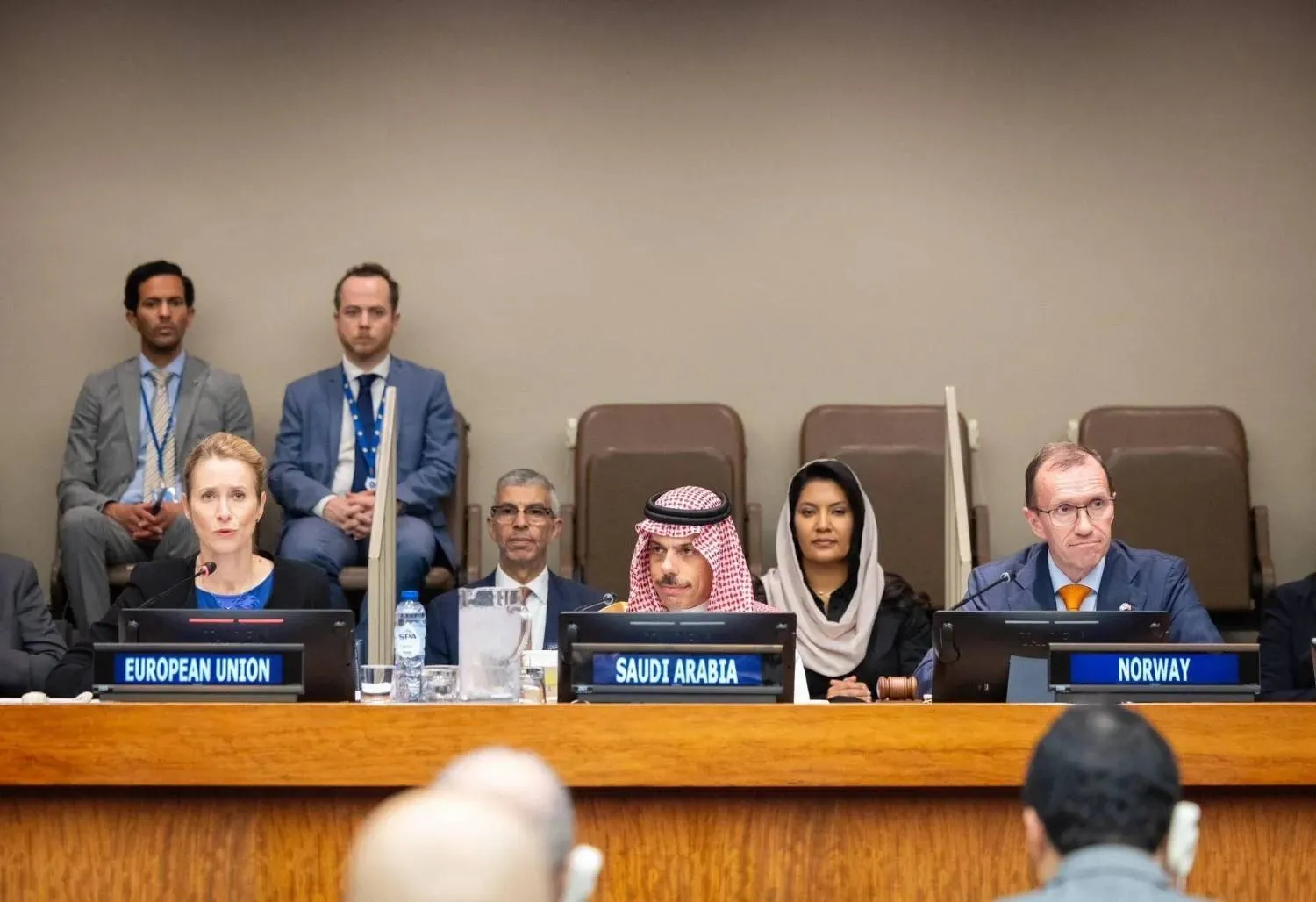
Saudi Foreign Minister Prince Faisal bin Farhan chairs high-level meeting of the Coalition to Implement the Two-State Solution in New York (Saudi Foreign Ministry/Handout)
TT

Saudi Arabia Announces Int’l Coalition to Back Palestinian Authority

Saudi Foreign Minister Prince Faisal bin Farhan chairs high-level meeting of the Coalition to Implement the Two-State Solution in New York (Saudi Foreign Ministry/Handout)

Saudi Arabia’s foreign minister said on Thursday the kingdom would provide $90 million in direct funding to the Palestinian Authority as part of a newly launched international coalition to support it, reiterating there would be no normalization with Israel without the creation of a Palestinian state.

Prince Faisal bin Farhan announced the initiative at a press conference in New York following a high-level ministerial meeting of the “Global Coalition to Implement the Two-State Solution.”

The meeting, chaired by Saudi Arabia on behalf of the Arab-Islamic Committee on Gaza and co-hosted with the European Union and Norway, was held on the sidelines of the United Nations General Assembly.

The minister said the gathering followed the UN’s adoption of the “New York Declaration,” which he described as a historic international consensus on ending Israel’s occupation and establishing an independent Palestinian state.

According to Prince Faisal, this process also coincides with growing recognition of Palestine, with 159 countries now acknowledging its statehood, representing the overwhelming majority of UN members.

This affirms that the realization of a Palestinian state has become an irreversible fact backed by growing international will, said the top Saudi diplomat.

He said the coalition’s discussions focused on turning the declaration and the wave of recognitions into an actionable plan with a clear timetable and follow-up mechanisms.

Priorities included an immediate ceasefire in Gaza, ensuring territorial unity between the West Bank and Gaza, and enabling the Palestinian Authority to assume full responsibilities.

Saudi Arabia reaffirmed that, based on its Arab, Islamic and international responsibilities, it will continue working with partners to ensure this process leads to a just and lasting peace, and to regional and international security and stability, he said.

Prince Faisal added that Arab and Islamic states had also conveyed to US President Donald Trump during a meeting in New York this week the risks of Israel annexing the West Bank.

Ending the war in Gaza will pave the way for implementing the two-state solution, and we are engaging with the United States to stop it, he said.

He stressed that a two-state solution remained the only path to revive hope for peace and was achievable.

Prince Faisal underlined the need for a viable Palestinian state alongside Israel and hoped that this will be realized in the near future.


Saudi Arabia and Canada: Questions and Answers on Joint Action and Coordination Council

Part of the memorandum signing ceremony attended by the Saudi Crown Prince and the Canadian Prime Minister in Jeddah on Thursday. (SPA)
TT

Saudi Arabia and Canada: Questions and Answers on Joint Action and Coordination Council

Part of the memorandum signing ceremony attended by the Saudi Crown Prince and the Canadian Prime Minister in Jeddah on Thursday. (SPA)

Saudi Arabia and Canada announced a series of agreements and memorandums of understanding signed in the presence of Saudi Crown Prince and Prime Minister Mohammed bin Salman and Canadian Prime Minister Mark Carney in Jeddah on Thursday.

The signing followed talks between the two sides and an official reception for Carney, the first Canadian prime minister to visit Saudi Arabia in 25 years.

The following questions, answers and background explain the Joint Action Document and the establishment of the Saudi-Canadian Coordination Council, both referenced in the joint statement issued after the leaders’ meeting, based on explanations provided to Asharq Al-Awsat by informed sources.

What is the Joint Action Document?

According to the sources, the Joint Action Document will serve as the overarching framework for bilateral cooperation.

It is intended to bring together the priority areas of cooperation for the next phase, with its provisions to be institutionalized and implemented through the establishment of the Saudi-Canadian Coordination Council.

What does the document aim to achieve?

The document seeks to strengthen the partnership in line with both countries’ national priorities in relevant fields, reflecting their shared commitment to expanding cooperation, deepening consultation and reinforcing ties in areas of mutual interest.

It also aims to establish a comprehensive framework for cooperation based on a shared understanding of global challenges, including enhancing security and stability, supporting economic growth and empowering communities.

What areas of cooperation are envisaged?

• Political affairs
• Security and defense
• Economic, trade and investment cooperation
• Cultural, educational and scientific cooperation
• Consular affairs

What is the Saudi-Canadian Coordination Council?

As part of their commitment to strengthening and deepening friendly relations, the two governments are working to establish a Saudi-Canadian Coordination Council at the level of the two countries’ foreign ministers.

The council will operate under a governance framework, organizational structure and clear implementation mechanisms for the relevant authorities on both sides. The objective is to ensure the council fulfills its mandate by developing strategic initiatives jointly agreed upon in the areas covered by the Joint Action Document.

Each initiative will be supported by a clear implementation timetable and defined performance indicators, with progress monitored under the council’s approved governance framework.

What are the council’s objectives?

• Establish an institutional framework for cooperation between the two countries.
• Strengthen bilateral cooperation through continuous consultation and coordination across all fields.
• Serve as a unified platform encompassing all existing areas of cooperation between Saudi Arabia and Canada.
• Advance bilateral relations at all levels.
• Promote shared interests and mutual benefit.

What are the council’s main pillars?

• Develop the council’s governance framework, including its organizational structure, responsibilities, procedures, operating models and subsidiary committees, in coordination with the relevant authorities.
• Prepare an annual schedule for meetings of the council and its subsidiary committees, to be approved as part of the council’s official meeting minutes.
• Implement joint initiatives across the full spectrum of bilateral cooperation.


Saudi Arabia Condemns Repeated Iranian Attacks on Kuwait, Bahrain, and Jordan

File photo of the Saudi flag/AAWSAT
TT

Saudi Arabia Condemns Repeated Iranian Attacks on Kuwait, Bahrain, and Jordan

File photo of the Saudi flag/AAWSAT

Saudi Arabia condemned in the strongest terms the repeated heinous Iranian attacks on Kuwait, Bahrain, and Jordan. The ministry renewed the Kingdom’s categorical rejection of Iran’s violation of the sovereignty of brotherly countries and its continued threat to the security and stability of the region, the Saudi Press Agency reported on Thursday.

The Kingdom reaffirmed that these attacks violate UN Security Council Resolution 2817 (2026), regarding the immediate cessation of all attacks launched by Iran against countries of the region.

It stressed the importance of respecting the sovereignty of brotherly countries and adhering to international resolutions and laws. The Kingdom also reaffirmed that these violations undermine international efforts to restore security and stability in the region.


Saudi FM Receives Phone Call from Qatari Premier and Foreign Minister

Saudi Minister of Foreign Affairs Prince Faisal bin Farhan bin Abdullah. (SPA file)
TT

Saudi FM Receives Phone Call from Qatari Premier and Foreign Minister

Saudi Minister of Foreign Affairs Prince Faisal bin Farhan bin Abdullah. (SPA file)

Saudi Minister of Foreign Affairs Prince Faisal bin Farhan bin Abdullah received a phone call on Thursday from Prime Minister and Minister of Foreign Affairs of Qatar Sheikh Mohammed bin Abdulrahman Al Thani, the Saudi Press Agency said.

During the call, the two sides discussed the latest regional developments and condemned the Iranian attacks on Kuwait, Bahrain and Jordan, as well as the continued threats to maritime navigation in the Strait of Hormuz.

They also reviewed the efforts being made to restore security and stability, emphasizing the importance of continued coordination and joint action to de-escalate tensions and mitigate the negative repercussions of the crisis at both the regional and international levels.
