Netanyahu Again Turns to Props and Visual Aids as He Fends off Critics at the UN

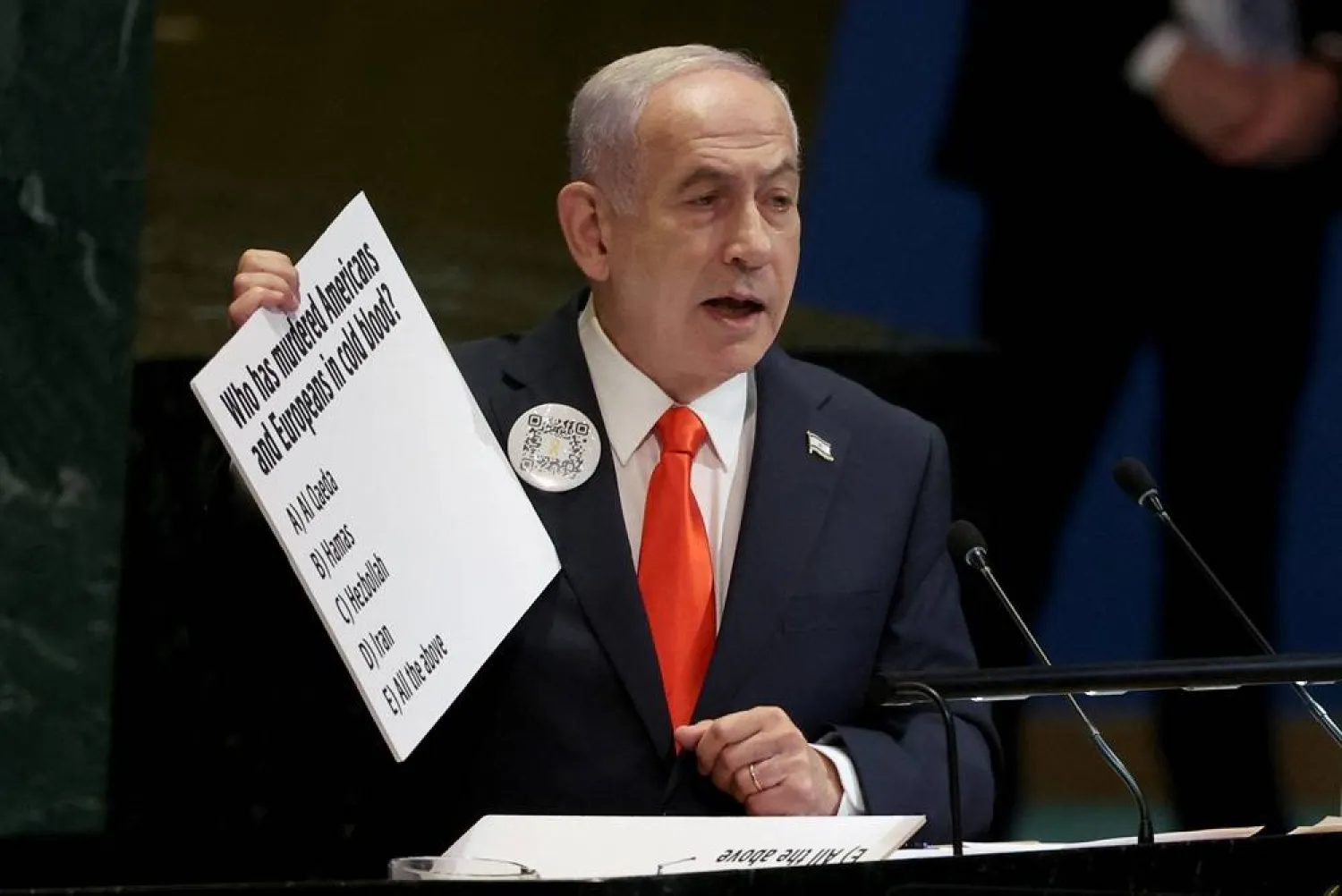
 Israeli Prime Minister Benjamin Netanyahu addresses the 80th United Nations General Assembly (UNGA) at UN headquarters in New York City, US, September 26, 2025. (Reuters)
Israeli Prime Minister Benjamin Netanyahu addresses the 80th United Nations General Assembly (UNGA) at UN headquarters in New York City, US, September 26, 2025. (Reuters)
TT

Netanyahu Again Turns to Props and Visual Aids as He Fends off Critics at the UN

 Israeli Prime Minister Benjamin Netanyahu addresses the 80th United Nations General Assembly (UNGA) at UN headquarters in New York City, US, September 26, 2025. (Reuters)
Israeli Prime Minister Benjamin Netanyahu addresses the 80th United Nations General Assembly (UNGA) at UN headquarters in New York City, US, September 26, 2025. (Reuters)

In his speeches to the United Nations when world leaders gather, Prime Minister Benjamin Netanyahu has quite the history of turning to props and visual aids to hammer his points home. But even by the Israeli leader’s elevated standards of showmanship, this year’s address took things to a new level.

Moments into the speech Friday morning, Netanyahu unfurled a map – titled "THE CURSE" (the all-caps were his) – in which he methodically used a fat marker to check off the countries where Israel has killed its enemies during a nearly two-year regionwide war.

He then addressed the audience with a pair of multiple-choice questions, depicted on a large card. "Who shouts 'Death to America'?" he asked as he read off the names of Iran, Hamas, Hezbollah and Yemen’s Houthi militia. The answer, familiar to anyone who has taken a standardized test: "All of the above."

It was vintage Netanyahu, who over the years has shared maps, photos and, in one instance, a crude cartoon of an atomic bomb as he railed against Iran's nuclear program.

Then there was the QR code. He showed up wearing a huge button bearing one of the codes often used by advertisers and popularized by restaurants who used them during the COVID pandemic era to avoid asking contagion-fearing customers to touch menus. The code linked to a website about the Oct. 7, 2023, attacks by Hamas, the hostages they took and Israel's point of view about it all.

Even before he took to the podium, Netanyahu’s office said it had set up massive loudspeakers on trucks along the Gaza border to blare the speech to the people inside. He said his intended audience included the Israeli hostages held captive in Gaza. "We have not forgotten you," he said.

His office later claimed the Israeli army had hacked the phones of people of Gaza, including Hamas operatives, to make sure they heard his words. Inside Gaza, Palestinians said they could not hear the speech, and there were no immediate reports of phones being hacked.

And at the UN General Assembly, it is doubtful that many minds were changed. Dozens of diplomats walked out of the hall before his speech to protest the Gaza war, leaving the hall largely empty, save for a small but loud group of aides and supporters to cheer him on.

But Netanyahu had other audiences on his mind — namely his base of supporters in a deeply divided Israel and President Donald Trump, whom he is to meet on Monday at the White House.

With a colorful and defiant speech rejecting international criticism of Israeli policies, Netanyahu portrayed himself to his supporters as a master showman, communicator and statesman at a time that the country is increasingly seen as a pariah. And a long list of compliments for Trump could help clear the way for a smooth meeting on Monday.


Local Elections Could Hasten the Exit of Britain’s Embattled Prime Minister

 06 May 2026, United Kingdom, London: UK Prime Minister Keir Starmer helps out in the call center at Labour Party headquarters in London, on the last day of campaigning ahead of the elections on Thursday. (Stefan Rousseau/PA Wire/dpa)
06 May 2026, United Kingdom, London: UK Prime Minister Keir Starmer helps out in the call center at Labour Party headquarters in London, on the last day of campaigning ahead of the elections on Thursday. (Stefan Rousseau/PA Wire/dpa)
TT

Local Elections Could Hasten the Exit of Britain’s Embattled Prime Minister

 06 May 2026, United Kingdom, London: UK Prime Minister Keir Starmer helps out in the call center at Labour Party headquarters in London, on the last day of campaigning ahead of the elections on Thursday. (Stefan Rousseau/PA Wire/dpa)
06 May 2026, United Kingdom, London: UK Prime Minister Keir Starmer helps out in the call center at Labour Party headquarters in London, on the last day of campaigning ahead of the elections on Thursday. (Stefan Rousseau/PA Wire/dpa)

British voters will cast ballots Thursday in elections that could hasten the end of Prime Minister Keir Starmer’s troubled term and confirm that an increasingly fractured United Kingdom has entered an era of messy multiparty politics.

Starmer’s center-left Labour Party is expected to take a battering in elections for local authorities across England and for semiautonomous legislatures in Scotland and Wales.

With the prime minister’s popularity in the doldrums from a weak economy and repeated questions about his judgment, rival parties are framing Thursday’s votes as a referendum on Starmer and his 2-year-old government. “Vote Reform, Get Starmer Out” is the campaign slogan of the hard-right party Reform UK.

The next national election does not have to be held until 2029, but a wipeout on Thursday could tip a restive Labour Party into revolt against its unpopular leader.

Less than two years after winning a landslide election victory, “Keir Starmer has become a vessel for people’s disappointment (and) disillusionment,” said Luke Tryl of pollster More in Common.

Starmer's popularity has plunged after repeated missteps since he became prime minister in July 2024. His government has struggled to deliver promised economic growth, repair tattered public services and ease the cost of living — tasks made harder by the US-Israeli war with Iran, which has choked off oil shipments through the Strait of Hormuz.

The prime minister has been further hurt by his disastrous decision to appoint Peter Mandelson, a scandal-tarnished friend of Jeffrey Epstein, as Britain’s ambassador to Washington.

Forecasters suggest Labour will lose well over half of the 2,500 seats it is defending on English local councils. It is expected to lose votes to parties on both left and right — especially to the Green Party in London and Reform UK in working-class, former Labour strongholds in England’s north.

“These elections are a perilous, perilous moment for Keir Starmer,” said Tony Travers, professor in the Department of Government at the London School of Economics. He said that after a series of policy U-turns and in an economy where “there isn’t much money to spend on anything ... his opponents are lining up.”

Starmer has already survived one crisis in February, when some Labour lawmakers, including the party’s leader in Scotland, urged him to quit over the Mandelson appointment.

An election rout could trigger a snap leadership challenge from a high-profile rival such as Health Secretary Wes Streeting, former Deputy Prime Minister Angela Rayner or Greater Manchester Mayor Andy Burnham.

Any challenger would need the support of 80 lawmakers, one-fifth of the party in the House of Commons, to trigger a contest. In Burnham’s case he would have to win election to Parliament before he could take over.

Alternately, Starmer could face pressure from the party to set a timetable for his departure after an orderly leadership contest.

“His parliamentary party is unsure as to whether now is the right time to unseat him,” said Tim Bale, professor of politics at Queen Mary University of London. “So there might be a stay of execution.”

But, Bale added, “it’s a case of when rather than if he goes.”

Polls point to fragmented politics and a fractured country

For decades, Labour losses would have been good news for its main rival, the right-of-center Conservative Party. But the Conservatives are tarnished by 14 tumultuous years in power that ended in 2024. In these elections, it’s Nigel Farage-led Reform UK, the left-leaning Greens and nationalist Welsh and Scottish parties that will likely be the main beneficiaries.

Opponents have heightened their scrutiny of Reform and the Greens in an effort to stop their rise. Farage is facing questions over a 5-million-pound ($6.8 million) donation from a cryptocurrency billionaire that he accepted in 2024 but did not declare. He says it was a personal gift.

The environmentalist Greens, who have stressed their pro-Palestinian credentials under self-described “eco-populist” leader Zack Polanski, have fired several candidates for antisemitic social media posts.

Travers said Britain is moving from being a “two-and-a-half party system” — with the Liberal Democrats as the usual third party — “to something more like a five-party one.”

That is excellent news for Rhun ap Iorwerth, who leads Plaid Cymru (the Party of Wales) and stands a strong chance of leading that country’s semiautonomous government.

“The old politics is gone,” he said. “Labour is not going to win this election.”

A possible seismic shift on the horizon

Labour has dominated Welsh politics for a century and has held power in Cardiff since the Welsh government was established in 1999. Polls suggest Labour will be pushed into third place behind Plaid Cymru and Reform UK, who are running neck-and-neck.

A Plaid victory would give three of the four parts of the UK pro-independence leaders. Northern Ireland is governed by Irish nationalist party Sinn Fein in a power-sharing arrangement with the pro-British Democratic Unionist Party.

The Scottish National Party, which has governed in Edinburgh since 2007, says it will push for a new referendum on independence if it wins a majority on Thursday. Scottish voters rejected leaving the UK in a 2014 vote.

Plaid Cymru says a secession vote isn’t on the agenda in the next few years, though independence remains the party’s ultimate goal. In the short term, it wants more power to raise taxes and more control over how money is spent.

“We need a fundamental redesign of Britain,” ap Iowerth said. “This is an unequal union.”


Trump’s Germany Troop Cuts Show Limits of NATO Efforts to Keep US on Board

Combat aircraft from a NATO country stand in front of a hangar during a fighter plane maneuver exercise at the American military's Ramstein Air Base, near Ramstein-Miesenbach, Germany, June 6, 2024. (Reuters)
TT

Trump’s Germany Troop Cuts Show Limits of NATO Efforts to Keep US on Board

Combat aircraft from a NATO country stand in front of a hangar during a fighter plane maneuver exercise at the American military's Ramstein Air Base, near Ramstein-Miesenbach, Germany, June 6, 2024. (Reuters)

European officials have been working on ways to convince Donald Trump to keep the United States in NATO despite severe tensions over the Iran war. But his abrupt move to cut US forces in Germany is the latest sign that such efforts have their limits and are far from certain to succeed.

The substance of the decision announced on Friday to remove 5,000 troops from Germany did not come as a surprise to NATO officials. European leaders have agreed with the US president that Europeans will take over more responsibility for their own security from US forces.

Dropping a plan to deploy long-range US Tomahawk missiles to Germany was more concerning for Berlin. But even that was not a huge shock, as that deal was made by Trump’s predecessor, Joe Biden, and US Tomahawk stocks have been depleted by the US-Israeli war against Iran.

More alarming for European governments was how the move was made – with little prior notification or consultation and with US officials linking it to Trump’s displeasure at German Chancellor Friedrich Merz’s criticism of US conduct of the Iran war.

“What is worrying is not ‌the figure of ‌5,000 troops, but the political signal from Washington that longstanding, absolutely reliable partnerships no longer seem to count ‌for ⁠anything and appear to ⁠be subject to arbitrary decisions,” said Siemtje Moeller, a senior lawmaker from Germany’s Social Democrats, who are part of Merz’s governing coalition.

The move followed accusations by Trump that US allies have not been doing enough to support the US in the Iran war and suggestions by him that this meant Washington no longer needs to honor the alliance’s Article 5 mutual defense clause.

Trump also pushed the alliance to the brink by threatening to take Greenland from Denmark, a fellow NATO member. NATO Secretary General Mark Rutte helped to defuse that crisis but the underlying dispute has not been resolved.

European diplomats say they fear Trump may make further moves that could test the alliance before a summit of its 32 national leaders in Ankara in July, especially if the Iran war is not over by ⁠then and he is still venting anger at allies.

"The longer game for NATO and European allies ‌is getting through Ankara," said a European diplomat, speaking on condition of anonymity. "We need to do ‌things with the Americans if we can, and without them if we must.”

EUROPEANS PUSH BACK ON TRUMP CRITICISM

Defense experts say Europeans have little choice but to ‌try to keep the US on board, given their heavy reliance on the United States to deter any possible attack by Russia.

As part of ‌their efforts to convince Trump of the value of European allies, officials have said many European countries are honoring agreements to allow US forces to use bases on their soil and fly in their airspace during the Iran campaign - even if they are not keen to advertise the fact, given Trump and the war are deeply unpopular in much of Europe.

While Spain has banned the use of bases on its territory, Rutte said countries including Britain, Croatia, France, Germany, Greece, Italy, Montenegro, Portugal and ‌Romania were delivering on their commitments.

European officials are also working to make a broader case to Trump, other US officials, lawmakers and Republican-friendly think tanks that it is in their interests to stick with the North ⁠Atlantic Treaty Organization.

Their efforts include highlighting ⁠support for a post-war mission in the Strait of Hormuz, underlining the military and economic value of European allies and demonstrating that Europe is taking on a greater role within NATO, diplomats say.

DIFFERENCES AMONG NATO LEADERS ON IRAN WAR

While there is broad support for these efforts across the alliance, the crisis has also exposed stark differences among European NATO leaders over how to respond to the war on Iran.

Leaders of Western European countries such as Spain, France and Germany have voiced blunt criticism, reflecting domestic public opinion but risking Trump’s ire.

Rutte, by contrast, has made clear he sees anti-war rhetoric as unhelpful. Some eastern European countries, fearing any weakening of NATO will embolden Russia, have taken a similar view, diplomats say.

“When European countries are saying ‘this is not our war’, it irritated the hell out of me,” Rutte told "What the Hell is Going on", a podcast hosted by the American Enterprise Institute think tank, after meeting Trump in Washington last month.

On Monday, Rutte also said several countries were "pre-positioning essential logistical and other support" such as minehunters and minesweepers near the Gulf to be ready for a possible Strait of Hormuz mission after the war ends.

The Netherlands, Belgium and Germany have said they are sending ships that could be part of such a mission. France, which is leading planning of a potential mission with Britain, also has ships in the Middle East that could take part.

"European leaders have gotten the message, they’ve heard the message from the US loud and clear," Rutte told reporters at a summit of European leaders in Armenia.


Families Evacuated from Gaza Enjoy a Day to Decompress at Rome’s Ancient Baths

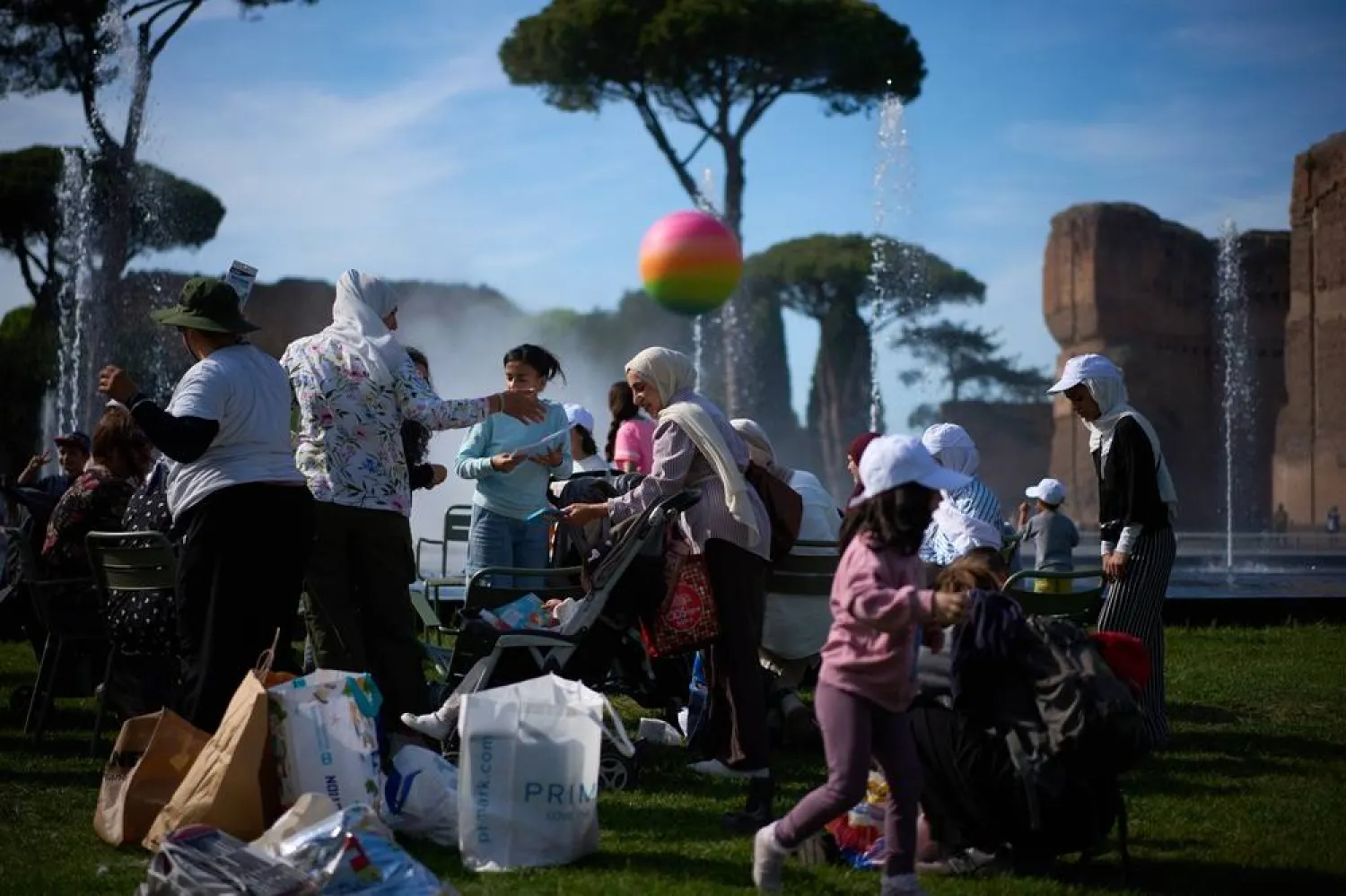
 Families of Palestinian refugees who have arrived in Italy from the Gaza Strip through humanitarian corridors due to serious medical reasons, take part in a visit to Rome's Baths of Caracalla offered by the "Guides for Gaza" association, Sunday, May 3, 2026. (AP)
Families of Palestinian refugees who have arrived in Italy from the Gaza Strip through humanitarian corridors due to serious medical reasons, take part in a visit to Rome's Baths of Caracalla offered by the "Guides for Gaza" association, Sunday, May 3, 2026. (AP)
TT

Families Evacuated from Gaza Enjoy a Day to Decompress at Rome’s Ancient Baths

 Families of Palestinian refugees who have arrived in Italy from the Gaza Strip through humanitarian corridors due to serious medical reasons, take part in a visit to Rome's Baths of Caracalla offered by the "Guides for Gaza" association, Sunday, May 3, 2026. (AP)
Families of Palestinian refugees who have arrived in Italy from the Gaza Strip through humanitarian corridors due to serious medical reasons, take part in a visit to Rome's Baths of Caracalla offered by the "Guides for Gaza" association, Sunday, May 3, 2026. (AP)

The Baths of Caracalla, the sumptuously decorated public baths complex near the Colosseum, were long a place of leisure, healthcare and relaxation for ancient Romans.

On Sunday, the place provided a different sort of decompression to a group of Palestinian children and their families who had been evacuated from Gaza for medical care, thanks to Italy’s program of “humanitarian corridors.”

“We brought families with children so they could experience visiting an ancient archaeological site," Luisa delle Fratte, a tour guide in the group Guides for Gaza, told The Associated Press. "We also offered them a snack, some games and moments of social interaction and togetherness.”

Ordinary Italian families milled about the sprawling site, some settling on the grass to enjoy the springtime sun. The Palestinian families, all of whom now reside in Rome, blended right in — following their tour guide and translator, taking selfies in front of the ruins and watching the jets of water shooting upward from the new reflecting pool. Organizers say they intended the day as a respite from medical treatments and memories of the war.

“I was injured and lost my ability to speak, as well as mobility and normal function in my hand and leg,” 13-year-old Ahmed Skena said, struggling to string together his words. He haltingly added that he also lost his father and brother in the war.

Mariam Dawwas, 25, attended with her husband and four young children, one of whom is ill. They wound up in Italy after being displaced over 10 times.

“Thank God, I am still in a better situation than in Gaza, away from the bombing. At least I am safe, I have shelter, and there is light for my children,” she said.

Some of the families at Caracalla on Sunday knew each other from Gaza, but hadn't seen one another since their evacuation, said delle Fratte of Guides for Gaza, a network founded last year in Umbria and Tuscany, and recently expanded to Naples and Rome.

"It was very beautiful to see them there embracing again and meeting one another once more,” she said.

While the Palestinian families toured the ruins, other guides offered tours to Italians in exchange for donations to support Gazzella, a nonprofit involved in child protection projects in the Gaza Strip.

The war in Gaza began with a 2023 Hamas-led attack on southern Israel, in which the fighters killed 1,200 people, most of them civilians, and abducted 251. More than 72,000 Palestinians have been killed since the start of the war, according to the Gaza Health Ministry, which does not distinguish between fighters and civilians.

The ministry, which is part of the Hamas-led government, maintains detailed casualty records that are seen as generally reliable by UN agencies and independent experts.