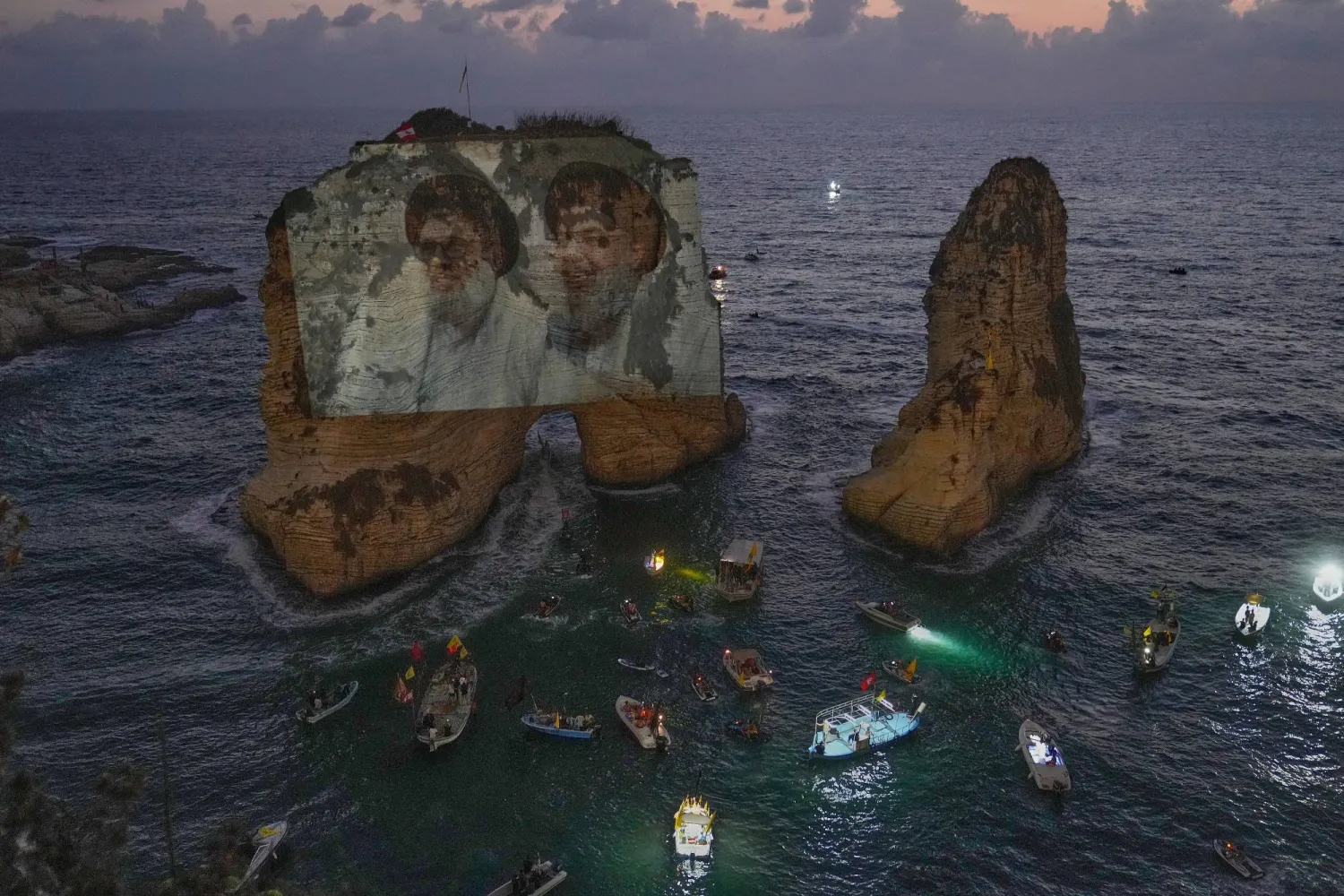

Lebanese ministers meeting with Prime Minister Nawaf Salam on Friday pledged to “take the necessary legal measures to preserve the authority of the state and respect for its decisions” after Hezbollah defied government orders by projecting images of slain leaders Hassan Nasrallah and Hashem Safieddine onto Beirut’s Raouche sea rock.
The incident plunged Lebanon into a new political crisis, prompting Salam to suspend his activities while awaiting security and judicial steps to hold those responsible accountable, government sources told Asharq Al-Awsat.
Salam said the lighting of the rock was “a clear violation” of the approval granted by Beirut’s governor to the organizers, which had explicitly banned any illumination from land, sea or air and the projection of any images.
“This constitutes a breach of explicit commitments by the organizers and their backers, and a new lapse that undermines their credibility in dealing with the logic of the state and its institutions,” he said. Salam asked the interior, justice and defense ministers to act against those who organized the rally in violation of the permit.
Salam’s reaction
Following his statement, government sources said Salam shifted his priorities and cancelled his appointments on Friday in protest against Hezbollah’s breach of its commitments.
His move would continue “until those who violated the government’s decisions are held accountable,” they said, adding that the prime minister was serious about pursuing legal action. They also noted that the government was considering revoking the license of the association that requested permission to hold the event.
Talks picked up on Friday morning to contain the fallout. Sources involved in the discussions said they aimed to “spare the country further escalation.”
Ministerial meeting
A consultative ministerial meeting was held at Salam’s residence in the afternoon and lasted until 6 p.m. Deputy Prime Minister Tarek Mitri said afterwards the meeting reaffirmed government solidarity and its commitment to extend state sovereignty across all Lebanese territory.
“We also stressed the importance of applying laws equally to all citizens without exception,” he said. The breach of the Raouche permit, he added, required legal measures “to preserve the authority of the state and respect for its decisions.”
Defense ministry
The defense ministry said in a statement that the army’s “primary mission” was to prevent strife, deter violence and preserve national unity. It rejected attempts to blame the military for unrest, saying its soldiers “refuse ingratitude and unjust accusations” and would not evade their responsibilities.
Internal party rifts
The Raouche event followed a compromise reached on Wednesday granting the Lebanese Arts Association a license for a symbolic rally to mark the assassinations of Nasrallah and Safieddine.
The agreement, brokered after talks between Salam and Parliament Speaker Nabih Berri, included a pledge not to project images onto the rock. Party lawmaker Amin Sherri had also given assurances to the interior minister and Beirut governor.
But those commitments collapsed when Hezbollah pressed ahead, drawing thousands of supporters and lighting up the landmark. Sources familiar with the party’s internal deliberations said divisions had emerged, with political representatives absent from the scene while Hezbollah’s security chief Wafiq Safa was seen near the rock overseeing the display.
Political backlash
The incident triggered political criticism. Lebanese Forces leader Samir Geagea praised Salam’s stance and urged him to continue efforts to strengthen state authority. He called on security and judicial agencies to summon those responsible for the violations, investigate unlicensed participants and road closures, and hold accountable those who projected Hezbollah images on the rock.
Geagea also urged officials to carry out internal investigations to identify shortcomings and close gaps that allowed the violations.