


After Armani, Italian Fashion Houses Are in Flux

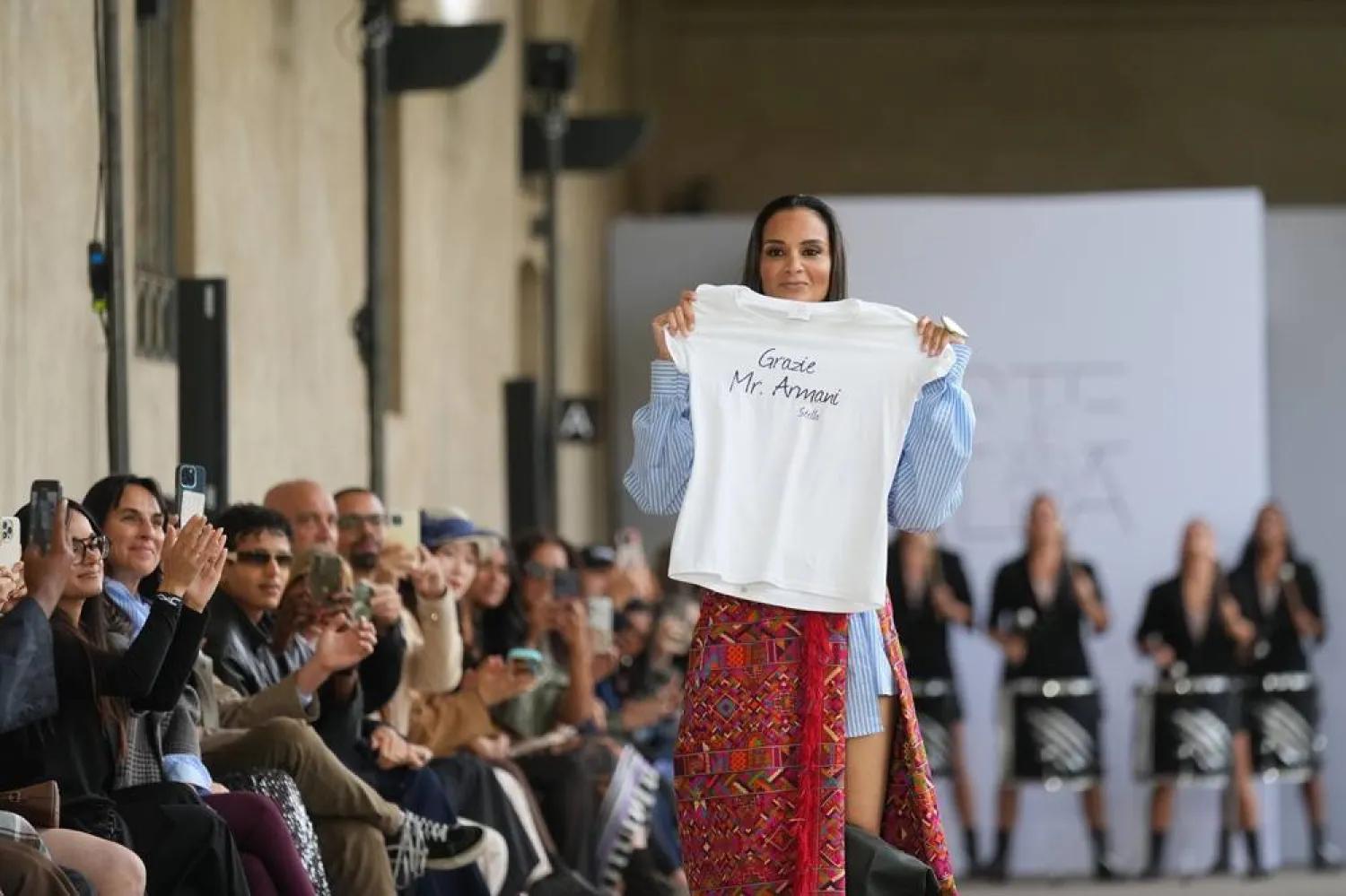
 Fashion designer Stella Jean walks the runway with a tribute to late Italian fashion legend Giorgio Armani who died in Milan on Sept. 4, at the end of her Spring/Summer 2026 collection during Milan Fashion Week in Milan, Italy, Saturday, Sept. 27, 2025. (AP)
Fashion designer Stella Jean walks the runway with a tribute to late Italian fashion legend Giorgio Armani who died in Milan on Sept. 4, at the end of her Spring/Summer 2026 collection during Milan Fashion Week in Milan, Italy, Saturday, Sept. 27, 2025. (AP)
TT

After Armani, Italian Fashion Houses Are in Flux

 Fashion designer Stella Jean walks the runway with a tribute to late Italian fashion legend Giorgio Armani who died in Milan on Sept. 4, at the end of her Spring/Summer 2026 collection during Milan Fashion Week in Milan, Italy, Saturday, Sept. 27, 2025. (AP)
Fashion designer Stella Jean walks the runway with a tribute to late Italian fashion legend Giorgio Armani who died in Milan on Sept. 4, at the end of her Spring/Summer 2026 collection during Milan Fashion Week in Milan, Italy, Saturday, Sept. 27, 2025. (AP)

The first Milan Fashion Week without Giorgio Armani marks the end of an era in Italian luxury, at a time when houses across the sector are already in transition.

After defending his independence throughout his life, the legendary designer, who died this month aged 91, has entrusted his heirs with the task of selling his group.

He cited French companies L'Oreal and LVMH as potential buyers of his multi-million-euro empire, which spans from hotels to haute couture, as well Franco-Italian eyewear giant EssilorLuxottica.

Failing that, his will states the company should be listed on the stock market.

This year also saw the departure of Donatella Versace from the house she ran for three decades, shortly before it was acquired by Prada.

"These are the last years of the first generation of Italian designers. We're in the middle of a major reshuffle," the manager of a major Milanese house told AFP this week on the margins of fashion week.

Roberto Cavalli, the king of sexy dresses and animal prints since the 1970s, also died last year.

But his company had since 2019 belonged to an Emirati conglomerate -- reflecting a wider trend.

In 2012, 76.8 percent of Italian fashion companies with annual revenues exceeding 50 million euros were still managed by the founding family.

This fell to 57 percent in 2022, according to a survey by the Aub Observatory published in 2024.

Over the past 30 years, many of Italy's top fashion names have been snapped up by foreign groups, notably French giants Kering, which owns Gucci and Bottega Veneta, and LVMH, which counts Fendi and Loro Piana among its brands.

Shoe company Sergio Rossi is owned by China's Lanvin Group, and Golden Goose by a London-based private equity fund.

Iconic names such as Dolce & Gabbana and Missoni remain independent, as does Brunello Cucinelli, but their size is limited.

The largest of them, Prada -- with 76-year-old Miuccia Prada still at the helm -- is eyeing combined revenues of around six billion euros after its deal with Versace.

This is far from the 84.7 billion euros in revenue expected by LVMH in 2024 or the 17.2 billion euros of Kering.

Luca Solca, an expert in luxury at Bernstein, said that, despite a few attempts in the past, "Italy didn't have an inspired businessman that could potentially aggregate a conglomerate".

Armani was better than many at building a major brand, but in the end, appeared to have decided there was nobody after him to run it, Solca told AFP.

But the luxury market is changing, and not just because of the hit from a slowdown in Chinese consumer spending.

Some see this as an opportunity for smaller Italian brands.

Bernardo Bertoldi, an economics professor at the University of Turin, said that LVMH and Kering capitalized on the rise of new, rich consumers in Asia and the Middle East, providing an accessible place for luxury goods.

"With a more evolved, more sophisticated consumer, they will stop shopping at the luxury supermarket and go looking for the best high-heeled shoe artisan," he told AFP.

Italian brands make much of their artisanal offerings, with Tod's bringing in a dozen craftsmen and women for their catwalk show on Friday to show guests how handmade handbags and shoes are made.

And in this world, Bertoldi says price is no issue.

Amid an increasingly competitive market, many big brands have installed new creative leads who are debuting this season, from Gucci, Versace and Bottega Veneta, Chanel and Dior.

But Ian Griffiths, lead designer at Max Mara who has been with the family-owned Italian brand since 1987, questioned what this meant for a brand's heritage -- a key selling point.

"I really feel for those designers who get thrown into a house and have to prove themselves within a season or two, produce instant results," the Briton told AFP backstage after his Milan show.

"Because, you know, what happens to the heritage? I had 20 years to learn the Max Mara sartorial codes before I was let loose on any kind of decision making."

Milan Fashion Week wraps up on Monday.



Kering’s Fourth-Quarter Sales Fall Less Than Expected as Gucci Slide Continues

The logo of French luxury group Kering is seen at Kering headquarters in Paris, France, February 13, 2023. (Reuters)
TT

Kering’s Fourth-Quarter Sales Fall Less Than Expected as Gucci Slide Continues

The logo of French luxury group Kering is seen at Kering headquarters in Paris, France, February 13, 2023. (Reuters)

Kering reported on Tuesday a slightly smaller-than-expected drop in fourth-quarter sales, as investors await details of CEO Luca de Meo's plans ​to revive the Gucci owner's flagging fortunes.

Sales reached 3.9 billion euros ($4.64 billion), down 3% from the previous year when adjusted for currency swings. That beat analysts' consensus forecast for a 5% drop, according to Visible Alpha.

The revenue drop was 10% at Italian flagship label Gucci, which accounts for most of Kering's profits, versus analyst expectations of a 12% decline.

It ‌was the brand's ‌10th straight quarter of revenue ‌decline.

Finance ⁠Chief ​Armelle ‌Poulou told journalists Gucci saw some improvement at the end of last year in "almost all regions", helped by newly introduced products and handbag sales.

Grappling with weak sales since the maximalist styles of Gucci's former star designer Alessandro Michele fell out of fashion in 2022, Kering has faced heightened investor scrutiny over its high ⁠debt and declining profitability.

Free cash from operations fell by 35% last year ‌when excluding one-off payments from real estate ‍sales, reaching 2.3 billion euros, Kering ‍said.

"For Kering, it's really about (restoring) the broad desirability globally," said ‍JPMorgan analyst Chiara Battistini.

Facing an uncertain business outlook, the group, which also owns Gucci Balenciaga, Bottega Veneta and Yves Saint Laurent, further reduced its store network by 75 boutiques with further closures planned, Poulou said.

The ​earnings underscored the steep challenges Kering faces to catch up with peers even though its shares have ⁠risen around 50% since de Meo's appointment was announced last June.

"2025 did not reflect Kering's true potential or the strength of our brands, but it enabled us to lay the foundations for our future recovery," said Poulou.

Kering's annual operating income reached 1.63 billion euros, less than a third of its 2022 level. Kering's operating profit margin fell to 11% group-wide and 16% at Gucci, down from 28% and 36% three years earlier.

By contrast, LVMH delivered a 22% margin last year amid ‌a broader luxury slowdown, with its leather and fashion division - home to Louis Vuitton and Dior - hitting 35%.


Pieter Mulier Named Creative Director of Versace

(FILES) Pieter Mulier attends the 2025 CFDA Awards at The American Museum of Natural History on November 03, 2025 in New York City. (Photo by Dimitrios Kambouris / GETTY IMAGES NORTH AMERICA / AFP)
TT

Pieter Mulier Named Creative Director of Versace

(FILES) Pieter Mulier attends the 2025 CFDA Awards at The American Museum of Natural History on November 03, 2025 in New York City. (Photo by Dimitrios Kambouris / GETTY IMAGES NORTH AMERICA / AFP)

Belgian fashion designer Pieter Mulier has been named the new creative director of the Milan fashion house Versace starting July 1, according to an announcement on Thursday from the Prada Group, which owns Versace.

Mulier is currently creative director of the French fashion house Alaïa, and was previously the right-hand man of fellow Belgian designer and Prada co-creative director Raf Simons at Calvin Klein, Jil Sander and Dior.

In his new role, Mulier will report to Versace executive chairman Lorenzo Bertelli, the designated successor to manage the family-run Prada Group. Bertelli is the son of Miuccia Prada and Prada Group chairman Patrizio Bertelli.

“We believe that he can truly unlock Versace’s full potential and that he will be able to engage in a fruitful dialogue,’’ The Associated Press quoted Lorenzo Bertelli as saying of Mulier in a statement.

Mulier takes over from Dario Vitale, who departed in December after previewing just one collection during his short-lived Versace stint.

Mulier was honored last fall by supermodel and longtime Alaïa muse Naomi Campbell at the Council of Fashion Designers of America for his work paying tribute to brand founder Azzedine Alaïa. Mulier took the creative helm in 2021, after Alaïa’s death.


Ralph Lauren’s Margin Caution Eclipses Stronger‑than‑expected Quarterly Results

Guests wait after viewing the latest Ralph Lauren collection in New York City, US, April 17, 2025. REUTERS/Caitlin Ochs/File photo
TT

Ralph Lauren’s Margin Caution Eclipses Stronger‑than‑expected Quarterly Results

Guests wait after viewing the latest Ralph Lauren collection in New York City, US, April 17, 2025. REUTERS/Caitlin Ochs/File photo

Ralph Lauren posted third-quarter results above Wall Street estimates on Thursday, but the luxury retailer's warning of margin pressure tied to US tariffs sent its shares down nearly 6.4% in premarket trading.

The company expects fourth-quarter margins, its smallest revenue period, to shrink about 80 to 120 basis points due to higher tariff pressure and marketing spend.

Ralph Lauren, which sources its products from regions such as China, India and Vietnam, has relied on raising prices and reallocating production to regions with lower duty exposure to offset US tariff pressures, Reuters reported.

"Ralph Lauren has been able to raise prices for some time now. There is some limit on how long it can continue to do this. I think (the company's) gross margins are near peak levels," Morningstar analyst David Swartz said.

The company, which sells $148 striped linen shirts and $498 leather handbags, has tightened inventory, lifted full-price sales and refreshed core styles, boosting its appeal among wealthier and younger customers, including Gen Z.

Higher-income households are still splurging on luxury items, travel and restaurant meals, while lower- and middle-income consumers are strained by higher costs for rents and food as well as a softer job market.

The New York City-based company saw quarterly operating costs jump 12% year-on-year as it ramped up brand building efforts through sports-focused brand campaigns such as Wimbledon and the US Open tennis championship.

The luxury retailer said revenue in the quarter ended December 27 rose 12% to $2.41 billion, above analysts' estimates of a 7.9% rise to $2.31 billion, according to data compiled by LSEG.

It earned $6.22 per share, excluding items, compared to expectations of $5.81, aided by a 220 basis points increase in margins and an 18% rise in average unit retail across its direct-to-consumer channel.

Ralph Lauren now expects fiscal 2026 revenue to rise in the high single to low double digits on a constant currency basis, up from its prior forecast of a 5% to 7% growth.
