

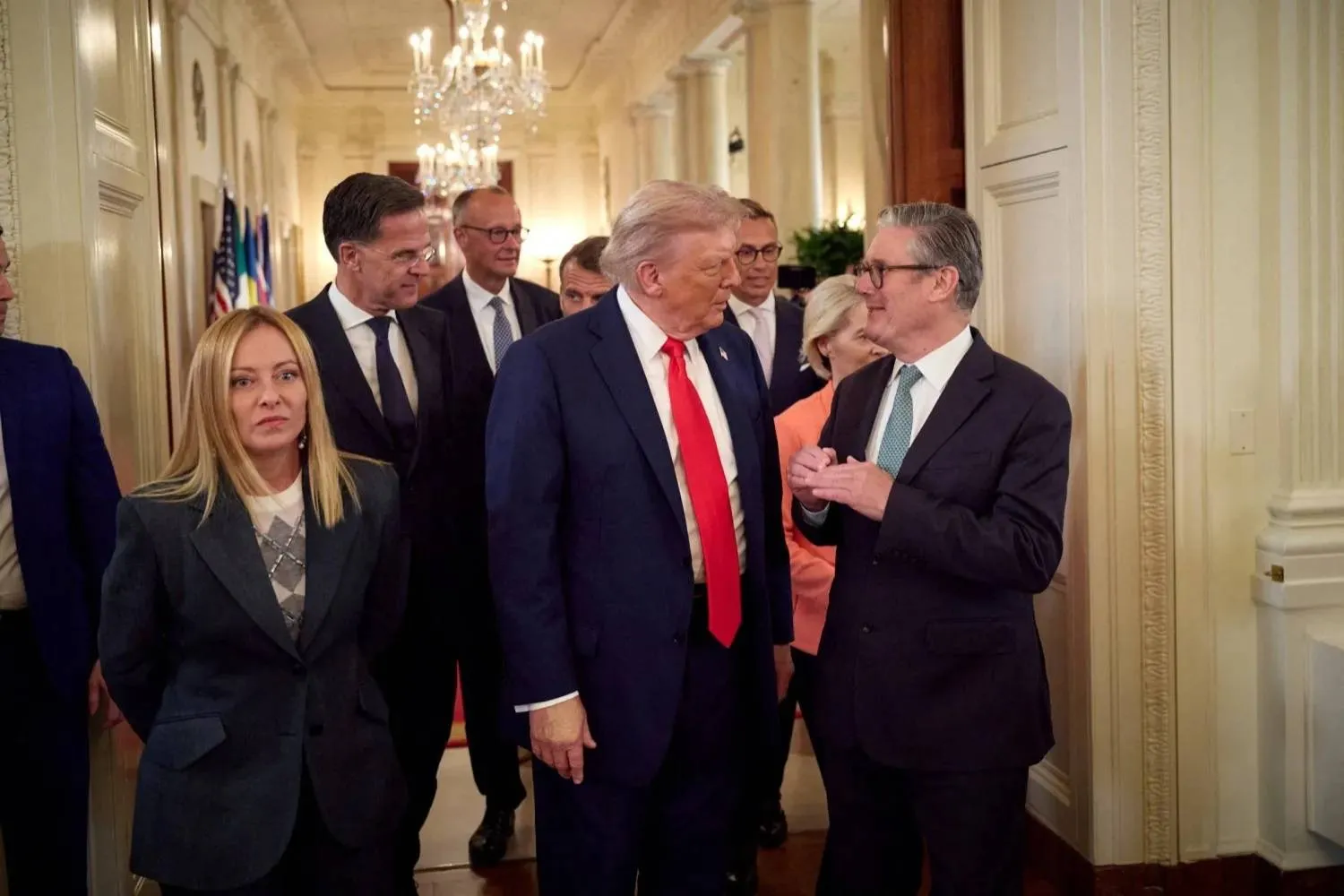

Report Says Europe Must Not Cave in Trump’s Culture War

Trump and European leaders ahead of their talks on the war in Ukraine at the White House on August 18. (Reuters)
TT

Report Says Europe Must Not Cave in Trump’s Culture War

Trump and European leaders ahead of their talks on the war in Ukraine at the White House on August 18. (Reuters)

The Trump administration is waging a “culture war” on Europe by promoting right-wing allies and undermining the EU’s credibility, according to a study by the European Council on Foreign Relations (ECFR) and the European Cultural Foundation.

The report, prepared by a network of 27 associate researchers, said the moment Trump’s America openly declared a culture war on Europe was during US Vice President JD Vance’s “infamous” speech at the Munich Security conference (MSC) in February.

Vance used his pulpit, just days before the German federal election, to sketch a transatlantic clash over democracy itself. He accused Europe of retreating from the “fundamental values shared with the United States.”

The researchers investigated their governments’ and citizens’ attitudes towards Europe, focusing on how and whether these have interrelated with Trump’s return to the White House.

Their study warned that Trump relies on governments in several European countries to use his “Make America Great Again” (MAGA) narratives and reinforce American influence in the EU. Hungary under Prime Minister Viktor Orban is MAGA’s stronghold in Europe. Trumpists also have footholds in Italy and Slovakia, under their respective Prime Ministers Giorgia Meloni and Robert Fico.

According to the study, Trump and his allies are actively trying to interfere in European elections, shift the continent’s ideological center to the right, and frame transatlantic relations as a divide over values.

The researchers said Trump dismisses the EU as an American foe, ridicules European leaders and bypasses EU institutions in favor of bilateral deals.

They listed some scenes of Trump’s “humiliation” and said the July 2025 trade deal between the EU and the US illustrates this dynamic.

“Trump threatened the bloc with 30% tariffs on imports to the US, which pushed the European Commission to accept a 15% ceiling and pledge hundreds of billions of dollars in purchases from the US. Member states were divided: some leaders wanted Brussels to threaten retaliatory measures, but most preferred to avoid escalation,” according to the report.

Also, as an example of Trump’s humiliation to Europe, the report cited US pressure on NATO members to spend 5% of GDP on defense, instead of 2% at their summit in The Hague.

The same script applies to Ukraine diplomacy. Europeans strive to be involved in negotiations to end the war. Trump, however, prefers to deal with Russia’s President Vladimir Putin bilaterally.

Also, the US President delights in ridiculing the EU’s “liberal” policies. At the EU-US trade deal announcement, he called wind turbines “ugly” and wind energy “a con job”, mocking Europe’s climate ambitions as foolish and vain.

The study said European leaders need to abandon the strategy of “flatter, appease, distract” towards Trump, explaining that it is flawed and short-sighted.

They instead need to be assertive and show a willingness to take greater responsibility for Europe’s security.

Researchers also noted that a recent polling showed that most European governments are aware of their countries’ real and imagined dependence on the US in trade, investment, energy, technology, weapons and troops.

According to the study, Trump and his acolytes can only do this because Europeans let them.

At the first level Trumpists exploit polarization in societies and the rise of Europe’s “new right”. At the second they take advantage of division and hesitation among European leaders.

But also, the study found “European sentiment” - the sense of belonging to a common space, sharing a common future and subscribing to common values, which is best observed against the background of major shocks and events - remains strong across the EU.

The study concluded that there is no reason why Europe’s “summer of humiliation” should have to turn into a “century.”

“If European leaders get their acts together, Europe can thrive. Trump has accelerated the destabilization of the world order and created new threats. But lurking underneath all this are genuine opportunities,” the report said.



Israeli Reservist Arrested on Suspicion of Spying for Iran

A long exposure showing the interception of a ballistic missile in the skies above Tel Aviv, as sirens sounds across central Israel, 20 March  2026. EPA/ABIR SULTAN
A long exposure showing the interception of a ballistic missile in the skies above Tel Aviv, as sirens sounds across central Israel, 20 March 2026. EPA/ABIR SULTAN
TT

Israeli Reservist Arrested on Suspicion of Spying for Iran

A long exposure showing the interception of a ballistic missile in the skies above Tel Aviv, as sirens sounds across central Israel, 20 March  2026. EPA/ABIR SULTAN
A long exposure showing the interception of a ballistic missile in the skies above Tel Aviv, as sirens sounds across central Israel, 20 March 2026. EPA/ABIR SULTAN

Israeli police said on Friday they had arrested an army reservist who served on the Iron Dome air defense system on suspicion of passing secrets to Iran.

The arrest comes as Israel and the United States are locked in a war with Iran that has spread across the Middle East.

"Raz Cohen, a 26-year-old resident of Jerusalem who served in the reserves in the Iron Dome system, was recently arrested on suspicion of committing security offenses involving contact with Iranian intelligence," Israeli police said.

"Over the course of several months, the citizen maintained contact with Iranian intelligence operatives and, under their instructions, was asked to carry out various security missions, including passing on sensitive security information."

Iran has been firing barrages of missiles at Israel in retaliation for a US-Israeli bombing campaign that began on February 28 with the killing of supreme leader Ali Khamenei.

Israel's state-of-the-art air defenses have managed to intercept many of the missiles fired by Tehran, but there have been deaths and damage to some strategic sites.

According to Israeli rescue services and authorities, Iranian missile fire toward Israel has killed 15 civilians in the country since the start of the war.

Four Palestinian women also died after Iranian missile fire in the occupied West Bank, the Ramallah-based health ministry said.


Italy, Germany and France Offer Help with Hormuz Only after Ceasefire

Britain, France, Germany, Italy, Japan and the Netherlands say they are ready "to contribute to appropriate efforts to ensure safe passage through the Strait of Hormuz" post-ceasefire. Giuseppe CACACE / AFP/File
TT

Italy, Germany and France Offer Help with Hormuz Only after Ceasefire

Britain, France, Germany, Italy, Japan and the Netherlands say they are ready "to contribute to appropriate efforts to ensure safe passage through the Strait of Hormuz" post-ceasefire. Giuseppe CACACE / AFP/File

Six major international powers said Thursday they were ready "to contribute to" ensuring safe passage through the Strait of Hormuz, though three stressed that any initiative would take place post-ceasefire.

Britain, France, Germany, Italy, Japan and the Netherlands said Thursday they were ready "to contribute to appropriate efforts to ensure safe passage through the Strait of Hormuz".

The grouping said they "welcome the commitment of nations who are engaging in preparatory planning", as they condemned "in the strongest terms recent attacks by Iran on unarmed commercial vessels in the Gulf".

But Italy, Germany and France made clear later Thursday that they were not talking about any immediate military help, but rather a potential multilateral initiative after a ceasefire.

The declaration came as an effective Iranian blockade of the strait has paralyzed commercial shipping through the crucial maritime chokepoint, which in peacetime sees a fifth of global crude oil and liquefied natural gas pass through it.

The war, which erupted on February 28 when the United States and Israel began bombing Iran, has led Tehran to retaliate with strikes across the Gulf region.

Twenty-three commercial vessels, including 10 tankers, have reported incidents or having been attacked.

The situation has left around 20,000 seafarers stranded on approximately 3,200 vessels west of the strait, according to the International Maritime Organization.

"We express our deep concern about the escalating conflict," the allies' joint statement said.

"We call on Iran to cease immediately its threats, laying of mines, drone and missile attacks and other attempts to block the Strait to commercial shipping," it added.

"Freedom of navigation is a fundamental principle of international law, including under the United Nations Convention on the Law of the Sea.

"The effects of Iran's actions will be felt by people in all parts of the world, especially the most vulnerable."

- Not a 'war mission' -

US President Donald Trump has urged other world powers, and NATO, to help reopen the Hormuz Strait to commercial shipping.

But they have rebuffed his call in the short term while insisting they were open to discussions and planning.

Italy's Defense Minister Guido Crosetto said the statement by the six countries should not be seen as a "war mission".

"No entry into Hormuz without a truce and a comprehensive multilateral initiative", for which "it is right and appropriate for the United Nations to provide the legal framework", he said in a statement.

And in Berlin, Defense Minister Boris Pistorius said that any German military involvement "would depend on the situation after a ceasefire... and whether we could participate within the framework of an international mandate".

Military involvement would also require approval by the German parliament, he added.

French President Emmanuel Macron told reporters his country planned to sound out permanent members of the UN Security Council on the possibility of establishing a UN framework for future plans -- once the ongoing exchange of fire had ended -- to secure navigation in the Strait of Hormuz.

"We have initiated an exploratory process, and we will see in the coming days whether it stands a chance of succeeding," he said in Brussels following a European summit that took place on Thursday.

A UK defense official told reporters at a briefing Wednesday that "the level of threat is such that I don't see many nations being willing to put warships into the middle of that threat right now".

The defense official noted London has sent a "small number" of additional military "planners" to US Central Command to "help with the planning and option development for... whatever comes next in the Strait of Hormuz might look like".


Iran's Supreme Leader Says Enemies' 'Security Must be Taken Away'

19 March 2026, Iran, Tehran: An Iranian flag bearing the picture of 
Supreme Leader Mojtaba Khamenei, is waved in Tehran. Photo: Saeid Zareian/dpa
19 March 2026, Iran, Tehran: An Iranian flag bearing the picture of Supreme Leader Mojtaba Khamenei, is waved in Tehran. Photo: Saeid Zareian/dpa
TT

Iran's Supreme Leader Says Enemies' 'Security Must be Taken Away'

19 March 2026, Iran, Tehran: An Iranian flag bearing the picture of 
Supreme Leader Mojtaba Khamenei, is waved in Tehran. Photo: Saeid Zareian/dpa
19 March 2026, Iran, Tehran: An Iranian flag bearing the picture of Supreme Leader Mojtaba Khamenei, is waved in Tehran. Photo: Saeid Zareian/dpa

Iran’s new Supreme Leader Mojtaba Khamenei called Friday for the enemies of his nations to have their “security” taken away, in his latest message to the public.

Khamenei made the remarks in a statement issued on his behalf and sent to President Masoud Pezeshkian, after Israel killed Intelligence Minister Esmail Khatib.

Khamenei hasn’t been seen since he was named as supreme leader, succeeding his father, the 86-year-old Supreme Leader Ali Khamenei, who was killed in an Israeli airstrike on the first day of the war on Feb. 28.

American and Israeli officials have suggested that Mojtaba Khamenei was hurt in the war.