


A Raptor with No Qualms About Eating Its Opponents Wins New Zealand’s Annual Bird Election 

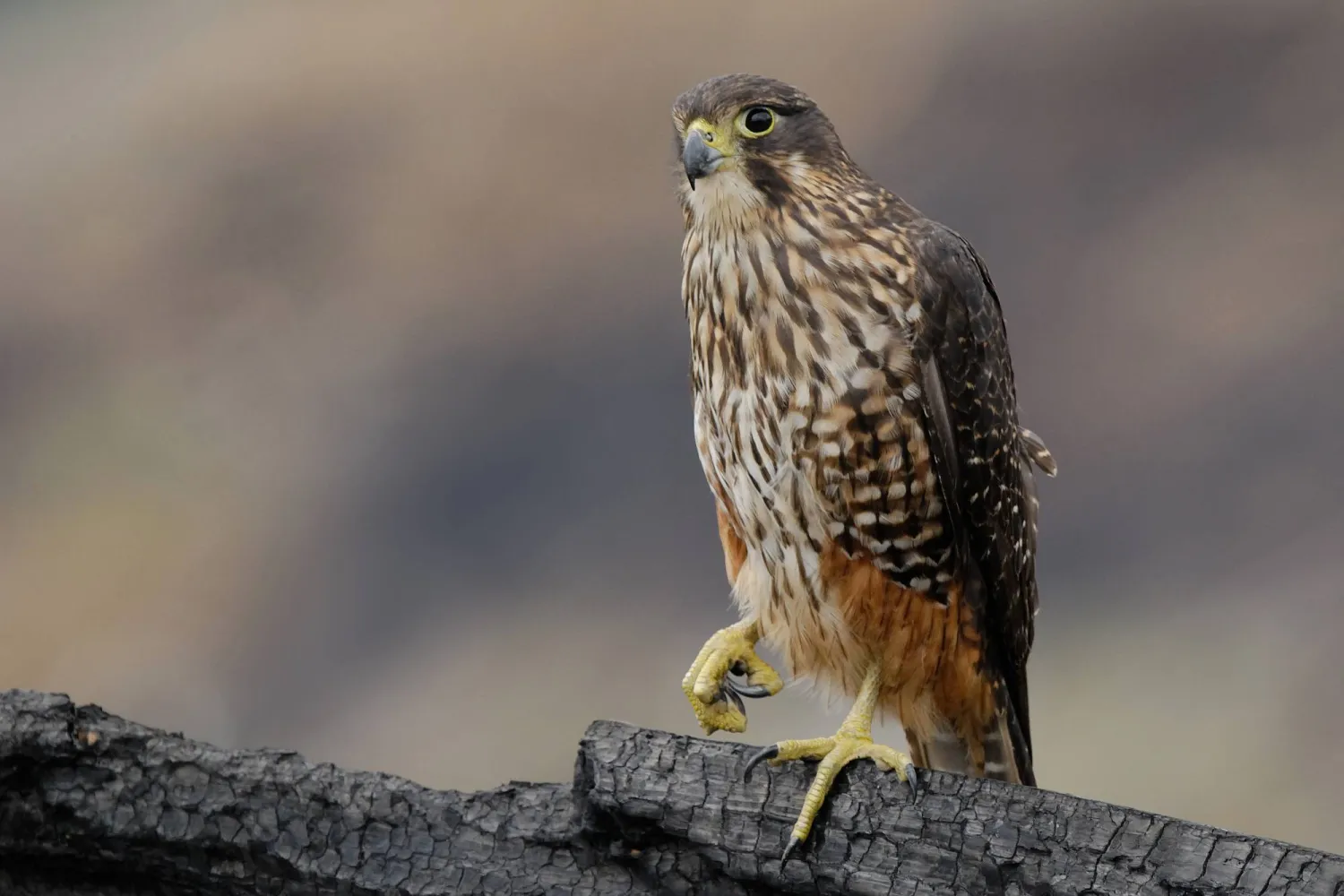
A kārearea or New Zealand falcon is pictured in Fiordland National Park in New Zealand, on Jan. 4, 2011. (Craig McKenzie via AP)
TT

A Raptor with No Qualms About Eating Its Opponents Wins New Zealand’s Annual Bird Election 

A kārearea or New Zealand falcon is pictured in Fiordland National Park in New Zealand, on Jan. 4, 2011. (Craig McKenzie via AP)

New Zealand ’s annual bird election is contested by cheeky parrots, sweet songbirds and cute, puffball robins. This year’s winner was a mysterious falcon that wouldn’t think twice about eating them.

Kārearea, the Indigenous Māori name for the New Zealand falcon, was crowned Bird of the Year on Monday. But the annual poll, run by conservation group Forest & Bird, is no ordinary online vote.

The fiercely fought election sees volunteer (human) campaign managers apply to stump for their favorite bird. Feathers fly as avian enthusiasts seek to sway the public through meme battles, trash-talking poster campaigns and dance routines performed in bird costumes.

“Bird of the Year has grown from a simple email poll in 2005 to a hotly contested cultural moment,” said Forest & Bird Chief Executive Nicola Toki. “Behind the memes and mayhem is a serious message.”

The contest draws attention to New Zealand’s native bird species, with 80% designated as being in trouble to some degree. But it attracts passionate fandom because New Zealanders are bird-obsessed.

In a country with no native land mammals except for two species of bat, birds reign supreme. They appear in art, on jewelry, in schoolchildren’s songs, and in the name New Zealanders are known by abroad, “kiwis.”

Beloved birds include alpine parrots that harass tourists and pigeons which get so drunk on berries that they sometimes fall out of trees.

“This is not a land of lions, tigers and bears,” said Toki. “The birds here are weird and wonderful and not what you would expect to see perhaps in other countries.”

The first contest two decades ago attracted fewer than 900 votes. More than 75,000 people in the country of 5 million cast ballots this year.

It was the highest-ever voter turnout apart from an episode when Last Week Tonight host John Oliver volunteered as a campaign manager in 2023, prompting mostly joking accusations from New Zealanders of American interference. Perhaps inevitably, Oliver’s bird, the pūteketeke or Australasian crested grebe, won in a 290,000-vote landslide.

Other controversies have struck the poll. In 2021, there was mild uproar when a bat won the title, despite not being a bird.

The vote was ruffled by a foreign influence scandal in 2018 when self-styled comedians in Australia cast hundreds of fraudulent votes for a bird that shares its name with an Antipodean slang term for sex. Voters must now verify the email addresses used to cast their votes.

Forest & Bird said 87% of the votes in this year’s poll came from New Zealand. The falcon’s more than 14,500 votes appeared to have been won fair and square.

The majestic kārearea can fly at speeds of more than 200 km (124 miles) per hour and swoops to capture its prey, often smaller birds. The endemic species is threatened in New Zealand, vulnerable to electrocution on wires and loss of their forest habitats.

“They’re a mysterious bird and that’s partly because they’re cryptic, they’re often well-hidden,” said Phil Bradfield, a trustee of Kārearea Falcon Trust in Marlborough, on New Zealand’s South Island.

Official figures suggest between 5,000 and 8,000 New Zealand falcons remaining, although the true number is unknown. Bradfield said the “fast and sneaky and very special” raptor was a deserving Bird of the Year winner.

Other campaigns knew victory on Monday would take a miracle. Birds that are ugly — but not ugly enough to be funny — unknown or perceived as boring face an uphill slog.

That doesn’t deter bird lovers. The year 2025 was the first that all 73 bird competitors attracted campaign managers, with some electing to stump for contenders they knew would lose.

One was Marc Daalder whose scrappy, grassroots campaign for the tākapu, or Australasian gannet, drew 962 votes — about a 15th of the falcon’s.

“Running a campaign for one of the less popular birds is a more satisfying experience because you know the votes your bird received are a result of your hard work,” said Daalder, who is a (human) political journalist and three-time (bird) campaign manager.

Despite the near-record voter turnout, Toki from Forest & Bird said she feared New Zealanders would give up on some of the most threatened species as they grew more costly to protect, particularly from predators such as cats, rats and stoats.

“Successive governments in New Zealand have cumulatively reduced investment in conservation, which is the cornerstone of New Zealand’s economic prosperity,” she said, referring to tourism campaigns promoting the country’s scenic landscapes.

“People come here to see our native birds and the places they live in,” she said. “They’re not coming here to see shopping malls.”



Huge Rotating Structure of Galaxies and Dark Matter Is Detected

A figure depicting the rotation of neutral hydrogen in galaxies residing in an extended filament, where the galaxies exhibit a coherent bulk rotational motion tracing the large-scale cosmic web, is seen in this undated illustration obtained by Reuters on December 4, 2025. (Lyla Jung/Handout via Reuters)
TT

Huge Rotating Structure of Galaxies and Dark Matter Is Detected

A figure depicting the rotation of neutral hydrogen in galaxies residing in an extended filament, where the galaxies exhibit a coherent bulk rotational motion tracing the large-scale cosmic web, is seen in this undated illustration obtained by Reuters on December 4, 2025. (Lyla Jung/Handout via Reuters)

Scientists have observed the largest-known rotating structure in the cosmos - a gargantuan thread-like assemblage of hundreds of galaxies, gas and dark matter that makes up a filament in the macrostructure of the universe called the cosmic web.

The filament, located about 140 million light-years from Earth, was observed by scientists primarily using the MeerKAT radio telescope located in South Africa, an array of 64 interlinked satellite dishes.

The rotating filament is astonishingly large, measuring about 50 million light-years long and 117,000 light-years wide. A light-year is the distance light travels in a year, 5.9 trillion miles (9.5 trillion km). By way of comparison, our Milky Way galaxy, which itself is part of a filament in the cosmic web, measures roughly 100,000 light-years in diameter.

"We believe that the universe on very large scales is made of a network-like distribution of galaxies, gas and dark matter," said University of Cambridge astrophysicist Madalina Tudorache, co-lead author of the study published this month in the journal Monthly Notices of the Royal Astronomical Society.

"This network is called the cosmic web, and it is formed of clusters, which are very dense clumps of matter, often formed of many groups of galaxies; voids - which are empty or almost empty regions of space; and filaments, which are strand-like structures which connect the very dense regions and border the voids," Tudorache said.

The rotating filament described in the new study is populated by nearly 300 galaxies of various sizes as well as gas and dark matter, the mysterious invisible stuff estimated to make up 27% of the cosmos.

Everything visible in the universe is made of ordinary matter - stars, planets, moons and all the stuff on Earth. It can be seen in wavelengths from infrared to visible light and gamma rays, but comprises only about 5% of the universe. Dark matter, on the other hand, does not absorb or reflect or emit light, but its presence is known through its gravitational effects on large scales.

The researchers determined that the filament is spinning by observing that the galaxies on either side of its central axis are moving through space in opposite directions, with the whole thing having a rotational velocity of about 246,000 miles (396,000 km) per hour.

"This is the largest individual spinning structure so far detected. Statistically, we believe there are other spinning structures, some of which could be larger. However, we have not been able to detect them directly with our current data and telescopes," said University of Oxford astrophysicist and study co-lead author Lyla Jung.

The researchers likened what they see in this filament to the amusement park attraction called a teacup ride.

"The teacup ride analogy explains the two levels of spinning motion that make this object unique," Jung said.

"First, each galaxy in the filament spins on its own. The gas and stars in each galaxy orbit around the galaxy center, like each teacup on the ride spins individually. Second, the entire cosmic filament also rotates. The filament is made of many galaxies, and this study demonstrates that the entire structure is rotating, like the teacup platform spins as a whole," Jung added.

In studying the cosmos, astrophysicists examine it at the smallest and largest scales. They look at tiny fundamental particles such as neutrinos. They look at objects such as comets, asteroids, moons, planets and stars that make up solar systems. They look at galaxies comprised of billions of stars and at clusters of galaxies. And then on the largest scales they look at filaments and other components of the cosmic web.

This study looks at the large end of things.

"This is a very exciting time to work in this field, as our capacity of discovering such structures is increasing with the advent of better radio and optical surveys. It will deepen our understanding of the universe," Tudorache said.


NCW Releases 37 Wildlife Species in Hegra Reserve in AlUla

The release included six mountain ibex, 20 sand gazelles (reem), six idmi gazelles, and five ostriches - SPA
TT

NCW Releases 37 Wildlife Species in Hegra Reserve in AlUla

The release included six mountain ibex, 20 sand gazelles (reem), six idmi gazelles, and five ostriches - SPA

The National Center for Wildlife (NCW), in cooperation with the Royal Commission for AlUla, has released 37 wildlife species into Hegra Reserve as part of ongoing breeding and reintroduction programs aimed at restoring natural habitats, enriching biodiversity, supporting ecological balance, and promoting environmental tourism.

The release included six mountain ibex, 20 sand gazelles (reem), six idmi gazelles, and five ostriches, SPA reported.

This effort is part of NCW's continuing work to increase the numbers of threatened native species and expand their presence across suitable natural environments.

NCW CEO Dr. Mohammed Qurban stated that releasing these species into the reserve helps protect wildlife, safeguard ecosystems, and enrich biodiversity, strengthening the sustainability of the reserve and its role as a natural and cultural destination of national significance.

Qurban noted that this release is an extension of the center’s reintroduction efforts across reserves in the Kingdom, aimed at rehabilitating ecosystems, increasing biodiversity, and ensuring long-term sustainability. It aligns with the goals of Saudi Vision 2030, the Saudi Green Initiative, and the National Environment Strategy, while also adhering to global approaches to wildlife conservation.


Australian Bushfires Raze Homes in Two States; Firefighter Dies 

Ruins of buildings and a car smolder after a wildfire destroyed houses in Koolewong, Australia, Saturday, Dec. 6, 2025. (Dan Himbrechts/AAP Image via AP)
TT

Australian Bushfires Raze Homes in Two States; Firefighter Dies 

Ruins of buildings and a car smolder after a wildfire destroyed houses in Koolewong, Australia, Saturday, Dec. 6, 2025. (Dan Himbrechts/AAP Image via AP)

An Australian firefighter was killed overnight after he was struck by a tree while trying to control a bushfire that had destroyed homes and burnt large swathes of bushland north of Sydney, authorities said on Monday.

Emergency crews rushed to bushland near the rural town of Bulahdelah, 200 km (124 miles) north of Sydney, after reports that a tree had fallen on a man. The 59-year-old suffered a cardiac arrest and died at the scene, officials said.

Prime Minister Anthony Albanese said the "terrible news is a somber reminder" of the dangers faced by emergency services personnel as they work to protect homes and families.

"We honor that bravery, every day," Albanese said in a statement.

A fast-moving fire over the weekend destroyed 16 homes in New South Wales state's Central Coast region, home to about 350,000 people and a commuter region just north of Sydney.

Resident Rouchelle Doust, from the hard-hit town of Koolewong, said she and her husband tried to save their home as flames advanced.

"He's up there in his bare feet trying to put it out, and he's trying and trying, and I'm screaming at him to come down," Doust told the Australian Broadcasting Corp.

"Everything's in it: his grandmother's stuff, his mother's stuff, all my stuff - everything, it's all gone, the whole lot."

Conditions eased overnight, allowing officials to downgrade fire danger alerts, though the weather bureau warned some inland towns in the state could hit more than 40 degrees Celsius (104 Fahrenheit) on Tuesday, raising fire dangers.

More than 50 bushfires were burning across New South Wales as of Monday.

On the island state of Tasmania, a 700-hectare (1,729 acres) blaze at Dolphin Sands, about 150 km (93 miles) northeast of the state capital of Hobart, destroyed 19 homes and damaged 40. The fire has been contained, but residents have been warned not to return as conditions remain dangerous, officials said.

Authorities have warned of a high-risk bushfire season during Australia's summer months from December to February, with increased chances of extreme heat across large parts of the country following several relatively quiet years.

In neighboring New Zealand, five helicopters and multiple crews were working to put out a fire near the country's oldest national park, a month after a wildfire burnt through 2,589 hectares (6,400 acres) of alpine bush there.

Police said they had closed a road near the state highway and advised motorists to avoid the area and expect delays after the blaze near Tongariro National Park, a popular hiking spot, spread to 110 hectares (272 acres) by Monday afternoon.