

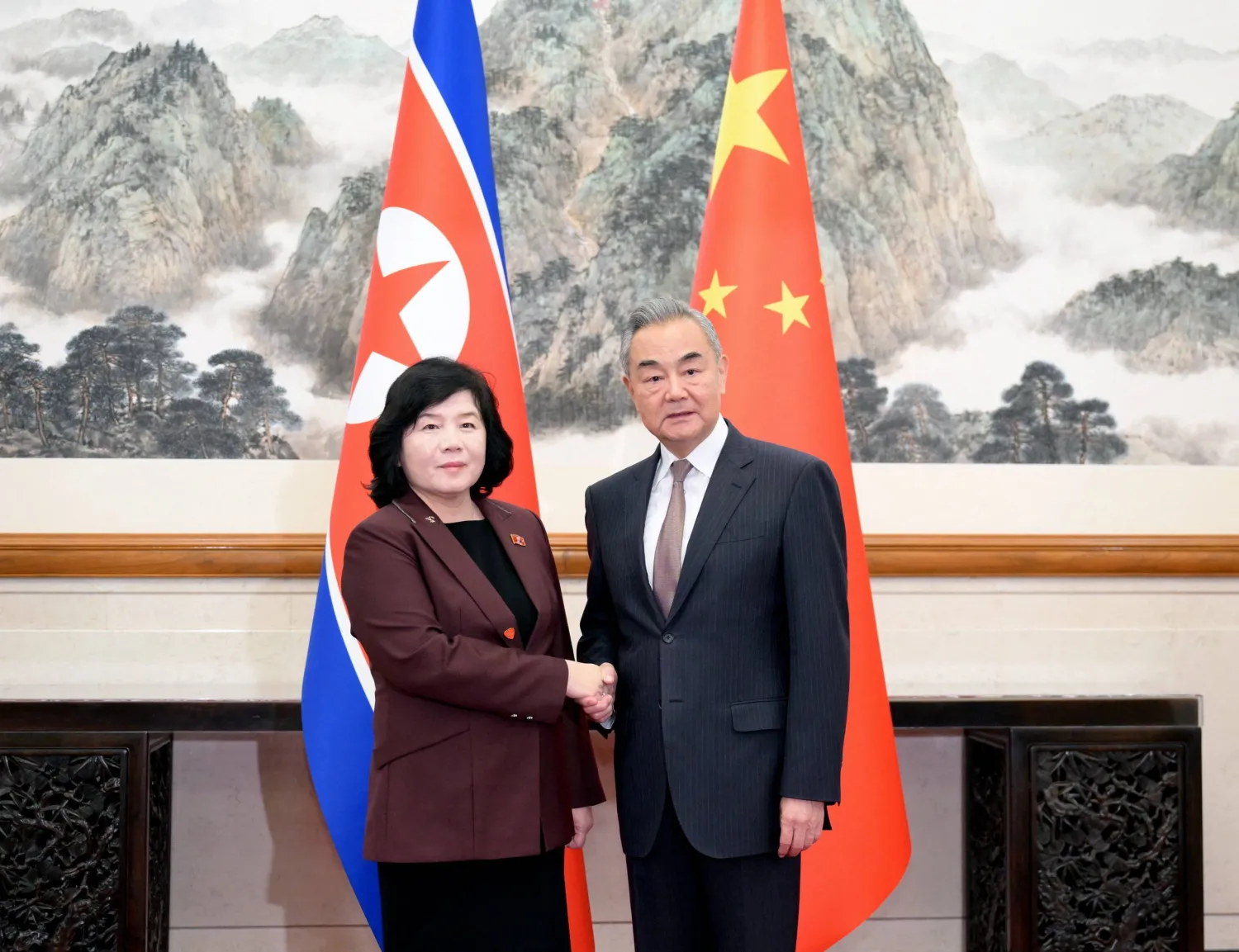

Top Diplomats of North Korea, China Agree to Deepen Ties and Resist Hegemonism 

Chinese Foreign Minister Wang Yi meets North Korea's Foreign Minister Choe Son Hui in Beijing, China, in this handout image obtained by Reuters on September 29, 2025. (China's Ministry of Foreign Affairs/Handout via Reuters)
TT

Top Diplomats of North Korea, China Agree to Deepen Ties and Resist Hegemonism 

Chinese Foreign Minister Wang Yi meets North Korea's Foreign Minister Choe Son Hui in Beijing, China, in this handout image obtained by Reuters on September 29, 2025. (China's Ministry of Foreign Affairs/Handout via Reuters)

The foreign ministers of North Korea and China agreed to deepen bilateral ties and resist hegemonism or unilateralism, a likely reference to their pushbacks against the United States.

Their meeting in Beijing on Sunday came about three weeks after North Korean leader Kim Jong Un and Chinese President Xi Jinping held their first summit in more than six years and pledged mutual support and enhanced cooperation. Kim and Xi earlier attended a massive Beijing military parade marking the end of the World War II, with other world leaders including Russian President Vladimir Putin.

The joint appearance of Kim, Xi and Putin, the first of its kind, displayed a potential three-way unity against the United States, though it's unclear how far China would go in such an anti-US partnership.

In a meeting with her Chinese counterpart Wang Yi, North Korean Foreign Minister Choe Son Hui cited Kim as saying that further bolstering ties with China is North Korea’s unwavering position. Choe expressed an intent to deepen and develop friendly ties with China in line with the spirits of Kim-Xi summit, the North’s Korean Central News Agency reported Monday.

Wang said China maintains a firm position that it intends to solidify bilateral ties, saying it’s necessary to boost strategic communications and exchanges, KCNA said.

China's Xinhua News Agency cited Wang as saying China oppose “all forms of hegemonism” and stands ready to strengthen cooperation with North Korea in international and regional affairs. It quoted Choe as saying that North Korea “is willing to closely cooperate with China in multilateral affairs, jointly resist unilateralism and power politics and promote a fairer and more just world order.”

The comments likely referred to their countries' separate confrontations with the United States and China over strategic competitions with the US and North Korea over its nuclear weapons program.

KCNA said Choe and Wang exchanged views on regional and international affairs reached a complete consensus on the issues, but didn't elaborate.

Kim's attendance at the Beijing military parade was his first attendance at a major multilateral event during his 14-year rule.

In recent years, North Korea has been focusing on expanding cooperation with Russia by supplying combat troops and ammunitions to support its war against Ukraine. But experts say Kim now feels the need to improve ties with China, North Korea’s biggest trading partner and aid benefactor, as he has to brace for the war’s end.

They say China, for its part, would want to maintain influence over North Korea, as bilateral ties reportedly cooled in the past few years.

Attention has turned to the makeup of the delegation China might send to North Korea when it commemorates the 80th founding anniversary of its ruling Workers’ Party next month. North Korea is expected to mark the anniversary with its own military parade to display new weapons targeting the US and its allies.



French, Japanese Ships Cross Strait of Hormuz in First Since War

A cargo ship in the Gulf, near the Strait of Hormuz, as seen from northern Ras al-Khaimah, near the border with Oman’s Musandam governance, amid the US-Israeli conflict with Iran, in United Arab Emirates, March 11, 2026. (Reuters)
TT

French, Japanese Ships Cross Strait of Hormuz in First Since War

A cargo ship in the Gulf, near the Strait of Hormuz, as seen from northern Ras al-Khaimah, near the border with Oman’s Musandam governance, amid the US-Israeli conflict with Iran, in United Arab Emirates, March 11, 2026. (Reuters)

One French- and another Japanese-owned vessel are among a handful of vessels to have crossed the war-torn Strait of Hormuz, maritime tracking data showed Friday.

The passage, a vital maritime route for oil and liquified natural gas, has been virtually blocked by Iran since the start of the war, said AFP.

But both ships made the crossing on Thursday, according to ship tracking company Marine Traffic's website.

The Maltese-flagged Kribi belonging to the French maritime transport group CMA CGM crossed the waterway to leave the Gulf on Thursday afternoon, Marine Traffic's data showed.

By early Friday, it was off Muscat, Oman, still broadcasting the message "owner France" on its transponder system in the field usually used to give the destination.

The vessel's navigation data showed it had crossed via an Iranian-approved route through its waters, dubbed the "Tehran Toll Booth" by leading shipping journal Lloyd's List.

- Southern route -

In addition, three tankers -- including one co-owned by a Japanese company -- crossed the Strait of Hormuz on Thursday by taking an alternative, southern route.

They hugged close to the shore of Oman's Musandam Peninsula -- a first in nearly three weeks according to Lloyd's List.

Before the war, which started more than a month ago, about a fifth of global oil and liquefied natural gas (LNG) passed through the Strait.

All three ships signaled they were an "OMANI SHIP" in the message broadcast by their transponder as they crossed the strait.

The Sohar LNG, which was empty when crossing, is co-owned by Japanese shipping company Mitsui O.S.K.

That makes it the first Japanese vessel to exit the Gulf since the start of the war, according to a company statement quoted by Japanese media.

The Hong-Kong flagged New Vision, which crossed the strait on March 1 right after the war started, is expected in the French port of Le Havre on Saturday evening.

Since the conflict started however, that has dwindled to a trickle as Iran selectively attacks ships and energy facilities throughout the Gulf in retaliation for US and Israeli attacks.

A few commercial ships crossing the Strait of Hormuz recently have passed through the Iranian-approved route in the north of the waterway.

- Down to a trickle -

Just 221 commodities vessels have crossed the Strait of Hormuz since March 1, some more than once, according to Kpler data up to Friday morning.

In peacetime, the same waterway handles around 120 daily transits, according to Lloyd's List.

Of the vessels that made the crossing, 60 percent either came from Iran or were heading there.

It was not clear from the data how many had been cleared to make the crossing by Tehran.

But it did show that, among the 118 crossings by ships carrying cargo, 37 had left the Gulf carrying crude oil.

Most of those oil tankers -- 30 of them -- came from Iran or sailed under the Iranian flag. And most ships carrying Iranian oil did not specify their destination on their transponder.

Of those who did, all but one reported they were heading to China.

In the early days of the war, transponder data showed dozens of ships broadcasting messages such as "Chinese crew" or "Chinese owner" in the field usually used for their destination.

This appeared to be an attempt by the ships to avoid being targeted by Iran.


Iran Executes Two Linked to Opposition Group

Executions in Iran have surged in recent years - AFP
TT

Iran Executes Two Linked to Opposition Group

Executions in Iran have surged in recent years - AFP

Iran on Saturday executed two men it said were convicted of links to an opposition group, the People's Mojahedin Organization of ‌Iran, and ‌of carrying out armed ‌attacks, ⁠domestic media reported.

The ⁠executions were the latest in recent days of individuals with PMOI links.

The PMOI confirmed ⁠Saturday's executions, saying ‌in ‌a statement that Iran was "trying ‌to hide its ‌weakness by executing political prisoners, especially PMOI members and supporters." Four PMOI ‌members were executed earlier this week, ⁠it ⁠said.

The group said the two men executed on Saturday were arrested in January 2024 and had their death sentences upheld in December 2025.


Earthquake Kills 8 Members of Same Family near Afghan Capital

Previous earthquake in Afghanistan (Archive-Reuters)
TT

Earthquake Kills 8 Members of Same Family near Afghan Capital

Previous earthquake in Afghanistan (Archive-Reuters)

An earthquake that struck Afghanistan overnight killed eight members of the same family in Kabul province, the health ministry said on Saturday.

The 5.8-magnitude quake struck at 8.42 pm (1612 GMT) on Friday at a depth of 186 kilometers (115 miles) at the epicenter in northeastern Badakhshan province, according to the US Geological Survey (USGS).

Shaking was felt in multiple parts of the country, including the capital Kabul, according to AFP journalists.

"In the Gosfand Dara area of Kabul Province, eight members of a family died as a result of the earthquake," Health Ministry spokesman Sharafat Zaman said in a message to media.

He added that a child aged around two years old was the only survivor from the household and the country's disaster management agency said the boy had been injured in the tremor.

Afghanistan is frequently jolted by earthquakes, particularly along the Hindu Kush mountain range near where the Eurasian and Indian tectonic plates meet.

In August, a shallow magnitude 6 earthquake wiped out mountainside villages and killed more than 2,200 people in eastern Afghanistan, making it the deadliest tremor in the country's recent history.