Treasury Chief Says Wars and Tariffs Are Harming the UK’s Economic Outlook https://english.aawsat.com/business/5191579-treasury-chief-says-wars-and-tariffs-are-harming-uk%E2%80%99s-economic-outlook%C2%A0
Treasury Chief Says Wars and Tariffs Are Harming the UK’s Economic Outlook
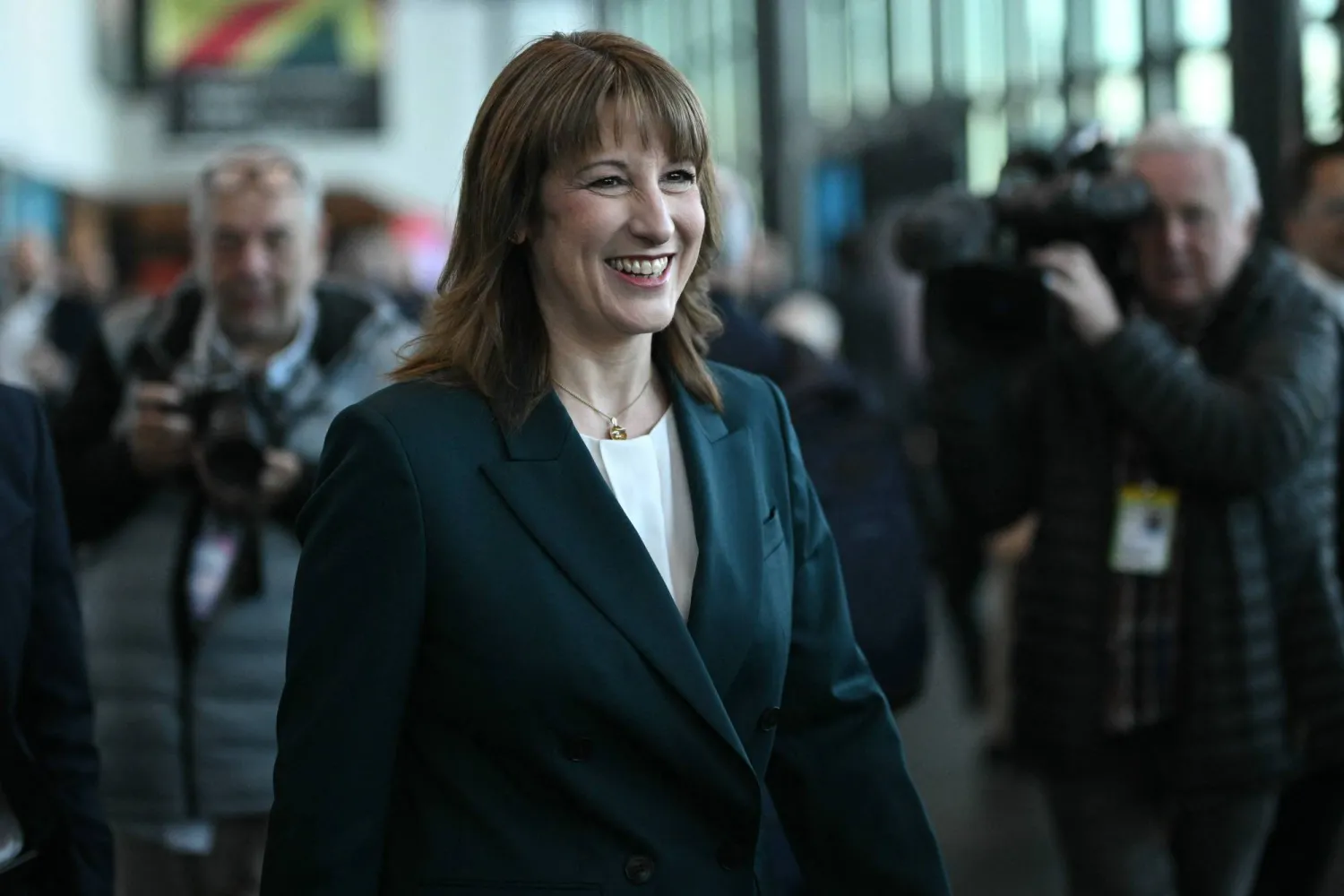
Britain's Chancellor of the Exchequer Rachel Reeves undertakes the morning media round on the second day of the annual Labour Party conference in Liverpool, northwest England, on September 29, 2025. (AFP)
TT
TT
Treasury Chief Says Wars and Tariffs Are Harming the UK’s Economic Outlook
Britain's Chancellor of the Exchequer Rachel Reeves undertakes the morning media round on the second day of the annual Labour Party conference in Liverpool, northwest England, on September 29, 2025. (AFP)
Britain’s Treasury chief warned Monday that wars in Ukraine and the Middle East and economic headwinds sparked by US President Donald Trump’s tariffs have worsened the UK's economic outlook since the governing Labour Party won power last year.
Chancellor of the Exchequer Rachel Reeves is under pressure to say whether she will raise taxes in her autumn budget on Nov. 26.
"In the last year the world has changed, and we are not immune to that change," she told the BBC. "Whether it is wars in Europe and the Middle East, whether it is increased barriers to trade because of tariffs coming from the United States, whether it is the global cost of borrowing, we’re not immune to any of those things."
Reeves hopes to deliver a touch of economic optimism when she addresses the Labour Party’s annual conference in Liverpool later on Monday.
Since ending 14 years of Conservative rule in July 2024, the Labour government has struggled to deliver the economic growth it promised. Inflation remains stubbornly high and the economic outlook subdued, frustrating efforts to repair tattered public services and ease the cost of living.
Labour pledged during last year’s election not to raise taxes on working people, but has since hiked levies on employers, and Reeves has not ruled out increasing other forms of tax in her budget.
"I’m determined not to increase those key taxes that working people pay," Reeves said.
The Treasury said Reeves' speech will include a pledge to end long-term youth unemployment, and kickstart the UK’s sluggish productivity. Under the plan, everyone under 25 who has been unemployed for 18 months will be offered guaranteed paid work. One in eight 16–24-year-olds in Britain — about 1 million people — is currently not in education, work, or training.
Thousands of Labour members from around the country are in Liverpool, in northwest England for the party conference – a mix of policy forum and pep rally that this year is lacking in pizazz.
Labour lags behind Nigel Farage’s hard-right Reform UK party in opinion polls, and some party members are losing faith in Prime Minister Keir Starmer even though there may be four years until the next election.
Many are rallying around Andy Burnham, the ambitious Labour mayor of Manchester, who said Sunday that the party is in "peril" and needs to change direction.
The threat posed by Reform is a top issue among Labour delegates at the four-day conference that ends Wednesday. Farage’s party has only five lawmakers in the 650 seat House of Commons, and Labour has more than 400. Nonetheless, Starmer said Reform, and not the main opposition Conservatives, is now Labour’s chief opponent.
Starmer has described the fight between Labour and Reform as "a battle for the soul of this country." On Sunday he accused Farage of sowing division with plans by Reform to deport immigrants who are in the UK legally. Starmer said such a policy would be "racist" and "immoral."
The UK government has toughened its own language about immigration, though. Home Secretary Shabana Mahmood is expected to announce plans on Monday to raise the bar immigrants must meet to gain permanent residency. Under the proposals, people will have to have a "high standard" of English, "a spotless criminal record" and give back to their communities to get the right to settle in the UK.
Kremlin spokesman Dmitry Peskov looks on as Russia's President Vladimir Putin (not pictured) and Togo's President of the Council of Ministers Faure Gnassingbe (not pictured) meet at the Kremlin in Moscow, Russia November 19, 2025. REUTERS/Ramil Sitdikov/Pool/File Photo
Russia Ready to Supply Gas to the EU if it Has a Surplus
Kremlin spokesman Dmitry Peskov looks on as Russia's President Vladimir Putin (not pictured) and Togo's President of the Council of Ministers Faure Gnassingbe (not pictured) meet at the Kremlin in Moscow, Russia November 19, 2025. REUTERS/Ramil Sitdikov/Pool/File Photo
Russia is ready to continue supplying gas to the European Union if there are volumes remaining after supplies to alternative markets, Russian state news agency TASS reported on Sunday.
"There is plenty of it for now. But alternative markets are very voracious, there are a great many requests for supplies," Kremlin spokesman Dmitry Peskov was quoted as saying, Reuters reported.
However, Europe will find a way to buy gas even if Russia does not supply it, Peskov said.
"There are so many gas liquefaction plants, both in Europe and in the Middle East, that this process, this spot market, functions like a living organism," Peskov added.
Saudi Energy Companies in 2025: Billion-Dollar Profits Defy Market Volatilityhttps://english.aawsat.com/business/5261467-saudi-energy-companies-2025-billion-dollar-profits-defy-market-volatility
Saudi Energy Companies in 2025: Billion-Dollar Profits Defy Market Volatility
Saudi and foreign investors stand in front of the logo of the giant Saudi oil company Aramco during the 10th Global Competitiveness Forum (AFP)
In 2025, the Saudi energy sector demonstrated a superior ability to fortify its financial gains and navigate global market fluctuations, achieving a net profit exceeding $92.5 billion (347.2 billion riyals). Despite pressures imposed by the global supply-and-demand equation and supply chain disruptions, the financial results of listed companies revealed a strategic shift in performance. Price momentum for oil was no longer the sole driver; instead, operational efficiency and smart hedging emerged as safety valves that ensured the continuity of massive cash flows, with revenues exceeding $430 billion.
While profits recorded a relative decline of approximately 11.5 percent compared to the exceptional year of 2024, when they reached $104.62 billion (392.58 billion riyals), the results showed a positive variance for logistics and drilling companies such as "Bahri" and "ADES." This indicates a new phase of operational maturity and diversification of income sources within the region's most vital sector.
This decline in sector profits is attributed to the falling earnings of "Saudi Aramco," the heaviest weight in the Saudi market index. Other sector companies were also affected by multiple challenges, including declining revenues, lower sales, and reduced dividend distributions from investment portfolios.
Variance in Company Profits
Financial results for energy sector companies showed a variance in performance: profits rose for two companies, declined for one, and another narrowed its losses. Additionally, one company continued its losses, while another shifted to a loss after recording profits during 2024.
In detail, "Saudi Aramco" achieved the highest profit margin among sector companies, reaching $92.75 billion (348.04 billion riyals) during 2025, despite a decline of 11.64 percent compared to the previous year. The company attributed this decline to lower revenues and sales-related income, though this was partially offset by a decrease in operating costs and lower income taxes and Zakat. "Bahri" ranked second with profits of $647.58 million (2.43 billion riyals) during 2025, a growth of 0.12 percent compared to the previous year's profits of $578.29 million (2.17 billion riyals). The company attributed its profit growth to higher total quarters for the oil transport sector and improved operational performance and global freight rates.
"ADES" came in third with profits reaching $218.13 million (818.5 million riyals), achieving a growth of 2 percent compared to the previous year. The company stated that the rise in net profit reflected an increase in depreciation and interest expenses relative to revenues, in addition to gains recorded in the third quarter under "profits from equity instruments at fair value through profit or loss," the impact of which was largely dissipated by costs related to an acquisition deal.
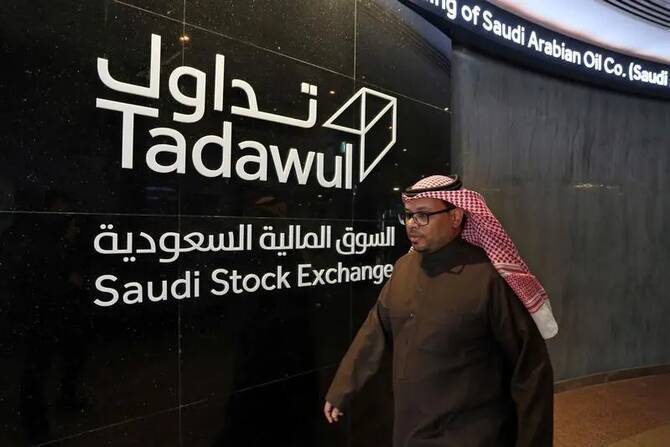
A man passes by the Saudi Stock Exchange logo (Reuters)
Sector Revenues
At the revenue level for sector companies during 2025, there was a decline of approximately 4.74 percent, recording revenues of about $430.12 billion (1.61 trillion riyals) compared to $450.4 billion (1.69 trillion riyals) in 2024, a decrease of $21.44 billion (80.45 billion riyals).
Commenting on these results, Dr. Sulaiman Al-Humaid Al-Khaldi, financial market analyst and member of the Saudi Economic Association, told Asharq Al-Awsat that the energy sector is strategic and vital to the Saudi economy, and these results reflect the continued high profitability of sector companies despite the relative decline. He described this decline as "natural" following the exceptional levels of 2024, reflecting the moderation of oil prices compared to the previous year, alongside the OPEC+ alliance's commitment to production cut policies to support balance.
He noted the decline in revenues resulted from lower prices and volumes despite remaining at strong levels, as well as rising operational and investment costs for some companies, particularly in expansion and renewable energy projects. Conversely, companies like "Bahri" and "ADES Holding" showed positive performance supported by growth in demand for maritime transport and drilling services, reflecting a diversification of profitability sources within the sector.
Al-Khaldi expected the sector to remain stable in the near term with a slight inclination toward growth, supported by several factors including continued global oil supply management to support prices within a balanced range, and Aramco’s expansion into gas, clean energy, and petrochemicals, reducing reliance solely on crude oil. He also noted the improved performance of service companies (drilling and transport) with the increase in regional projects.
Over the medium to long term, he expected the future of sector companies to carry a strategic shift toward focusing on diversifying energy sources through hydrogen and renewables, enhancing operational efficiency, and reducing costs. He highlighted that companies would benefit from Saudi Vision 2030 in supporting investments and infrastructure, noting that the sector remains strong and profitable, and the current decline is a healthy correction after a historical peak, while the trend toward diversification and sustainability will be the primary driver for growth in the coming years.
Operational Factors
For his part, Mohammed Hamdi Omar, CEO of "G-World," told Asharq Al-Awsat that the economic reading of these figures indicates the Saudi energy sector has not lost its strength but has entered a more complex phase than merely achieving high profits.
He added: "We are facing a sector that is still achieving massive profitability levels exceeding 347 billion riyals, but the more important picture is that growth is no longer based on price momentum alone; it has become more sensitive to operational factors, global demand, refining margins, and the variance in performance of companies within the sector."
He explained that the reasons for the decline in sector profits "stem from the exceptional weight of 'Aramco' within the sector; it is not just a company within the sector, but the main driver of the entire financial picture, and any decline in its revenues or profits is automatically reflected in the overall index. Furthermore, the sector did not move as a single bloc; some companies benefited from improved activity or the strength of their business models, such as 'Bahri' and 'ADES,' while others faced clear operational or market pressures. This reflects that the challenge is no longer just in the sector as a whole, but in the quality of positioning within it."
Omar noted that the "decline in total sector revenues indicates that the global energy market has entered a more volatile phase, where high prices alone are no longer sufficient to ensure a balanced improvement in results. Today, operational management, the ability to hedge, diversification of income sources, and supply chain efficiency have become factors no less important than the price itself. Therefore, those who read these results as merely an annual decline in profits are oversimplifying the picture; more accurately, it is an expression of the sector's transition from a phase of easy rents to a phase of more complex operational competition."
Regarding the future financial results of energy companies, he indicated that the sector "will remain a fundamental pillar of the Saudi economy and financial market, but the difference in the coming phase will be between companies that have the ability to adapt to global volatility and those that remain captive to the price cycle. In other words, the future belongs not just to those with scale, but to those with flexibility, financial discipline, and the ability to turn volatility into opportunity."
He viewed the outlook for the coming period as "positive" at the sector level, "but more precise at the company level, as gains will not be distributed equally, but will instead gravitate toward the most efficient, integrated companies that are best able to manage risks in a global environment that remains turbulent."
Economic Shock of Mideast War to Cast Shadow over IMF, World Bank Meetingshttps://english.aawsat.com/business/5261426-economic-shock-mideast-war-cast-shadow-over-imf-world-bank-meetings
FILE PHOTO: International Monetary Fund (IMF) logo is seen outside the headquarters building in Washington, US, September 4, 2018. REUTERS/Yuri Gripas/File Photo
Economic Shock of Mideast War to Cast Shadow over IMF, World Bank Meetings
FILE PHOTO: International Monetary Fund (IMF) logo is seen outside the headquarters building in Washington, US, September 4, 2018. REUTERS/Yuri Gripas/File Photo
Top finance officials from around the world will convene in Washington this week under the shadow of the war in the Middle East, which has delivered a third major shock to the global economy after the COVID pandemic and Russia's full-scale invasion of Ukraine in 2022.
Top International Monetary Fund and World Bank officials last week said they would downgrade their forecasts for global growth and raise their inflation predictions as a result of the war, warning that emerging markets and developing countries will be hit hardest by higher energy prices and supply disruptions.
Before the Iran war broke out on February 28, both institutions had expected to lift their growth forecasts given the resilience of the global economy - even in the wake of major tariffs imposed by US President Donald Trump beginning last year. But the war has delivered a series of shocks that will slow progress on recovering growth and beating back inflation.
The World Bank's baseline estimate now projects growth in emerging markets and developing economies of 3.65% in 2026, down from 4% in October, but sees that number dropping as low as 2.6% if the war lasts longer. Inflation in those countries was now forecast to hit 4.9% in 2026, up from the previous estimate of 3%, and could spike as high as 6.7% in the worst case.
The IMF warned last week that about 45 million additional people could also face acute food insecurity if the war persists and continues to disrupt fertilizer shipments needed now.
The IMF and World Bank are racing to respond to the latest crisis and support vulnerable countries at a time when public debt levels have reached record levels and budgets are tight.
The IMF said it expects demand for $20 billion to $50 billion in near-term emergency support to low-income and energy-importing countries. The World Bank has said it could mobilize some $25 billion through crisis response instruments in the near-term, and up to $70 billion in six months, as needed.
But economists are urging governments to use only targeted and temporary steps to ease the pain of higher prices for their citizens, since broader measures could fuel inflation.
"Leadership matters, and we've come through crises in the past," World Bank President Ajay Banga told Reuters, lauding work on fiscal and monetary controls that had helped economies weather previous storms. "But this is a shock to the system."
Countries now face a tough balancing act managing inflation while keeping an eye on growth and the longer-term challenge of creating enough jobs for the 1.2 billion people who will reach working age in developing countries by 2035.
IMF and World Bank also face a far different global landscape with tensions running high between the United States and China, the world's largest economies, and the Group of 20 major economies hobbled in its ability to coordinate a response.
The United States currently holds the rotating presidency of the G20, which also includes Russia and China, but it has excluded another member - South Africa - from participation, complicating the group's ability to coordinate on this crisis.
"You're trying to operate on consensus when there's no consensus in the world right now on anything," said Josh Lipsky, chair of international economics at the Atlantic Council.
Lipsky said statements by the IMF, World Bank and other multilateral lenders about their readiness to support countries hit hard by the war were clearly aimed at reassuring markets.
"It's a signal to private creditors. This is not a time to flee countries that are in problematic waters. They will have support from the multilateral development banks and the international financial institutions. This is not going to be COVID. This is something that we can handle."
Mary Svenstrup, a former senior US Treasury official now with the Center for Global Development, said many emerging market and developing economies entered the crisis worse off than just a few years ago, with lower buffers, higher debt vulnerabilities and lower reserves.
"We need to have this crisis be a catalyst for IMF stakeholders to really rethink how the Fund supports vulnerable countries with the recognition that we're going to be seeing more global shocks," she said. "We can't ask them to sacrifice growth and development for the sake of rebuilding buffers."
Svenstrup said countries should pursue more ambitious reforms if they received fresh funds. "There probably does need to be more financial support from the (international financial institutions) but it needs to be affordable, and it needs to be in the context of reform programs and potentially broader debt relief," she said.
Martin Muehleisen, a former IMF strategy chief who is now with the Atlantic Council, agreed, saying the IMF should work with donor countries to accelerate debt restructuring for borrowers and "get them off the debt cycle."
New lending should be tied to a credible debt-reduction road map, he said.
Eric Pelofsky, vice president at the Rockefeller Foundation, said low-income and lower middle-income countries paid twice the amount to service their debts in 2025 than before COVID, limiting funds for education, health care and other critical social programs. Half were now in or near debt distress, up from a quarter, just a few years ago.
"This new conflict threatens any recovery that occurred since the pandemic or the Ukraine war, and it takes countries that have basically been treading water, trying to stay away from default, and keeps them in a long term debt-growth-investment trap," he said.
لم تشترك بعد
انشئ حساباً خاصاً بك لتحصل على أخبار مخصصة لك ولتتمتع بخاصية حفظ المقالات وتتلقى نشراتنا البريدية المتنوعة