


AlUla Showcases Ancient Artifacts at Exhibition in China 

“Glimpses of the Ancient North Arabian Kingdoms” runs from September 26 to January 5. (SPA)
TT

AlUla Showcases Ancient Artifacts at Exhibition in China 

“Glimpses of the Ancient North Arabian Kingdoms” runs from September 26 to January 5. (SPA)

The Shang Dynasty Capital Site Museum in Henan Province, China, will host the international exhibition “Glimpses of the Ancient North Arabian Kingdoms” from September 26 to January 5. The exhibition is jointly organized by the Royal Commission for AlUla and the Chinese museum as part of the Saudi-Chinese Year of Culture 2025.

The exhibition highlights the rich heritage of both AlUla and Henan, which host UNESCO World Heritage sites, share histories dating back to around 6,000 BC, and serve as prominent centers of archaeological discovery, reported the Saudi Press Agency on Monday.

It explores the kingdoms of Dadan, Lihyan, and the Nabataeans, which flourished in the northwest of the Arabian Peninsula. The Dadan Kingdom emerged about 4,500 years ago in the fertile AlUla Valley and thrived in the first millennium BC as a powerful city controlling key points along the Incense Trade Route. It rose to prominence by exerting political and cultural influence, leaving behind inscriptions, tombs, and rock carvings.

The Nabataeans, known for their transcontinental trade, established a prosperous kingdom from Petra, whose reach extended deep into the Arabian Peninsula. Hegra, also known as Mada’in Salih, north of AlUla, became their most important southern city and a major commercial hub. In 2008, Hegra was inscribed as Saudi Arabia’s first UNESCO World Heritage site.

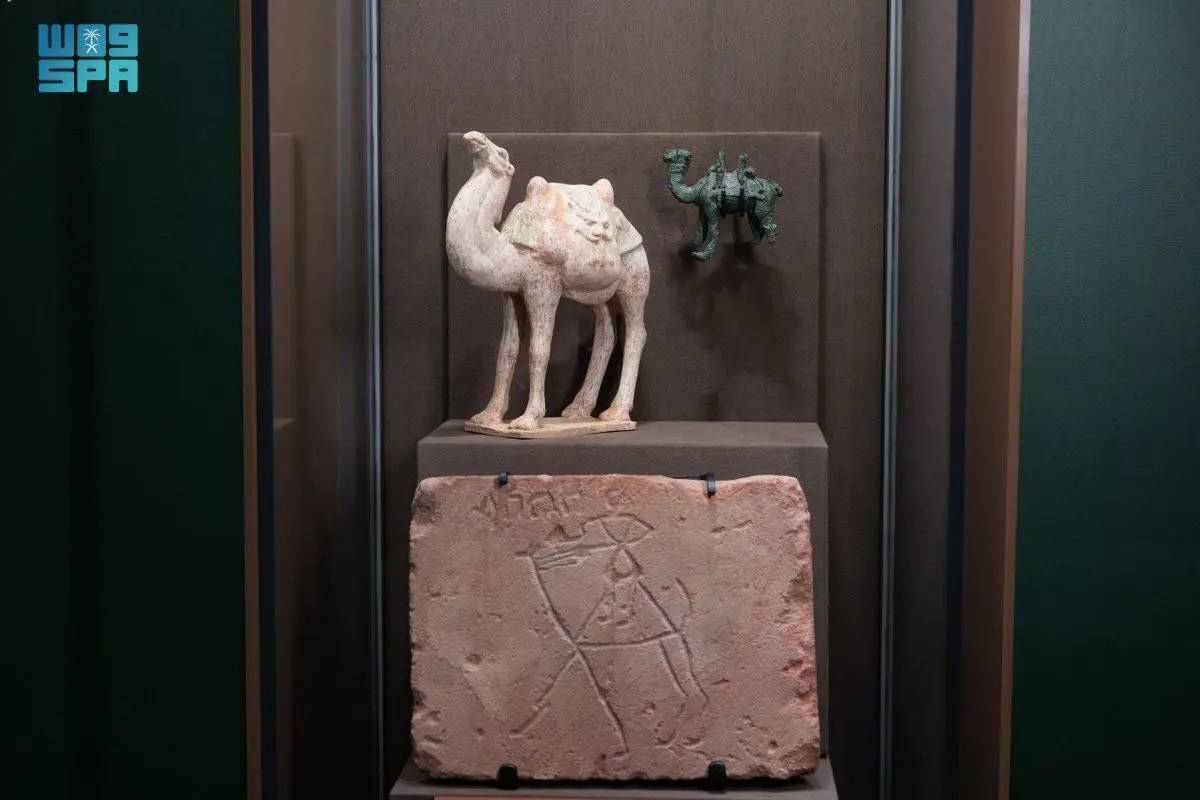
The exhibition features 30 artifacts from the Royal Commission for AlUla’s collection, half of which are on public display for the first time. Among the highlights is a massive sandstone sculpture of a Lihyanite ruler in Dadan, dating back to between the fifth and third centuries BC.
The exhibition reflects the historical ties linking China and the Arabian Peninsula since the first millennium BC. (SPA)

Visitors will see human remains left by pilgrims at Umm Daraj and Jabal Dadan, as well as a rare silk piece over 2,000 years old, discovered in a Nabataean burial site. AlUla’s collection is complemented by 10 Chinese artifacts, including camel models, incense burners, cosmetics, and engraved items, underscoring shared artistic traditions and values between the two civilizations.

The exhibition reflects the historical ties linking China and the Arabian Peninsula since the first millennium BC. Both regions witnessed the rise of writing systems, long-distance trade, and early economies. The Nabataeans, along with the Qin and Han dynasties, played a pivotal role in early Eurasian connectivity, laying foundations for the Silk Road.

Chinese interest in AlUla was underscored last year through the exhibition “AlUla, Wonder of Arabia” at the Palace Museum in Beijing, which drew more than 200,000 visitors and was extended for an additional week due to high demand. Travel to AlUla has since become easier for Chinese visitors, with Mandarin-speaking guides, signage, multimedia guides at heritage sites, and a free copy of “AlUla: a Rich History” fully translated into Mandarin.


Saudi Arabia, Syria Underline Depth of their Cultural Ties

Syrian President al-Sharaa receives the Saudi minister of culture and the accompanying delegation at the Conference Palace in Damascus on Thursday. (SPA)
TT

Saudi Arabia, Syria Underline Depth of their Cultural Ties

Syrian President al-Sharaa receives the Saudi minister of culture and the accompanying delegation at the Conference Palace in Damascus on Thursday. (SPA)

Saudi Arabia and Syria underlined the strength of their cultural relationship during high-level meetings held in Damascus on Thursday, on the sidelines of the opening of the Damascus International Book Fair 2026, where the Kingdom is participating as guest of honor.

Syrian President Ahmad al-Sharaa received Saudi Minister of Culture Prince Badr bin Abdullah bin Farhan at the Conference Palace in the capital.

Earlier the same day, Prince Badr met with his Syrian counterpart, Minister of Culture Mohammad Yassin Saleh, during an official visit to attend the fair. T

he Saudi minister congratulated Syria on hosting the exhibition and expressed his wishes for continued prosperity, progress, and stability for the Syrian government and people.

Both meetings highlighted the depth of cultural relations between the two countries, the importance of expanding joint cultural cooperation across various fields, and the alignment of positions on issues of mutual interest in a way that serves both nations.

The Saudi delegation included senior officials and advisers, among them representatives from the Royal Court, the Ministry of Culture, and the King Abdulaziz Public Library, reflecting broad institutional engagement in the visit.

In the evening, Prince Badr attended the opening ceremony of the fair’s special session, held under the patronage and in the presence of al-Sharaa. The event drew wide official and cultural participation, including Arab ministers, political and intellectual figures, and a distinguished group of writers and cultural figures.

In a post on the X platform, Prince Badr thanked “our brothers in Syria for their generous hospitality and their efforts in organizing the Damascus International Book Fair.”

The minister also inaugurated the Kingdom’s pavilion at the fair in the presence of the Syrian minister of culture and the Qatari minister of culture.

Saudi Arabia’s guest-of-honor participation continues until Feb. 16 and reflects its growing prominence and leadership in the Arab and global cultural landscape.

This participation aligns with Saudi Vision 2030, which places culture at the heart of national development, viewing it as a space for dialogue, a bridge for civilizational communication, and a tool for strengthening ties among Arab peoples.

The Saudi Literature, Publishing and Translation Commission is leading the Kingdom’s participation, highlighting the development of the cultural sector and reaffirming the central role of books as carriers of knowledge and awareness.

The Saudi pavilion boasts a comprehensive cultural program featuring intellectual seminars, poetry evenings, a manuscript exhibition, traditional Saudi fashion displays, hospitality corners, archaeological replicas, and performing arts that express the depth of the Kingdom’s cultural heritage.

On the sidelines of the visit, Prince Badr, accompanied by Minister Saleh, toured the National Museum of Damascus, which houses rare artifacts spanning prehistoric eras, ancient Syrian civilizations, classical and Islamic periods, as well as traditional and modern art.


UNESCO Honors Al-Bisht Al-Hasawi as Thousands Flock to Al-Ahsa Festival

Visitors can explore interactive displays, participate in live workshops, and witness the meticulous process of tailoring this iconic symbol of prestige - SPA
TT

UNESCO Honors Al-Bisht Al-Hasawi as Thousands Flock to Al-Ahsa Festival

Visitors can explore interactive displays, participate in live workshops, and witness the meticulous process of tailoring this iconic symbol of prestige - SPA

The third edition of Al-Bisht Al-Hasawi Festival is drawing thousands of regional and international visitors to Ibrahim Palace in historic Al-Hofuf.

Organized by the Heritage Commission, this year’s festival celebrates the inscription of the Bisht on UNESCO’s Representative List of the Intangible Cultural Heritage of Humanity.

The event showcases Al-Ahsa’s centuries-old tradition of hand-weaving and gold embroidery, a craft passed down through generations of local families, SPA reported.

Visitors can explore interactive displays, participate in live workshops, and witness the meticulous process of tailoring this iconic symbol of prestige.

With UNESCO's participation and representatives from six countries, the festival has evolved into a global platform for cultural dialogue, cementing the Bisht’s status as a world-class cultural treasure.


Saudi, Syrian Culture Ministers Tour National Museum of Damascus

The ministers observed the museum’s extensive collections spanning prehistoric eras to modern art. SPA
TT

Saudi, Syrian Culture Ministers Tour National Museum of Damascus

The ministers observed the museum’s extensive collections spanning prehistoric eras to modern art. SPA

Saudi Minister of Culture Prince Badr bin Abdullah bin Farhan and his Syrian counterpart, Mohammed Yassin Saleh, have toured the National Museum of Damascus during the Kingdom’s participation as guest of honor at the 2026 Damascus International Book Fair.

The ministers observed on Thursday the museum’s extensive collections spanning prehistoric eras to modern art.

A particular focus was placed on the Arab-Islamic wing, featuring significant artifacts from the Umayyad period.

The Kingdom's participation as guest of honor at the 2026 Damascus International Book Fair, which runs until February 16, stems from the role culture plays within Saudi Vision 2030.
