

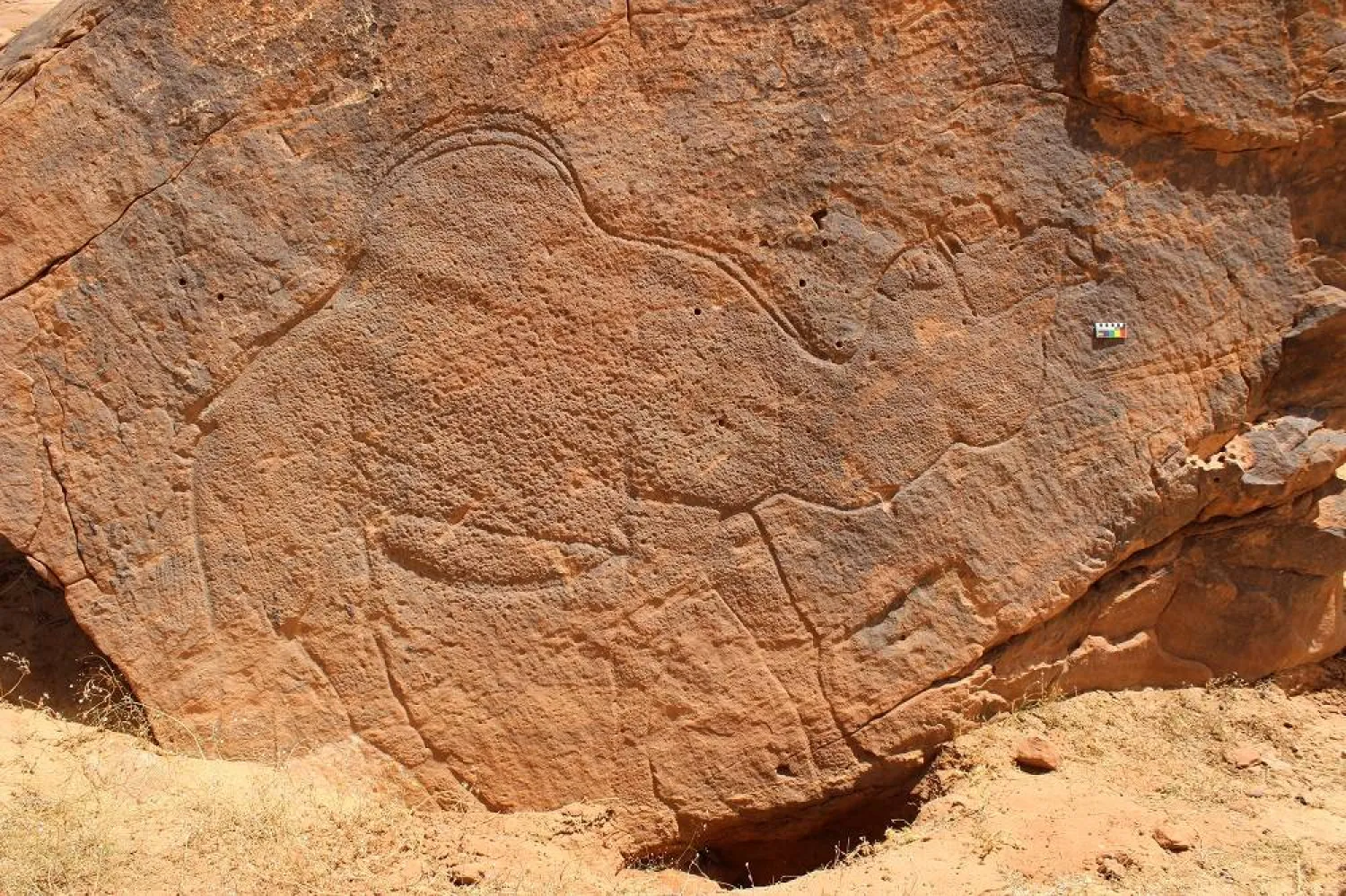

Early Rock Art Engravings Dating 12,000 Years Discovered in Saudi Arabia’s Al-Nafud Desert 

This image provided by Sahout Rock Art and Archaeology Project shows a life-size rock carving of a camel, in a desert in northern Saudi Arabia in 2023. (Maria Guagnin/Sahout Rock Art and Archaeology Project via AP)
TT

Early Rock Art Engravings Dating 12,000 Years Discovered in Saudi Arabia’s Al-Nafud Desert 

This image provided by Sahout Rock Art and Archaeology Project shows a life-size rock carving of a camel, in a desert in northern Saudi Arabia in 2023. (Maria Guagnin/Sahout Rock Art and Archaeology Project via AP)

Saudi Arabia’s Heritage Commission announced on Tuesday the discovery and documentation of an exceptional group of life-size early rock art engravings, estimated to date back between 11,400 and 12,800 years.

The findings, published in Nature Communications, were identified at sites south of Al-Nafud Al-Kabir desert in the Hail Region. The work was carried out under the "Green Arabia Project," in collaboration with an international research team from several local and global universities and research centers.

The discovery represents the earliest scientifically dated phase of rock art in Saudi Arabia.

About 12,000 years ago, hunter-gatherers who inhabited a swathe of Arabian desert carved life-sized images of camels and other animals on sandstone cliffs and boulders, using rock art to mark the location of water sources in an illustration of how ancient people tackled some of Earth's most inhospitable environs.

Researchers said the monumental rock art was found south of the Al-Nafud Desert of northern Saudi Arabia at locales spanning a distance of about 20 miles (30 km) in mountainous terrain.

About 60 rock art panels bear more than 130 images of animals - primarily camels, but also ibex, gazelles, wild donkeys and an aurochs, a bovine thought to be the wild ancestor of modern domestic cattle. Some of the camel engravings were more than 7 feet (2 meters) tall and 8-1/2 feet (2.6 meters) long.

While many of the images were situated on boulders within easy reach of the ground, some were crafted on towering cliffs including one that was about 128 feet (39 meters) off the ground and was engraved with 19 camels and three donkeys.

"The engravers would have had to stand on a ledge directly in front of the cliff," said archaeologist and rock art researcher Maria Guagnin of the University of Sydney and the Max Planck Institute of Geoanthropology in Germany, lead author of the study.

"It would have been extremely dangerous to make these engravings as the ledge is very narrow and slopes downwards. Standing on this ledge, the engravers would also not have been able to see the whole image they were creating. But they had the skill to still produce a naturalistic representation," Guagnin added.

The researchers said the rock art marked the location of transient water sources on the harsh desert landscape.

"These ancient communities survived in the desert by moving between seasonal lakes, and they marked these water sources, and the paths leading to them, with monumental rock art," Guagnin said.

The researchers used a technique called luminescence dating on simple stone tools they discovered that were used to make the rock art in order to determine that the engravings were made between 12,800 and 11,400 years ago.

"The findings show that communities were able to become fully established in desert environments much earlier than previously thought," Guagnin said. "They must have known the landscape incredibly well."

"Most of the camels show male camels in rut, identifiable by the straining neck muscles as they make a rumbling noise during the mating season, which is normally during the wet season. So the rock art links to the rainy season and marks locations where water pools," Guagnin added.

There also is evidence that these people added to the rock art for two to three millennia, Guagnin said.

The researchers do not know if the art originally was colorfully decorated with paint.

"The engravings are exposed to the elements, and if they were once painted the pigment would have washed off long ago," Guagnin said.

During the height of the last Ice Age some 20,000 to 25,000 years ago, Arabia was so arid that there was no known human habitation. But about 15,000 years ago a period of higher rainfall began, forming some wetlands and ponds in a desert environment that was getting a bit greener. The rock art reveals the timing of the hunter-gatherers who subsequently inhabited the region, the researchers said.

"This story resonates today in that these people show remarkable abilities to expand, cope and survive in marginal landscapes," said anthropologist and study co-author Michael Petraglia, director of the Australian Research Center for Human Evolution at Griffith University.

Some artifacts recovered in the excavations resemble those found in the broader region, suggesting a degree of interaction between these hunter-gatherers and other peoples. But the monumental rock art is unlike anything else known in the broader region.

"These communities had contact with neighboring groups in the Levant over 400 km (250 miles) away, but they also had their own identity," Guagnin said. "They clearly marked water sources with rock art, but we can't be sure if that marks access rights, or perhaps also expresses a wish for the water to return in the next season. Perhaps there were multiple reasons. From the sheer effort that was required, we can tell this rock art was very important to them."


Louvre Workers Vote to Strike in Another Blow to the Paris Museum 

This photograph shows a banner which reads "Louvre Museum on Strike" outside the entrance to the Louvre as museum workers voted to go on strike against increasingly deteriorating working conditions and the declining visitor experience at the world famous museum, in Paris on December 15, 2025. (AFP)
TT

Louvre Workers Vote to Strike in Another Blow to the Paris Museum 

This photograph shows a banner which reads "Louvre Museum on Strike" outside the entrance to the Louvre as museum workers voted to go on strike against increasingly deteriorating working conditions and the declining visitor experience at the world famous museum, in Paris on December 15, 2025. (AFP)

Workers at the Louvre Museum voted Monday to strike over working conditions and other complaints, dealing another blow to the Paris landmark and home of the Mona Lisa after an embarrassing jewelry heist in October.

The CFDT union said the vote was taken at a meeting of 400 workers on Monday morning and that they decided to strike for the day.

The world’s most-visited museum didn’t open as scheduled and turned people away. A notice on the Louvre's website said, “the museum is closed for the moment.”

“It's really sad, because I was really looking forward to this,” said Lindsey Hall, a bitterly disappointed would-be visitor from Sacramento, California. She had been planning to enjoy the museum's huge collection of art and artifacts with a friend, describing it as “one of those life experiences you crave.”

“This is just an epic collection of art and something that every human should see,” she said. “I can see the other side of it, like if you are the person that works in the museum and how that can be, like day after day after day.”

The strike vote followed talks last week between labor unions and government officials, including Culture Minister Rachida Dati. Labor leaders said the talks had not alleviated all of their concerns about staffing and financing for the museum that welcomes millions of visitors each year.

“Visiting the museum has become an obstacle course,” said Alexis Fritche, general secretary of the culture wing of the CFDT union.

For employees, the daylight jewel heist crystallized long-standing concerns that crowding and thin staffing are undermining security and working conditions at the Louvre.

Thieves used a basket lift to reach the Louvre’s facade, forced a window, smashed display cases and fled with pieces of the French crown jewels. A Senate inquiry released last week said the thieves escaped with barely 30 seconds to spare and pointed fingers of blame at broken cameras, outdated equipment, understaffed control rooms and poor coordination that initially sent police to the wrong location.

In a statement, the CFDT said employees wants more staffing for security and to welcome visitors, improved working conditions, stable long-term budgets for the Louvre and leadership that “truly listens to staff.”

Yvan Navarro of the CGT union complained that staff numbers have continually decreased while visitor numbers have increased.

“People come to Paris to visit the museums. So the visitor numbers go up, the tariffs and the prices go up, because everything is becoming more expensive, but the salaries and the numbers of staffers don't go up so obviously you reach a point like today, a day of anger,” he said.


Saudi Media Ministry Launches Sudanese Culture Week as Part of 'Global Harmony 2' Initiative 

The event is part of a series of cultural activities showcasing 14 global cultures, held at Al-Suwaidi Park, one of the Riyadh Season venues. (SPA)
TT

Saudi Media Ministry Launches Sudanese Culture Week as Part of 'Global Harmony 2' Initiative 

The event is part of a series of cultural activities showcasing 14 global cultures, held at Al-Suwaidi Park, one of the Riyadh Season venues. (SPA)

Saudi Arabia’s Ministry of Media launched on Sunday the Sudanese Culture Week as part of the "Global Harmony 2" initiative, organized in cooperation with the General Entertainment Authority (GEA) and the Quality of Life Program.

The event is part of a series of cultural activities showcasing 14 global cultures, held at Al-Suwaidi Park, one of the Riyadh Season venues.

The events began with a celebratory parade showcasing elements of Sudanese culture, featuring performances of traditional music, including the rhythms of the Dalooka and melodies of the Rababa, alongside scenes from a Sudanese bridal procession.

Sudanese Culture Week includes a diverse program of musical concerts, entertainment segments, and cultural pavilions, with participation from a selection of Sudanese singers and influencers presenting activities that reflect the cultural diversity of Sudan’s regions and communities.

The event stage hosted the first musical concerts, attended by thousands of visitors, who engaged with Rababa performances by traditional artists and popular social occasion songs from Sudan.

Sudanese Culture Week marks the final week of events under the Global Harmony 2 initiative, building on the program's success in promoting cultural exchange in the Kingdom, reflecting the values of coexistence and cultural openness embraced by the Kingdom.

The events will continue on Monday with a program featuring a variety of cultural and musical performances.


Saudi Heritage Commission Wins 2025 New York Product Design Award

Saudi Heritage Commission Wins 2025 New York Product Design Award
TT

Saudi Heritage Commission Wins 2025 New York Product Design Award

Saudi Heritage Commission Wins 2025 New York Product Design Award

Saudi Arabia's Heritage Commission achieved a new international milestone after winning the Silver Category at the 2025 New York Product Design Awards for its creative work, Al-Qaayed Craft Mural, one of the most prominent products of the Artisans House in Jazan Region.

This recognition coincides with the Year of Handicrafts 2025, launched by the Kingdom to strengthen the presence of traditional crafts and highlight their cultural and economic value. The award reflects the commission’s ability to present Saudi handicrafts in contemporary forms that keep pace with innovation while showcasing the richness of national identity, SPA reported.

With this achievement, the Heritage Commission has raised its total award count this year to six, including five international honors and one regional distinction, bringing its overall accolades since establishment to 13 across the fields of heritage, handicrafts, and design.

The commission emphasized that this international recognition embodies its ongoing commitment to preserving and developing handicrafts within the framework of the Year of Handicrafts 2025.

It also highlights the integration of efforts by its specialized teams and its effective local and international partnerships to support male and female artisans and enable their products to reach global creative platforms, in line with the objectives of Saudi Vision 2030.
