


Israel Intercepts Last Gaza Flotilla Boat, Begins Deportations 

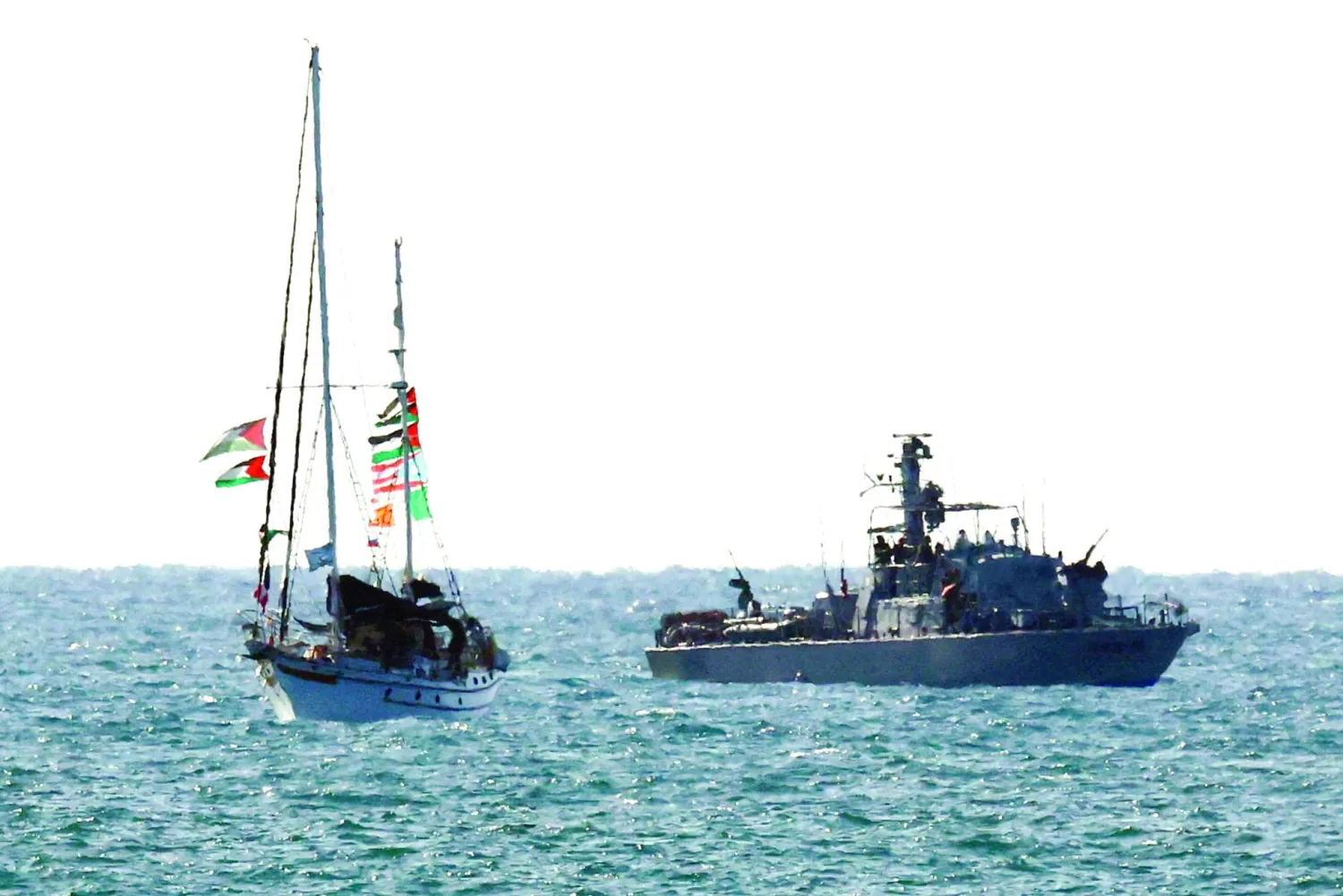
An Israeli navy vessel escorts a vessel from the Global Sumud Flotilla to Ashdod Port, after Israel intercepted some of the vessels of the Flotilla aiming to reach Gaza and break Israel's naval blockade, in southern Israel, October 2, 2025. REUTERS/Ammar Awad
TT

Israel Intercepts Last Gaza Flotilla Boat, Begins Deportations 

An Israeli navy vessel escorts a vessel from the Global Sumud Flotilla to Ashdod Port, after Israel intercepted some of the vessels of the Flotilla aiming to reach Gaza and break Israel's naval blockade, in southern Israel, October 2, 2025. REUTERS/Ammar Awad

The Israeli military intercepted the last boat in an aid flotilla attempting to reach blockaded Gaza on Friday, a day after stopping most of the vessels and detaining some 450 activists including Swedish campaigner Greta Thunberg. 

The organizers of the Global Sumud Flotilla said the Marinette was intercepted some 42.5 nautical miles (79 km) from Gaza. Israeli army radio said the navy had taken control of the last ship in the flotilla, detained those aboard and that the vessel was being led to Ashdod port in Israel. 

In a statement, the Global Sumud Flotilla said Israeli naval forces had now "illegally intercepted all 42 of our vessels, each carrying humanitarian aid, volunteers, and the determination to break Israel’s illegal siege on Gaza". 

MARINETTE PASSENGERS CLAIM TO SEE A WARSHIP 

A camera broadcasting from the Marinette showed someone holding up a note saying "We see a ship! It's a warship", before a boat is seen approaching and soldiers boarding. A voice is heard telling the people on board not to move and to put their hands in the air. 

An Israeli foreign ministry spokesperson did not immediately respond to a request for comment about the boat's status.  

The ministry said on Thursday the flotilla's one remaining vessel would be prevented from breaching the blockade if it tried to. 

The flotilla, which set sail in late August, marked the latest attempt by activists to challenge Israel's naval blockade of the enclave, almost two years into Israel's siege of Gaza which was sparked by the Hamas group’s October 7 attacks.  

Israeli officials have repeatedly denounced the mission as a stunt. The foreign ministry had said the flotilla was previously warned that it was approaching an active combat zone and violating a "lawful naval blockade", and asked organizers to change course. It had offered to transfer aid to Gaza. 

The Israeli foreign ministry on Friday said that four Italians had been deported.  

"The rest are in the process of being deported. Israel is keen to end this procedure as quickly as possible," it said in a statement. All the flotilla participants were "safe and in good health", it added. 

Pro-Palestinian demonstrators took to the streets in cities across Europe as well as in Karachi, Buenos Aires and Mexico City on Thursday to protest the flotilla's interception. 

On Friday, tens of thousands of Italians demonstrated, as part of a day-long general strike called by unions in support of the flotilla. 

BEN-GVIR CALLS ACTIVISTS 'TERRORISTS' 

During a visit to Ashdod on Thursday night, Israel's far-right National Security Minister Itamar Ben-Gvir was filmed calling the activists "terrorists" as he stood in front of them.  

"These are the terrorists of the flotilla," he said, speaking in Hebrew and pointing at dozens of people sitting on the ground. His spokesperson confirmed the video was filmed at Ashdod port on Thursday night. 

Some activists are heard shouting "Free Palestine". 

Cyprus said one of the flotilla boats had docked in Cyprus with 21 foreigners aboard. The vessel had asked to dock in Larnaca for refueling and humanitarian reasons, a Cypriot government spokesperson said. 

The spokesperson did not identify the boat, or say whether it had been among those stopped by the Israeli military. 

Israel has faced widespread global condemnation over the war in Gaza, and is defending itself against charges of genocide in the International Court of Justice. 

Israel says its actions have been in self-defense and has consistently denied genocide allegations. Israel's offensive has killed over 66,000 people, Palestinian health authorities say. It began after Hamas-led fighters attacked Israel on October 7, 2023. About 1,200 people were killed during the assault, and 251 were taken hostage, according to Israeli figures. 

Israel has accepted a new US proposal announced this week to end the war that demands Hamas surrender. US President Donald Trump, who said he would temporarily oversee governance of Gaza under the plan, has given Hamas a few days to respond, and warned Hamas that Israel would continue its siege of Gaza if the group refused. 


Iranians Celebrate Nowruz in Iraq’s Kurdistan Despite War

Kurds march with torches during a procession to celebrate the Nowruz New Year festival in the town of Akre in Iraq's northern autonomous Kurdish region (dpa) 
TT

Iranians Celebrate Nowruz in Iraq’s Kurdistan Despite War

Kurds march with torches during a procession to celebrate the Nowruz New Year festival in the town of Akre in Iraq's northern autonomous Kurdish region (dpa) 

In Iraq's northern Kurdistan region, women perform a traditional dance, their long dresses spinning, gold tassels and heavy necklaces catching the firelight, as smaller crowds than usual celebrate Nowruz, overshadowed by the Middle East conflict.

Among them were Iranian Kurds Sirwa Mustafazada and Kwestan Aminpana, who fled their home country as a result of their activism in 2018.

After three weeks of war, they share the same yearning: “Next year we will be back.”

Mustafazada, 32, who fled the city of Mahabad in western Iran, said, “We have lived all this time with this hope.”

Falling on the equinox in March, Nowruz -- the Persian New Year also celebrated by Kurdish communities in Iraq, Syria, Türkiye and Iran -- is typically marked by weeks of anticipation ahead of joyful family feasts and celebrations, according to AFP.

But this year the war, launched by Israel and the US on Iran on February 28, has cast a pall over the ancient festivities.

Security concerns muted celebrations across the autonomous Kurdistan region in Iraq, but crowds still gathered and small bonfires were lit in regional capital Erbil, as well as Sulaimaniyah and Akreh city.

In Sulaimaniyah, the region's second city, the crowd momentarily started when fireworks erupted -- recently, similar blasts have signaled drone strikes.

Attacks attributed to Iran and its proxies have repeatedly targeted armed groups of the Iranian Kurdish opposition, organizations long exiled in Iraq.

“The regime is doing everything it can to save its own skin,” said Mustafazada. “But it has no outside support, and nobody wants it anymore inside.”

Nowruz, long frowned upon by hardliners in Iran, is especially contentious this year.

It falls within the 40-day mourning period after the death of Iran's supreme leader Ali Khamenei, killed on the first day of the war.

Both women accuse the Iranian authorities of attempting to ban the celebration in the past.

But 33-year-old Aminpana said with a grin: “They'll push even harder, and we, in Kurdistan, will push back even more.”

“Nowruz is a symbol of rebirth, resilience, connection with nature, and joy,” said Saad Qazi, a former Kurdish fighter, also from Mahabad.

“It's important to preserve our traditions and our identity, to be able to answer our children when they ask us, 'Who are we?'”

On a coffee table in his living room in Erbil, the traditional seven ingredients of "Haft-Sin" are laid out, the candle burning bright.

Qazi's wife, Parang Jahani, has carefully arranged each item -- all of which begin with “S” in Farsi -- in small bowls: wheat germ, sweet pudding, jujube berries, sumac, garlic, vinegar and apple.

They will remain there for the 13 days of the festival, a promise of strength, vitality, health, and beauty.

And, again, yearning: “Next year, maybe, we'll be back. In any case, we have more hope than last year.”


Fighting in South Lebanon Reaches Close Combat Stage

Israeli tanks are deployed along the northern Israeli border with Lebanon, 21 March 2026. EPA/ATEF SAFADI
TT

Fighting in South Lebanon Reaches Close Combat Stage

Israeli tanks are deployed along the northern Israeli border with Lebanon, 21 March 2026. EPA/ATEF SAFADI

Israeli advances in the border town of Khiam and the coastal village of Naqoura triggered fierce clashes with Hezbollah, which said its fighters battled Israeli forces for four hours in central Khiam, as sustained Israeli shelling pounded the surrounding areas and one-way attack drones entered the fight.

The Israeli push toward the outskirts of Bint Jbeil and the Litani River from the Maroun al-Ras and Taybeh axes slowed, with fighting shifting to Khiam, where Israeli forces are seeking full control after advancing on the western axis facing the Marjayoun plain, the third stage of an offensive toward northern Khiam.

The battle for Khiam

Battlefield sources in Marjayoun told Asharq Al-Awsat that fighting erupted with light and medium machine guns, in one of the rare instances in which such intense clashes have been heard so clearly in the area. Explosions were followed by thick smoke rising over central and western Khiam.

Clashes focused on the Jallahiya neighborhood, one of the last high ground positions in northwestern Khiam and a key link between the city’s center and its eastern and western sectors. Israeli tanks had reached the area days earlier before withdrawing, in what observers described as a probing move to test Hezbollah’s defenses.

The latest incursion followed four days of airstrikes targeting northern and eastern neighborhoods, alongside relentless artillery fire, paving the way for the advance.

Hezbollah said its fighters engaged Israeli forces at close range in Khiam using light and medium weapons and rocket-propelled grenades, with clashes lasting four hours. The group’s media described the fighting as direct contact with enemy forces. It also said the heaviest battles took place in Jallahiya and the city’s eastern quarter.

Rocket fire was reported to target Israeli troop concentrations near the Khiam detention center and the eastern quarter, as well as strikes on the Hadabat al-Ajl site north of Kfar Yuval and two other gatherings in Metula.

A powerful Israeli blast later shook Khiam, shattering shop windows in the nearby town of Qlayaa.

The battle for Naqoura

On the Naqoura coastal axis in southwestern Lebanon, clashes broke out for the first time since the war began on March 2, as Israeli forces advanced from two directions.

One push came from the seafront, an area local sources described as militarily exposed. The other came from the east, expanding from the Labouneh heights and the outskirts of Alma al-Shaab, which Israel pressed Lebanon to fully evacuate last week.

Sources said the advance was relatively easy due to the area’s uninhabited nature, extensive destruction from previous fighting, and subsequent clearing operations by the Lebanese army and UN peacekeepers under the mechanism.

A large stretch between the sea and Alma al-Shaab now functions as a security zone, hosting the main headquarters of the UN peacekeeping force.

They said the first line of defense has shifted to populated parts of Naqoura, where fighting erupted on Saturday. While Israel’s military has not announced operations there, Hezbollah media said its fighters were confronting Israeli attempts to advance toward the town.

Local media reported clashes on Naqoura’s outskirts from the directions of Alma al-Shaab and Labouneh.

Hezbollah said it targeted Israeli soldiers east of Naqoura with rocket barrages and artillery, and that its fighters clashed with a force attempting to infiltrate from the Tabbasin area toward the municipal building using light and medium weapons.

Sustained bombardment

Israeli strikes hit Beirut’s southern suburbs before dawn on Saturday after a two-day lull, following a broad evacuation warning. Two buildings were targeted in Burj al-Barajneh and Ghobeiry.

Israeli bombardment continued across southern Lebanon, hitting the outskirts of Ghandooriyeh, Tayri, Bint Jbeil, Deir Seryan, Mansouri, Jabal al-Rayhan, Shaaitiyeh, areas between Bazouriyeh and Burj al-Shamali, and Haniyeh and Hamoul east of Naqoura. A house in Zawtar al-Sharqiya was also destroyed.

Artillery fire struck Naqoura, Hamoul, Khiam, Taybeh, Markaba, Houla, Shaqra, Burj Qalaouiyeh, Ghandooriyeh, and the Qleileh plain south of Tyre.

Before dawn, Israeli warplanes carried out a heavy strike on a house in Kafra in the Bint Jbeil district, Lebanon’s state news agency said.


Israeli Provocations Aim to Draw Damascus into Regional Escalation

Israeli soldiers operate in the occupied Golan Heights near the Syrian border, Dec. 28, 2023 (Reuters)
TT

Israeli Provocations Aim to Draw Damascus into Regional Escalation

Israeli soldiers operate in the occupied Golan Heights near the Syrian border, Dec. 28, 2023 (Reuters)

Damascus is treading carefully to avoid being pulled into the region’s escalating tensions, but Syrian-Israeli friction has resurfaced after Israel struck Syrian army sites and military infrastructure, claiming it was acting to “protect Druze citizens in Sweida.”

The attacks drew condemnations from Saudi Arabia and other Arab and Muslim states.

Sources close to the Syrian Defense Ministry told Asharq Al-Awsat that Israel is seeking to provoke Syria and drag it into war by stoking tensions in Sweida, which has seen a string of recent security incidents.

Syrian authorities said they had foiled an attempt to smuggle weapons and ammunition intended for hostile acts.

Israel carried out a series of strikes on Friday targeting Syrian army positions and infrastructure in southern Syria.

Syria TV, citing local sources, said one strike hit the former Transport Battalion site, now used as the finance headquarters of the 40th Division, opposite Brigade 12 in the city. The attack caused material damage.

Israeli Defense Minister Israel Katz threatened to hit Syria with greater force if necessary, saying he and Prime Minister Benjamin Netanyahu had instructed the military to strike Syrian government sites.

The Israeli military said it struck Syrian army weapons depots overnight and would not allow harm to come to the Druze in Syria, adding it would continue to act to protect them.

Syria’s Foreign Ministry condemned the strikes, calling them a new aggression based on flimsy pretexts and fabricated justifications, and a continuation of Israel’s escalation policy.

Saudi Arabia, in a Foreign Ministry statement, condemned “the blatant Israeli attack” on military infrastructure in southern Syria as a “flagrant violation of international law,” and urged the international community to act.

Egypt, Jordan, Qatar, Kuwait and the Gulf Cooperation Council also condemned the raids, stressing Syria’s sovereignty and calling for an end to such attacks.

Türkiye described the strikes as a “dangerous escalation” that must be stopped, urging adherence to the 1974 disengagement agreement, which established a ceasefire and separation of forces in the Golan under UN supervision.

The Arab League said the attack fits within “Israeli plans to destabilize Syria” and undermine regional peace and security.

Arab League Secretary-General Ahmed Aboul Gheit said the strikes were not only a “blatant violation” of Syria’s sovereignty but also aimed at dragging the region into broader confrontation.

He urged the UN Security Council to act to halt repeated attacks on Syrian territory and ensure respect for international law.

Unrest in Sweida

Sources close to the Syrian Defense Ministry said Israel is working to widen the regional war and pull Syria into it, pointing to what they described as a parallel disinformation campaign about an Israeli ground advance and false reports of rockets launched from Syrian territory toward the occupied Golan.

They said Syria remains intent on avoiding conflict unless required to ward off a greater danger, and that any such move would come under Arab and international political cover.

President Ahmed al-Sharaa said after Eid al-Fitr prayers on Friday that “what is happening now is a major event, rare in history,” adding that Syria is acting with precision to avoid being drawn into conflict.

Sweida province has seen mounting security tensions in recent days. Local media said Syrian internal security forces foiled an infiltration attempt by members of the National Guard in western Sweida, triggering clashes that killed four and led to the arrest of seven others.

The National Guard, formed in Sweida in August 2025, is a coalition of local armed factions under Sheikh Hikmat al-Hijri, opposed to the Syrian authorities that overthrew Bashar al-Assad.

In a statement on Friday, Syria’s Interior Ministry said special units carried out a “precise security operation” in Sweida, thwarting an attempt to smuggle weapons and ammunition for “hostile acts” by outlaw groups on the Bosra al-Sham-Bakka road.

The ministry said the operation followed the detection of infiltrators near internal security checkpoints and suspicious movements of hostile vehicles, as part of a “criminal plot” to undermine stability.

Clashes killed four members of the group, two were arrested, and weapons and ammunition were seized. The ministry said the operation is part of ongoing efforts to pursue “outlaw gangs” and reinforce security across the province.
