

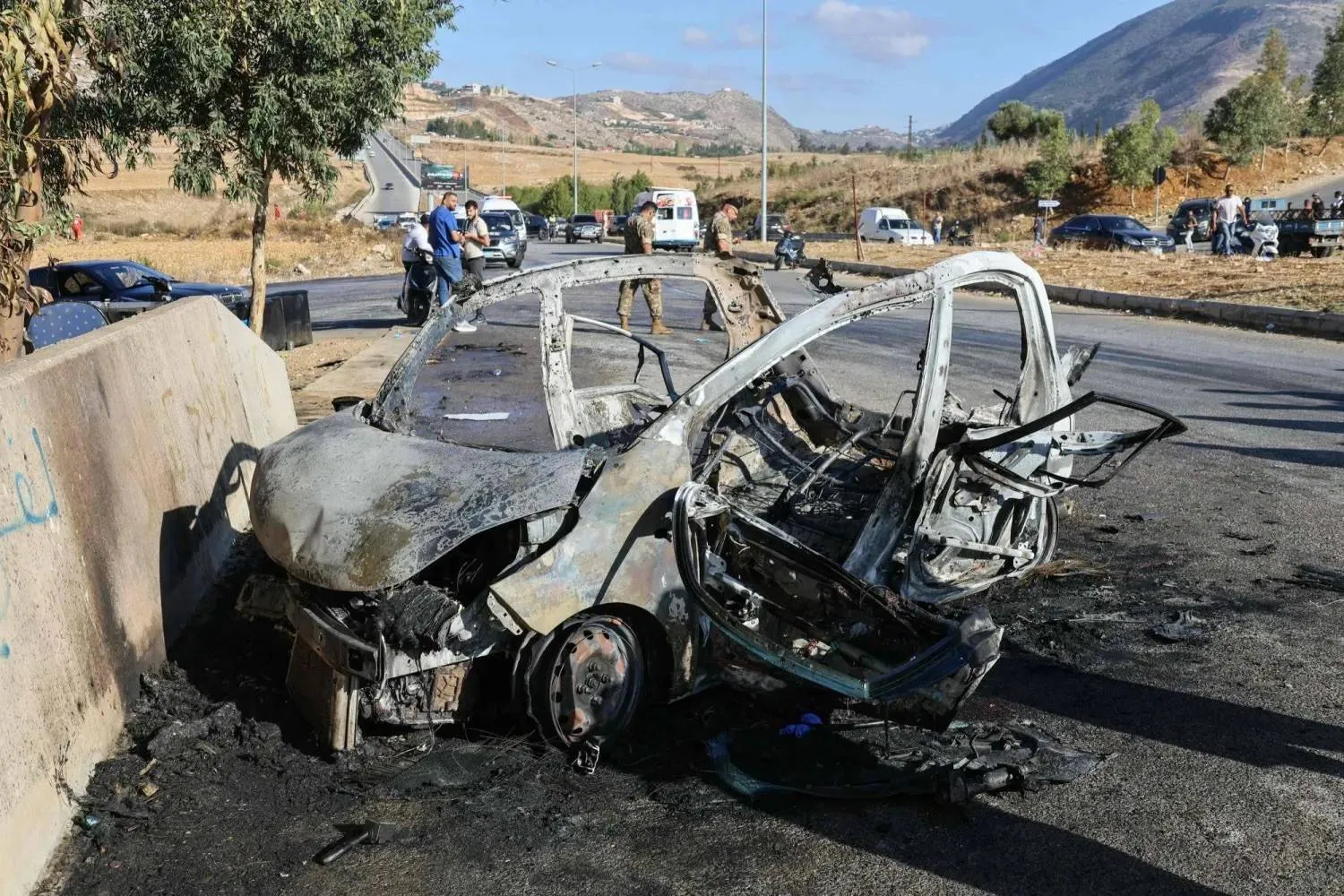

Israel Shifts Strikes from Hezbollah’s Military Infrastructure to Party’s Institutions

The vehicle targeted by an Israeli airstrike on the Jarmaq–Khardali road in southern Lebanon (AFP).
TT

Israel Shifts Strikes from Hezbollah’s Military Infrastructure to Party’s Institutions

The vehicle targeted by an Israeli airstrike on the Jarmaq–Khardali road in southern Lebanon (AFP).

An Israeli airstrike on Thursday targeting a civilian vehicle on the Jarmaq–Khardali road in southern Lebanon has marked a new escalation in the conflict.

The attack killed two engineers, Ahmad Saad and Mustafa Rizk, both from the town of Kfar Rumman, and signaled what observers see as a shift in Israel’s strategy: from striking Hezbollah’s military infrastructure to hitting civilian institutions tied to the group.

According to Lebanon’s National News Agency (NNA), the engineers were on assignment assessing damage from previous strikes for the construction company Meamar when their vehicle was struck.

The Lebanese Ministry of Health confirmed one other person was injured. Following the strike, Israeli aircraft conducted heavy overflights across several southern towns, including Arnoun, Kfar Tibnit, Nabatieh al-Fawqa, and Jarmaq.

In parallel, Israeli drones carried out a show of force across border areas. They dropped sound bombs on the towns of Kfarkila, Markaba, and Maroun al-Ras, also targeting bulldozers near the latter’s public park.

Local sources described these tactics as part of a psychological campaign to keep southern Lebanon under constant pressure, blending real airstrikes with repeated harassment.

Military analyst Brig. Gen. (ret.) Hassan Jouni said the targeting of the engineers marked “a shift in Israel’s objectives.” He explained: “In previous cases, Israel justified its actions by claiming to hit military officials. This time, the victims were engineers engaged in reconstruction work, showing a clear intent to attack the logistical and civilian networks connected to Hezbollah.”

The choice of location was also deliberate, Jouni argued. The strike occurred near the Khardali Bridge, a symbolic and strategic point between north and south of the Litani River. “It was not random. Israel wanted to send a message that this territory remains under its rules of engagement,” he said.

Analysts believe Israel is signaling that reconstruction in southern Lebanon will not be tolerated without broader political agreements. With tensions mounting, Jouni warned that escalation is likely: “Israel appears committed to daily pressure on Hezbollah and Lebanon, and may intensify operations if a Gaza settlement allows it to refocus on the northern front.”

The attack has also reignited focus on Meamar, the company linked to Hezbollah and sanctioned by the US Treasury in 2020. Washington accused it of securing government contracts with political backing and funneling profits to Hezbollah’s executive council. Experts say the strike underscores a gradual Israeli approach to dismantle Hezbollah’s civilian and economic networks, complementing US financial sanctions.



Israel Orders Army to Prepare for 'Expanding' Lebanon Operations

A man stands by the rubble of a destroyed building in the aftermath of overnight Israeli airstrikes in the southern Lebanese coastal city of Tyre on March 12, 2026. (Photo by Kawnat HAJU / AFP)
TT

Israel Orders Army to Prepare for 'Expanding' Lebanon Operations

A man stands by the rubble of a destroyed building in the aftermath of overnight Israeli airstrikes in the southern Lebanese coastal city of Tyre on March 12, 2026. (Photo by Kawnat HAJU / AFP)

Israeli Defense Minister Israel Katz said Thursday that he had ordered the military to prepare for expanding operations in Lebanon after Hezbollah fired a heavy barrage of rockets ⁠at Israel overnight.

"The Prime Minister and I have instructed the IDF to prepare for expanding IDF operations in Lebanon and for restoring quiet and security to the northern communities," Katz was quoted as saying in a statement.

"I warned the President of Lebanon that if the Lebanese government does not know how to control the territory and prevent Hezbollah from threatening northern communities and firing toward Israel -- we will take the territory and do it ourselves," Katz said in a situation assessment, according to the statement from his ministry.


A man walks over blood stains, in the aftermath of an Israeli strike in Ramlet al-Bayda at Corniche Beirut, in Beirut, Lebanon, March 12, 2026. REUTERS/Claudia Greco


An Israeli strike hit a car Thursday in Ramlet al-Bayda, a major seaside tourist area of Beirut where dozens of displaced people have been sheltering. Eight people were killed and 31 others were wounded, the Lebanese Health Ministry said.

In Aramoun, a town about 10 kilometers south of Beirut, another three people were killed and a child was wounded in another early Israeli attack.

At least 634 people have been killed in Lebanon since the latest fighting began, the Health Ministry said.

Lebanon was drawn into the Middle East war last week when Hezbollah attacked Israel in response to the killing of Iranian supreme leader Ali Khamenei in US-Israeli strikes.

Hezbollah launched some 200 rockets at Israel’s north and deeper into the country overnight, the Israeli military says.

Many rockets were intercepted and no serious injuries were reported.


Strikes Kill Nine Iran-backed Fighters near Iraq-Syria Border

Fighters raise the "Hashed" logo during military exercises (Archival - Popular Mobilization Forces)
TT

Strikes Kill Nine Iran-backed Fighters near Iraq-Syria Border

Fighters raise the "Hashed" logo during military exercises (Archival - Popular Mobilization Forces)

Air strikes killed at least nine Iran-backed fighters in Iraq on Thursday near the Iraqi-Syrian border, two senior security officials told AFP.

Another 10 fighters were wounded in the strikes that targeted a base belonging to the US-blacklisted Harakat Ansar Allah al-Awfiya, the officials added on condition of anonymity, with one saying that the death toll could rise.

"The base was destroyed, and the rescue teams who arrived at the site were also targeted," one of the officials said.

He added that it remained unclear who was behind the attack. But the Iran-backed faction said in a statement that a "Zionist-American aggression" targeted their fighters, though it did not provide a death toll.

Iraq has long been a proxy battleground between the United States and Iran, with the country's successive governments struggling to balance relations between the two rivals.

After decades of conflicts, it had recently regained some stability, but it remains volatile with increasingly influential armed groups operating outside the state's control.

Iraq was immediately dragged into the Middle East war triggered when the United States and Israel attacked Iran on February 28.

The base that was hit on Thursday belongs to the Hashed al-Shaabi or the Popular Mobilization Forces (PMF), a former paramilitary group now integrated into the regular army.

The Hashed also encompasses brigades from Iran-backed groups, which have been repeatedly targeted in attacks blamed on the United States and Israel since the start of the war.

The contingent on the base is made up of members of Harakat Ansar Allah al-Awfiya.

Iraq's national security advisor Qassem al-Araji mourned in a post on X dozens "of martyrs and wounded" from the Hashed forces in what he described as a "terrorist attack".


Indonesia Minister Says Gaza Deployment Hinges on Board of Peace Dynamic

Indonesia's Defense Minister Sjafrie Sjamsoeddin speaks to journalists following his meeting with Australian Deputy Prime Minister and Minister for Defense Richard Marles in Jakarta, Indonesia, March 12, 2026. REUTERS/Willy Kurniawan     TPX IMAGES OF THE DAY
Indonesia's Defense Minister Sjafrie Sjamsoeddin speaks to journalists following his meeting with Australian Deputy Prime Minister and Minister for Defense Richard Marles in Jakarta, Indonesia, March 12, 2026. REUTERS/Willy Kurniawan TPX IMAGES OF THE DAY
TT

Indonesia Minister Says Gaza Deployment Hinges on Board of Peace Dynamic

Indonesia's Defense Minister Sjafrie Sjamsoeddin speaks to journalists following his meeting with Australian Deputy Prime Minister and Minister for Defense Richard Marles in Jakarta, Indonesia, March 12, 2026. REUTERS/Willy Kurniawan     TPX IMAGES OF THE DAY
Indonesia's Defense Minister Sjafrie Sjamsoeddin speaks to journalists following his meeting with Australian Deputy Prime Minister and Minister for Defense Richard Marles in Jakarta, Indonesia, March 12, 2026. REUTERS/Willy Kurniawan TPX IMAGES OF THE DAY

Indonesia's deployments for the international security force in Gaza would ‌depend ‌on ​the current ‌dynamic ⁠of ​the Board ⁠of Peace, its defense minister said on Thursday.

Sjafrie Sjamsoeddin ⁠told reporters ‌Indonesia ‌had ​been prepared ‌to send ‌20,000 troops for the force but was ‌now ready to deploy 8,000, introduced ⁠gradually, ⁠adding that other countries had pledged to send lower numbers.

The Board of Peace (BoP) is an international organization established by US President Donald Trump, chaired by him for life, and formally instituted in January 2026. Its primary purpose is to oversee the implementation of the Gaza peace plan, including managing ceasefire processes, coordinating reconstruction, mobilizing international resources, ensuring accountability, and facilitating the transition of Gaza from conflict to stability.
