


Israeli Bombing of Gaza City Has ‘Significantly Subsided,’ Hospital Official Says

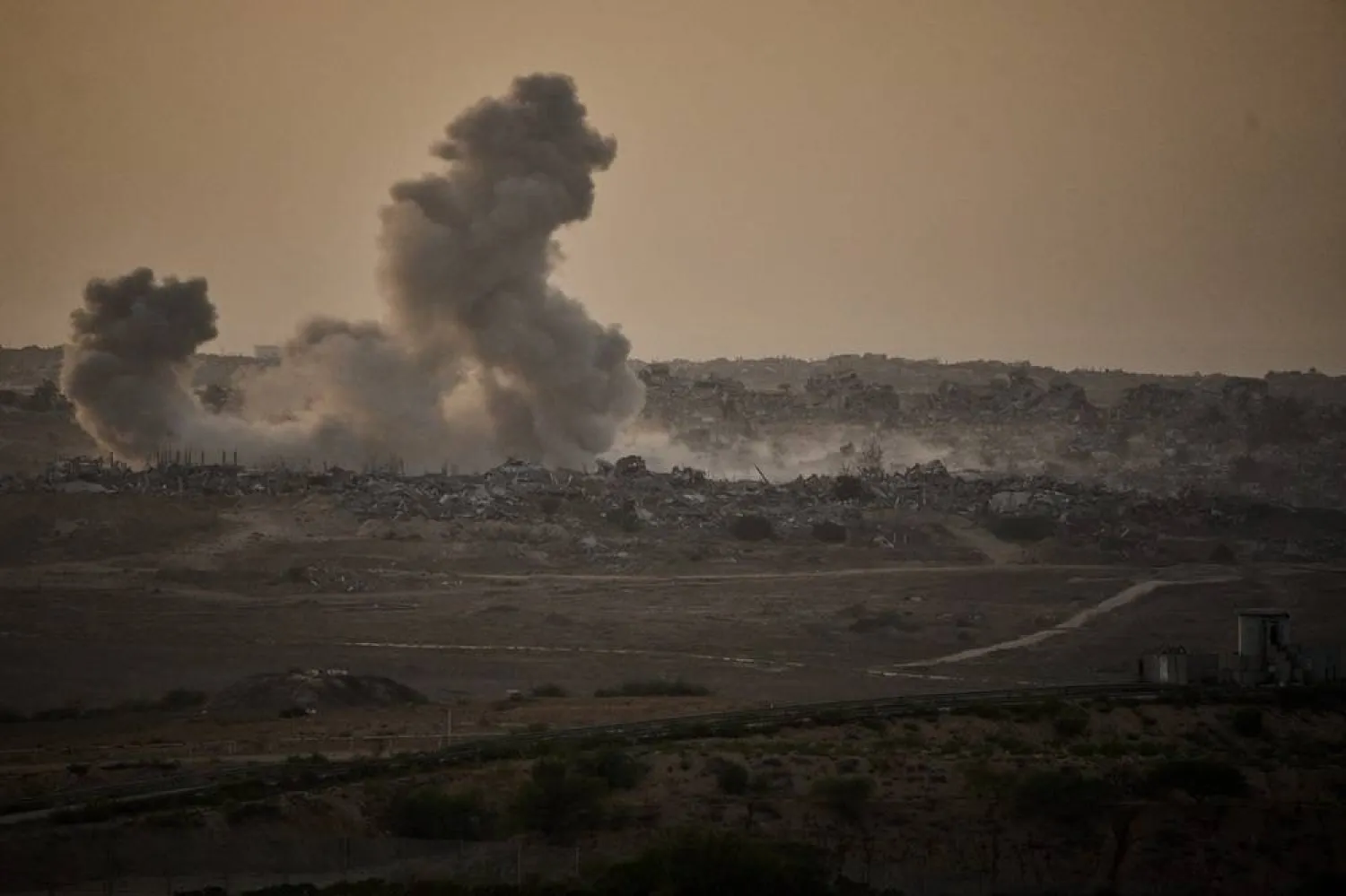
Smoke rises to the sky following an Israeli military strike in the northern Gaza Strip, as seen from southern Israel, Friday, Oct. 3, 2025. (AP)
TT

Israeli Bombing of Gaza City Has ‘Significantly Subsided,’ Hospital Official Says

Smoke rises to the sky following an Israeli military strike in the northern Gaza Strip, as seen from southern Israel, Friday, Oct. 3, 2025. (AP)

Israeli bombing of Gaza City has “significantly subsided” though at least five Palestinians were killed, a hospital official said Saturday, as Israel's army said the country's leaders had instructed it to prepare for the first phase of the US plan to end the war in Gaza. 

Israel has moved to a defensive-only position in Gaza and will not actively strike, said an official who was not authorized to speak to the media on the record. The official said no forces have been removed from the territory. 

Still, Shifa Hospital director Mohamed Abu Selmiyah told the AP that Israeli strikes killed five Palestinians across Gaza City, while bombing had "significantly subsided.” 

The army statement came hours after President Donald Trump ordered Israel to stop bombing Gaza once Hamas said it had accepted some elements of his plan. Trump welcomed the Hamas statement, saying: “I believe they are ready for a lasting PEACE.” 

Trump appears determined to deliver on pledges to end the war and return all hostages ahead of the second anniversary on Tuesday of the attack that sparked it. His proposal unveiled earlier this week has widespread international support. 

On Friday, Israeli Prime Minister Benjamin Netanyahu's office said Israel was committed to ending the war that began when Hamas attacked Israel on Oct. 7, 2023. Netanyahu is under increasing pressure to end the conflict.  

The official told the AP that Netanyahu put out the rare late-night statement on the Sabbath, saying that Israel has started to prepare for Trump's plan due to pressure from the US. 

The official also said a negotiating team was getting ready to travel, but there was no date specified. 

A senior Egyptian official said US envoy Steve Witkoff will travel to Egypt to head the US negotiating team in the talks to release the Israeli hostages in exchange for Palestinians in Israeli detention. Delegations from Israel and Hamas will join the talks, which also will discuss maps showing the expected withdrawal of Israeli forces from certain areas in Gaza, said the official who spoke on condition of anonymity because he wasn’t authorized to brief the media. 

The official involved in the ceasefire negotiations also said Arab mediators are preparing for a comprehensive dialogue among Palestinians aimed at unifying their position toward Gaza's future. 

The Palestinian Islamic Jihad, the second most powerful militant group in Gaza, said it accepted Hamas’ response to the Trump plan. The group had rejected the proposal days earlier. 

Progress, but uncertainty ahead  

Under the plan, Hamas would release the remaining 48 hostages — around 20 of them believed to be alive — within three days. It also would give up power and disarm. 

In return, Israel would halt its offensive and withdraw from much of Gaza, release hundreds of Palestinian prisoners and allow an influx of humanitarian aid and eventual reconstruction. 

Hamas said it was willing to release the hostages and hand over power to other Palestinians, but that other aspects of the plan require further consultations among Palestinians. Its statement also didn't address the issue of Hamas demilitarizing, a key part of the deal. 

Amir Avivi, a retired Israeli general and chairman of Israel’s Defense and Security Forum, said while Israel can afford to stop firing for a few days in Gaza so the hostages can be released, it will resume its offensive if Hamas doesn't lay down its arms. 

Others said that while Hamas suggests a willingness to negotiate, its position fundamentally remains unchanged. 

This “yes, but” rhetoric “simply repackages old demands in softer language,” said Oded Ailam, a researcher at the Jerusalem Center for Security and Foreign Affairs, who asserted that it serves more as a smoke screen than a signal of true movement toward resolution. 

Hostages’ families expressed cautious hope about the plan. 

Hamas and Netanyahu could sabotage the deal or Trump could lose interest, said Yehuda Cohen, whose son Nimrod is held in Gaza. Still, he said, if it’s going to happen it will be because of Trump. 

“We want to see him with us until the last step,” he said. 

Meanwhile, protests have erupted across Europe calling for the war's end. 

Unclear what it means for Palestinians  

Palestinians in Gaza tried to piece together what the plan means in real terms. 

“We want practical implementation. We want a truce on the ground,” said Sameer Qudeeh in Khan Younis. He worried that talks will break down again. 

“I hope Hamas ends the war, because we are truly tired,” said Mohammad Shaat in Khan Younis, as anxious Palestinians roamed the shattered streets. 

Israeli troops were still laying siege to Gaza City, the focus of its latest offensive. On Saturday, Israel's army warned Palestinians against trying to return to the city, calling it a “dangerous combat zone." 

Two Gaza City residents told the AP that since the morning, Israeli tanks and troops had not advanced but artillery shells and airstrikes were still heard. 

“We can still see the quadcopters everywhere,” Mohamed al-Nashar said. 

Gaza’s Health Ministry said the Palestinian death toll in the war has topped 67,000. The toll jumped after the ministry said it added more than 700 names to the list whose data had been verified. 

The Health Ministry does not say how many were civilians or combatants. It says women and children make up around half the dead. The ministry is part of the Hamas-run government, and the UN and many independent experts consider its figures to be the most reliable estimate of wartime casualties. 


Unified Arab, Islamic Stances ‘Tighten the Noose’ on Israel’s Moves in Somaliland

Somalis demonstrate in support of their country’s territorial unity in Mogadishu on January 7, 2026. (AP)
TT

Unified Arab, Islamic Stances ‘Tighten the Noose’ on Israel’s Moves in Somaliland

Somalis demonstrate in support of their country’s territorial unity in Mogadishu on January 7, 2026. (AP)

Arab and Islamic positions continued to express a firm rejection of Israel’s recognition of Somaliland as an independent state, reaffirming Somalia’s unity and territorial integrity.

This wave of coordinated diplomacy coincides with heightened engagement within international and UN-affiliated bodies, raising questions about the extent to which such positions can effectively constrain Israel’s recent moves, most notably the visit by Israeli Foreign Minister Gideon Saar to the self-declared breakaway region.

On Friday, Arab and Islamic states issued strong condemnations of what they described as Saar’s illegal visit to Somaliland earlier in the week, saying it constituted a blatant violation of Somalia’s sovereignty and territorial integrity and undermined established international norms and the UN Charter.

The condemnation came in a joint statement by the foreign ministers of Saudi Arabia, Egypt, Algeria, Bangladesh, Comoros, Djibouti, Gambia, Indonesia, Iran, Jordan, Kuwait, Libya, the Maldives, Nigeria, Oman, Pakistan, Palestine, Qatar, Somalia, Sudan, Türkiye and Yemen, along with the Organization of Islamic Cooperation (OIC).

The ministers reiterated their unwavering support for Somalia’s sovereignty and territorial integrity and rejected any encouragement of separatist agendas, warning that such moves risk exacerbating tensions in an already fragile region.

They stressed that respect for international law, non-interference in the internal affairs of sovereign states, and adherence to diplomatic norms are essential pillars of regional and international stability.

The statement came on the eve of an emergency ministerial meeting of the OIC on Saturday at the organization’s headquarters in Jeddah, aimed at forging a unified Islamic position in response to Israel’s recognition of Somaliland.

Analysts told Asharq Al-Awsat that coordinated collective action could “tighten the noose” around Israel’s recent steps in the breakaway region, discouraging other countries from following Israel’s lead and seeking to isolate Israel internationally. Such pressure, they said, could also create space for possible measures by the Somali government or open the door to intra-Somali dialogue.

Since Israel announced its recognition of Somaliland on Dec. 26, Egypt, Türkiye, Djibouti and Somalia have acted collectively, issuing a joint statement condemning the move and rejecting any unilateral measures that undermine Somali sovereignty or promote parallel entities that threaten the unity of the Somali state.

The following day, 21 Arab and Islamic countries, together with the OIC, warned that recognizing the independence of parts of sovereign states sets a dangerous precedent and threatens international peace and security.

Egyptian diplomat Salah Halima said the unified Arab and Islamic positions are active and effective, aligning with stances taken by the Arab League, the African Union, the European Union and the United Nations.

He noted that while the United States has expressed support for Somalia’s unity, its position on Israel’s step remains ambiguous, raising concerns about the possibility of further recognitions.

Former Egyptian assistant foreign minister for African affairs Mona Omar noted that Israel has a record of disregarding international appeals and resolutions, but broad collective opposition deepens its isolation and complicates efforts to advance its plans in Somaliland.

She added that stronger US backing for Somalia’s unity would leave Israel facing genuine isolation in the region, even if it does not ultimately reverse its recognition.

African affairs expert Rami Zahdi stressed that unified positions can have tangible impact if embedded in a comprehensive strategy to counter Israeli moves, protect stability in the Horn of Africa, and prevent the fragmentation of national states.

He described the explicit demand for Israel to withdraw its recognition as a form of measured, escalatory diplomacy that moves beyond symbolic condemnation toward organized political and legal pressure.


Israel Scales Back from ‘Major Strike’ on Hezbollah, Opts for ‘Limited Attacks’

The Israeli flag, with part of the Israeli settlement of Ma’ale Adumim visible in the background in the occupied West Bank on August 14, 2025. (Reuters)
TT

Israel Scales Back from ‘Major Strike’ on Hezbollah, Opts for ‘Limited Attacks’

The Israeli flag, with part of the Israeli settlement of Ma’ale Adumim visible in the background in the occupied West Bank on August 14, 2025. (Reuters)

Informed sources in Tel Aviv said the Israeli strike on Lebanon on Friday was the response chosen by the military following remarks by Prime Minister Benjamin Netanyahu, who praised what he described as the Lebanese army’s “insufficient” efforts to disarm Hezbollah.

The strikes also followed a statement by the Lebanese government announcing the completion of the first phase of that mission.

Military sources, quoted across Israeli media, said Hezbollah “remains present in southern Lebanon and is seeking to restore its strength, reinforce its positions, resupply its forces with weapons, and maintain its tunnel network.”

These claims were used to justify a series of Israeli air strikes targeting southern and eastern Lebanon on Friday.

Despite Israel’s official skepticism toward the Lebanese army’s declaration that it had achieved the “objectives of the first phase” of disarming Hezbollah south of the Litani River — an announcement the Israeli military dismissed as “inaccurate and not reflective of the security reality on the ground” — Israeli thinking about launching a large-scale military response has cooled.

Political and military sources said Israel has “begun to retreat, for now, from the idea of a major strike and decided to settle for intense but limited attacks.”

Those same sources had previously said Netanyahu agreed with US President Donald Trump during a meeting in Florida last week to carry out a major strike against Hezbollah, in exchange for Netanyahu’s acceptance of most US demands regarding Gaza and Syria.

The rationale for striking Hezbollah is said to be ready and enjoys near consensus in Israel, with opinion polls showing 57 percent of the public in favor of an immediate attack.

On Wednesday, Netanyahu’s office issued an official statement asserting that the US-brokered ceasefire agreement between Israel and Lebanon “clearly stipulates the complete disarmament of Hezbollah,” describing this as “essential for Israel’s security and Lebanon’s future.”

According to Israel’s Haaretz newspaper, army sources say Hezbollah’s presence in the area “has not ended” and that the military “continues to monitor the group’s activities even now.”

While Israel views positively the Lebanese army’s acknowledgment that “tasks remain unfinished,” it doubts the army’s “ability to carry them out in practice.”

An Israeli military source said Tel Aviv’s assessment of the disarmament file “is not based on statements, but on operational data and results,” stressing that “as long as Hezbollah’s military infrastructure south of the Litani remains, there can be no talk of real disarmament.”

According to military sources cited by the Walla news site, Hezbollah has smuggled large quantities of weapons and bags containing millions of dollars across the Turkish border to rebuild its power and bolster its popular support.

While this underscores, in Israeli eyes, the inevitability of a major strike, the tone has shifted in recent hours.

Sources say Netanyahu fears such an operation now could divert attention from dramatic developments in Iran, where Israel, keenly interested in the regime’s collapse, does not want to distract from ongoing protests.


Mladenov Shuttle Talks between Israel and Ramallah Hasten Gaza Administration Committee

A general view shows the destruction in the Bureij refugee camp in central Gaza (AFP)
TT

Mladenov Shuttle Talks between Israel and Ramallah Hasten Gaza Administration Committee

A general view shows the destruction in the Bureij refugee camp in central Gaza (AFP)

Nickolay Mladenov, the man chosen to serve as the director-general for US President Donald Trump's Board of Peace in Gaza, discussed arrangements for the second phase of the ceasefire agreement with Palestinian Vice President Hussein al-Sheikh.

The meeting, which took place a day after Mladenov met with Israeli Prime Minister Benjamin Netanyahu, was viewed by experts speaking to Asharq Al-Awsat as increasing the chances of launching the second phase and announcing the formation of a body to administer Gaza.

Netanyahu had announced the selection of Bulgarian diplomat Mladenov, the former United Nations Middle East envoy from early 2015 until the end of 2020, to serve as director general of the Board of Peace, chaired by US President Donald Trump and tasked with overseeing the peace process in Gaza.

Al-Sheikh received Mladenov and his accompanying delegation on Friday at his office in the West Bank city of Ramallah, in the presence of Maj. Gen. Majed Faraj, head of the General Intelligence Service, according to the Palestinian News Agency, which did not describe Mladenov by his new American-appointed title.

The meeting discussed “the role of the Palestinian administrative committee and Palestinian police and security forces in assuming their duties and linking them to the Palestinian Authority, the holder of sovereignty and legitimacy, as well as ways to implement the second phase of President Trump’s plan as the announcement of the Board of Peace approaches.”

Al-Sheikh stressed the need to begin implementing the second phase, underlining the importance of a full Israeli withdrawal from the Gaza Strip as part of that phase, which includes ending Hamas rule, handing over its weapons, and moving toward reconstruction under President Trump’s plan.

He also stressed that the Gaza Strip is an integral part of the State of Palestine, highlighting the importance of political, administrative, and legal linkage between Palestinian institutions in Gaza and the Palestinian National Authority in the West Bank, and respect for the principle of one authority, one law, and one legitimate weapon.

Al-Sheikh said that while a transitional plan is being implemented in Gaza, there must be an urgent plan to halt all unilateral actions that violate international law, foremost among them settlement expansion, settler violence, and the release of withheld Palestinian funds.

On Thursday evening, the Israeli prime minister’s office said in a statement that Netanyahu insisted on the need to disarm Hamas and demilitarize Gaza, describing both as conditions under the Trump administration’s 20-point ceasefire plan.

Tarek Fahmy, a professor of political science specializing in Palestinian and Israeli affairs, said Mladenov is a professional diplomat with a good reputation and will be the board’s appointed director, despite being ranked second after former British Prime Minister Tony Blair, who did not enjoy widespread Arab acceptance.

Fahmy said Mladenov is “preparing the ground and accelerating steps toward announcing a technocratic committee under Palestinian leadership.”

Palestinian political analyst Abdul Mahdi Moutawe said Mladenov is not new to Gaza, noting his previous role at the UN in the Middle East.

He said Mladenov met Netanyahu and al-Sheikh to gauge positions and narrow differences in order to reach understandings leading to partial Palestinian administration of Gaza, which would expand as progress is made in the second phase, and depending on the ability to resolve obstacles, particularly those related to disarming Hamas and the enclave.

Under Trump’s 20-point peace plan for Gaza, the territory would be governed by a temporary Palestinian transitional committee composed of nonpartisan technocrats, under the supervision and oversight of the Board of Peace.

The US website Axios cited American officials and informed sources as saying Trump is expected to announce the Board of Peace this week as part of the second phase of the ceasefire agreement reached between Israel and Hamas, which took effect on Oct. 10.

Egyptian Foreign Minister Badr Abdelatty, in a phone call with UN Secretary-General Antonio Guterres on Thursday evening, stressed the importance of an Israeli withdrawal from Gaza, the announcement of a temporary Palestinian technocratic committee to administer the enclave, and the formation of an international stabilization force.

Fahmy expects the Board of Peace to be announced in the coming days, alongside pressure to announce the committee and avoid objections to proposed names, in order to begin implementing the second phase in earnest and away from any Israeli maneuvering or obstruction.

Moutawe believes the board and the administrative committee will be announced this week, allowing them to move forward with the second phase and begin its actual implementation.
