

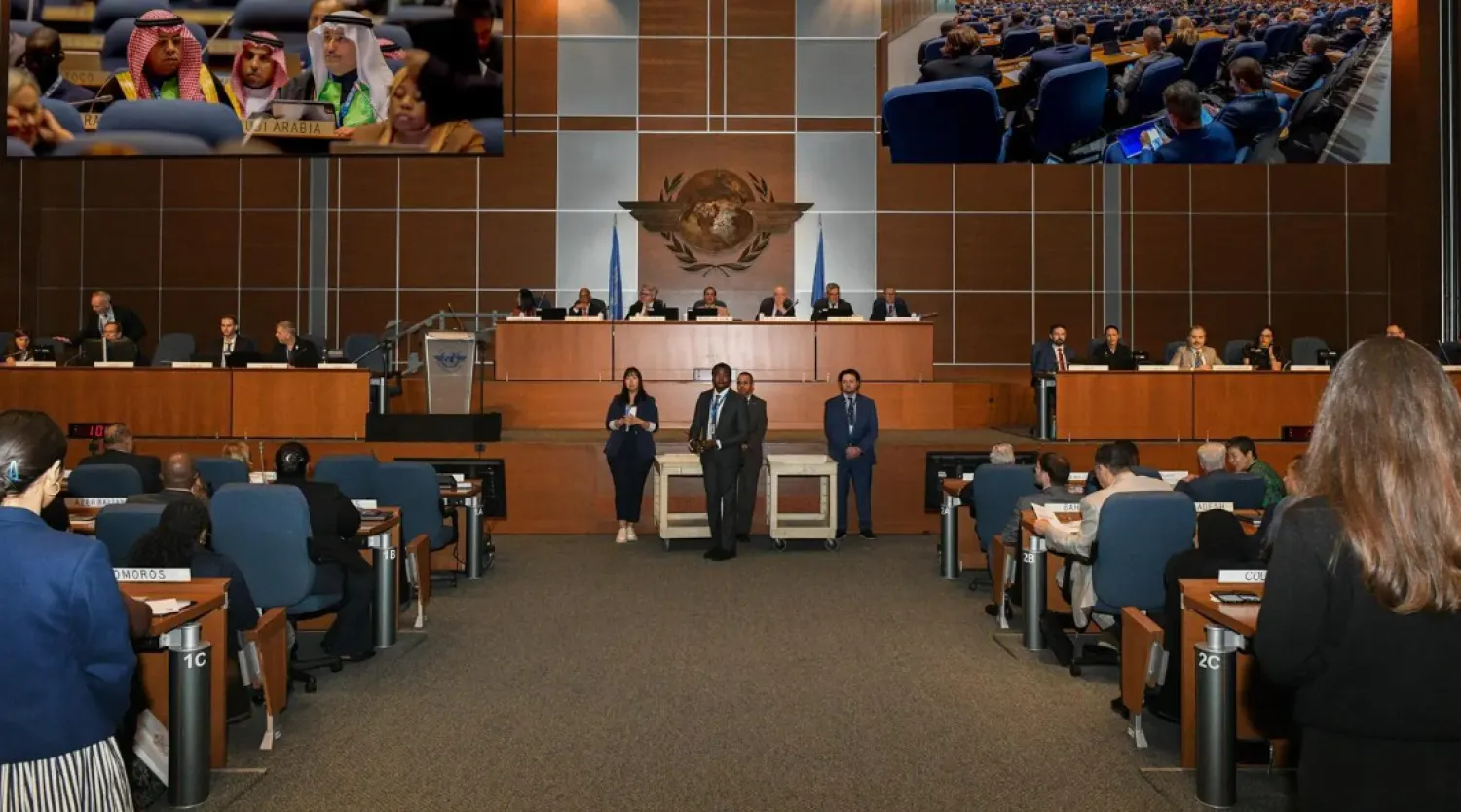

Saudi Arabia Expands Global Aviation Network with 17 New Agreements at ICAO Assembly

The ICAO Executive Council has renewed the Kingdom of Saudi Arabia’s membership for the 2026–2028 term - SPA
TT

Saudi Arabia Expands Global Aviation Network with 17 New Agreements at ICAO Assembly

The ICAO Executive Council has renewed the Kingdom of Saudi Arabia’s membership for the 2026–2028 term - SPA

The Kingdom of Saudi Arabia, represented by the General Authority of Civil Aviation (GACA), concluded its participation in the 42nd General Assembly of the UN International Civil Aviation Organization (ICAO), held in Montreal, Canada, from September 23 to October 3.

The delegation’s participation resulted in the signing of 17 air transport agreements and memoranda of understanding and held 40 bilateral meetings to boost international cooperation in aviation.

These efforts underline the Kingdom’s commitment to expanding its global presence in air transport, establishing regulatory frameworks for air traffic, enhancing aviation safety and security standards, and broadening travel options for passengers, SPA reported.

Additionally, the Kingdom submitted 31 working papers covering a wide range of topics aligned with its leading role in civil aviation and air transport facilitation at both regional and international levels.

These papers addressed aviation safety and security, airport infrastructure development, passenger transport facilitation, sustainability initiatives, environmental stewardship, carbon emissions reduction, and investment in biofuels and clean technologies, all in line with Saudi Vision 2030, which aims to position the Kingdom as a global logistics hub.

The ICAO Executive Council has renewed the Kingdom of Saudi Arabia’s membership for the 2026–2028 term. The Kingdom received 175 out of 184 votes, maintaining its uninterrupted membership since 1986.

Minister of Transport and Logistic Services Saleh Al-Jasser announced a $1 million donation from Custodian of the Two Holy Mosques King Salman bin Abdulaziz Al Saud to support the ICAO.

The contribution is dedicated to advancing the strategic objectives of the “No Country Left Behind” initiative during the 2025–2028 cycle, which aims to assist developing countries in implementing international standards and recommended practices to enhance civil aviation safety and security.

ICAO also honored Saudi Arabia, represented by Chairman of the Cooperative Aviation Security Program–Middle East (CASP-MID) Mohammed Alfozan, in recognition of his leadership and management of the program and his contributions to enhancing the aviation security capabilities of countries in the region.

The recognition reflects the Kingdom’s pioneering role in supporting ICAO programs and global initiatives to strengthen civil aviation security and its commitment to ensuring that “no country is left behind.”

Furthermore, Saudi Arabia hosted a reception attended by more than 450 participants from various countries, including representatives from the aviation sector, diplomats, and ICAO member states.

The event featured an exhibition showcasing participating entities, traditional handicrafts such as weaving and leatherwork, and performances of Saudi folk music and dance.

A documentary film was also screened, tracing the history and development of civil aviation in the Kingdom and its progress toward becoming a modern aviation powerhouse.



Global Unemployment ‘Stable’ in 2026, but Decent Jobs Lacking

A Palestinian employee inspects sweet locally known as "al-Shatwi" (Winter) Crimbo sweets, as the Al-Arees factory gradually resumes operations after a hiatus caused by the Gaza war which led to shortages of raw materials used in their products, in Deir al-Balah, in the central Gaza Strip on January 12, 2026, following a US-brokered truce that halted the two-year war. (AFP)
TT

Global Unemployment ‘Stable’ in 2026, but Decent Jobs Lacking

A Palestinian employee inspects sweet locally known as "al-Shatwi" (Winter) Crimbo sweets, as the Al-Arees factory gradually resumes operations after a hiatus caused by the Gaza war which led to shortages of raw materials used in their products, in Deir al-Balah, in the central Gaza Strip on January 12, 2026, following a US-brokered truce that halted the two-year war. (AFP)

The global unemployment rate is expected to hold steady in 2026, the United Nations said Wednesday, but cautioned the labor market's seeming stability belies a dire shortage of decent jobs.

The UN's International Labor Organization said the global economy and labor market appeared to have weathered recent economic shocks better than expected.

But the ILO warned that efforts to improve global job quality had stagnated, leaving hundreds of millions of workers wallowing in poverty, even as trade uncertainty risked cutting into workers wages.

The global unemployment rate was estimated at 4.9 percent last year and the year before, and is now projected to remain at a similar level until 2027, a report from the UN labor agency said.

That amounts to 186 million people out of work this year, it said.

"Global labor markets look stable, but that stability is quite fragile," Caroline Fredrickson, head of the ILO's research department, told reporters, cautioning that the "apparent calm masks deeper and unresolved problems".

At a time when US President Donald Trump has slapped towering tariffs on friends and foes alike, the report cautioned that "disruptions caused by trade uncertainty, combined with ongoing long-term transformations in global trade, could significantly affect labor market outcomes".

Going forward, the ILO said its modelling suggested that a moderate increase in trade policy uncertainty "may reduce returns to labor and, as a consequence, real wages for both skilled and unskilled workers across all sectors", especially in Southeast Asia, Southern Asia and Europe.

The potential of trade to generate new employment opportunities was also being challenged by the ongoing disruptions, the report said, pointing out that 465 million jobs globally depended on foreign demand through exports of goods and services and related supply chains in 2024.

- Extreme poverty -

Another major concern highlighted by the ILO was the quality of jobs available.

"Resilient growth and stable unemployment figures should not distract us from the deeper reality: hundreds of millions of workers remain trapped in poverty, informality, and exclusion," ILO chief Gilbert Houngbo said in a statement.

Nearly 300 million workers continue to live in extreme poverty, earning less than $3 a day, Wednesday's report found.

At the same time, some 2.1 billion workers are expected to hold informal jobs this year, with limited access to social protection, labor rights and job security.

Young people remain particularly vulnerable, with unemployment among 15- to 24-year-olds projected to reach 12.4 percent for 2025, with around 260 million young people not engaged in education, employment or training, ILO said.

It warned that artificial intelligence and automation could exacerbate challenges, particularly for educated young people in wealthier countries seeking their first high-skill jobs.

"While the full impact of AI on youth employment remains uncertain, its potential magnitude warrants close monitoring," the report said.

The ILO also highlighted "entrenched gender inequalities", pointing out that women still account for just two-fifths of global employment.

"Stable labor markets are not necessarily healthy," Fredrickson said, stressing the growing need for "domestic policy choices to strengthen decent work outcomes".

"Without decisive action, today's stability risks giving way to deeper inequalities."


China Had a Record $1.2 Trillion Trade Surplus in 2025, as Exports Rose 6.6% in December

Women dressed in traditional Chinese-style attire cross a street in Beijing, China, Tuesday, Jan. 13, 2026. (AP)
TT

China Had a Record $1.2 Trillion Trade Surplus in 2025, as Exports Rose 6.6% in December

Women dressed in traditional Chinese-style attire cross a street in Beijing, China, Tuesday, Jan. 13, 2026. (AP)

China’s trade surplus surged to a record of almost $1.2 trillion in 2025, the government said Wednesday, as exports to other countries made up for slowing shipments to the United States.

China's exports rose 5.5% for the whole of last year to $3.77 trillion, customs data showed, while imports flatlined at $2.58 trillion. The 2024 trade surplus was over $992 billion.

In December, China’s exports climbed 6.6% from the year before in dollar terms, better than economists’ estimates and higher than November’s 5.9% year-on-year increase. Imports in December were up 5.7% year-on-year, compared to November’s 1.9%.

China’s trade surplus surpassed the $1 trillion mark for the first time in November, when the trade surplus reached $1.08 trillion in the first 11 months of last year.

Economists expect exports will continue to support China’s economy this year, despite trade friction and geopolitical tensions.

“We continue to expect exports to act as a big growth driver in 2026,” said Jacqueline Rong, chief China economist at BNP Paribas.

While China’s exports to the US have fallen sharply for most of last year since President Donald Trump returned to office and escalated his trade war with the world’s second-largest economy, that decline has been largely offset by shipments to other markets in South America, Southeast Asia, Africa and Europe.

For the whole of 2025, China’s exports to the US fell 20%. In contrast, exports to Africa surged 26%. Those to Southeast Asian countries jumped 13%; to the European Union 8%, and to Latin America, 7%.

Strong global demand for computer chips and other devices and the materials needed to make them were among categories that supported China’s exports, analysts said. Car exports also grew last year.

China's strong exports have helped keep its economy growing at an annual rate close to its official target of about 5%. But that has triggered alarm in countries that fear a flood of cheap imports are damaging local industries.

China faces a “severe and complex” external trade environment in 2026, Wang Jun, vice minister of China’s customs administration, told reporters in Beijing. But he said China’s “foreign trade fundamentals remain solid.”

The head of the International Monetary Fund last month called for China to fix its economic imbalances and speed up its shift from reliance on exports by boosting domestic demand and investment.

A prolonged property downturn in China after the authorities cracked down on excessive borrowing, triggering defaults by many developers, is still weighing on consumer confidence and domestic demand.

China’s leaders have made increasing spending by consumers and businesses a focus of economic policy, but actions taken so far have had a limited impact. That included government trade-in subsidies over the past months that encouraged consumers to buy newer, more energy efficient items, such as home appliances and vehicles, and replace older models.

“We expect domestic demand growth to stay tepid,” said Rong of BNP Paribas. “In fact, the policy boost to domestic demand looks weaker than last year -- in particular the fiscal subsidy program for consumer goods.”

Gary Ng, a senior economist at French investment bank Natixis, forecasts that China’s exports will grow about 3% in 2026, less than the 5.5% growth in 2025. With slow import growth, he expects China's trade surplus to remain above $1 trillion this year.


Saudi Arabia Signs Mineral Cooperation Deals with Chile, Canada, Brazil

The MoUs were signed on the sidelines of the Ministerial Roundtable of ministers concerned with mining affairs, held as part of the fifth annual Future Minerals Forum (FMF) in Riyadh. (SPA)
TT

Saudi Arabia Signs Mineral Cooperation Deals with Chile, Canada, Brazil

The MoUs were signed on the sidelines of the Ministerial Roundtable of ministers concerned with mining affairs, held as part of the fifth annual Future Minerals Forum (FMF) in Riyadh. (SPA)

Saudi Arabia, represented by the Ministry of Industry and Mineral Resources, signed on Tuesday three international memoranda of understanding (MoUs) on mineral resources cooperation with the Chile, Canada, and Brazil.

The MoUs were signed on the sidelines of the Ministerial Roundtable of ministers concerned with mining affairs, held as part of the fifth annual Future Minerals Forum (FMF), hosted by Riyadh from January 13 to 15.

The deals reflect the Kingdom’s efforts to expand its international partnerships and strengthen technical and investment cooperation in the mining and minerals sector in a manner that serves mutual interests and supports the sustainable development of mineral resources.

The signing ceremony included MoUs on cooperation in the mineral resources field with the Chilean Ministry of Mining, the Canadian Department of Natural Resources, and the Brazilian Ministry of Mines and Energy.

The Ministerial Roundtable recorded the largest level of international representation of its kind globally, with participation from more than 100 countries, including all G20 members in addition to the European Union, as well as 59 multilateral organizations, industry associations, and non-governmental organizations.

The attendance reflects the standing the ministerial meeting has attained as a leading international platform for aligning perspectives, building partnerships, and developing practical solutions to global challenges in the mining and minerals sector.