


Surging Nile Waters Inundate Egypt and Sudan, Revive Row over Ethiopian Mega-Dam

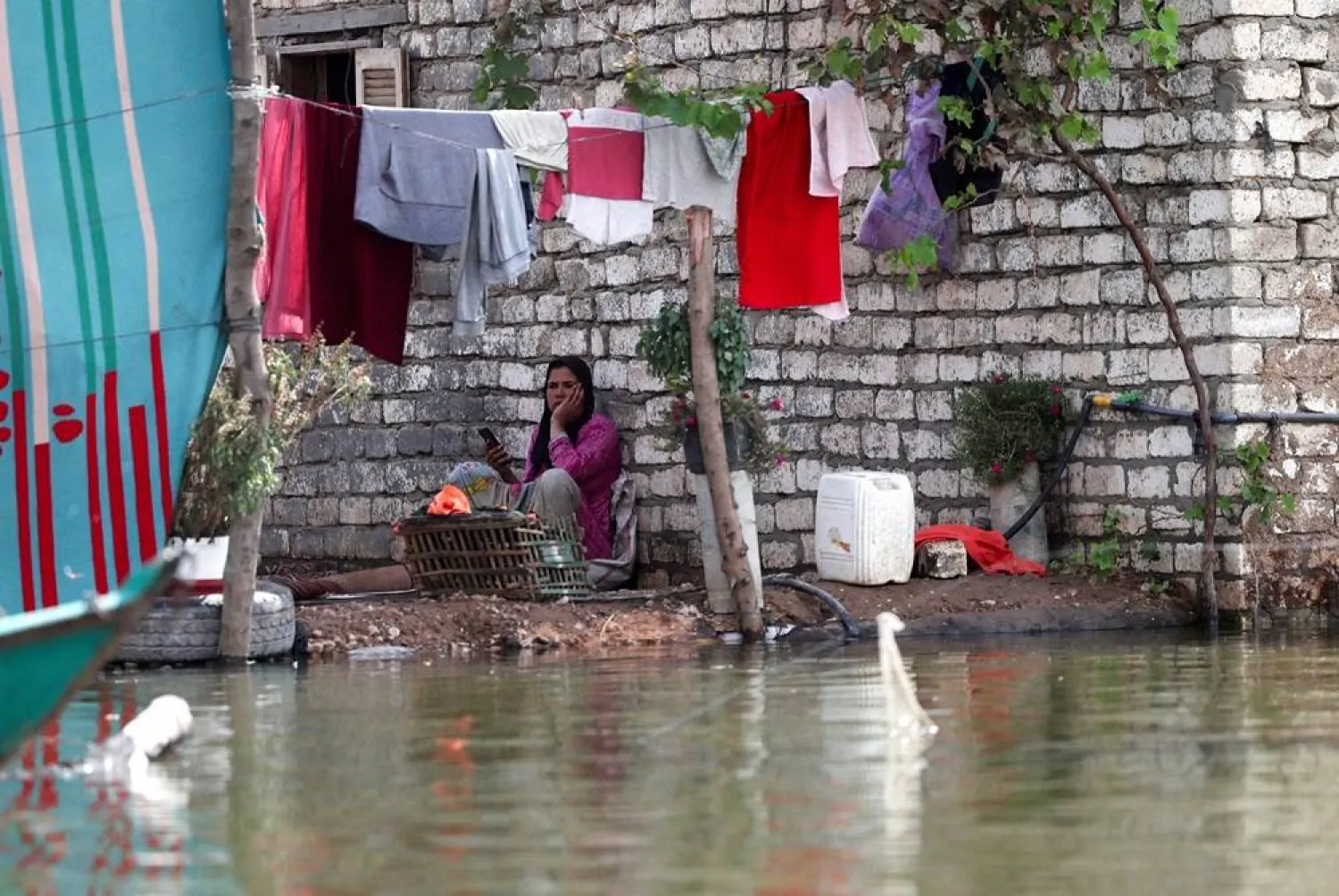
A woman sits near her flooded house in Dalhamo Village, near the Delta city of Ashmoun, in Menoufia Governorate, Egypt, October 5, 2025. (Reuters)
TT

Surging Nile Waters Inundate Egypt and Sudan, Revive Row over Ethiopian Mega-Dam

A woman sits near her flooded house in Dalhamo Village, near the Delta city of Ashmoun, in Menoufia Governorate, Egypt, October 5, 2025. (Reuters)

Rising Nile waters inundated homes and fields in northern Egypt over the weekend, forcing residents to move by boat and intensifying a war of words between Cairo and Addis Ababa over whether Ethiopia's giant Nile dam has worsened seasonal floods.

In the Nile Delta village of Dalhamo, in Menoufia Governorate, some 50 km (31 miles) northwest of Cairo, men paddled wooden boats through narrow lanes where water lapped at the walls of their homes.

"We lost everything," said fisherman Saied Gameel, standing knee-deep in his flooded house. "The water level is extremely high, much higher this year ... before it would rise for two days and then recede."

FLOODS IN SUDAN DISPLACE THOUSANDS

The Nile has long been affected by seasonal flooding due to monsoon rainfall in the Ethiopian Highlands that usually peaks in July and August. But this year a late-season surge has pushed north from Ethiopia, through Sudan, and into Egypt.

In Sudan, the UN migration agency said floods in Bahri, Khartoum state, displaced about 1,200 families last week and destroyed homes, compounding an 18-month war that has crippled the country's response.

Egypt's Water Resources and Irrigation Ministry has accused Ethiopia of "reckless unilateral" operation of its Grand Ethiopian Renaissance Dam, saying sharp, unannounced swings in water releases after the dam's September 9 inauguration helped trigger a "man-made, late flood".

It said, in a statement on October 3, that discharges jumped to about 485 million cubic meters on September 10 and as high as 780 million on September 27 before easing, straining Sudan's Roseires Dam and pushing excess water through to Egypt.

Ethiopia, which sees the $5 billion dam as central to its development, rejected Cairo's claims, describing Egypt's statement as "malicious and riddled with numerous baseless claims".

In a statement on October 4, its Water and Energy Ministry said regulated releases from the Blue Nile project had reduced flood impacts and that without it, heavy rain "would have caused historic destruction in Sudan and Egypt".

Ethiopia inaugurated the dam on September 9, with Prime Minister Abiy Ahmed saying it was built "to prosper, to electrify the entire region, and to change the history of black people", insisting it was "not to harm its brothers".

The dam is designed to generate 5,150 megawatts of power and hold up to 74 billion cubic meters of water in its lake.

Cairo bitterly opposed the dam from the start, arguing that it violated water treaties dating back to the early part of the last century and poses an existential threat.

'NOWHERE ELSE TO GO'

Egyptian Prime Minister Mostafa Madbouly said in a press conference on October 2 that authorities had anticipated higher-than-normal flows this month and warned that low-lying tracts in Menoufia and neighboring Beheira, long encroached by informal building and farming on the river's floodplain, were at risk.

Health teams were deployed to flooded areas over the weekend.

Back in Dalhamo, Gameel said residents were still waiting for help.

"People were warned before the water rose, but there's nowhere else for anyone," he said. "When the water rises, everyone ends up staying on top of their houses."



Israeli Soldiers Kill Palestinian Teen in West Bank

Israeli Soldiers Kill Palestinian Teen in West Bank
TT

Israeli Soldiers Kill Palestinian Teen in West Bank

Israeli Soldiers Kill Palestinian Teen in West Bank

Israeli soldiers shot dead a Palestinian hurling a rock at them in the occupied West Bank, the military said on Friday, and the Palestinian health ministry said the person killed was a 14-year-old boy.

There was no further comment from Palestinian officials about the fatal incident in the village of ⁠Al-Mughayyir. Official Palestinian news agency WAFA said the teen was killed during an Israeli military raid that led to confrontations, Reuters reported.

The Israeli military said its forces were called to the area after ⁠receiving reports that Palestinians were throwing stones at Israelis and blocking a road with burning tires.

The soldiers fired warning shots in an attempt to repel a person who was running at them with a rock, the military said, and then shot and killed him to eliminate the ⁠danger.

Violence has surged over the past year in the West Bank. Attacks by Israeli settlers on Palestinians have risen sharply, while the military has tightened movement restrictions and carried out sweeping raids in several cities.

Palestinians have also carried out attacks on Israeli soldiers and civilians, some of them deadly.


Israeli Strikes in South Lebanon Kill Two

Smoke rises from the site of an Israeli airstrike that targeted the village of Sohmor, in southern Lebanon on January 15, 2026. (Photo by Rabih DAHER / AFP)
TT

Israeli Strikes in South Lebanon Kill Two

Smoke rises from the site of an Israeli airstrike that targeted the village of Sohmor, in southern Lebanon on January 15, 2026. (Photo by Rabih DAHER / AFP)

An Israeli strike on south Lebanon killed one person on Friday, the health ministry in Beirut said a day after raids that Israel said had targeted Hezbollah.

Israel has kept up regular strikes in Lebanon despite a November 2024 ceasefire that sought to end more than a year of hostilities with Hezbollah, usually saying it is targeting members of the group or its infrastructure.

In a statement, the health ministry said an "Israeli enemy strike" on a vehicle in Mansuri in south Lebanon killed one person.

According to AFP, it also said that a strike on Mayfadun in south Lebanon the previous night killed one person.

Israel said Thursday's attack killed a Hezbollah member it alleged "took part in attempts to reestablish Hezbollah's infrastructure in the Zawtar al-Sharqiyah area.”

The attacks come a week after Lebanon's military said it had completed disarming Hezbollah south of the Litani River, the first phase of a nationwide plan, although Israel has called those efforts insufficient.

On Thursday, Israel carried out several strikes against eastern Lebanon's Bekaa region, north of the Litani, after issuing warnings to evacuate.

United Nations peacekeepers, deployed in the south to separate Lebanon from Israel, said on Friday that an Israeli drone "dropped a grenade" on its troops.

On Monday, the peacekeeping force said an Israeli tank fired near its troops, and warned that such incidents were becoming "disturbingly common".


Syria's Leader Sharaa in Berlin on Tuesday, Says German Presidency

Syria's President Ahmed al-Sharaa.
TT

Syria's Leader Sharaa in Berlin on Tuesday, Says German Presidency

Syria's President Ahmed al-Sharaa.

Syria's President Ahmed al-Sharaa will be visiting Berlin next Tuesday and meet his German counterpart Frank-Walter Steinmeier, the German presidency said.

The office of Chancellor Friedrich Merz has yet to announce whether they would also hold talks during the visit, which comes at a time when the German government is seeking to step up repatriations of Syrians to their homeland.