
Top Officials from US and Qatar Join Talks Aimed at Brokering Peace in Gaza

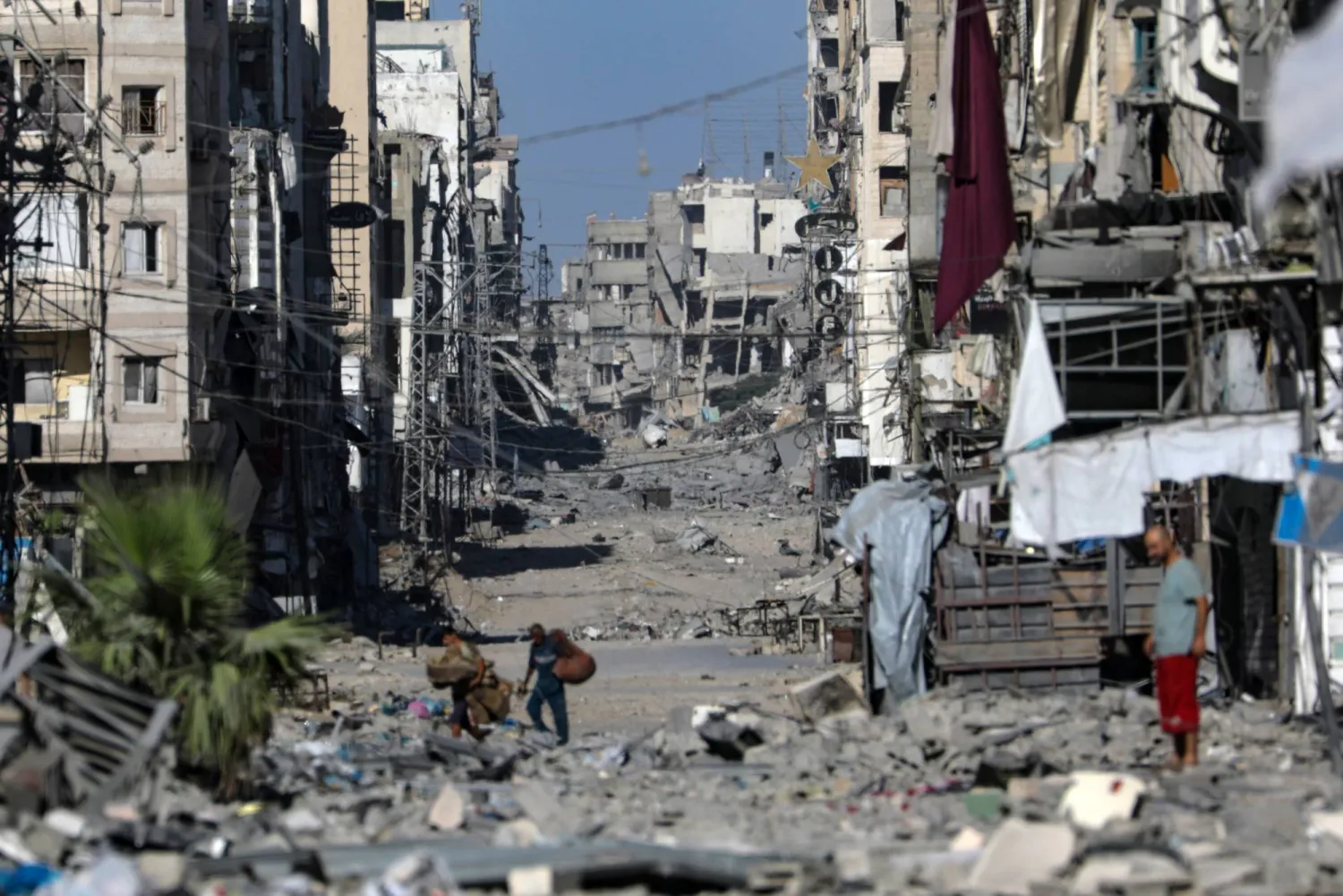
Palestinians move on the damaged Al-Nassr street during an Israeli military operation in Gaza City, Gaza Strip, 07 October 2025. (EPA)
TT

Top Officials from US and Qatar Join Talks Aimed at Brokering Peace in Gaza

Palestinians move on the damaged Al-Nassr street during an Israeli military operation in Gaza City, Gaza Strip, 07 October 2025. (EPA)

US President Donald Trump’s top adviser for the Middle East and other senior officials joined the third day of peace talks between Israel and Hamas in an Egyptian resort on Wednesday, a sign that negotiators aim to dive deeply into the toughest issues of an American plan to end the war in Gaza. 

Hamas says it's seeking firm guarantees from Trump and mediators that Israel won't resume its military campaign in the Palestinian territory after the group releases all the remaining hostages. 

All sides have expressed optimism for a deal to end the two-year war that has left tens of thousands of Palestinians dead and most of the Gaza Strip destroyed. But key parts of the peace plan still haven't been agreed to, including a requirement that Hamas disarm, the timing and extent of an Israeli troop withdrawal from Gaza, and the creation of an international body to run the territory after Hamas steps down. 

Trump's Middle East envoy, Steve Witkoff, and his son-in-law, Jared Kushner, arrived Wednesday at Sharm el-Sheikh for the discussions, as did Qatar’s prime minister, Sheikh Mohammed bin Abdulrahman Al Thani, and Israeli Prime Minister Benjamin Netanyahu’s top adviser, Ron Dermer. 

Representatives from fringe armed groups, the Popular Front for the Liberation of Palestine, or PFLP, and Palestinian Islamic Jihad, which holds an unknown number of Israeli hostages, are scheduled to arrive later Wednesday, according to officials who spoke on condition of anonymity because they weren't authorized to speak to the media. Their attendance underscores the aim of the talks to encompass all Palestinian groups. 

As Qatari, Egyptian and US mediators met with both sides in preliminary talks on Wednesday morning, a senior Hamas official, Taher Nounou, said the group has provided a list of Palestinian prisoners it wants released from Israel in return for hostages in Gaza as part of the deal. 

Trump’s peace plan  

The plan calls for an immediate ceasefire and release of the 48 hostages that fighters in Gaza still hold from their surprise attack on Israel on Oct. 7, 2023, that started the war and triggered Israel's devastating retaliation. Around 20 of the hostages are believed to still be alive. 

It envisions Israel withdrawing its troops from Gaza after Hamas disarms, and an international security force moving in. The territory would be placed under international governance, with Trump and former UK Prime Minister Tony Blair overseeing it. 

Egyptian President Abdel Fattah al-Sisi said Wednesday in televised comments that the negotiations so far “were very encouraging.” 

Netanyahu has accepted Trump’s plan. His office said Tuesday that Israel was “cautiously optimistic,” framing the talks as technical negotiations over a plan that both sides already had approved. 

In a statement Tuesday, Hamas reiterated its longstanding demands for a lasting ceasefire and a full Israeli withdrawal from Gaza, but said nothing about disarmament, a step it has long resisted. Hamas has also spoken against the idea of international rule, though it has agreed it will have no role in governing post-war Gaza. 

Speaking in Sharm el-Sheikh, Khalil al-Hayya, Hamas’ top negotiator, told Egypt’s Qahera TV that the group wanted solid guarantees from Trump and mediators that the war “will not return.” It appeared to be his first public appearance since an Israeli strike targeting him and other top Hamas leaders in Qatar last month killed six people, including his son and office manager. 

In January, the two sides had a ceasefire that brought the release of some Israeli hostages in exchange for Palestinians imprisoned by Israel. Under the agreement, which Trump and Witkoff played a major role in brokering, the two sides were then supposed to enter negotiations over a long-term truce, an Israeli withdrawal and a full hostage release. 

But Israel broke the ceasefire in March, resuming its campaign of bombardment and offensives, saying it aimed to pressure Hamas for the remaining hostage releases. 

Past rounds of negotiations have frequently fallen apart over the same obstacle, with Hamas demanding assurances of the war's end and Netanyahu vowing to keep fighting until the group is destroyed. The Trump plan attempts to resolve all the issues at once, by laying out Hamas disarmament and a post-war scenario for governing the territory with provisions for a major reconstruction campaign. 

Islamic Jihad leader Ziad Nakhaleh said that a prisoners’ exchange can happen “in the next few days,” removing any pretext for Israel to mount any further attacks. But he warned in a televised statement to Beirut-based Al-Mayadeen TV that Israel and its allies shouldn’t expect the Palestinians to “succumb to their conditions and dictation after all the sacrifices.” 

Senior Hamas official Izzat al-Rishq said that the participation of the Qatari prime minister and top intelligence officials from Türkiye and Egypt give the talks “a strong boost toward achieving positive results” while “narrowing Netanyahu’s room for maneuver to continue the aggression and sabotage the negotiations.” 

Praying for a deal  

In the Hamas-led attack two years ago, fighters stormed into southern Israel and killed around 1,200 people, mostly civilians, and abducted 251. Most hostages have since been released in ceasefires or other deals. 

A growing number of experts, including those commissioned by a UN body, have said that Israel’s offensive in Gaza amounts to genocide — an accusation Israel denies. More than 67,000 Palestinians have been killed in Gaza and nearly 170,000 wounded, according to Gaza’s Health Ministry. 

The ministry, which doesn’t differentiate between civilians and combatants but says around half of the deaths were women and children, is part of the Hamas-run government. The United Nations and many independent experts consider its figures to be the most reliable estimate of wartime casualties. 

The ministry said Wednesday that the bodies of 10 people killed by Israeli strikes had been brought to local hospitals over the past 24 hours. Hospitals also received 61 wounded, it said in its daily report. 

In the Gaza Strip, where much of the territory lies in ruins, Palestinians are desperate for a breakthrough. Thousands fleeing Israel’s latest ground offensive in northern Gaza and Gaza City have set up makeshift tents along the beach in the central part of the territory, sometimes using blankets for shelter. 

“There is no food, nor good water, and blockage of crossings,” said Um Sulaiman Abu Afash, a displaced woman from Gaza City. “Our kids sleep in the streets. We buy drinking water. Where do we go? There’s no mercy.” 

Sara Rihan, a displaced woman from Jabaliya, said she was praying for an end to the war. 

“I hope we return to our places and homes even if there are no homes,” she said. “Our existence in our land is the biggest happiness for us.” 



UN: 53 Migrants Dead or Missing in Shipwreck Off Libya

(FILES) Migrants sit on board a RHIB (Rigid inflatable boat) after being evacuated by crew members of the “Ocean Viking” rescue ship from the oil tanker the 'Maridive 703' in the search-and-rescue zone of the international waters between Malta and Tunisia, on December 31, 2025. (Photo by Sameer Al-DOUMY / AFP)
TT

UN: 53 Migrants Dead or Missing in Shipwreck Off Libya

(FILES) Migrants sit on board a RHIB (Rigid inflatable boat) after being evacuated by crew members of the “Ocean Viking” rescue ship from the oil tanker the 'Maridive 703' in the search-and-rescue zone of the international waters between Malta and Tunisia, on December 31, 2025. (Photo by Sameer Al-DOUMY / AFP)

The UN migration agency on Monday said 53 people were dead or missing after a boat capsized in the Mediterranean Sea off the Libyan coast. Only two survivors were rescued.

The International Organization for Migration said the boat overturned north of Zuwara on Friday.

"Only two Nigerian women were rescued during a search-and-rescue operation by Libyan authorities," the IOM said in a statement, adding that one of the survivors said she lost her husband and the other said "she lost her two babies in the tragedy.”

According to AFP, the IOM said its teams provided the two survivors with emergency medical care upon disembarkation.

"According to survivor accounts, the boat -- carrying migrants and refugees of African nationalities departed from Al-Zawiya, Libya, at around 11:00 pm on February 5. Approximately six hours later, it capsized after taking on water," the agency said.

"IOM mourns the loss of life in yet another deadly incident along the Central Mediterranean route."

The Geneva-based agency said trafficking and smuggling networks were exploiting migrants along the route from north Africa to southern Europe, profiting from dangerous crossings in unseaworthy boats while exposing people to "severe abuse.”

It called for stronger international cooperation to tackle the networks, alongside safe and regular migration pathways to reduce risks and save lives.


Eight Muslim Countries Condemn Israel’s ‘Illegal’ West Bank Control Measures

 Israeli soldiers stand guard during a weekly settlers' tour in Hebron, in the Israeli-occupied West Bank, February 7, 2026. (Reuters)
Israeli soldiers stand guard during a weekly settlers' tour in Hebron, in the Israeli-occupied West Bank, February 7, 2026. (Reuters)
TT

Eight Muslim Countries Condemn Israel’s ‘Illegal’ West Bank Control Measures

 Israeli soldiers stand guard during a weekly settlers' tour in Hebron, in the Israeli-occupied West Bank, February 7, 2026. (Reuters)
Israeli soldiers stand guard during a weekly settlers' tour in Hebron, in the Israeli-occupied West Bank, February 7, 2026. (Reuters)

Saudi Arabia and seven other Muslim countries on Monday condemned new Israeli measures to tighten control of the West Bank and pave the way for more settlements on the occupied Palestinian territory.

Saudi Arabia, Jordan, the UAE, Qatar, Indonesia, Pakistan, Egypt and Türkiye "condemned in the strongest terms the illegal Israeli decisions and measures aimed at imposing unlawful Israeli sovereignty", a Saudi Foreign Ministry statement said.

Israel's security cabinet approved a series of steps on Sunday that would make it easier for settlers in the occupied West Bank to buy land while granting Israeli authorities more enforcement powers over Palestinians, Israeli media reported.

The West Bank is among the territories that the Palestinians seek for a future independent state. Much of it is under Israeli military control, with limited Palestinian self-rule in some areas run by the Palestinian Authority (PA).

Citing statements by Finance Minister Bezalel Smotrich and Defense Minister Israel ‌Katz, Israeli ‌news sites Ynet and Haaretz said ‌the ⁠measures included scrapping ‌decades-old regulations that prevent Jewish private citizens buying land in the West Bank.

They were also reported to include allowing Israeli authorities to administer some religious sites, and expand supervision and enforcement in areas under PA administration in matters of environmental hazards, water offences and damage to archaeological sites.

Palestinian President Mahmoud Abbas said ⁠the new measures were dangerous, illegal and tantamount to de-facto annexation.

The Israeli ministers ‌did not immediately respond to requests for ‍comment.

The new measures come three ‍days before Prime Minister Benjamin Netanyahu is scheduled to ‍meet in Washington with US President Donald Trump.

In his statement, Abbas urged Trump and the UN Security Council to intervene.

Jordan’s foreign ministry condemned the decision, which it said was “aimed at imposing illegal Israeli sovereignty” and entrenching settlements. The Hamas group called on Palestinians in the West Bank to “intensify the confrontation with the occupation and its settlers.”

Trump has ruled out Israeli annexation of the West Bank, but his administration has not sought to curb Israel's accelerated settlement building, which the Palestinians say denies them a potential state ⁠by eating away at its territory.

Netanyahu, who is facing an election later this year, deems the establishment of any Palestinian state a security threat.

His ruling coalition includes many pro-settler members who want Israel to annex the West Bank, land captured in the 1967 Middle East war to which Israel cites biblical and historical ties.

The United Nations' highest court said in a non-binding advisory opinion in 2024 that Israel's occupation of Palestinian territories and settlements there is illegal and should ‌be ended as soon as possible. Israel disputes this view.

The West Bank is divided between an Israeli-controlled section where settlements are located and sections equaling 40% of the territory where the Palestinian Authority has autonomy.

Palestinians are not permitted to sell land privately to Israelis. Settlers can buy homes on land controlled by Israel’s government.

More than 700,000 Israelis live in the occupied West Bank and east Jerusalem, territories captured by Israel in 1967 from Jordan and sought by the Palestinians for a future state. The international community overwhelmingly considers Israeli settlement construction in these areas to be illegal and an obstacle to peace.

Smotrich, previously a firebrand settler leader and now finance minister, has been granted cabinet-level authority over settlement policies and vowed to double the settler population in the West Bank.

In December, Israel’s Cabinet approved a proposal for 19 new Jewish settlements in the West Bank as the government pushes ahead with a construction binge that further threatens the possibility of a Palestinian state. And Israel has cleared the final hurdle before starting construction on a contentious settlement project near Jerusalem that would effectively cut the West Bank in two, according to a government tender reported in January.


Shibani Meets Barrack in Riyadh

Syrian Foreign Minister Asaad Hassan al-Shibani during his meeting with US Special Envoy to Syria Thomas Barrack in Riyadh (SANA)
TT

Shibani Meets Barrack in Riyadh

Syrian Foreign Minister Asaad Hassan al-Shibani during his meeting with US Special Envoy to Syria Thomas Barrack in Riyadh (SANA)

Syrian Foreign Minister, Asaad al-Shibani, met on Monday in Riyadh with US Special Envoy for Syria, Tom Barrack, the Syrian Foreign Ministry reported via its Telegram channel.

According to the Syrian Arab News Agency (SANA), the meeting took place on the sidelines of the meeting of political leaders of the International Coalition to Defeat ISIS.

Al-Mikdad, accompanied by General Intelligence Chief Hussein al-Salama, arrived in Riyadh on Sunday to participate in the Coalition’s discussions.

On February 4, the UN Security Council warned during a session on threats to international peace and security that the terrorist group remains adaptable and capable of expansion.

The council emphasized that confronting this evolving threat requires comprehensive international cooperation grounded in respect of international law and human rights.