
Lebanon: Election Law Nears Compromise That Ends Expat Representation, Overseas Voting

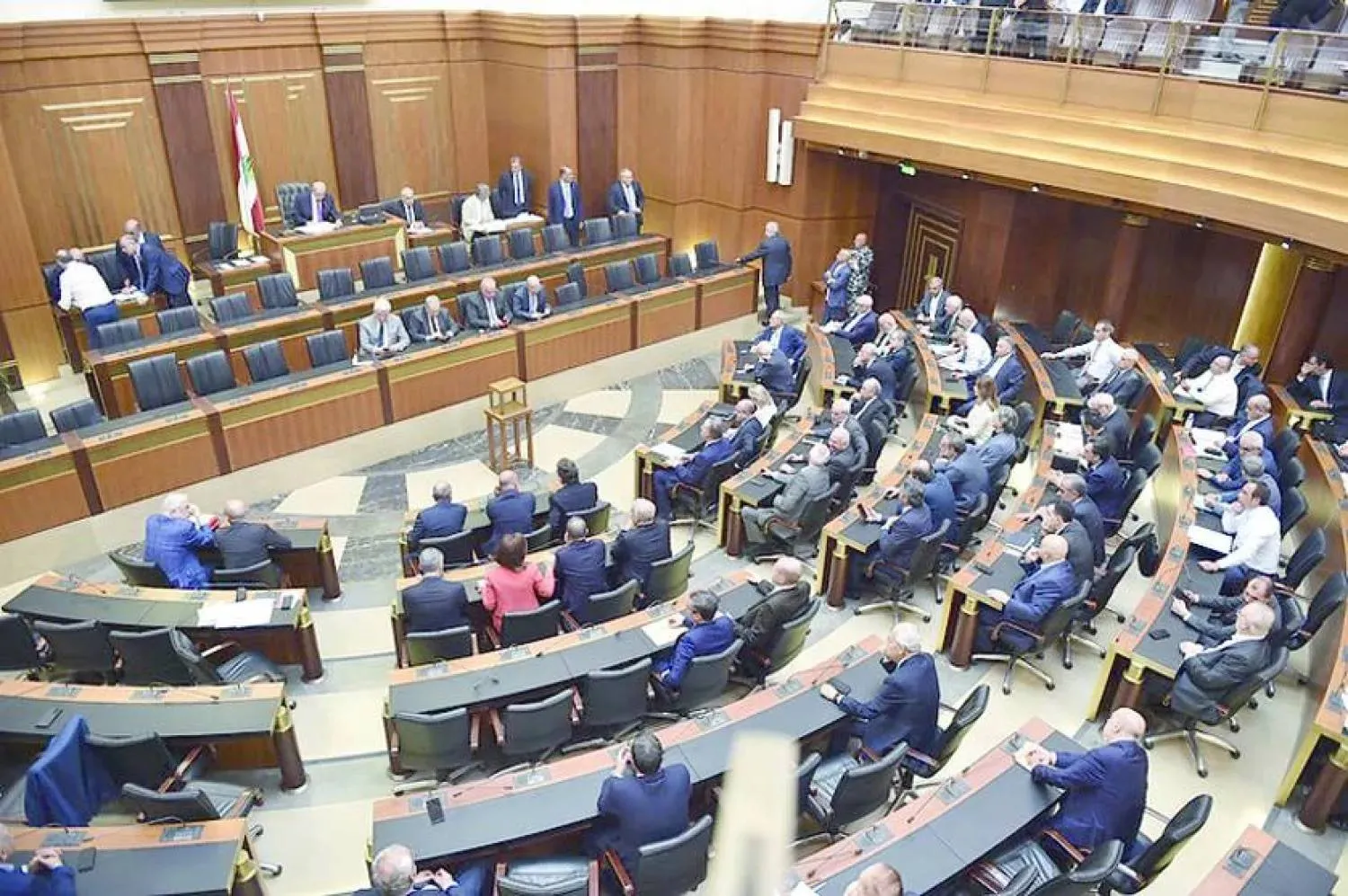
The Lebanese Parliament during a general session last week (Parliament Media Office). 
TT

Lebanon: Election Law Nears Compromise That Ends Expat Representation, Overseas Voting

The Lebanese Parliament during a general session last week (Parliament Media Office). 

Lebanon’s electoral scene remains subdued amid growing political confrontation between the Shiite “duo” - Hezbollah and the Amal Movement - and the Free Patriotic Movement, as well as with the parliamentary majority over whether Lebanese citizens abroad can vote from overseas.

The dispute has delayed agreement on the electoral law that will govern the 2026 parliamentary elections, a process increasingly entangled with broader questions about Lebanon’s future after the Gaza war. Hezbollah, wary of what it calls the “Gaza-style solution” being discussed for southern Lebanon, fears that Israel may expand its campaign, targeting its remaining military infrastructure - particularly tunnels allegedly used for precision missiles - to pressure Beirut into disarming under US cover.

The disagreement over the voting rights of expatriates has paralyzed the parliamentary subcommittee tasked with reviewing election law amendments. Without a compromise, legislative progress will remain frozen. A political settlement would be required to reactivate the committee and pave the way for a vote in Parliament.

Although all blocs publicly support holding elections on schedule in spring 2026, failure to agree on the legal framework threatens the process.

According to visitors to President Joseph Aoun quoted by Asharq Al-Awsat, the President insists that the elections must take place on time and has urged political forces not to waste months in delay. Behind the scenes, discussions are intensifying over a possible compromise that would cancel the allocation of six parliamentary seats for expatriates and revoke their right to vote from abroad.

A senior source within the Shiite duo confirmed the position to Asharq Al-Awsat: “We remain opposed to allowing expatriates to vote for all 128 MPs from abroad.”

He added: “We are open to a compromise, provided that Article 112 of the current law, which governs external voting, is not removed. Eliminating it would tilt the playing field in favor of our rivals, who can campaign freely in the diaspora, unlike us. Hezbollah is listed as a terrorist organization in several countries, and many of our members are under US sanctions. We must protect our community abroad and avoid exposing them to any form of legal or security pursuit.”

The source stressed that the decision to cancel overseas voting, effectively dropping the six seats allocated to expatriates, is “final and irreversible.” Those wishing to vote, he said, must return to Lebanon to exercise their democratic right.

“We are fighting an existential battle,” he added. “Our opponents rely on foreign support and aim to weaken our parliamentary influence by running Shiite candidates against us. But the elections will reaffirm our popular legitimacy.”

The parliamentary subcommittee studying electoral reforms has suspended its meetings “until political conditions mature,” the source said. No consensus has been reached, and progress now depends on “outside intervention” from senior political figures to forge a national agreement that Parliament could later formalize.

Speaker Nabih Berri, meanwhile, has reiterated that elections will proceed under the current law, a stance widely seen as a counter to the parliamentary majority’s demand to delete Article 112, which would allow expatriates to vote from their countries of residence. Berri’s position suggests a trade-off: dropping the six dedicated expat seats in exchange for excluding overseas voting altogether.


Türkiye Calls Israel’s Recognition of Somaliland ‘Illegitimate’

This handout photograph taken and released by the Turkish presidential press service on December 30, 2025, shows Türkiye’s President Recep Tayyip Erdogan (R) and Somalia's President Hassan Sheikh Mohamud (L) shaking hands before their meeting in Istanbul. (Photo by Handout / Turkish Presidential Press Service / AFP)
TT

Türkiye Calls Israel’s Recognition of Somaliland ‘Illegitimate’

This handout photograph taken and released by the Turkish presidential press service on December 30, 2025, shows Türkiye’s President Recep Tayyip Erdogan (R) and Somalia's President Hassan Sheikh Mohamud (L) shaking hands before their meeting in Istanbul. (Photo by Handout / Turkish Presidential Press Service / AFP)

Türkiye’s president on Tuesday called Israel's recognition of Somaliland "illegitimate and unacceptable" as he hosted a visit by his Somali counterpart.

"Preserving the unity and integrity of Somalia in all circumstances holds special importance in our view. Israel's decision to recognize Somaliland is illegitimate and unacceptable," Turkish leader Recep Tayyip Erdogan said in a press conference alongside Somali President Hassan Sheikh Mohamud.

Israel sparked criticism last Friday when it said it was officially recognizing Somaliland -- a breakaway territory in Somalia's north.

The declaration was a first for the territory, which in 1991 had unilaterally declared secession from Somalia.

Israel's move has drawn widespread criticism from the African Union, Egypt and the European Union, which insist on war-torn Somalia's sovereignty.

Türkiye has frequently clashed with Israel over a range of issues, especially over the conflict in Gaza and Israeli obstruction of aid to the Palestinian territory.

Mohamud said Israeli Prime Minister Benjamin Netanyahu's "aggressive position, which also includes Somalia, is unacceptable".

He called Netanyahu's Somaliland declaration "a violation of international law" and "the start of insecurity and instability, especially for Somalia and the African region".


10 Countries Warn of ‘Catastrophic’ Gaza Situation

 Palestinians stand next to a tent set up on the rubble of buildings destroyed during Israeli air and ground operations in the Sheikh Radwan neighborhood, in Gaza City, Tuesday, Dec. 30, 2025. (AP)
Palestinians stand next to a tent set up on the rubble of buildings destroyed during Israeli air and ground operations in the Sheikh Radwan neighborhood, in Gaza City, Tuesday, Dec. 30, 2025. (AP)
TT

10 Countries Warn of ‘Catastrophic’ Gaza Situation

 Palestinians stand next to a tent set up on the rubble of buildings destroyed during Israeli air and ground operations in the Sheikh Radwan neighborhood, in Gaza City, Tuesday, Dec. 30, 2025. (AP)
Palestinians stand next to a tent set up on the rubble of buildings destroyed during Israeli air and ground operations in the Sheikh Radwan neighborhood, in Gaza City, Tuesday, Dec. 30, 2025. (AP)

The foreign ministers of 10 nations on Tuesday expressed "serious concerns" about a "renewed deterioration of the humanitarian situation" in Gaza, saying the situation was "catastrophic". 

"As winter draws in, civilians in Gaza are facing appalling conditions with heavy rainfall and temperatures dropping," the ministers of Britain, Canada, Denmark, Finland, France, Iceland, Japan, Norway, Sweden and Switzerland said in a joint statement released by the UK's Foreign Office. 

"1.3 million people still require urgent shelter support. More than half of health facilities are only partially functional and face shortages of essential medical equipment and supplies. The total collapse of sanitation infrastructure has left 740,000 people vulnerable to toxic flooding," the statement added. 

The ministers said they welcomed the progress that had been made to end the bloodshed in Gaza and secure the release of Israeli hostages. 

"However, we will not lose focus on the plight of civilians in Gaza," they said, calling on the government of Israel to take a string of "urgent and essential" steps. 

These included ensuring that international NGOs could operate in Gaza in a "sustained and predictable" way. 

"As 31 December approaches, many established international NGO partners are at risk of being de-registered because of the government of Israel's restrictive new requirements," the statement said. 

It also called for the UN and its partners to be able to continue their work in Gaza and for the lifting of "unreasonable restricts on imports considered to have a dual use". 

This included medical and shelter equipment. 

The foreign ministers also called for the opening of crossings to boost the flows of humanitarian aid into Gaza. 

While welcoming the partial opening of the Allenby crossing, they said other corridors for moving goods remained closed or severely restricted for humanitarian aid, including Rafah. 

"Bureaucratic customs processes and extensive screenings are causing delays, while commercial cargo is being allowed in more freely," the statement said. 

"The target of 4,200 trucks per week, including an allocation of 250 UN trucks per day, should be a floor not a ceiling. These targets should be lifted so we can be sure the vital supplies are getting in at the vast scale needed," it added. 


UN Condemns Israel's Moves against Agency for Palestinian Refugees

UNRWA center targeted by Israeli shelling in northern Gaza (DPA)
TT

UN Condemns Israel's Moves against Agency for Palestinian Refugees

UNRWA center targeted by Israeli shelling in northern Gaza (DPA)

The United Nations warned Tuesday that recent actions by Israel against the UN agency for Palestinian refugees risked depriving millions of people of basic services such as education and healthcare.

Israel's parliament passed new legislation on Monday formally stripping the United Nations Relief and Works Agency (UNRWA) of diplomatic immunity, and barring Israeli companies from providing water or electricity to the agency's institutions, AFP reported.

According to UNRWA, the legislation also grants the Israeli government the authority to expropriate the agency's properties in East Jerusalem, including its headquarters and main vocational training center.

UNRWA chief Philippe Lazzarini condemned the legislation as "outrageous", decrying it on social media as "part of an ongoing, systematic campaign to discredit UNRWA and thereby obstruct the core role that the agency plays providing human-development assistance and services to Palestine refugees".

Filippo Grandi, the outgoing head of the UN refugee agency, UNHCR, and a former UNRWA chief, also criticised the move as "very unfortunate".

In an interview with AFP, he highlighted that UNRWA, unlike other UN agencies, provides basic public services such as education and healthcare to the millions of registered Palestinian refugees it serves across Gaza and the West Bank, as well as in Lebanon, Jordan and Syria.

"If you deprive those people of those services... then you had better find a substitute," he said, warning: "I think it would be very difficult."

"At the moment, there is a great risk that millions of people will be deprived of basic services if UNRWA is further deprived of space to work, and resources to work."

Israel has been ratcheting up pressure on UNRWA over the past two years.

It has accused the agency of providing cover for Hamas militants, claiming that some UNRWA employees took part in the militant group's October 7, 2023 assault on Israel, which sparked the war in Gaza.

A series of UN-linked internal and external investigations found some "neutrality-related issues" at UNRWA, but stressed Israel had not provided conclusive evidence for its headline allegation.

Grandi criticised the torrent of accusations that have swirled around the agency.

"UNRWA is a very indispensable organization in the Middle East," he said.

"Contrary to much of the frankly baseless rhetoric that we have heard in the past couple of years, UNRWA is a force for peace and stability," he added.

"In a region in which you need every bit of stability and efforts towards peace, it would be really irresponsible to let such an important organization decline further."